Comparisons
2 Oct 2026

Pop-Up Drain vs Grid Drain: Which Should You Choose?
Pop-up drains seal to hold water; grid drains never close but resist clogs better and cost less. Here's how to choose between them for your bathroom sink.
Rheem vs AO Smith water heaters compared head-to-head across tank and tankless performance, warranty terms, pricing and availability — so you can choose confidently without wading through spec sheets.
Please note: Product availability, pricing and warranty terms are based on our research at time of writing and are subject to change. Always confirm the exact specifications on the model you are purchasing before buying.
Rheem and AO Smith are two of the most recognized water heater brands in the United States — and for most homeowners replacing a failed unit or upgrading during a renovation, these are the two names that come up first. Both have been manufacturing water heaters for over 100 years, both have earned strong reputations across millions of US homes, and both offer a full range of tank and tankless models across every capacity and price tier.
This guide compares Rheem and AO Smith directly across tank and tankless performance, warranty terms, pricing, availability and reliability — so you can make a confident choice without wading through spec sheets. If you’re still deciding between a tank and tankless system altogether, our tankless vs tank water heaters guide covers that decision first. For sizing your new unit correctly, see our water heater sizing guide before you buy.
✏️ Our Take
Both Rheem and AO Smith are trusted American manufacturers with decades of history, and either brand will serve most households reliably for years. The real difference comes down to availability and specific use case — Rheem has stronger retail availability through Home Depot and a wider range of tankless options, while AO Smith has a longer manufacturing history and is the brand most often installed by professional plumbers through wholesale supply houses.
IN THIS GUIDE
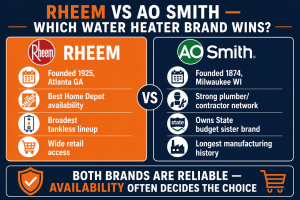
Rheem was founded in 1925 and is headquartered in Atlanta, Georgia. The company manufactures water heaters, HVAC systems and pool heaters, and has grown into one of the largest manufacturers of residential and commercial heating products in North America. Rheem owns several subsidiary brands across the HVAC and water heating space and distributes through both retail and contractor channels.
AO Smith was founded in 1874 — making it the older of the two companies by over 50 years — and is headquartered in Milwaukee, Wisconsin. Measured by revenue, AO Smith is the larger of the two companies globally, with significant business in international markets alongside its US residential and commercial water heater lines. AO Smith also owns State Water Heaters as a budget sister brand, sold through the same manufacturing infrastructure but positioned at a lower price point with shorter standard warranty terms.
Both Rheem and AO Smith offer a full lineup of gas and electric tank water heaters across all common residential capacities — 30, 40, 50 and 80 gallon being the most widely stocked. Both companies organize their product lines into entry, mid and premium residential tiers, and both offer self-cleaning or sediment-reduction technology on their upper-tier tank models to reduce maintenance frequency and extend tank life.
Rheem’s premium residential tank line is the Performance Platinum series, which adds features like a higher first-hour rating, extended warranty and improved energy factor compared to their entry and mid-range models. AO Smith’s equivalent premium residential tier is the Signature Premier line, which similarly steps up recovery rate, efficiency and warranty length over their baseline models. Recovery rates across comparable tiers between the two brands are broadly similar — neither brand has a significant performance advantage over the other at the same tier and capacity.
Rheem offers a broader residential tankless lineup than AO Smith, including both condensing and non-condensing models across a wider range of flow rates. This breadth is an advantage for homeowners trying to match a tankless unit precisely to their household’s peak demand — more GPM options means a better chance of landing on the right unit without oversizing or undersizing. Rheem’s condensing tankless models, which capture heat from exhaust gases for greater efficiency, are among the more accessible options in the condensing category for DIY-friendly installation.
AO Smith’s tankless range is narrower but covers the same core technology — condensing and non-condensing gas models with comparable GPM ratings to Rheem at equivalent price tiers. For homeowners working through a plumber rather than buying retail, AO Smith’s tankless offering is a solid choice. For ongoing tankless maintenance, both brands require annual descaling — our guide to water heater flush tools covers the isolator valve kits and descaling equipment needed for DIY tankless servicing.
Rheem residential tank water heater warranties typically range from 6 years on entry-tier models up to 12 years on premium-tier models. Labor warranty terms are shorter than parts warranty terms on most models — a standard pattern across the industry. AO Smith residential tank warranties follow a similar structure, ranging from 6 years on baseline models up to 12 years on the Signature Premier and higher-tier products.
Both brands also offer extended warranty tiers on their premium models, and both offer comparable tankless warranty terms — typically longer on the heat exchanger component than on parts overall. When comparing warranties between Rheem and AO Smith at the same tier, the terms are very similar and should not be a deciding factor on their own.
Entry-level tank models from both Rheem and AO Smith fall in a similar $$ price tier — the difference at this level between the two brands is typically minor and varies more by retailer and capacity than by brand. Premium tank models from both brands step up to the $$$ to $$$$ range depending on capacity, with 80-gallon and larger units sitting at the higher end of that range for either manufacturer.
Tankless units from both brands span the $$$ to $$$$ tier depending on flow rate capacity and whether the unit is condensing or non-condensing. Condensing units carry a premium over non-condensing across both brands. Installation cost — which typically exceeds the unit cost for tankless conversions and is comparable for tank replacements — is generally similar regardless of which brand you choose. Professional installation labor rates are set by the contractor, not the manufacturer.
Rheem is the primary water heater brand stocked at Home Depot locations nationwide. For homeowners who prefer to purchase directly from a big-box retailer — whether for same-day availability during an emergency replacement or for the convenience of returning to a familiar buying experience — Rheem’s Home Depot relationship is a meaningful practical advantage. Most Home Depot locations carry a core selection of Rheem tank models in the most common residential capacities.
AO Smith is more commonly distributed through plumbing supply houses and professional contractor channels. This is why AO Smith tends to be the brand your plumber specifies when they handle the procurement — they have established supply relationships with wholesale houses that carry the full AO Smith lineup. AO Smith manufactures most of its US water heaters domestically, including a major facility in Tennessee, while Rheem also manufactures domestically across multiple states. Availability can vary by region — Rheem tends to be more consistently stocked at retail nationwide, while AO Smith is more commonly found through plumbing supply houses that professional contractors use, which can mean a short wait for non-stock models in some areas. Both brands are also available online and through licensed plumbers who source through any number of distribution channels.
Both Rheem and AO Smith have comparable failure rates when units are properly installed and maintained over their service life. Neither brand has a meaningful reliability advantage over the other at equivalent tiers — both are established manufacturers producing units to similar residential quality standards. The most commonly reported issues for both brands relate to installation quality rather than manufacturing defects: incorrect sizing, improper venting, inadequate gas supply pressure, and failure to flush the unit regularly are the causes behind the majority of premature failures attributed to either brand.
Both Rheem and AO Smith recommend annual flushing to extend tank lifespan and maintain heating efficiency — sediment accumulation at the base of the tank is the leading maintenance-related cause of early failure for both brands in US markets with moderate to hard water. For the tools needed to handle flushing yourself, our guide to water heater flush tools covers both tank sediment removal tools and tankless isolator valve kits.
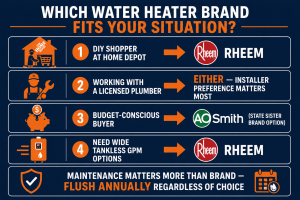
For most homeowners, the choice between Rheem and AO Smith comes down to one of two practical factors: where you’re buying from and who is doing the installation. The head-to-head breakdown below covers the scenarios where one brand has a genuine edge.
| Scenario | Winner |
|---|---|
| DIY buyer purchasing at Home Depot | Rheem (availability) |
| Working with a licensed plumber | Either (plumber’s supply preference often decides) |
| Wide tankless GPM options needed | Rheem (broader tankless lineup) |
| Budget-conscious — sister brand option wanted | AO Smith (State Water Heaters option) |
| Brand longevity and manufacturing history | AO Smith (founded 1874) |
| Warranty at equivalent tier | Tie (very similar terms across brands) |
| Price at equivalent tier | Tie (minor differences only) |
Water heater installation — particularly tankless unit conversions — involves gas lines, venting and electrical work that most homeowners are not equipped to handle safely without a license. A professional installation also protects your warranty, since most manufacturers require licensed installation to honor warranty claims on failure.
Find a licensed plumber in your area at PlumberArchive.com — the US plumber directory with 12,000+ verified local plumbers across all 50 states.
Get weekly plumbing tips, honest brand comparisons and DIY maintenance guides delivered straight to your Facebook feed. We cover water heater maintenance, pipe repairs, drain cleaning and everything in between — written for US homeowners who want to make smarter decisions without overspending.
Both brands have comparable reliability records when units are properly installed and maintained. Neither brand has a meaningful advantage over the other at equivalent tiers — the most common causes of premature failure for both brands are installation errors (incorrect sizing, improper venting) and lack of regular maintenance (failure to flush the tank annually). A properly installed and maintained unit from either brand should reach or exceed the manufacturer’s rated service life. The brand name is far less important than the quality of installation and whether you keep up with annual flushing.
Yes. State Water Heaters is a subsidiary brand owned by AO Smith Corporation. Both AO Smith and State branded units are manufactured in the same facilities. The primary differences are warranty length — State units typically carry a shorter standard warranty — and price positioning, with State sitting below AO Smith as the budget entry point in the same manufacturer’s lineup. If your plumber quotes you a State water heater, it comes from the same manufacturing base as AO Smith.
At equivalent product tiers, Rheem and AO Smith offer very similar warranty terms — typically 6 years on entry-level models and up to 12 years on premium-tier models. Neither brand has a consistent warranty advantage over the other across their lineups. The more important variable is which tier within each brand you’re comparing. Always confirm the specific warranty length on the exact model you’re buying, since warranty terms vary significantly between entry and premium within the same brand.
You can purchase either brand without a plumber — Rheem tank models are widely available at Home Depot, and AO Smith units can be purchased through online retailers and plumbing supply houses. However, installation is a different question. A like-for-like tank replacement of the same capacity and fuel type is within reach for experienced DIYers in most jurisdictions. A tankless conversion, or any installation involving new gas lines or electrical circuits, requires a licensed contractor in most US states and must be permitted. Installing without a permit can also void the manufacturer warranty — check your local code requirements before attempting self-installation.
Both Rheem and AO Smith are reliable choices from established American manufacturers with over a century of water heater production behind them. At equivalent product tiers, neither brand has a meaningful advantage over the other in performance, efficiency or warranty terms — the comparison is genuinely close, and homeowners choosing carefully between the two are unlikely to make a wrong decision either way.
The practical differentiators are clearer: Rheem offers stronger retail availability through Home Depot and a broader tankless lineup, making it the more accessible choice for DIY purchasers and homeowners who need a wider flow rate selection. AO Smith’s longer brand history and established contractor supply relationships make it the more common choice for professional installations — and the State Water Heaters sister brand gives budget-conscious buyers a path to the same manufacturing quality at a lower price point. If a plumber has recommended a trade-focused brand instead, our Bradford White vs Rheem comparison covers that distribution-channel tradeoff in more detail.
Before buying either brand, make sure you have the right size unit for your household using our water heater sizing guide, and confirm whether a tank or tankless system is the right fit with our tankless vs tank water heaters comparison. Once your new unit is installed, keep it running efficiently with annual flushing — our guide to water heater flush tools covers everything you need for DIY tank and tankless maintenance.
✍️ About This Comparison
PTR Editorial Team — Product Comparisons. We compare manufacturer specifications, installation requirements, compatibility and available product documentation to help homeowners choose suitable tools and parts. How we review →
Pop-up drains seal to hold water; grid drains never close but resist clogs better and cost less. Here's how to choose between them for your bathroom sink.
Test strips, digital meters or send-to-lab testing? Match the method to your situation — screening, ongoing monitoring, or a real health concern.
25-foot vs 50-foot drain snake: compare handling, the cable diameter trade-off and the jobs that justify extra length, plus where 50 feet stops.

