Comparisons
2 Oct 2026

Pop-Up Drain vs Grid Drain: Which Should You Choose?
Pop-up drains seal to hold water; grid drains never close but resist clogs better and cost less. Here's how to choose between them for your bathroom sink.
25-foot vs 50-foot drain snake: compare handling, the cable diameter trade-off and the jobs that justify extra length, plus where 50 feet stops.
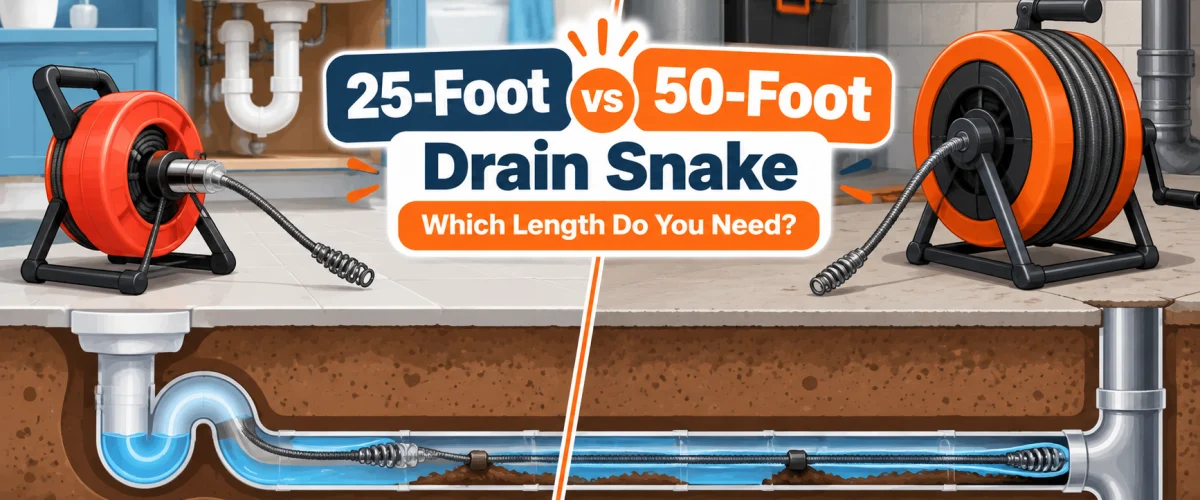
Please note: This comparison is based on our research at time of writing and describes drain snake lengths by category. Cable ratings, drum capacities and machine specifications vary by brand and model, so check the specs for the specific machine you’re considering.
“How long should my drain snake be?” usually gets a one-line answer: 25 feet for sinks, 50 feet to be safe. The second half of that advice is where money and storage space quietly go to waste. Length is only one of the things that define a snake, and it’s the one most often chosen on the assumption that more is better.
Our drain snake size chart already breaks cable down by diameter and by drain type. This comparison does something narrower: it sets exactly two lengths side by side and asks what the extra 25 feet actually buys you, what it costs in handling, storage and cable diameter, and which jobs really justify it. If you haven’t settled on a cable diameter yet, start with the size chart, then come back here for the length decision.
✏️ Our Take
For a clog close to the fixture in a sink, tub or shower, 25 feet is often enough, and it is easier to handle, store and feed by hand. A 50-foot snake earns its extra length on longer branch lines, floor drains, and homes where one machine has to cover many jobs. It is not a main-sewer-line tool: many main-line runs can exceed 50 feet, and that work usually calls for a longer-cable machine or a professional. Buy the shortest length that reaches your likely clog, and spend the difference on the right cable diameter.
IN THIS GUIDE
The table sets the two lengths side by side on the factors that decide the purchase. The sections that follow explain the reasoning behind each row.
| Factor | 25 Feet | 50 Feet |
|---|---|---|
| Typical use | Sink, tub and shower clogs close to the fixture | Longer branch lines, floor drains, or one machine covering many different jobs |
| Handling | Less cable to feed, retrieve and clean; easier to manage by hand | Twice the cable to feed, retrieve and clean; a bulkier drum to hold steady |
| Storage | Smaller drum or coil that fits a cabinet or shelf | Larger drum that takes real floor or shelf space |
| Diameter trade-off | A drum of a given size can often hold a thicker cable at a shorter length | The same drum often carries a thinner cable at the longer length, so check both numbers |
| What it can’t reach | A blockage farther down a long branch line | Main sewer line work: many main-line runs can exceed 50 feet |
| Over-buying risk | Low; if a job outruns it, you step up later | Paying for, storing and cleaning length you may never use |
| Best for | Households dealing with clogs close to the fixture | Homes with long branch runs or floor drains, or owners who want one machine for many jobs |
A fixture clog sits close to the drain opening, in the trap or just past it, which is why a 25-foot cable is often enough for a clog close to the fixture. That’s consistent with our best drain snakes roundup and electric vs manual drain snake comparison, and it’s the baseline this whole comparison builds on. Extra length doesn’t make a snake better at those jobs. It just gives you more cable to manage while doing them.
Fifty feet is built for a different problem: a blockage that may sit farther down a branch line, or a household that wants one machine to cover many drains. Our drain snake size chart gives the full range-by-range breakdown, so we won’t repeat it here. Toilets are a separate case entirely; see our toilet auger vs drain snake comparison.
Handling, Storage and Drum Weight
A 50-foot snake carries twice the cable of a 25-foot one, and every extra foot has to be fed into the drain, retrieved, and cleaned before it goes back in the drum. That is more work at every stage, most of all when you’re cranking by hand. As our electric vs manual comparison notes, feeding even 25 feet of manual cable into a stubborn blockage is hard work, so doubling the length doubles the cable to fight with.
Storage and weight follow the same logic. More cable means a larger drum, and a larger drum means more space and more to carry from the closet to the job. At the far end of the scale, a RIDGID K-3800 kit, a drum machine rated for runs up to 100 feet, is listed by one retailer at roughly 72 pounds. That is not a machine you casually carry up from a cabinet, and it shows where the curve goes as length and diameter increase.
Here is the point that surprises many shoppers: on a given drum, cable length and cable diameter compete for the same space. Milwaukee’s M18 drain snake, for example, carries up to 50 feet of 1/4- or 5/16-inch cable but only 35 feet of 3/8-inch cable. RIDGID’s K-3800 drum holds up to 100 feet of 3/8-inch cable or 90 feet of 1/2-inch cable. Thicker cable takes up more room, so the same drum holds less of it.
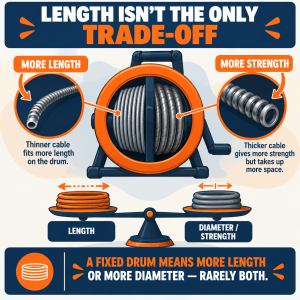
That means “50 feet” on a box describes one thing about the cable, not everything. A 50-foot rating on 1/4-inch cable doesn’t tell you that you can have 50 feet of 3/8-inch cable on the same machine. Our drain snake size chart explains why diameter should come first: thin cable bends more easily through traps and tight turns, while thicker cable brings more strength for larger lines. Pick the diameter for your pipe, then check what length that diameter comes in on the machine you’re considering.
In practice, this is why the length decision is smaller than it looks. If your drains call for 1/4-inch cable, a 50-foot rating is easy to find. If they call for something thicker, the longer length may not be available on a compact machine at all, and the decision quietly becomes a choice between a shorter cable that’s right for the pipe and a longer cable that isn’t.
Extra length pays for itself in a few specific situations, and “just in case” isn’t one of them:
If the cable is fully extended and the problem persists, or it keeps coming back, that’s a diagnosis problem rather than a length problem. A camera shows what a snake can only feel. Our guide on how to use a drain inspection camera explains how to use one, and our best drain cameras covers the models.
It’s tempting to assume 50 feet must be enough to reach the main sewer line. Nothing supports that, and we won’t claim it. How far a house sits from the sewer main varies enormously with lot size, street layout and region, and no source gives a figure we can call representative.
What we can say comes from the codes and from the manufacturers. Plumbing codes, including the UPC, the IPC and the IRC as locally adopted, require a cleanout at intervals of no more than about 100 feet along horizontal drains and building sewers, plus a cleanout near the junction of the building drain and the building sewer. That is a maximum spacing requirement, not a typical run length, and it isn’t a measure of how far a 50-foot snake reaches. It does show that a single run between access points can be longer than 50 feet.
The machines built for this work reflect it. RIDGID’s K-3800 is rated for a 100-foot maximum run and ships with 75 feet of 3/8-inch cable, and its K-60 sectional machine is rated for 125 feet on 5/8-inch cable and 150 feet on 7/8-inch cable. Professional sewer-line machines are built for considerably more than 50 feet, which is why 50 feet is best understood as a branch-line tool.
Buying more length than you’ll use has costs beyond the sticker. A longer snake usually sits at a higher price tier, and the extra cable is something you carry, store and clean whether or not you ever feed it out. If it comes at the expense of cable diameter, you may end up with a machine that reaches farther but suits your pipes less well.
The bigger risk is false confidence. A 50-foot cable can make a homeowner feel equipped for a main-line problem that really needs a professional machine or a camera, and the result is time spent wrestling more cable into a line it can’t fully clear. Under-buying has a cost too, since a job may outrun 25 feet and force a second purchase. But stepping up later is a cheaper mistake than carrying length you never use.
If you’re weighing specific models, our best drain snakes roundup is the place to start. Its picks run from 25 to 33 feet, and whichever you consider, check each listing’s cable diameter as well as its length.
There’s no universally better length. Work through these questions in order:
Cost tiers here are general comparisons and can change over time. Check current pricing before you buy.
If a clog keeps coming back, several fixtures back up at once, or you suspect the main line, a licensed plumber can diagnose what a longer cable won’t. Find a licensed plumber in your area at PlumberArchive.com — the US plumber directory with 12,151+ verified local plumbers across all 50 states.
Get weekly plumbing tips, honest tool reviews and DIY guides delivered to your Facebook feed.
Often, for a sink, tub or shower clog close to the fixture. Kitchen sink and shower lines can call for 25 to 50 feet depending on the line and machine, so 25 feet isn’t always enough. If the cable is fully fed in and the drain hasn’t cleared, the blockage is farther down the line, and that’s the point to consider more length or a camera.
Not automatically. It reaches farther, but it costs more to buy, store, handle and clean, and on some machines the longer length comes at the expense of cable diameter. Use enough cable to reach the likely blockage rather than assuming more is better.
Sometimes it may reach, but many main-line runs can exceed 50 feet, and we can’t give a typical distance because none is reliably documented. Machines built for main-line work are rated well beyond that: RIDGID’s K-3800 for a 100-foot maximum run, and its K-60 for 125 to 150 feet depending on cable diameter. Main sewer line work usually calls for a longer-cable machine or a professional.
No. Length and diameter are separate specs, and on a given drum they often compete for space. Milwaukee’s M18 carries up to 50 feet of 1/4- or 5/16-inch cable but only 35 feet of 3/8-inch cable, so always check the length listed for the diameter you need.
The 25-versus-50 question is less about which snake is better and more about which problem you have. Twenty-five feet is often enough for a clog close to the fixture and keeps handling, storage and cost in check. Fifty feet earns its place on long branch lines, floor drains and homes that want one machine for many jobs, but it comes with more cable to manage and, on many machines, a trade against cable diameter.
And neither length is a main-sewer-line tool. Many main-line runs can exceed 50 feet, so that work usually calls for a longer-cable machine or a professional. Choose the diameter your pipes need first with our drain snake size chart, then pick the shortest length that reaches your likely clog. For specific models, see our best drain snakes roundup.
✍️ About This Comparison
Written by Sarah Mitchell, Home Improvement Editor at PlumbingToolsReview — specializing in helping homeowners make smart buying decisions without overspending. Learn how we test →
Pop-up drains seal to hold water; grid drains never close but resist clogs better and cost less. Here's how to choose between them for your bathroom sink.
Test strips, digital meters or send-to-lab testing? Match the method to your situation — screening, ongoing monitoring, or a real health concern.
Wood vs plastic toilet seats: what molded wood really is, how each is cleaned and how each fails, and how to choose, based on manufacturer guidance.

