Guides
4 Oct 2026

How to Make a PEX Crimp or Clamp Connection (2026) — Step-by-Step Guide
Make a PEX crimp or clamp connection step by step: ring and clamp placement, gauge checks, failed joints and code notes from maker sheets.
Drain snake size chart: match cable diameter (1/4, 5/16, 3/8 inch and up) and length to each drain type, within your machine's capacity limits.
Please note: Information in this guide is based on our research at time of writing and is subject to change. Always consult a licensed plumber for diagnosis of serious plumbing issues before attempting repairs.
A drain snake works best when its cable matches both the diameter of the drain line and the distance to the blockage. A cable that’s too light can struggle with larger lines and tougher clogs, while an oversized cable can be difficult to guide through small traps and tight bends.
For most household drain-cleaning jobs, cable diameters commonly range from 1/4 inch for small fixture drains to 1/2 inch or larger for bigger drain lines. Cable length matters too: a 25-foot snake may be plenty for a nearby sink or tub clog, while longer branch lines can require 50 feet or more.
This guide explains how drain snake cable diameter and length relate to common household drains, including bathroom sinks, kitchen sinks, tubs, showers, floor drains and larger drain lines.
At a Glance
For a quick starting point:
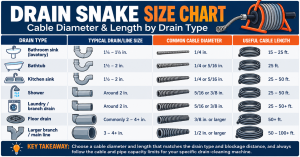
| Drain type | Typical drain/line size | Common cable diameter | Useful cable length |
|---|---|---|---|
| Bathroom sink / lavatory | 1¼–1½ in. | 1/4 in. | 15–25 ft. |
| Bathtub | 1½–2 in. | 1/4 or 5/16 in. | 25 ft. |
| Kitchen sink | 1½–2 in. | 1/4 or 5/16 in. | 25–50 ft. |
| Shower | Around 2 in. | 5/16 or 3/8 in. | 25–50 ft. |
| Laundry / branch drain | Around 2 in. | 5/16 or 3/8 in. | 25–50+ ft. |
| Floor drain | Commonly 2–4+ in. | 3/8 in. or larger | 50+ ft. |
| Larger branch / main line | 3–4+ in. | 1/2, 5/8 in. or larger | 50–100+ ft. |
These are practical starting ranges rather than universal specifications. Spartan, for example, recommends 1/4-inch cable for lavatory drains, 1/4- or 5/16-inch for tubs, and several progressively larger cable options for showers and floor drains.
✏️ Our Take
For most homeowners dealing with fixture and smaller branch-line clogs, 1/4-, 5/16- and 3/8-inch cables are the sizes that matter most.
A 1/4-inch cable favors flexibility in small fixture lines. A 5/16-inch cable gives you a useful middle ground for many sink, tub and shower applications. A 3/8-inch cable provides more strength for larger secondary lines, but whether it is appropriate depends on the machine and pipe.
Once you move into larger drain and sewer lines — or long runs and difficult obstructions — the job starts moving beyond the typical homeowner drum snake. Larger machines may use 1/2-, 5/8-, 7/8-inch or other specialized cables. RIDGID, for example, rates its K-60 sectional machine’s 5/8-inch cable for 1¼–4-inch lines and its 7/8-inch cable for 2–4-inch lines.
The safest rule is therefore:
Choose the cable for the drain, but make sure your machine is designed to run that cable.
IN THIS GUIDE
Here’s the basic relationship to remember:
Smaller cable = more flexibility. Larger cable = greater strength and suitability for larger lines.
But the usable ranges overlap.
RIDGID’s K-46, for example, specifies:
| Cable diameter | Rated drain capacity |
|---|---|
| 1/4 in. | 3/4–2 in. |
| 5/16 in. | 1¼–2½ in. |
| 3/8 in. | 1¼–3 in. |
Meanwhile, Milwaukee specifies its 5/16-inch cable for 1¼–2½-inch drain lines and its 3/8-inch SWITCH PACK cable for 2–3-inch lines.
That overlap is why you shouldn’t buy a cable based solely on pipe diameter. You also need to consider the drain’s bends, the blockage and the machine you’re using.
Cable diameter affects three important characteristics: flexibility, strength and the size of line the cable can effectively clean.
Thin cable bends more easily. That’s useful when you’re trying to negotiate a small trap or multiple changes in direction in a fixture drain.
As cable diameter increases, you generally gain more strength and the ability to work in larger lines. The trade-off is reduced suitability for small, tight plumbing.
The machine matters as well. A drain snake is designed around specific cable diameters and capacities. You shouldn’t assume that a larger cable can simply be installed in a smaller machine.
A 1/4-inch cable is one of the most flexible common drain-cleaning cables.
It’s particularly useful for small fixture lines where negotiating bends matters more than having maximum cable strength. RIDGID rates 1/4-inch cable for 3/4–2-inch lines on the K-45 and K-46 systems, while Spartan lists 1/4-inch as its recommendation for lavatory drains and as an option for bathtubs.
Typical applications include bathroom sinks, some tubs and other small fixture drains.
For homeowners, this is often the cable size associated with compact hand-operated or small powered drum snakes.
Don’t choose 1/4-inch cable simply because it fits into a pipe.
Longer runs, larger lines and tougher blockages can demand a stronger cable and a machine intended for the application. If a small cable repeatedly twists, binds or fails to make progress, forcing it harder is not the solution.
A 5/16-inch cable bridges the gap between small, flexible fixture-drain cables and heavier drain-cleaning cable.
RIDGID rates 5/16-inch cable for 1¼–2½-inch lines on the K-46, while Milwaukee gives the same 1¼–2½-inch recommendation for its 5/16-inch SWITCH PACK cable.
That makes 5/16 inch particularly relevant to common residential drains such as sinks, tubs and some shower lines.
It can be a useful choice when you need more cable body than a 1/4-inch snake provides but still need good flexibility.
A 3/8-inch cable moves you toward heavier drain-cleaning work.
RIDGID rates the K-46’s 3/8-inch cable for 1¼–3-inch lines. Milwaukee recommends its 3/8-inch SWITCH PACK cable for 2–3-inch drain lines.
Common applications can include showers, floor drains and larger secondary/branch lines, depending on the machine.
A 3/8-inch cable is stronger than the smaller fixture-drain sizes, but it isn’t automatically better. Trying to send a heavier cable through plumbing that’s too small or too tight can make the job harder and may exceed the machine manufacturer’s recommendations.
Once you reach 1/2-inch cable and above, you’re moving into larger drain-cleaning equipment and applications.
For example, Milwaukee lists 3/8-inch cable for 1½–3-inch lines and 1/2-inch cable for 3–4-inch lines on one of its drum-machine systems.
Larger professional sectional systems go farther. RIDGID’s K-60 uses 5/8-inch cable in 1¼–4-inch lines and 7/8-inch cable in 2–4-inch lines, with maximum runs of 125 and 150 feet respectively.
For a homeowner, this is an important dividing line. A clog in a large building drain or sewer line is not simply a reason to put a thicker cable on a small drain snake.
It may require an entirely different machine — and potentially professional drain-cleaning experience.
Diameter determines whether the cable suits the pipe. Length determines whether it can reach the blockage.
The right length depends on where you enter the plumbing and how far downstream the clog sits.
A short snake can be enough when the blockage is close to the fixture.
Think of localized bathroom sink, tub or nearby fixture-line clogs.
The advantage is simple: you aren’t managing dozens of feet of unnecessary cable for a clog only a few feet beyond the trap.
This is a useful range for many residential fixture and branch-line jobs.
It gives you additional reach when the clog isn’t immediately below the fixture or when the drain travels some distance before joining a larger branch.
Compact professional machines commonly reflect this range. Milwaukee’s M18 drain snake, for example, can carry up to 50 feet of 1/4- or 5/16-inch cable and 35 feet of 3/8-inch cable.
Longer cables become relevant for more distant blockages and longer branch lines.
But don’t buy 100 feet just because 100 feet sounds better than 50.
Cable length increases the amount of cable the machine must control, and machines have maximum capacities. Milwaukee’s larger SWITCH PACK system, for example, is designed around interchangeable drums and can extend some configurations to 100 feet.
At this point you’re generally moving toward professional drain and sewer-cleaning equipment rather than a basic household snake.
RIDGID’s K-60 sectional system, for example, is rated for runs up to 125 feet with 5/8-inch cable and 150 feet with 7/8-inch cable.
The farther and larger the line, the more important machine selection, cable control and blockage diagnosis become.
Starting point: 1/4-inch cable, roughly 15–25 feet.
Bathroom sink drains are relatively small and often include tight bends, so flexibility matters.
Before snaking, remember that many bathroom sink clogs are close to the stopper or P-trap. Hair and buildup may be accessible without sending a cable deep into the plumbing.
Starting point: 1/4- or 5/16-inch cable, commonly 25–50 feet depending on the line and machine.
Kitchen clogs can occur farther along the branch and often involve grease and food-related buildup.
If the sink has a garbage disposal or multiple connected fixtures, identify the plumbing arrangement before inserting a cable.
Starting point: 1/4- or 5/16-inch cable, commonly around 25 feet for a nearby clog.
Hair and soap buildup are common bathtub blockages. Spartan lists both 1/4- and 5/16-inch cable for 1½–2-inch bathtub drains.
Where possible, access through the appropriate drain opening rather than forcing an unsuitable cable through tight hardware.
Starting point: 5/16- or 3/8-inch cable, depending on the line and machine.
Showers commonly use larger drain lines than lavatory sinks, but there is no universal cable choice. Spartan’s recommendations for shower drains include 5/16-, 3/8- and other cable sizes depending on the application.
For an ordinary hair clog close to the drain, always check whether it can be removed mechanically near the opening before reaching for a powered snake.
Starting point: often 3/8 inch or larger, depending heavily on pipe diameter and machine.
Floor drains vary significantly, which makes a single cable recommendation misleading.
Spartan’s chart moves from 3/8-inch and larger options for floor drains around 3 inches and above, with progressively heavier cable options as pipe diameter increases.
If the floor drain backs up because of a blockage farther into the building drain, the required equipment can be substantially larger than a fixture snake.
This is where the simple homeowner cable chart stops being sufficient.
Larger drain-cleaning systems may use 1/2-, 5/8-, 7/8-inch or still larger cable systems depending on the pipe, machine and obstruction.
Tree roots, recurring main-line blockages, sewage backup and suspected damaged piping are also reasons to consider professional diagnosis rather than repeatedly running a small snake.
For a localized fixture clog, 25 feet is often easier to manage and may be all the reach you need.
A 50-foot cable makes more sense when the blockage may be farther down a branch line or when you need one machine to cover a wider range of residential jobs.
But cable length alone doesn’t determine capability. A 50-foot 1/4-inch cable and a 50-foot 3/8-inch cable are designed for different jobs.
This distinction deserves its own deeper comparison — see our 25-foot vs 50-foot drain snake comparison for the full breakdown of handling, storage, and which jobs actually justify the extra length.
It’s easy to assume that a thicker cable means a more powerful and therefore better drain snake.
That’s the wrong way to choose.
A drain-cleaning cable needs enough flexibility to follow the plumbing while still having enough strength for the line and blockage. Manufacturers therefore publish overlapping but specific cable-to-pipe capacities rather than simply recommending the largest cable that physically fits.
Using the wrong cable can also increase the likelihood of binding or losing control of the cable.
The goal isn’t to use the biggest snake.
It’s to use the correct cable-and-machine combination for the drain you’re cleaning.
Two drain snakes with the same nominal diameter can still behave differently.
Cable construction, inner core, winding, flexibility and attached head or cutter all affect what the cable is designed to do.
For example, Milwaukee distinguishes between inner-core and open-wind cable configurations in its drain-cleaning systems.
That’s another reason our size chart should be treated as a starting point rather than permission to interchange any two cables that happen to share the same diameter.
Stop if the cable repeatedly binds, twists or won’t advance normally.
You should also consider professional help when multiple fixtures back up at once, sewage appears in a lower drain, a main sewer blockage is suspected, roots may be involved, or the same clog keeps returning after cleaning.
Those symptoms can indicate a problem that requires more than simply reaching farther with a longer cable.
If several fixtures back up at once, sewage appears in a lower drain, or you suspect a main sewer blockage or roots, it is worth getting a professional to look. Search PlumberArchive.com — the US plumber directory with 12,151+ verified local plumbers across all 50 states.
Get weekly plumbing tips and DIY guides delivered straight to your Facebook feed.
A 1/4- or 5/16-inch cable is a common starting range for smaller residential sink lines, but check your machine’s specifications. RIDGID, for example, rates 1/4-inch cable for lines up to 2 inches and 5/16-inch cable for lines up to 2½ inches on its K-46.
Neither is universally better. A 1/4-inch cable provides more flexibility for small fixture drains, while a 3/8-inch cable is intended for larger lines on compatible machines.
It can be for many localized fixture clogs. If the blockage is farther down a branch line, 50 feet may provide more useful reach.
Not automatically. The correct length is the one that reaches the blockage while remaining within the machine’s capacity. Cable diameter and machine type matter just as much as length.
Several cable sizes can potentially serve a 2-inch line depending on the machine. Manufacturer specifications overlap: RIDGID’s K-46 permits 1/4-, 5/16- and 3/8-inch cables across ranges that include 2-inch pipe. Check the specific machine and cable rather than choosing from pipe diameter alone.
Don’t assume that you can. Some larger machines and cable systems have specific pipe ranges, and a 1/2-inch cable may be intended for larger lines. Milwaukee, for example, lists 1/2-inch cable for 3–4-inch lines on one drum-machine system. Follow the manufacturer’s specification for your equipment.
Professionals use multiple sizes rather than one universal cable. Small fixture work may use 1/4-, 5/16- or 3/8-inch cables, while larger drain and sewer machines can use 1/2-, 5/8-, 7/8-inch and other specialized cable systems.
Choosing a drain snake isn’t about finding the thickest or longest cable available.
For smaller fixture drains, 1/4 inch emphasizes flexibility. 5/16 inch is a useful middle ground for many residential drains. 3/8 inch steps into larger secondary lines, while 1/2 inch and larger cables belong to heavier drain-cleaning systems and larger applications.
Length should follow the same principle. Use enough cable to reach the likely blockage, but don’t assume 50 or 100 feet is automatically better than 25 feet.
Most importantly, match all three pieces together: the drain size, cable and machine.
If you’re still deciding which machine fits your household drains, see our Best Drain Snakes guide for the models and configurations we recommend.
✍️ About This Guide
Written by Mike Reynolds, DIY Home Improvement Writer at PlumbingToolsReview — former residential contractor helping US homeowners tackle plumbing repairs with confidence. Learn how we test →
Make a PEX crimp or clamp connection step by step: ring and clamp placement, gauge checks, failed joints and code notes from maker sheets.
Install a bathroom sink pop-up drain assembly step by step: remove the old stopper, seat the flange, connect the pivot rod, and adjust the lift rod strap.
Replace or install a submersible sump pump in an existing pit: disconnect power, set the pump, connect the discharge pipe and check valve, then test.

