Reviews
11 Sep 2026

5 Best Septic Tank Riser Kits (2026) — Expert Reviews
5 septic tank riser kits compared for 2026 — Tuf-Tite and Polylok risers by diameter and height, so you can bring tank access to grade level.
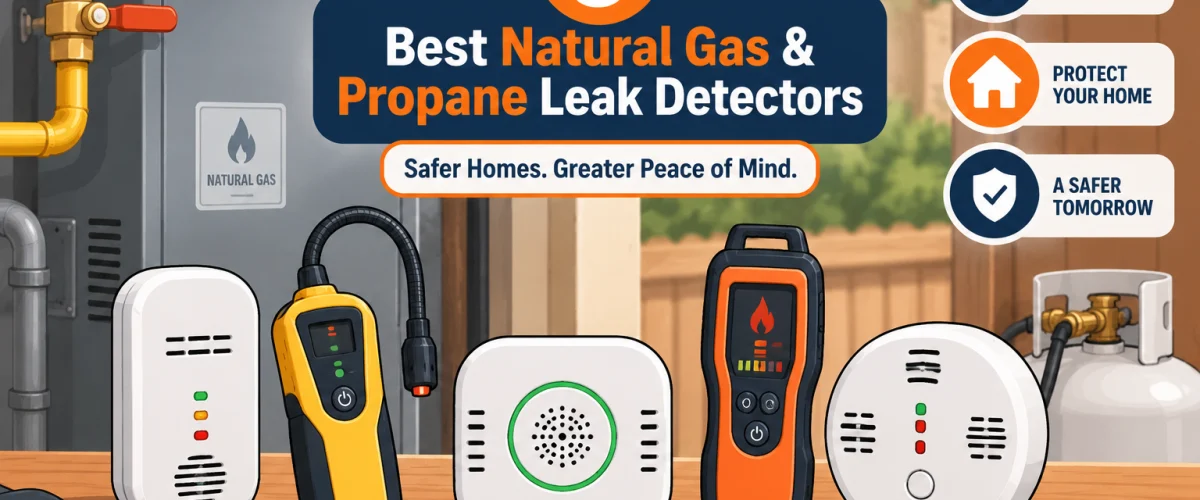
Compare 5 top natural gas & propane leak detectors for 2026 — plug-in alarms vs handheld sniffers, tested for accuracy, price and home safety.
Please note: Product availability and information are based on our research at time of writing and are subject to change. Always check Amazon for the latest details before purchasing. Some products in this roundup are featured via Amazon Creator Connections in addition to our standard Amazon Associates program. Reviews remain editorially independent.
Natural gas and propane leak detectors fall into two categories that solve different problems: a permanent plug-in or hardwired alarm watches the air around the clock, the same way a smoke alarm watches for fire, while a handheld sniffer only helps once you already suspect a leak and want to pinpoint the source at a specific fitting or joint. Most gas-heated homes should buy an alarm first, since it’s the only one working while you’re asleep or away, and add a handheld for checking connections directly. This roundup covers combustible gas specifically — natural gas and propane. Looking for sensors that catch water leaks instead? Our water leak detector roundup covers that entirely separate category.
⚠️ Warning
If you smell a strong gas odor or an alarm sounds, don’t search for the leak. Leave the building immediately, don’t operate light switches, appliances, or phones inside, and call your gas utility or 911 from outside. Handheld detectors are for faint or intermittent odors and for checking connections after a repair — not for an active emergency. Our guide on how to shut off gas to your home in an emergency covers the safe steps once it’s safe to act.
✏️ Our Take
The right setup for most gas-heated homes is an alarm for 24/7 protection plus a handheld for pinpointing — one doesn’t replace the other. A plug-in combo alarm like the Kidde below does the passive, always-on job a homeowner actually needs. A handheld earns its keep in specific moments an alarm can’t help with: confirming a repair sealed properly, or checking a suspicious joint behind an appliance. Buy the alarm first if you only buy one thing.
IN THIS GUIDE
| Product | Rating | Best For | Price |
|---|---|---|---|
| Kidde KN-COEG-3 Nighthawk BEST OVERALL |
★★★★★ | Plug-in explosive gas + CO alarm, 24/7 coverage | $$ |
| TOPTES PT199 | ★★★★☆ | Pocket sniffer for checking fittings on a budget | $ |
| TOPTES PT520A | ★★★★☆ | Gooseneck reach behind appliances and in tight spots | $$ |
| RIDGID 36163 CD-100 Micro | ★★★★★ | Professionals checking installations and repairs | $$$ |
| MTI 20441PWT Safe-T-Alert | ★★★★☆ | RVs, travel trailers and campers running propane | $$ |
🏆 Best Overall
The Kidde KN-COEG-3 earns the top spot by covering two separate hazards in one unit — it watches for explosive gas (natural gas or methane, and propane) at the same time it monitors for carbon monoxide, instead of requiring two separate plug-in devices for two hazards that often stem from the same gas appliances. It plugs into a standard 120V outlet with a rotating plug that keeps it upright on vertical or horizontal outlets, and a 9V battery backup keeps it monitoring through a power outage. The digital display reads CO concentration in ppm (30–999, updating every 15 seconds) and switches to a “GAS” readout the moment it senses explosive gas.
The 85 dB alarm uses distinct patterns for a CO event versus a gas event, so you know which hazard you’re facing before you’re fully awake. A peak level memory records the highest reading since the last reset, useful for catching a slow, intermittent problem, and a test/reset button confirms the unit works without waiting for a real event. The included 6-ft cord lets you place it on a shelf rather than directly at outlet height. It’s UL-listed, meets UL 2034, and carries a 7-year service life, after which the entire unit needs replacing.
✓ Pros
Covers two separate hazards — explosive gas and CO — in one plug-in unit
Digital CO readout in ppm plus peak level memory catches slow, intermittent problems
9V battery backup and a 6-ft cord keep it working and usefully placed during an outage
✗ Cons
The display reads “GAS” when explosive gas is detected but doesn’t show a concentration number the way the CO readout does
The 9V backup battery needs periodic replacement and its low-battery chirp is loud; the whole unit is replaced at the end of its 7-year life
🛒 Check Price on Amazon — $$ →
💰 Best Budget Handheld
The TOPTES PT199 is the cheapest way here to physically check a fitting or connection rather than relying only on a passive alarm across the room. It’s a pen-style, pocket-sized sniffer that detects natural gas, methane, propane, butane and LPG, runs on two included AAA batteries, and comes with a storage bag. After a 30-second warm-up, it offers dual sensitivity — High for a broad 50–500 ppm range and Low for a more sensitive 500–1,000 ppm range (methane-based) — letting you switch between a general sweep and a focused check once you’ve narrowed down the area.
The alarm triggers within half a second and intensifies as concentration rises, with the LCD turning red at high levels. The trade-off for the pocket size and price is reach: there’s no probe, so it has to be held close to the joint — roughly 1 to 5 cm — rather than reaching behind an appliance. It auto-shuts-off after 5 minutes, and a low battery indicator warns before it dies mid-check. For confirming a fitting sealed properly after a repair, or a quick pass around visible connections, it’s a straightforward, inexpensive tool to keep on hand.
✓ Pros
The cheapest way in this roundup to physically check fittings and connections
Dual sensitivity settings help narrow down a leak once you’re in the right general area
Pocket size and included storage bag make it a genuine grab-and-go tool
✗ Cons
No probe — it has to be held directly against or very close to the joint you’re checking
Narrower overall detection range than the probe-style models in this roundup
🎯 Best Long-Reach
The TOPTES PT520A solves the PT199’s exact limitation: reach. Its 17-inch flexible gooseneck extends behind appliances, dryers and furnaces and into tight spots a straight sniffer can’t reach without moving the unit. It detects methane, propane, natural gas, LPG and butane across a wide 50–10,000 ppm range (methane-calibrated) — considerably broader than the PT199’s dual-range sensitivity — and after a 30-second warm-up in clean air it’s ready to sweep along a connection or into a gap behind an appliance.
Detection shows two ways at once: a 7-bar color scale that fills in as concentration rises, and a 75 dB alarm that intensifies with it, both responding within half a second. Three sensitivity levels and a mute button help in a noisy mechanical room, and it auto-powers-off after 10 minutes, though that can be disabled. It ships with 3 AAA batteries and a protective case included. What it doesn’t do that the Kidde alarm does is give a specific number — the 7-bar scale shows relative concentration, not an exact ppm reading, and the screen can be hard to read in bright daylight.
✓ Pros
17-inch gooseneck reaches behind appliances and into gaps a straight sniffer can’t
Wide 50–10,000 ppm range with a clear visual color scale alongside the audible alarm
Protective case and batteries included — ready to use out of the box
✗ Cons
Bar-scale readout only — no numeric ppm reading like the Kidde alarm provides
Screen can be hard to read in bright daylight
🛒 Check Price on Amazon — $$ →
🔧 Best Pro-Grade
The RIDGID 36163 CD-100 Micro is built for the professional side of this category — plumbers and gas technicians checking installations and repairs rather than an occasional homeowner spot check. It detects a wider gas range than the other handhelds here, including methane, propane, butane, ethanol, ammonia and hydrogen, with adjustable sensitivity. A 16-inch flexible probe gives real reach into tight installation spaces, and RIDGID’s Tri-Mode alerting — visual, audible or vibration — works in a loud mechanical room where an audible alarm alone might be missed.
Build quality is where the RIDGID name carries weight: it’s a rugged tool for repeated daily job-site use, and its sensor is field-replaceable, so the whole unit doesn’t get discarded once the sensor wears out. That build and sensor longevity come at the highest price point in this roundup, and it needs a startup calibration in clean air taking close to a minute, plus it shuts off after a period of inactivity — reasonable trade-offs for accuracy and longevity, but slower to deploy than the simpler consumer sniffers above.
✓ Pros
Vibration alert mode is genuinely useful in loud mechanical rooms where an audible alarm can be missed
Field-replaceable sensor extends the tool’s service life instead of replacing the whole unit
RIDGID build quality suited to daily professional use, not just occasional checks
✗ Cons
Startup calibration in clean air takes close to a minute, and it powers off after periods of inactivity
Highest price tier in this roundup
🛒 Check Price on Amazon — $$$ →
🚐 Best for RVs & Propane
Every other product here is built for a standard 120V outlet — the MTI 20441PWT Safe-T-Alert is built specifically for an RV, travel trailer or camper. It’s a 12V DC propane alarm that wall-mounts and wires directly into the vehicle’s own 12V system rather than plugging into an outlet. LED status indicators show whether the unit is powered, in alarm, showing a fault, or at end of life, so a glance at the panel tells you its condition without a manual test.
It’s also the product most homeowners here will buy as a direct replacement rather than a first-time purchase — RV propane alarms carry a labeled service life, and this one specifies replacement 60 months after the original retail sale date, printed on the unit. Because these alarms fail toward the end of that window without an obvious sign, it’s commonly bought specifically to swap out an alarm that’s aged out. The trade-off: it’s single-purpose — a 12V RV propane alarm only, not for a household outlet or a home on natural gas.
✓ Pros
Purpose-built for RV propane systems and wired into the vehicle’s own 12V system
LED status panel clearly shows power, alarm, fault and end-of-life states at a glance
A straightforward, direct replacement for many existing RV propane alarms that have aged out
✗ Cons
12V RV use only — not suitable for a household outlet or a home running natural gas
Rated for a 5-year replacement cycle, so check the manufacture date as soon as it arrives
🛒 Check Price on Amazon — $$ →
Start with the alarm-versus-handheld question, since it shapes your whole setup: a plug-in or hardwired alarm watches passively while you’re asleep or away, and a handheld only helps once you already suspect a leak and want to pinpoint it. Most gas-heated homes should buy an alarm first, and treat a handheld as the second tool for confirming a repair or checking a specific connection.
Placement matters more than most homeowners expect, since natural gas and propane behave differently in the air. Natural gas is lighter than air and rises, so alarms for a natural gas system are typically placed higher on the wall. Propane is heavier than air and sinks, so a propane alarm is generally placed lower, since a leak pools downward rather than rising. Always follow the manufacturer’s specific placement instructions for the fuel you’re actually using.
A standard carbon monoxide alarm does not detect natural gas or propane — separate hazards, even though they often come from the same gas-burning appliances. A combo unit like the Kidde above covers both; a CO-only alarm gives no protection against an explosive gas leak. Sensors also have a limited service life — note the replacement date, and check it alongside a broader annual home plumbing inspection rather than only when an alarm starts chirping. If using a handheld, let it complete its warm-up in clean air before testing. Our guide on gas line safety covers what else is worth knowing.

A detector tells you a leak exists — it doesn’t fix the fitting, valve or line that’s actually causing it. If your alarm or handheld has flagged a real leak, or you’re not confident diagnosing and repairing gas line work yourself, search PlumberArchive.com — the US plumber directory with 12,151+ verified local plumbers across all 50 states.
Get weekly plumbing tips, honest tool reviews and DIY guides delivered to your Facebook feed.
No. A standard CO alarm senses carbon monoxide specifically and doesn’t respond to natural gas or propane — they’re chemically different hazards that often come from the same appliances, like a furnace or water heater. For protection against both, you need either two separate devices or a combo unit like the Kidde KN-COEG-3 above, which monitors for explosive gas and CO at once. A CO-only alarm gives zero warning if the actual problem is an unburned gas leak rather than incomplete combustion.
It depends on the fuel. Natural gas is lighter than air and rises toward the ceiling, so alarms for a natural gas home are generally placed higher on the wall. Propane is heavier than air and sinks toward the floor, so a propane alarm is generally placed lower, since that’s where a leak accumulates. Always check the specific manufacturer instructions for the unit you buy, since guidance can vary slightly even within the same fuel type.
No — they’re not meant to do the same job. A handheld only tells you something the moment you’re holding it to a specific connection; it has no idea what’s happening in the room five minutes later or while you’re asleep. A permanent alarm is the only one of the two providing continuous, passive protection. The right setup pairs both: an alarm for 24/7 coverage, and a handheld for confirming a repair or checking a suspicious fitting on demand.
It varies by product; the service life is printed on the unit rather than fixed industry-wide. The Kidde KN-COEG-3 alarm above is rated for 7 years before the entire unit needs replacing. The MTI 20441PWT RV propane alarm specifies replacement 60 months (5 years) after its retail sale date. Handheld sniffers don’t carry a fixed expiration, but their sensors can drift with heavy use, so it’s worth periodically testing one against a known source.
For most gas-heated homes, the Kidde KN-COEG-3 Nighthawk is the best overall starting point — it covers explosive gas and carbon monoxide in one plug-in unit, keeps working through a power outage on battery backup, and gives a digital readout rather than a simple pass/fail light. It’s the passive, 24/7 protection every gas-heated home benefits from, regardless of what else you add.
A handheld belongs alongside it, not instead of it. For checking fittings on a budget, the TOPTES PT199 pocket sniffer is the cheapest genuinely useful option here. If you need to reach behind appliances, the TOPTES PT520A‘s 17-inch gooseneck solves that. And for professionals — or anyone who wants the most rugged, longest-serving tool — the RIDGID 36163 CD-100 Micro justifies its higher price with build quality and a field-replaceable sensor.
RV owners are a separate case: the MTI 20441PWT Safe-T-Alert is purpose-built for a 12V propane system and is most often bought as a direct swap for an aged-out alarm. Whichever combination fits, remember what a detector can and can’t do — it tells you a problem exists, but fixing the leak is a separate step.
Prices and ratings may change. Always check Amazon for current prices.
✍️ About This Review
Reviewed by James Carter, Senior Tool Reviewer at PlumbingToolsReview — 15 years of hands-on experience in residential plumbing and tool testing. Learn how we test →
5 septic tank riser kits compared for 2026 — Tuf-Tite and Polylok risers by diameter and height, so you can bring tank access to grade level.
The 5 best sewage and effluent ejector pumps for 2026, expert-reviewed: grinder, standard solids-handling and light-duty effluent pumps compared.
Expert reviews of the 5 best whole house sediment pre-filters for well water in 2026 — cartridge housing systems vs. reusable spin-down filters compared.

