
Guides
19 Oct 2026

Can’t Reach the Faucet Nut? Choose the Right Tool Before You Buy
Not sure which tool fits your faucet nut? Identify the fixing, see how it lets go and check your clearance first. Then choose a tool, or use one you own.
Gas line safety for homeowners: how to recognize a leak, respond in an emergency, find your shutoff valve, and know what only a licensed pro should do.

Please note: This guide is based on our research at time of writing and is for general safety awareness only. It is not a substitute for your gas utility’s emergency instructions, your local fire department, or a licensed gas professional. Gas line installation, repair, modification, and reconnection must always be performed by a licensed, qualified professional — this guide does not provide instructions for doing any gas line work yourself. If you smell gas, follow the emergency steps below immediately and contact your gas utility’s emergency line or 911.
Natural gas and propane are safe, reliable ways to heat a home, cook, and run a water heater or dryer — tens of millions of US households use one or the other every day without incident. What sets a gas system apart from the rest of your home’s plumbing is not that it is fragile or exotic; it is that the failure modes are different in kind, not just degree. A leaking supply line is an inconvenience. A leaking gas line, in the wrong conditions, is a fire or explosion risk, and the appliances that burn that gas can produce carbon monoxide if they are not installed, vented, or maintained correctly. That combination is why gas work is treated differently than almost anything else in this guide’s usual scope.
This guide is deliberately not a how-to for gas line repair, installation, or modification — nowhere in it will you find instructions for cutting, threading, connecting, or sealing a gas pipe yourself, because that work should not be done by anyone without a gas fitting or plumbing license, the required permit, and the pressure-testing equipment to verify the job is airtight before it goes back into service. What this guide is for is everything a homeowner actually can and should own: recognizing the signs of a leak, knowing exactly what to do in the first sixty seconds if you suspect one, knowing where your main shutoff valve is and how to use it in an emergency, understanding the basic vocabulary and components of your system well enough to describe a problem clearly to a professional, and knowing who to call. Treat that as the whole job. Everything past it belongs to someone licensed to do it. Two things are worth doing before you ever need them: our how to shut off gas to your home in an emergency guide walks through the physical shutoff procedure in a calm moment rather than a stressful one, and our natural gas and propane leak detector reviews cover the early-warning devices that catch a leak before you’d ever smell it.
IN THIS GUIDE
At a Glance
| What You CAN Do Yourself | Recognize the smell, sound, and sight of a leak; know where your main shutoff valve is and how to turn it; do a hands-off visual walk-around of exposed piping and appliance connections; install, test, and replace batteries in carbon monoxide detectors; and know your gas utility’s emergency number and when to call 911. |
| What Requires a Licensed Professional | Everything hands-on: installing, repairing, or modifying any gas line or fitting; connecting or reconnecting an appliance; turning your gas supply back on after it has been shut off; relighting pilot lights; tightening, sealing, or replacing any gas connection; and converting equipment between natural gas and propane. |
| Critical First Step | Find your main gas shutoff valve today, before you ever need it in an emergency. It typically sits on the supply pipe next to your gas meter. Knowing exactly where it is and which way to turn it, before you’re standing outside smelling gas and thinking clearly is hard, is the single most useful thing in this entire guide. |
Natural gas and propane are both naturally odorless. Utilities add a chemical called mercaptan to the supply specifically so a leak announces itself before it reaches a dangerous concentration — that distinctive rotten-egg or sulfur smell is not the gas itself, it is a deliberate, life-saving additive. Learning to recognize it, and taking it seriously the instant you notice it, is the most important skill in this guide.
Smell. A rotten-egg or sulfur odor, indoors or outdoors, near an appliance, the meter, or anywhere along where you know or suspect a line runs. It can be faint and easy to dismiss the first time, or strong and unmistakable. Either way, do not wait to see if it gets stronger or fades.
Sound. A hissing or whistling noise near a gas appliance, the meter, or an exposed section of pipe, especially right after the appliance was serviced, moved, or connected. Gas escaping under pressure is often audible before it is smelled.
Sight. A patch of dead, discolored, or unusually stressed-looking vegetation above where a buried gas line runs, while the grass around it is healthy — gas escaping into the soil can suffocate plant roots. Also watch for a visible white cloud, mist, or blowing dust near a gas line or meter, or persistent bubbling in a puddle or standing water with no other explanation.
Physical symptoms. Dizziness, headache, nausea, fatigue, or irritated eyes, nose, or throat that appear indoors and ease when you go outside can indicate you are being exposed to escaping gas or its combustion byproducts. Do not try to work out which one it is — treat any pattern like this as an emergency and leave the building.
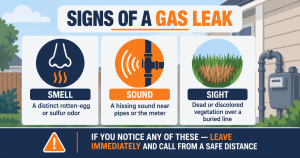
⚠️ Warning: If you notice any of the signs above, do not investigate further, do not try to find the source, and do not wait to see if it’s “really” a leak. Leave the building immediately and follow the emergency steps in the next section. A gas leak is one of the very few home problems where hesitating to confirm the problem is itself the danger.
The sequence below is the standard emergency guidance from gas utilities and fire departments across the US. Memorize the shape of it — leave, don’t spark anything, call from a distance — even if you never need the details.
1. Leave immediately. Get everyone, including pets, out of the building right away. Do not stop to open windows, look for the source, or gather belongings. Leave doors open behind you as you go rather than pausing to close them.
2. Do not create a spark on your way out. Do not flip any light switch, on or off. Do not use a phone, tablet, or any electronic device inside the building. Do not use a garage door opener, doorbell, or any switch or outlet. Do not light a match, a lighter, or a candle. Do not start a car in an attached garage. Any small spark near an accumulated gas concentration can ignite it, and light switches and electronics are common ignition sources precisely because people reach for them without thinking.
3. Get to a safe distance and call for help. Once you are safely away from the building — across the street or further, not just outside the front door — call your gas utility’s emergency line and, if you smell strong gas, have any symptom of exposure, or hear a hissing sound suggesting a significant leak, call 911 as well. Most gas utilities list a 24/7 emergency number on your bill and their website; it’s worth saving that number in your phone now, before you need it.
4. Do not re-enter until you’re told it’s safe. Wait for the fire department or utility crew to inspect, clear, and tell you directly that it is safe to go back in. Re-entering to check on something, grab a pet you left behind, or see if the smell is gone is how people get hurt after correctly evacuating the first time.
5. Shutting off the gas is optional, not a delay. If your main shutoff valve is genuinely on your way out and you can reach it in seconds without doubling back or lingering, turning it off on the way is reasonable. It is never worth turning around for, searching for the wrench, or spending extra time inside to find it. Leaving the building comes first, every time.
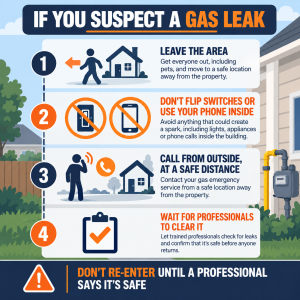
⚠️ Warning: Never assume a small or faint smell means a small or manageable problem. Gas concentration and leak severity are not something you can judge by nose alone, and treating a faint smell as “probably fine” is one of the most common and most dangerous mistakes homeowners make. Every suspected leak gets the same response: leave, don’t spark anything, call from a distance.
Every home on natural gas or a propane tank has a main shutoff valve on the supply line, usually right next to the gas meter — outside the house for natural gas service, or at the tank itself for a propane system. It is typically a rectangular or lever-style valve on the pipe: turned parallel to the pipe, the gas is flowing; turned a quarter-turn so it sits perpendicular (crosswise) to the pipe, the supply is shut off. Many appliances also have their own individual shutoff valve nearby, but the main valve is the one that matters in an emergency because it cuts gas to the entire house at once.
Turning the main valve off in a genuine emergency — a suspected leak, storm or earthquake damage, a fire — is one of the few hands-on actions this guide treats as appropriate for a homeowner, and it typically takes an adjustable or specific gas shutoff wrench, which is worth keeping somewhere easy to grab, such as tied near the meter or in a spot you’d remember under stress. Locate the valve now, in a calm moment, and physically confirm you know which way it turns; do not wait until you’re standing outside in an emergency to work it out for the first time.
What you should not do is turn the gas back on yourself once it has been shut off, or attempt to relight any pilot lights afterward. Restoring gas service requires purging air from the lines, checking every connection and appliance for leaks under pressure, and relighting pilots in the correct sequence — done wrong, it can leave unburned gas accumulating in the house. Many gas utilities will not restore service to a home unless one of their technicians does it personally, and that is the right default to expect: once the gas is off, treat turning it back on as exclusively your utility’s or a licensed professional’s job.
You do not need to know how to work with any of these materials — this section exists purely so you can recognize what a professional is talking about and describe your own system accurately when you call one.
Black iron pipe. The traditional material, especially in older homes: rigid black steel pipe joined with threaded fittings. It is durable and has been the standard for decades, but every threaded joint is a potential leak point if it was not assembled and sealed correctly, which is exactly the kind of work a licensed installer pressure-tests before signing off on.
CSST (corrugated stainless steel tubing). A flexible, corrugated stainless tubing widely used in newer construction because it’s faster to route through walls and framing than rigid pipe. CSST has a well-documented installation detail that matters for safety: it must be properly electrically bonded and grounded, because an inadequately bonded system is vulnerable to being punctured by the electrical energy from a nearby lightning strike. This is a code requirement a licensed installer handles as a matter of course — it is not something a homeowner needs to do, only something worth knowing exists if you have CSST in your home.
Copper. Permitted for gas piping in some jurisdictions and prohibited in others, largely because certain gas compositions can corrode copper over time if the wrong type or fitting is used. Whether copper is allowed, and what type, is a local code question a licensed installer will already know the answer to for your area.
There is a narrow, genuinely useful visual check a homeowner can do periodically, as long as it stays strictly look-don’t-touch.
Look at exposed piping. Where gas pipe is visible — in a basement, utility room, or running to an outdoor grill or generator — look for rust, corrosion, dents, or obvious physical damage, particularly after any excavation, landscaping, or construction nearby that could have disturbed a buried line.
Look at appliance connections. The flexible connector linking an appliance — a range, dryer, water heater — to its shutoff valve should look intact: no visible cracking, kinking, or corrosion, and no sign it has been stretched or crimped by the appliance being pushed back against a wall. An old, damaged, or clearly deteriorated connector is worth a call to a professional to have it assessed and replaced.
Check the meter area. After storms, heavy snow removal, mowing, or any yard work near the meter or the line’s known path, take a look for physical damage, and check for the dead-vegetation pattern described earlier along the buried run.
⚠️ Warning: This inspection is visual only. Do not tighten, adjust, wrap, or attempt to reseal any fitting or connector yourself, even one that looks slightly loose — a fitting that looks fine but is actually loose, or one you make worse by handling it, is exactly how a small problem becomes a real leak. If anything looks off, note what and where, and call a licensed professional to evaluate and correct it.
Carbon monoxide (CO) is a separate risk from a gas leak, and it deserves its own attention because the two are easy to conflate. CO is produced when a fuel — natural gas, propane, wood, or any other combustible — burns incompletely, typically because an appliance is malfunctioning, improperly installed, or inadequately vented. Furnaces, gas water heaters, gas ranges and ovens, fireplaces, and portable generators are all potential sources.
Unlike natural gas, which has mercaptan added specifically so you can smell it, carbon monoxide is completely colorless and odorless. There is no smell to notice, no warning your nose will give you — a functioning CO detector is the only reliable way to know it’s present before symptoms set in. If you’re comparing gas and electric appliances for your home, our electric vs gas water heater guide covers the venting and CO-detector requirements that come with choosing gas.
Early CO exposure symptoms mimic the flu without a fever: headache, dizziness, weakness, nausea, and confusion. Because it’s easy to mistake for just feeling unwell, pay attention to whether symptoms affect everyone in the house at once, or ease when you leave and return when you’re back inside — both are red flags that point to CO rather than a passing illness.
Install CO detectors on every level of the home and near sleeping areas at minimum — most local codes require this near bedrooms and outside sleeping areas, and many require one near an attached garage as well. Test them monthly the same way you’d test a smoke detector, and replace units on the manufacturer’s schedule, typically every five to seven years, since the sensor itself has a service life even if the alarm still powers on.
Almost every other topic on this site includes a DIY path with a “call a professional if it’s beyond you” caveat. Gas line work does not get that treatment, for reasons that are legal, financial, and physical, not just cautious editorial policy.
Licensing. Installing, repairing, or modifying a gas line requires a licensed gas fitter or plumber in virtually every US jurisdiction — in many states this is a distinct license from general plumbing, with its own testing on code, materials, and pressure-testing procedure. This isn’t a paperwork formality; it exists because the training verifies someone actually knows how to do the work safely.
Permits and inspection. New gas line work, and most repairs or modifications, require a permit and a follow-up inspection in most municipalities. Unpermitted gas work is often illegal on its own, and it routinely surfaces as a problem later — during a home sale, an insurance claim, or a future renovation — as work nobody can verify was ever tested or approved.
Insurance. If unlicensed gas work causes a fire, explosion, or CO incident, a homeowner’s insurance claim can be denied outright, and the homeowner can be personally liable. Lenders and buyers’ inspectors also flag unpermitted gas work during a sale, which can delay or derail a closing.
The physical reasoning. Gas work requires equipment most homeowners don’t own and wouldn’t know how to interpret correctly even if they did — a manometer to verify supply pressure, a proper pressure or soap-solution leak test on every joint before the line goes back into service, and correct pipe sizing for the BTU load of every connected appliance. A joint that looks tight can still leak slowly; the wrong thread sealant, one not rated for gas, can fail invisibly over months. None of that is about the work being conceptually hard — it’s that the margin for error is thin and the failure mode is fire, explosion, or carbon monoxide poisoning rather than a drip under a sink.
Given everything above, it’s worth stating the split plainly, in one place, rather than leaving it implied.
Safe for the homeowner: recognizing the smell, sound, and sight of a leak; knowing and evacuating to the emergency steps above; locating your main shutoff valve and knowing how to turn it off; a hands-off visual check of exposed pipe and appliance connectors; installing, testing, and replacing batteries in CO detectors; and knowing your gas utility’s emergency number. None of that involves opening a fitting, touching a joint, or working on the system itself.
Always a licensed professional:
Installing a new gas line — for a new appliance, an addition, an outdoor kitchen or fire feature, or a generator.
Repairing any existing line or fitting — corrosion, damage, or a confirmed or suspected leak.
Connecting or reconnecting any appliance — a range, dryer, water heater, furnace, or grill, whether it’s a new install or moving an existing one.
Restoring gas service after a shutoff and relighting any pilot lights.
Converting equipment between fuel types — natural gas to propane or the reverse — which changes orifice sizes, regulators, and pressure settings throughout the system.
If you’re choosing who does that work, look for a current state or local gas fitting or plumbing license — ask to see the number and verify it through your state’s licensing board if one exists online — along with liability insurance and, for larger jobs, a contractor who pulls their own permit rather than asking you to. Get more than one quote on non-emergency work, and check whether your gas utility maintains a list of approved or recommended contractors; many do, and it’s a reliable shortlist to start from.
US Regional Context: Natural gas reaches homes through utility pipelines and is most common in cities and suburbs with mains already in the ground; propane is more common in rural areas without gas-main infrastructure, stored in an above-ground or buried tank on the property and refilled by a delivery truck under contract with a local supplier. The two behave a little differently in a leak: natural gas is lighter than air and tends to rise and dissipate, while propane is heavier than air and can pool near the floor, in basements, and in other low spots, which is worth knowing when you think about where in a room a leak might collect. Building codes, permit requirements, and which materials are approved for gas piping all vary by state and even by municipality, and your specific utility or propane supplier is the best source for local emergency numbers and code specifics — confirm the details for your area rather than assuming a national standard applies everywhere.
✏️ Our Take
If you take one thing from this guide, make it this: know where your main gas shutoff valve is, and know what a gas leak smells like. Those two facts are the entire practical difference between a calm, correct response and a dangerous delay, and neither takes more than a few minutes to learn. Everything past that — every repair, every connection, every pilot light relit after a shutoff — belongs to a licensed professional, not because the site is being overly cautious, but because the actual failure modes here are fire, explosion, and carbon monoxide poisoning. Awareness is the homeowner’s job. The wrench is the professional’s.
Any gas line installation, repair, connection, or reconnection calls for a licensed gas fitter or plumber and, in most areas, a permit and inspection. Search PlumberArchive.com — the US plumber directory with 12,151+ verified local plumbers across all 50 states.
Get weekly plumbing tips and DIY guides delivered straight to your Facebook feed.
A rotten-egg or sulfur smell. Natural gas and propane are odorless on their own; utilities add a chemical called mercaptan specifically so a leak is noticeable by smell before it reaches a dangerous concentration. The smell can be faint at first or immediately strong — treat either the same way: leave the building and follow the emergency steps in this guide. Don’t wait to see if it gets stronger before taking it seriously.
No. Turning the main valve off in an emergency is one of the few hands-on actions a homeowner should do, but turning it back on is not. Restoring service safely means purging air from the lines, pressure-testing every connection and appliance for leaks, and relighting pilot lights in the correct order — done incorrectly, it can leave unburned gas accumulating in the house. Most gas utilities require one of their own technicians, or a licensed professional, to restore service after a shutoff, and that is the right default to follow.
No, not legally or safely in virtually any US jurisdiction. Gas line work requires a licensed gas fitter or plumber, and in most places a permit and inspection as well. Beyond the legal requirement, the work needs pressure-testing equipment and training to verify every joint is actually sealed before the line is put back into service — a leak from an improperly sealed joint can be slow and go undetected for months. This is true even for work that looks simple, like reconnecting an appliance.
A gas leak has the deliberately added mercaptan smell, so your nose is a real warning system. Carbon monoxide, produced when a gas appliance burns fuel incompletely, is completely colorless and odorless — there is no smell to notice at all. A working carbon monoxide detector, tested monthly and replaced on schedule, is the only reliable way to know it’s present. The two risks are related (both come from gas appliances and systems) but require different detection: your nose for one, a detector for the other.
Neither is inherently more dangerous when properly installed and maintained; the practical difference is behavior in a leak. Natural gas is lighter than air and tends to rise and disperse, while propane is heavier than air and can pool near the ground, in basements, and in other low areas. That affects where a leak might concentrate, but the response is identical either way: leave immediately, avoid anything that could spark, and call for help from a safe distance. If you’re unsure which fuel your home uses, that’s worth confirming with your utility or supplier so you know what you’re dealing with.
Gas line safety, for a homeowner, comes down to a short list of things worth actually knowing cold: what a leak smells, sounds, and looks like; that the response is always leave, don’t spark anything, and call from a safe distance; where your main shutoff valve is and how to turn it; and that carbon monoxide is a separate, odorless risk a detector handles, not your nose. None of that is technical work, and none of it requires a tool beyond a wrench for the shutoff valve. Every piece of actual gas line work — installation, repair, reconnection, restoring service, relighting a pilot — belongs to a licensed professional, every time, without exception. Get the awareness right, keep a working CO detector on every level of the house, and know who to call, and you’ve done the entire homeowner side of gas line safety correctly.
Prices and ratings may change. Always check Amazon for current prices.
✍️ About This Guide
PTR Editorial Team — Plumbing Guides. We compare manufacturer specifications, installation requirements, compatibility and available product documentation to help homeowners choose suitable tools and parts. How we review →
Not sure which tool fits your faucet nut? Identify the fixing, see how it lets go and check your clearance first. Then choose a tool, or use one you own.
Check your manual and the drain route first: gravity hose, built-in pump or external pump. Then see whether you need a dehumidifier hose at all.
Explore portable bidets that need no water-line connection, from bottle caps and squeeze bottles to battery-powered handhelds.

