
Guides
19 Oct 2026

Can’t Reach the Faucet Nut? Choose the Right Tool Before You Buy
Not sure which tool fits your faucet nut? Identify the fixing, see how it lets go and check your clearance first. Then choose a tool, or use one you own.
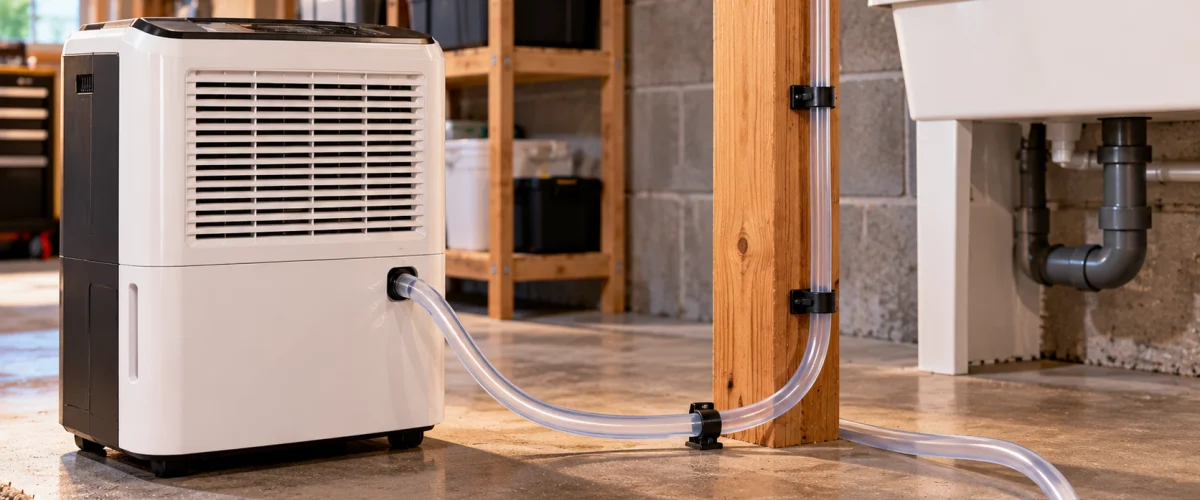
Check your manual and the drain route first: gravity hose, built-in pump or external pump. Then see whether you need a dehumidifier hose at all.
Please note: Product availability and information are based on our research at time of writing and are subject to change. Always check Amazon for the latest details before purchasing.
If your dehumidifier fills its bucket faster than you want to empty it, running it to a drain is the obvious fix, and a hose seems the obvious purchase. But the hose is the last piece of the puzzle, not the first. Start with the route: where the water leaves the machine, where it has to end up, and what your model’s manual says about the stretch in between.
This guide walks through it in that order: your appliance, gravity or pump, the route, the connection, and only then a purchase. Often there is nothing to buy at all, and we’ll say so where that’s the case.
✏️ The Short Answer
Your model’s manual says how it drains: by gravity through a hose, with a built-in pump, or into an external pump. A gravity hose can only run downhill, and where the water is allowed to end up is a separate question that your local rules answer. So buy a hose only when the route you need is longer than any hose you already have, your manual allows that route, and the hose fits your unit’s outlet (and its thread, if the outlet has one). And if there is no suitable drain route, the bucket is still a perfectly good way to run the machine.
IN THIS GUIDE
Find the model number on the label on the unit and open that model’s manual. Four things matter here: the drain connection on the unit, whether a hose comes in the box, whether your model has a pump, and any limit on hose length or lift.
Manuals differ on all four, so a generic hose can’t be assumed to suit every unit. Three examples show how much.
| Manual | Gravity drainage | Pump drainage |
|---|---|---|
| GE dehumidifiersOwner’s manual 49-5000545 Rev. 4 Six models, listed in Sources |
A garden hose, “not included”, on the side nozzle and down to a floor drain. | An internal pump “on some models”; the manual doesn’t say which. Where fitted: included pump hose, maximum lift 16 ft. |
| Whirlpool WHHD501PAWUse and care guide W11740392A, 09/25 Retailer copy |
Hose “not included”, standard garden hose connector; the instruction says to cut it to “no longer than 3.2 feet (1000mm)”. | Packing list shows a pump pipe of about 16.4 ft; maximum pump height about 16.4 ft. |
| LG LD25ELUser’s guide MFL47379701 Manual-library copy |
Connector and hose “not supplied”; no thread or size given. Don’t bend the hose or put its end in water. | Not covered in the continuous-drain section. |
Those are the makers’ words for those particular models, not rules for every dehumidifier. Wherever your own manual says something different, go with your manual; that applies to everything below.
Which of these three setups you have decides almost everything that follows.
Before you buy anything, walk the path from the unit to where the water will end up and look for the problems below.
The manuals we read name a floor drain for continuous drainage (GE, LG and Whirlpool do), but none says that any drain you can reach will do.
That part is up to your local plumbing and mechanical rules, which decide which fixtures may receive a dehumidifier’s water and how the connection must be made, and they differ from place to place. We haven’t verified them for you, so don’t assume that a nearby sink, laundry tub, standpipe or floor drain is acceptable. Before you connect a hose to a fixed drain, ask your local building department or a licensed plumber.
Hose listings say “3/4 inch” a lot, and the phrase can mean quite different things. It helps to keep three measurements apart.
A pump hose is a different matter. A pump model’s own hose connects with its own fitting: the hOmeLabs manual for its pump model, for instance, lists a pump drain hose with a 1/4-inch outer diameter, which is not a garden hose thread at all. For pump mode, use the hose the manual names (GE says “only use the hose included with the product”).
Often not. Look at what came in the box and what the manual says about each item, then see which of these describes you.
That leaves one case for buying: the route you need is longer than any hose you have, your appliance’s manual allows it, and the hose’s connector suits your outlet.
Several manuals name an ordinary garden hose for continuous drainage: GE’s manual for its six models, Frigidaire’s guides for the FHDD5033W1 and FHDP5033W1, and Whirlpool’s guide for the WHHD501PAW. If yours does, a garden hose is the documented answer, and you may already own one. What follows is not a ranking, and none of it is confirmed for your unit until you have checked your own manual and outlet.
Flexzilla 5/8 in. garden lead-in hose, 10 ft. It is an ordinary garden hose, not a dehumidifier product, and that is the point: Frigidaire’s FHDD5033W1 and FHDP5033W1 guides, GE’s manual and Whirlpool’s WHHD501PAW guide all describe a garden hose on the drain connection. (“GHT” means garden hose thread, which Whirlpool’s manual spells out as 1-1/16 in. outer diameter and 11.5 threads per inch.) On the specifications, Flexzilla’s catalog lists model HFZG510YW (10 ft) with a 5/8 in. hose I.D. and 3/4 in.–11 1/2 GHT fittings on both ends, and Frigidaire’s guides recommend a drain hose of 1/2 in. or larger.
Check the selected seller, the New offer and the return terms before ordering; offers on the same listing can differ in condition.
A hose from the maker. Frigidaire also sells its own 12 ft, cut-to-length dehumidifier hose, 18FFDHMH01, and says it fits most dehumidifiers. We don’t link it. We did not find a hose diameter or a list of models for it from Frigidaire, its own guides don’t name it, and the Amazon listing describes only a 3/4-inch threaded garden-hose-style coupling with a washer. If you’re considering it, ask Frigidaire for the inside diameter and check your outlet’s thread first.
Once the line is running, it needs a little upkeep. Frigidaire says dust can form sludge and algae that block the hose, and suggests flushing it with clean water now and then; a blocked hose can send water back into the bucket, light the “Full Bucket” indicator and shut the unit off. LG says to check the filter and hose for clogs every two weeks, and Whirlpool’s WHHD501PAW manual says to check the filter every two weeks and to clean the water bucket every few weeks to prevent mold and mildew. Follow your own manual’s schedule, and switch the unit off and unplug it before you disconnect anything.
No. Makers who describe gravity drainage say the hose has to run down from the outlet, and TCL says a hose that rises can let water back up into the bucket. If the drain sits higher than the unit, your options are a model with a pump, an arrangement your maker allows, or the bucket.
Only if your manual allows it. In pump mode GE says to use only the hose included with the product, and Whirlpool’s WHHD501PAW manual says to cut its gravity hose to no longer than 3.2 ft. Other manuals say nothing about length, in which case the maker is the one to ask.
Only if your dehumidifier can’t drain by gravity or with its own pump, and its maker allows an external one. If that’s you, our condensate pump guide explains how to choose.
Read at the time of writing. Manufacturer-hosted documents are marked; copies on retailer or manual-library sites are marked as copies, so check the maker’s own file for your model.
✍️ About This Guide
PTR Editorial Team — Plumbing Guides. We compare manufacturer specifications, installation requirements, compatibility and available product documentation to help homeowners choose suitable tools and parts. How we review →
Not sure which tool fits your faucet nut? Identify the fixing, see how it lets go and check your clearance first. Then choose a tool, or use one you own.
Explore portable bidets that need no water-line connection, from bottle caps and squeeze bottles to battery-powered handhelds.
A strap wrench grips round parts with a strap, not teeth. See where makers call for one, how to size it, and when you can skip it.

