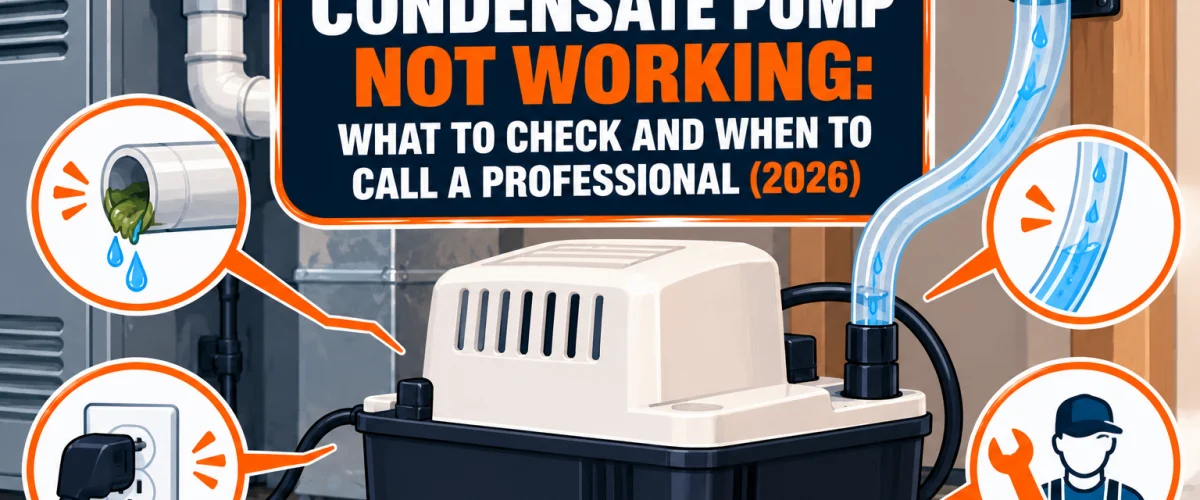
Please note: Information in this guide is based on our research of manufacturer manuals and pages at time of writing and is subject to change. It is general information and does not replace your pump and equipment manuals or a qualified professional. It deliberately leaves out electrical testing and any instructions for opening the pump. Always consult a qualified professional for diagnosis and repair.
Introduction
A condensate pump does one quiet job: it lifts the water that an air conditioner or dehumidifier removes from the air to a drain that gravity cannot reach. When it stops working, the first sign is usually not the pump itself. It is a system that stops cooling, or water showing up where it should not. This guide explains what you can safely observe from the outside, what the pump and equipment manufacturers list as likely causes, and which problems belong to an HVAC technician, an electrician or a plumber.
It covers reservoir-style condensate pumps serving air conditioners and dehumidifiers, the small tank-and-float units that sit near an air handler or in a basement or utility room. It does not cover ductless mini-split pumps, neutralizing pumps, or the acidic condensate from condensing furnaces, boilers and water heaters; for those, follow the appliance maker’s manual and a qualified technician. If you are choosing a replacement rather than diagnosing a fault, our review of the best condensate pumps compares five reservoir-style models using each maker’s documents. If you are not sure the water is condensate at all, our guide to detecting a water leak helps trace it.
At a Glance
| Difficulty |
Easy visual checks; repairs depend on the fault |
| Time |
Varies with the fault and access |
| Cost |
No purchase needed for visual checks; service costs vary |
| Tools Needed |
Flashlight and the pump/equipment manuals |
| Skill Level |
Beginner observations; qualified professional for servicing |
✏️ Our Take
Your job as a homeowner here is to observe, stay safe and describe the problem accurately, not to open the pump. The manuals we read list causes such as a dirty or obstructed float, a blocked or kinked outlet, a stuck check valve, a pump that is not level, more water than the pump can move, and a failed switch or motor. Nearly all of those fixes mean opening the pump or working on wiring, so they belong in the professional section. A system that shut itself off on a condensate safety switch is working as designed: find the cause, never bypass the switch.
Before You Start: Scope and Safety Limits
The steps below are observations and external checks made with your eyes, a flashlight and the manuals. Nothing here involves opening the pump, freeing a float, removing a check valve, cleaning the inside of the pump or any electrical work. Those jobs are in the professional section.
Little Giant’s VCMA owner’s manual says not to touch the motor, the pipes or the water around an installed pump until it has been unplugged or electrically disconnected, and not to handle a pump with wet hands or while standing on a wet or damp surface. It also warns that this equipment can start automatically.
⚠️ Warning: Turning the thermostat to Off is not electrical isolation. It stops the call for cooling, but the pump and the equipment stay connected to power, and the pump’s float can still start its motor. Carrier describes its technicians turning power off at the breaker or disconnect box before drain work. If there is water on the floor near the pump, its cord or the equipment, do not walk into it; call a qualified person.
This guide does not include live electrical testing, test steps that need the pump powered with its cover off, or any way to bypass, jump or disable a safety or overflow switch. Do not attempt those procedures; leave them to a qualified professional.
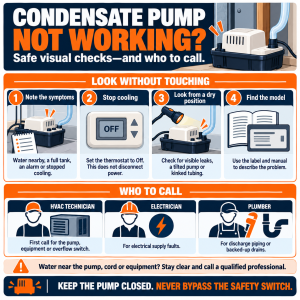
Step 1 — Notice and Write Down the Symptoms
Note what you see and when it began. These are the signs the manufacturers and the code describe:
- The air conditioner or heat pump stops or will not start. Trane says a system with a condensate overflow switch can shut down suddenly when the drain line or pan is clogged, and Carrier lists a safety float switch among the causes. Where a pump serves equipment in an attic or crawl space, the 2021 International Mechanical Code (Section 307.3) calls for the equipment to be prevented from operating when the pump fails, so a failed pump can look like a failed air conditioner.
- Water near the equipment or the pump, or stains on the ceiling or floor nearby, which Carrier lists among the symptoms of a clogged drain.
- Water at an emergency or secondary drain outlet, such as an outdoor outlet near a door or walkway. A technician quoted on Carrier’s page says excess water there usually signals a problem, and the 2021 IMC (Section 307.2.3) describes auxiliary drains that discharge to a conspicuous point to alert occupants to a stoppage of the primary drain, where installed.
- Musty odors from the indoor unit or the vents, which Carrier lists as a sign of a clogged drain line.
- Pump-specific signs: a reservoir that looks full while the pump seems idle, a pump that never seems to stop, or an alarm light. DiversiTech’s CP-22LP and ULTRACP-22 booklets say green means the pump has power and is ready, amber means it is running, and red means alarm mode and, if the safety switch is connected, that the system is shut off. Check your own manual before assuming other pumps use lights the same way.
💡 Tip: Photograph the pump and its data label and note the model number. A technician can narrow the cause faster with a model number, a clear description and the date it started.
Step 2 — Stop Making More Condensate, Without Touching the Pump
Set the thermostat to Off so the equipment stops calling for cooling and making more condensate, and switch a standalone dehumidifier off at its own control. If the system has already shut itself off, leave it off: repeated shutdowns point to a drain or pump problem that needs diagnosing. Limit water damage with towels, but only from places you can reach without standing in water or near the pump’s plug or cord.
Step 3 — Look at the Pump (Eyes and Flashlight Only)
With the flashlight, look at the pump from the outside. Do not lift its cover, pull on its tubing, move it or touch it while it is connected. The manufacturers’ troubleshooting tables list each of these as a possible cause of overflow or of a pump that does not discharge:
- Is it level and stable? Little Giant and DiversiTech both list a pump that is not level as a cause of overflow, because a tilted pump may not activate.
- Is the visible outlet tubing kinked, pinched, crushed or sagging? Both makers list kinked or blocked outlet tubing as a cause of overflow, and Little Giant lists it for a pump that runs without discharging too.
- Is there water at the tubing connections or under the pump? Note where it is and roughly how much.
- Is anything covering or crowding the pump? DiversiTech’s booklet says the pump is air cooled and its vent holes must not be covered.
- If the reservoir is see-through, as DiversiTech says its ULTRACP-22’s tank is, note the water level and any visible dirt or sludge. Looking is as far as you should go.
- Is the power cord visibly damaged? If so, do not use or touch the pump; call a qualified person. Little Giant’s VCMA manual says a pump with a damaged cord must be replaced as a whole unit.
Step 4 — Follow the Discharge Line
Trace the visible discharge tubing from the pump to where it ends, which may be a floor drain, a standpipe, a utility sink or an outdoor outlet. Note any kinks, pinches, crushed or pulled-loose sections and, if you can safely see the end of the line, whether water is reaching it.
Do not try to clear the line or disconnect it from the pump; that is servicing, covered below. One observation is worth passing on: the 2021 IMC (Section 307.2.1.1) says condensate drains shall not connect directly to a plumbing drain, waste or vent pipe and lists the fixtures they may discharge into. Whether your setup meets your local code is a question for an HVAC technician or a plumber; the IMC is a model code, and local adoption and amendments decide what applies.
Step 5 — Check What the Manuals Say About Your Model
Find the pump’s model number on its label and look up the maker’s manual. Statements differ by model, so keep them tied to the pump they come from:
- Little Giant VCMA and VCCA series: the owner’s manuals say to inspect and test the condensate removal system every 6 months, more often in heavy use, and give a 12-month limited warranty from original purchase by the consumer.
- Little Giant VCL-24ULS: the linked VCL instruction sheet specifies seasonal motor oiling; have a technician confirm the instructions applicable to your exact unit. We have not confirmed a warranty period for this model; check Little Giant and your seller.
- DiversiTech CP-22LP and ULTRACP-22: the booklets give a 36-month limited warranty counted from the distributor’s sale to the contractor and do not say how it applies to a homeowner.
- Your equipment: its manual says whether it has a condensate overflow switch; Trane notes that not every air handler has one.
Symptom Guide: What the Manuals List and Who to Call
The middle column lists what the manufacturers’ troubleshooting tables give as possible causes. It is a list of possibilities for a professional to check, not a diagnosis, and it is not a set of instructions.
| What you see |
What the manuals list as possible causes |
Who to call |
| The AC or heat pump shut off or will not restart |
A condensate safety switch tripped by a clogged drain line or pan (Trane, Carrier); a pump problem where the pump is wired to stop the equipment (2021 IMC 307.3, attics and crawl spaces) |
HVAC technician |
| Water overflowing from the pump or collecting around it |
More water arriving than the pump can move; pump not level; blocked or kinked outlet; stuck or plugged check valve; dirty float; impeller not turning; no power; defective switch or motor (Little Giant, DiversiTech) |
HVAC technician; electrician if the cause is the power supply; plumber if the discharge piping or drain is at fault |
| Pump seems idle although the reservoir looks full |
No power; debris or build-up on the float; float movement obstructed; impeller not turning; defective switch or motor (Little Giant, DiversiTech) |
HVAC technician; electrician for a power-supply fault |
| Pump runs but little or no water leaves |
Check valve stuck or plugged; lift too high for the pump; inlet to the impeller plugged; outlet obstructed (Little Giant) |
HVAC technician; plumber if the discharge piping or drain is at fault |
| Pump keeps cycling after it empties |
Check valve leaking (Little Giant) |
HVAC technician |
| Pump never seems to shut off |
Float movement obstructed; more water arriving than the pump can move; defective switch (Little Giant, DiversiTech) |
HVAC technician |
| Water at an emergency or secondary drain outlet |
Stoppage of the primary drain, where the installation includes an auxiliary drain (2021 IMC 307.2.3; Carrier) |
HVAC technician; plumber for blockages in the drain piping beyond the equipment |
| A damaged power cord |
Little Giant’s VCMA manual requires the whole unit to be replaced |
Stop using it; qualified professional |
Who to Call — HVAC Technician, Electrician or Plumber
HVAC technician (first call)
Start with the company that installs or services your air conditioner, heat pump or air handler. Trane says a technician checks the condensate drain line and pan for clogs or cracks, and Carrier describes the line and pan work as a technician’s job done with power off at the breaker or disconnect box. The technician can also confirm that the pump’s high-water switch is connected to the equipment as the maker intends: Little Giant says its pumps should be installed and serviced by technically qualified personnel, directs that the switch be wired into a low-voltage circuit following the thermostat and equipment manuals, and says a backup system or alarm should be used and monitored where an inoperative pump could cause damage.
The manuals describe servicing with the pump disconnected from power: checking that the floats move freely, removing and cleaning the check valve, cleaning the tank with warm water and mild soap (DiversiTech says no solvent cleaners), and checking the inlet and outlet piping for kinks and blockage. Some test procedures need the pump energized with its cover off; they are for qualified personnel and are not described here.
Electrician (supply faults)
Little Giant’s tables list a pump that is not connected to power, and a breaker that is off or a fuse that has been removed, among the causes of a pump that will not start; DiversiTech lists power not being supplied. Finding why the circuit has no power, any hardwired connection and any 230-volt or junction-box work belong to an electrician or the HVAC technician. A damaged power cord should be assessed by a qualified professional, who should follow the manufacturer’s replacement instructions; Little Giant’s VCMA manual requires the whole unit to be replaced. This guide does not include a breaker or GFCI reset step.
Plumber (discharge piping and drain problems)
If the problem is where the water goes, such as a blockage in the drain piping beyond the equipment, a discharge connected where the code does not allow, or a floor drain or standpipe that backs up, that is plumbing work. The pump and equipment remain the HVAC technician’s territory.
Need a Plumber for the Drain Side?
If a technician traces the problem to the discharge piping, a backed-up floor drain or standpipe, or a connection the code does not allow, a licensed plumber can assess it. PlumberArchive lists plumbers, not HVAC technicians; for the equipment itself, call the company that services your system.
Find a licensed plumber in your area at PlumberArchive.com — the US plumber directory.
Find a trusted plumber near you → PlumberArchive.com
When Replacement May Be Appropriate
The manufacturers’ troubleshooting tables point to replacement in a few specific cases worth discussing with a technician:
- A defective switch or motor. Little Giant’s tables say to replace the pump.
- A damaged power cord. Little Giant’s VCMA manual requires the whole unit to be replaced.
- More water than the pump can move. Little Giant says a larger pump is required when inflow matches or exceeds the pump’s output.
- Lift too high for the pump. Little Giant lists a lift beyond the pump’s rated performance as a cause of a pump that runs without discharging.
- A motor that stays stuck. DiversiTech says to return the pump to the place of purchase if it is under warranty.
We found no manufacturer statement giving a service life for a condensate pump, so this guide does not estimate one; the manuals tie replacement to a fault, not to age. Ask the technician to confirm that a new pump suits your equipment, the vertical lift and the installation. Our review of the best condensate pumps compares five reservoir-style models using each maker’s documents, and a condensate pump is not a sump or utility pump; see our comparison of a utility pump vs sump pump.
Keeping the Problem From Coming Back
- Follow the schedule for your model (Step 5) and schedule routine equipment maintenance: Trane recommends air-conditioner maintenance every spring and heat-pump maintenance in the spring and fall.
- Ask your technician two questions. Does your air handler have a condensate overflow switch? (Trane suggests considering one if not.) And is there anything safe to do between visits? Carrier describes a distilled-vinegar step a technician can show you, and notes some clogs are not organic, so vinegar or bleach may not prevent them. Add nothing to the pump or drain line unless your technician and your pump’s manual agree.
- Add a backup alert. Little Giant says a backup system or alarm should be used and monitored where an inoperative or leaking pump could cause damage. A water alarm such as those in our roundup of the best water leak detectors can warn you of water on the floor, but it does not replace the equipment’s safety switch.
For a wider routine, our annual home plumbing inspection guide covers room-by-room checks.
Follow Us on Facebook
Get weekly plumbing tips, honest tool reviews and DIY maintenance guides delivered straight to your Facebook feed. We cover pumps, fixtures, pipe maintenance and everything in between — written for US homeowners who want to handle more themselves.
Follow PlumbingToolsReview on Facebook →
Frequently Asked Questions
Q: Why did my air conditioner stop, and is the pump the cause?
It could be the pump or the drain. Trane says a system with a condensate overflow switch can shut down suddenly when the drain line or pan is clogged, and Carrier lists a safety float switch among the reasons an air conditioner turns off or will not start. Where a pump serves equipment in an attic or crawl space, the 2021 IMC (Section 307.3) calls for the equipment to be prevented from operating when the pump fails. You cannot tell which from the outside, so call an HVAC technician and share what you noted in Steps 1 to 4.
Q: Is it safe to bypass or jump the safety switch to get the air conditioner running?
No. The switch exists to stop the equipment before water overflows, and Little Giant warns that an inoperative or malfunctioning pump can lead to flooding. Do not attempt to bypass, jump or disable it; have a technician find the cause.
Q: How often should a condensate pump be inspected?
It depends on the model. Little Giant’s VCMA and VCCA manuals say every 6 months, and more often in heavy use. For the VCL-24ULS, the linked VCL instruction sheet specifies seasonal motor oiling; have a technician confirm the instructions applicable to your exact unit. DiversiTech says to inspect the tank periodically for dirt or sludge. Follow your own pump’s manual.
Q: How long does a condensate pump last?
We found no manufacturer document that gives a service life, so we do not give an estimate. The manuals we read tie replacement to a fault such as a defective switch or motor, a damaged cord or a pump that is too small for the job.
Conclusion
A condensate pump that is not working usually shows up as a system that has stopped or as water in the wrong place. What you can safely do is look: note the symptoms, keep the equipment off, check that the pump looks level and its tubing is not kinked, follow the discharge line and read your model’s manual. Almost every fix the manuals list means opening the pump or working on the equipment’s wiring or drain, which belongs to an HVAC technician, an electrician or a plumber, and the safety switch is never something to bypass.
If the pump does need replacing, our review of the best condensate pumps covers five reservoir-style models, and our guide to detecting a water leak helps if you are unsure where the water is coming from.
Manufacturer, Equipment-Maker and Code Sources
This guide draws on these manufacturer documents, equipment-maker pages and code text. The 2021 International Mechanical Code is a model code; your jurisdiction’s adopted edition and amendments decide what applies to you.
✍️ About This Guide
PTR Editorial Team — Plumbing Guides. We compare manufacturer specifications, installation requirements, compatibility and available product documentation to help homeowners choose suitable tools and parts. How we review →