
Guides
22 Nov 2026

Boiler Pressure Keeps Dropping? Possible Causes and What to Check Safely
Boiler pressure keeps dropping? Learn how to compare cold readings, what patterns can point to, and what to report to a heating professional.
Boiler pressure rising? Learn what is normal, how rising while heating differs from rising while cold, possible causes and what to tell a heating pro.
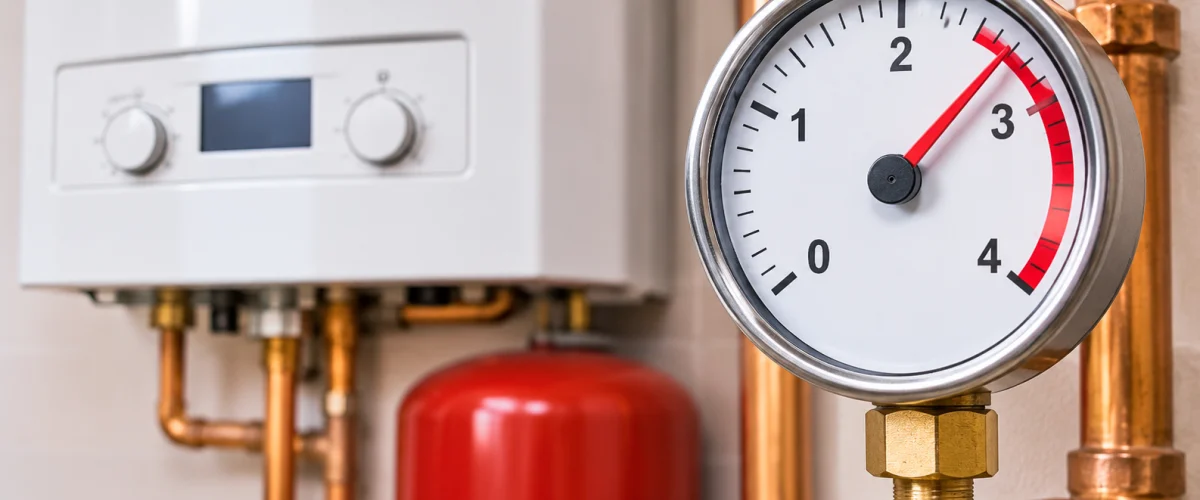
Please note: This is general information about closed-loop hot-water heating, not a diagnosis of your system. Your boiler’s own documentation comes first, and a heating professional should handle anything involving pressurised, hot or leaking equipment.
This guide is about closed-loop hot-water boilers: the kind that heat water and circulate it through baseboards, radiators or radiant floors. It isn’t about steam boilers, which behave very differently.
The short answer: a little more pressure while the heating is on is normal, because water expands as it warms. What deserves attention is a rise that goes further than your boiler’s documentation allows, pressure that climbs even when the system is cold, or any discharge from the relief valve. Those are patterns to record and report, not problems to fix with a wrench. This guide helps you recognise which pattern you have, understand what it can point to, and give a heating professional useful notes.
✏️ Our Take
IN THIS GUIDE
A closed heating system is full of water, and water takes up more room as it heats. An expansion tank gives that extra volume somewhere to go. Most residential tanks hold a cushion of air behind a flexible diaphragm, and the cushion compresses as the system warms. That is why a gauge normally reads higher after the boiler has been running than when it started cold.
How much higher is acceptable depends on your boiler, your tank and the way the system was designed, so this guide gives no target numbers. Your boiler’s manual and labels state the requirements for your equipment. Two points are worth keeping in mind. A rise you can’t match to those documents is worth noting. And the relief valve is a safety device, not a target: a reading creeping toward the point where it opens is a warning, not a normal operating range.
To compare like with like, note the cold reading before the boiler has fired, then the hot reading at the same point in a heating cycle.
Treat these as clues, not diagnoses. Several different faults can look alike, and only a professional can tell them apart.
| What you notice | What it could suggest | What to note |
|---|---|---|
| Pressure rises while the boiler heats, further than your documentation allows | The expansion tank may not be absorbing the extra water: it could be undersized, have lost its air charge or have failed. A cold starting pressure higher than the system calls for can also push the hot reading up. | The cold reading, the hot reading, and how long the rise takes. |
| Pressure climbs while the boiler is cold or off | Water may be entering rather than expanding: a filling valve passing water or, in some designs, domestic water getting in through a heat exchanger. The gauge itself can also be checked. | How fast it climbs, and whether it happens daily or only after work on the system. |
| Water comes out of the relief valve pipe | The valve may be doing its job because pressure is too high, which points back to the causes above. Or the valve itself may be faulty or fouled. | Whether it drips or flows, when it happens, and any wet floor or mineral trail. Look from a distance. |
These are possibilities a professional works through, not a checklist for you to act on. Knowing them makes the technician’s questions easier to follow.
If the tank’s air cushion has gone, the tank is too small for the system, or its diaphragm has failed, heated water has nowhere to go and pressure can climb until the relief valve opens. Weil-McLain’s boiler manual says an undersized expansion tank can cause system water to be lost through the relief valve and make-up water to be added through the fill valve. Amtrol says that if a relief valve drips after startup, its tank may be improperly charged or undersized.
Weil-McLain also tells installers to confirm that a weeping relief valve is the valve itself, and not over-pressure from a waterlogged or undersized tank, before replacing it. A tank’s air charge is set to match the boiler’s fill valve setting, and Amtrol says not to adjust it except during installation or regular inspection. Checking it means working on a pressurised system, so it isn’t a homeowner job. If a replacement is later recommended, our comparison of closed-loop expansion tanks explains tank size and acceptance volume.
Most boilers have an automatic filling valve that tops the system up to a set pressure and then stops. Caleffi describes its version as a pressure-reducing valve that holds a set pressure and refills as required. If a valve like that leaks past its seat, supply water can keep trickling in, because supply pressure is normally higher than the pressure in the heating loop. That can look like a slow rise even when the system is cold. Caleffi’s troubleshooting guide lists debris in the pressure-reducing valve that supplies make-up water among the causes of a relief valve that opens frequently. Some systems also have a manual fast-fill lever; leave it alone while you’re watching a rising gauge. On combination boilers, depending on the system, an open filling connection or a passing filling valve can be a possibility too.
This applies only where domestic and heating water are kept apart by a heat exchanger, such as an indirect water heater, a boiler with a tankless coil or a combination boiler. Domestic supply pressure is normally higher than the pressure in a heating loop, so an internal leak in that heat exchanger could potentially let higher-pressure domestic water into the heating circuit and raise its pressure. This is a diagnostic possibility for a heating professional to confirm or rule out, not something to test yourself.
Observe only from a safe, accessible position. If there is steam, spraying water or an active discharge, keep clear rather than approaching to read or photograph the gauge. Observations are facts you can report; the causes above are only possibilities.
Don’t touch the relief valve or its discharge pipe, add or drain water, use a fill lever or adjust the filling valve, or open or press the expansion tank’s air valve. Never cap or plug a relief valve discharge. If rooms are also staying cold, mention that too; our guide to cold baseboards when the boiler is running covers that side.
Get professional help
Call a heating professional for any relief valve discharge, pressure that rises while the system is cold, a reading beyond what your boiler’s documentation allows, pressure that keeps returning after it was corrected, or any leak.
Keep clear and seek urgent professional help for steam, spraying hot water or an active hot discharge. Don’t approach the boiler or its discharge pipe, and follow your boiler’s emergency instructions only where it is safe to do so.
Tell them: the cold and hot readings with times, how fast the pressure moves, recent work, any discharge you saw, and whether your system has an indirect tank, tankless coil or combination design.
Some rise is expected, because the expansion tank is there to absorb the extra volume as water heats. What matters is how far it goes against your boiler’s documentation, and whether it also rises when the system is cold. Note both readings, and ask a professional to check them against your system’s requirements if you’re unsure.
Not necessarily. The valve can fail, but makers also point to tank problems, and Weil-McLain says to rule out over-pressure from a waterlogged or undersized tank before replacing the valve. Amtrol says a licensed professional should inspect the relief valve at least every three years, or if discharge is present. Don’t plug it, cap it or operate it yourself; get it looked at.
No. Tanks for heating systems are made for closed hydronic loops; Amtrol’s heating tanks, for example, are marked for closed systems only and not for domestic water. Our guides to water heater expansion tanks and boiler expansion tanks keep the two apart.
Record the cold and hot readings, note when and how fast the pressure moves, and look for discharge from a distance, but only from a safe, accessible position. If there is steam, spraying water or an active discharge, keep clear rather than approaching to check anything. Then give a heating professional those notes before anyone replaces a part. Any of the possibilities above can look like the others from the gauge alone, so a diagnosis should come before a purchase.
✍️ About This Guide
PTR Editorial Team — Plumbing Guides. We compare manufacturer specifications, installation requirements, compatibility and available product documentation to help homeowners choose suitable tools and parts. How we review →
Boiler pressure keeps dropping? Learn how to compare cold readings, what patterns can point to, and what to report to a heating professional.
Radiant floor loop not heating? Learn what purging air involves, how to tell whether air is the cause, and when to call a heating professional.
Boiler running but baseboards still cold? Check thermostat settings, affected zones and common circulation problems—and know when to call a professional.

