Please note: This comparison is based on our research at time of writing and describes pumps by category. Models vary widely, so always check the specifications and features of the specific pump you’re considering — especially whether it includes an automatic float switch — before you buy or install it.
Introduction
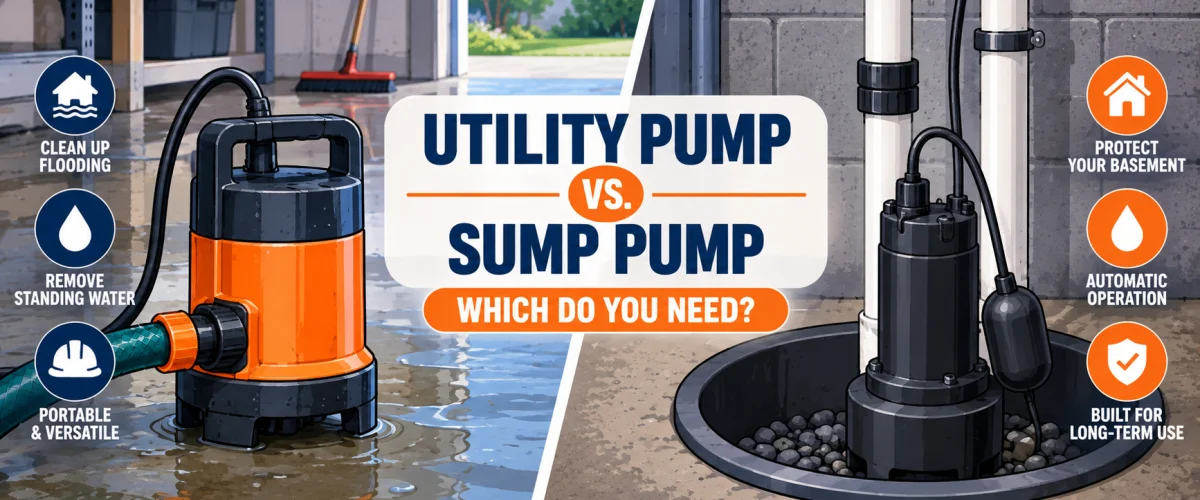
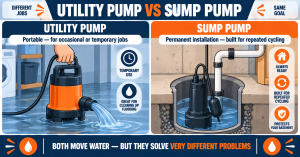
Utility pumps and sump pumps both move water, both are submersible, and both are commonly sold with a similar-looking hose connection and power cord — so it’s no surprise homeowners treat them as the same thing with different labels. They aren’t. They solve fundamentally different problems. A utility pump is a portable tool: you carry it to the water, drop it in, and use it for a job that has a beginning and an end. A sump pump is a permanent installation: it lives in a pit in your basement floor and manages groundwater continuously, whether or not anyone is home.
That difference — portable and occasional versus permanent and continuous — drives almost every other distinction between the two, from how they’re built to how they’re switched on. This comparison walks through those differences by category, not by brand, so you can decide which one fits your situation. If you’re ready to shop, our best utility pumps roundup covers portable options, and our best sump pumps roundup covers pumps for a permanent pit installation.
✏️ Our Take
The real distinction here isn’t brand or model — it’s duty and permanence. A utility pump is the tool you grab when water is somewhere it shouldn’t be right now. A sump pump is the system that keeps water from becoming a problem in the first place. Those are different jobs, and for most basements they aren’t competing choices: owning a good utility pump for the occasional emergency and eventually installing a sump pump for ongoing groundwater isn’t contradictory, it’s a reasonable way to cover both situations. What matters is matching the pump to the job, not deciding which one is “better.”
Quick Comparison Table
The table below maps the most common decision factors to whichever pump category wins on that point. The sections that follow explain the reasoning behind each row.
| Factor |
Winner |
| Installation type — permanent, fixed in a pit |
SUMP PUMP |
| Duty cycle — built for continuous, repeated use |
SUMP PUMP |
| Float switch — automatic operation as a core design feature |
SUMP PUMP |
| Typical use case — occasional, temporary water removal |
UTILITY PUMP |
| Construction for long-term wet environments |
SUMP PUMP |
| Portability — move it wherever the water is |
UTILITY PUMP |
| Cost — lower to buy and set up |
UTILITY PUMP |
| Best for a one-time flood cleanup or pool cover |
UTILITY PUMP |
How Each Pump Works
A Sump Pump: Permanent and Automatic
A sump pump sits in a basin — the sump pit — set into your basement floor, where groundwater collects. As the water in the pit rises, a float switch lifts with it and turns the pump on. The pump pushes the water out through a fixed discharge pipe and away from your foundation, then shuts off when the pit is clear. The whole cycle happens without anyone touching it, which is the point: a sump pump is designed to run whether you’re home, asleep, or on vacation.
A permanent installation also brings hardware a portable pump never needs — a rigid discharge line to carry water outside and, typically, a check valve on that line so water doesn’t drain back into the pit each time the pump stops. If you’re setting one up, our guide to installing a sump pump check valve covers that piece step by step.
A Utility Pump: Portable and Attended
A utility pump has no pit and no fixed plumbing. You carry it to wherever the water is — a flooded basement corner, a pool cover, a hot tub, a water heater you’re draining — connect a discharge hose, plug it in, and it runs until you unplug it. Most utility pumps are operated by hand this way, and for occasional jobs that’s a perfectly good arrangement: you start it when you need it and stop it when the water’s gone. Some models add an automatic float switch or water sensor, which is worth knowing about, but automatic operation is an option on a utility pump rather than the defining feature it is on a sump pump.
💡 Tip: A quick way to keep the two straight: a sump pump is part of your house, and a utility pump is a tool you own. If you’d store it in a closet between uses, it’s a utility pump. If it’s bolted into a pit and wired up, it’s a sump pump.
Key Differences
Duty Cycle
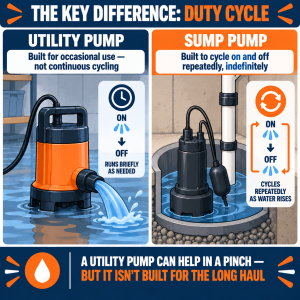
This is the difference that matters most. A sump pump in a basement with a high water table may switch on and off many times during a single storm, and it does that year after year. It’s built for that repeated cycling. A utility pump is designed for the opposite pattern: a few hours of work, a few times a year, with someone standing nearby. Asking a pump built for occasional use to cycle continuously through every wet season is asking it to do something it wasn’t designed for, and that’s where wear shows up.
Float Switch and Automation
A sump pump is built around its float switch, because the whole job depends on it — the pump has to turn on by itself when the pit fills. Sump pumps typically use either a vertical or a tethered float, and which one suits a given pit depends on how much room the float has to move. Utility pumps are more often manual: you decide when they run. That difference isn’t a flaw in either category. It reflects how each is used. But it matters a great deal for one reason — the flooding that does the most damage is usually the flooding nobody’s home to see.
⚠️ Warning: A manual pump only removes water while someone is there to run it. If it’s your only protection against a basement that takes on water repeatedly, water can rise while you’re at work or asleep. Recurring water calls for a system that responds on its own.
Horsepower vs. Flow Rate
The two categories are usually described with different specs. Sump pumps are typically sized by horsepower, which reflects how much motor is available to lift water out of the pit and up the discharge line, cycle after cycle. Utility pumps are usually sized by flow rate in gallons per hour, which describes how quickly they can clear standing water. Our utility pump roundup explains how to pick a flow rate for the job, and our sump pump roundup covers how much horsepower a pit typically needs. One caution on flow rates: they’re generally quoted under ideal, low-lift conditions, so real-world output drops as the water has to travel farther up and out.
Construction
Portable pumps are built to be lifted, carried, and stored, so lightweight, corrosion-resistant thermoplastic housings are common and make sense for the job. Pumps meant to sit submerged in a pit for years are more often built heavier — cast-iron housings and thermal overload protection are common on dedicated sump pumps, because a pump that runs constantly has to shed heat and survive constant wet conditions. Neither approach is better in the abstract. Each is right for the role it was designed for.
Can One Do the Job of the Other?
Partly, and it’s worth being precise about which part. Some utility pumps can function as a temporary or backup sump pump. Our sump pump roundup says so directly, using the Superior 91250 — which appears in both our utility pump and sump pump roundups — as its example of a portable submersible that can handle a sump-style job, and our utility pump roundup notes that pumps with an automatic sensor are useful in a sump pit. If your pit overflows, your primary pump fails, or you’re waiting for a permanent installation, dropping a portable pump into the pit is a legitimate and often smart move.
What a utility pump isn’t is a replacement for a dedicated sump pump in a pit that fills again and again. Our sump pump roundup notes that dedicated sump pumps are built for the repeated cycling a permanent pit demands, and our utility pump roundup reaches the same conclusion from the other direction: for recurring basement flooding, a permanently installed sump pump with an automatic float switch is a better long-term solution than relying on a portable pump. Those two statements don’t conflict. A utility pump can step in for a stretch. A sump pump is what you want handling the job season after season.
💡 Tip: If you use a second pump as a backup in the pit, confirm that the specific model has its own float switch or sensor. A backup only takes over automatically if it can tell when the water is rising. Check the features of the exact unit rather than assuming.
One limit applies to a backup of any kind: a second pump that runs on household power won’t help in a power outage, and storms that flood basements often knock the power out too. That’s a separate problem, and the answer is a battery backup rather than another plug-in pump. Our sump pump vs battery backup sump pump comparison covers that decision.
The reverse doesn’t really work. A sump pump is installed in a pit with a fixed discharge line, so it isn’t something you carry to a pool cover or a flooded room. It’s built for one location and one job, and that’s a strength for what it does rather than a limitation.
Cost Tiers
Utility pumps span a wide range, from an entry-level tier ($) up to a higher tier ($$$) for cordless or high-output models. Dedicated sump pumps generally start a step higher ($$) and reach the top tier ($$$$) for heavy-duty, cast-iron units. The overlap is real: some portable pumps sit in the same tier as some sump pumps, so purchase price alone won’t tell you which category you need.
The bigger cost difference is everything around the pump. A utility pump has almost no setup cost: you buy it, connect a hose, and plug it in. A sump pump comes with a pit, a discharge line, a check valve, and an electrical connection, and unless the pit already exists, installing it is a larger project. That’s a one-time cost, and for a basement with chronic water it buys years of automatic protection. For a basement with an occasional spill, it may be more system than you need.
Which Should You Choose?
Start with a simple question: is your water problem an event or a pattern? An event — a burst pipe, a one-time storm flood, a drained water heater, a pool cover full of rain — calls for a tool. A pattern — water that comes back every time it rains — calls for a system.
Choose a Utility Pump If:
- You need to clear water occasionally — a flooded room, a pool cover, a hot tub, or a water heater — and will be there to run it
- You want one portable tool that can be used around the house, garage, and yard
- You want emergency capability on hand without a permanent installation, particularly in areas prone to sudden flooding
- Your basement doesn’t take on water regularly
If this describes your situation, our best utility pumps roundup covers portable options across flow rates and power sources.
Choose a Sump Pump If:
- Your basement takes on water repeatedly, especially after rain or snowmelt
- You already have a sump pit, or you’re ready to install one
- You need protection that works automatically while you’re away or asleep
- You have a finished basement or stored belongings worth protecting from recurring water
If this describes your situation, our best sump pumps roundup covers pumps for a permanent pit installation. Many basements end up wanting both, and that’s a sensible outcome rather than a sign you chose wrong.
Prices and ratings may change. Always check Amazon for current prices.
Need a Professional Plumber?
A new sump pit means cutting into your basement floor and running a discharge line, which is a job worth handing to a professional if you’re not experienced with it. Find a licensed plumber in your area at PlumberArchive.com — the US plumber directory with 12,151+ verified local plumbers across all 50 states.
Find a trusted plumber near you → PlumberArchive.com
Frequently Asked Questions
Q: Can I use a utility pump as a sump pump?
For a stretch, yes. A utility pump can work as a temporary or backup sump pump, and that’s a legitimate way to use one while you wait for a permanent installation or when your primary pump needs help. It isn’t built for the repeated, automatic cycling a permanent pit requires, so it’s not the right long-term answer for a basement that takes on water regularly. See the section above on whether one pump can do the job of the other.
Q: Do I need both a utility pump and a sump pump?
Not necessarily, but many basements benefit from both. A sump pump handles ongoing groundwater automatically, and a utility pump covers the one-off jobs a fixed pump can’t: draining a water heater, clearing a pool cover, or dealing with a sudden flood somewhere other than the pit. If your basement stays dry, a utility pump alone is often enough. If it doesn’t, a sump pump comes first.
Q: How do I know if my basement needs a permanent sump pump?
The clearest sign is a pattern. If water shows up after most heavy rains or during snowmelt, or if you’ve had to run a portable pump more than once for the same reason, that’s a recurring problem, and recurring problems are what a permanent sump pump is for. A single flood from a one-time cause, like a burst pipe, doesn’t necessarily point to one. If you’re deciding between a pump and a passive drainage approach, our sump pump vs French drain comparison covers that separate question.
Q: Will either pump work during a power outage?
Corded models of either type stop when the power does. Some utility pumps run on rechargeable batteries, which lets them work without an outlet, though battery models trade run time for that freedom and aren’t meant for hours of continuous pumping. For a permanent sump system, the usual answer is a battery backup, which we cover in our sump pump vs battery backup sump pump comparison.
Conclusion
A utility pump and a sump pump both move water, but they’re built for different jobs. A utility pump is a portable tool for occasional, attended work. A sump pump is a permanent, automatic system for water that keeps coming back. The differences that follow from that — duty cycle, float switch, construction, and cost — all trace back to the same question: is this water an event or a pattern?
A portable pump can step in as a temporary or backup sump pump, and that’s worth knowing, but it isn’t a substitute for a dedicated sump pump in a pit that fills repeatedly. For most homeowners the sensible answer is matching each pump to its job, and for many basements that ends up meaning both.
To keep going, our best utility pumps roundup covers portable options, our best sump pumps roundup covers permanent installations, and our guide to installing a sump pump check valve covers a key piece of any permanent setup.
✍️ About This Comparison
Written by Sarah Mitchell, Home Improvement Editor at PlumbingToolsReview — specializing in helping homeowners make smart buying decisions without overspending. Learn how we test →