Reviews
23 Sep 2026

5 Best Natural Gas & Propane Leak Detectors (2026) — Expert Reviews
Compare 5 top natural gas & propane leak detectors for 2026 — plug-in alarms vs handheld sniffers, tested for accuracy, price and home safety.
5 best utility pumps for US homeowners in 2026 — from budget pool cover models to 4000 GPH submersible pumps with auto sensors. Expert reviews across all price ranges.
Please note: Product availability and information are based on our research at time of writing and are subject to change. Always check Amazon for the latest details before purchasing. some products on this page are part of the Amazon Creator Connections program. our recommendations are always based on genuine reseach and editorial judgement. Read our full disclosure →
A utility pump is one of those tools that earns its place in a garage or basement the moment you actually need it. Whether you are draining a flooded basement after a heavy storm, clearing water off a pool cover, emptying a hot tub, or transferring water between containers, nothing else does the job as fast or as easily. The problem is that most homeowners only think about buying one when the situation is already urgent — and that is not a good time to be researching options.
We reviewed five of the most popular utility pumps available in the US — covering a range of flow rates, power sources and price points from budget pool cover models to high-output submersible pumps with automatic water sensors. If you are also dealing with ongoing water intrusion, see our guide to the best sump pumps for a permanent basement solution, or check our roundup of the best water leak detectors to catch problems before they become flooding events.
🔧 OUR TAKE
Utility pumps are one of those tools most homeowners never think about until they need one urgently — a flooded basement or overflowing pool cover does not give you time to shop. The Superior Pump 91250 is the sensible choice to keep on hand. If you already own DeWalt 20V tools the cordless option is genuinely impressive for its versatility.
IN THIS GUIDE
| Product | Rating | Best For | Price |
|---|---|---|---|
| Superior Pump 91250 1/4 HP 1800 GPH BEST OVERALL | ★★★★★ | Best Overall | $$ |
| Pool Cover Pump 850 GPH 25ft Cord | ★★★★☆ | Best Value | $ |
| Limodot 4000 GPH Submersible Pump | ★★★★☆ | Our Top Pick | $$ |
| DeWalt 20V Cordless Water Transfer Pump | ★★★★★ | Staff Pick | $$ |
| Cleartide 1/3 HP 2790 GPH Auto Sensor Pump | ★★★★★ | Pro Choice | $$ |
🏆 Best Overall
The Superior Pump 91250 earns the top spot by covering the full range of common residential tasks at 1/4 HP and 1800 GPH: draining a flooded basement after a storm, clearing water off a pool cover, emptying a water feature, or transferring water between tanks and containers.
The thermoplastic housing is corrosion-resistant — important for a pump that will often be sitting in groundwater or pool runoff — and the 10-foot power cord gives you enough reach for most basement and pool installations without needing an extension. It runs on a standard 115V household outlet and is simple to set up: drop it in, connect the discharge hose, plug in, and it runs. There is no float switch, which means manual operation, but for most homeowners that is not a drawback — you start it when you need it and stop it when the job is done.
🛒 Check Price on Amazon — $$ →
💰 Best Value
If you need a utility pump primarily for pool covers, light basement water removal, or occasional water transfer tasks — and you want the most affordable option that still works reliably — this Pool Cover Pump is the clear pick.
The 25-foot power cord is the standout feature at this price point — it gives you far more reach than typical budget models, so you can drop the pump into a pool cover or basement without worrying about whether the cord will reach the outlet. The box includes a drainage hose and three adapters, so you can connect it to standard hose fittings without additional purchases. At 850 GPH the output is lower than the premium picks in this list, which limits it to lighter jobs — but for pool cover drainage and routine water transfer, 850 GPH is more than sufficient.
⭐ Our Top Pick High Flow
When speed matters — draining a flooded basement before water reaches your drywall, or clearing a large pool quickly — the Limodot 4000 GPH is the pump you want. At 4000 gallons per hour it has the highest flow rate in this selection, moving water more than twice as fast as the Superior Pump 91250 and nearly five times faster than the budget pool cover model. That translates directly into time saved in an emergency.
The 25-foot power cord gives you reach into deep basement areas and large pool installations, and the included hose kit means you do not need to source additional equipment before you can start. The portable, submersible design works in basements, crawl spaces, pools, ponds, and construction sites. With strong monthly buyer demand backing it up, this is a pump that real US homeowners are choosing for high-volume water removal tasks — and finding it delivers. If you want the highest throughput in this lineup, this is the pick.
🛒 Check Price on Amazon — $$ →
🎯 Staff Pick Cordless
Every other pump in this lineup runs on mains power — you need an outlet within cord reach. The DeWalt 20V Cordless Water Transfer Pump breaks that constraint entirely. Running on the DeWalt 20V MAX battery platform (sold separately, tool-only), it goes anywhere: a crawl space without a nearby outlet, a flooded yard, a construction site, a remote water tank. At 720 GPH it is not the highest-output option here, but cordless operation at that flow rate covers a very wide range of residential water transfer tasks.
The brushless motor is a meaningful detail — brushless motors run more efficiently, generate less heat, and last significantly longer than brushed alternatives, which matters in a pump that may see hard use in emergency conditions. If you are already in the DeWalt 20V ecosystem — which covers an enormous range of power tools — this pump slots in without requiring a new battery investment. It is a genuinely versatile tool that justifies its place in a well-equipped home toolkit.
🛒 Check Price on Amazon — $$ →
👷 Pro Choice Auto Sensor
Every other pump in this lineup requires you to be present to start it — you plug in, run the pump, and switch it off when done. The Cleartide 1/3 HP changes that dynamic with an automatic water sensor that activates the pump when water is detected and shuts it off when the area is clear. For pool maintenance, hot tub draining, or basement water management where you cannot always be watching — this is a meaningful quality-of-life upgrade that justifies the step up in price.
At 2790 GPH it delivers strong throughput, only surpassed in this lineup by the Limodot 4000 GPH model. The 1/3 HP motor is more powerful than the Superior Pump’s 1/4 HP, which translates to better sustained performance at depth and across longer discharge runs. The Cleartide is suitable for pools, basements, and hot tubs — three of the most common residential utility pump applications — and its growing popularity with homeowners reflects how well it covers those use cases.
🛒 Check Price on Amazon — $$ →
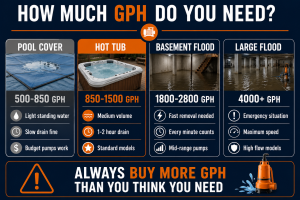
GPH stands for gallons per hour and is the primary performance metric for any utility pump. The higher the GPH, the faster the pump removes water. As a rough guideline: under 1000 GPH suits pool covers and light water transfer tasks; 1000–2000 GPH handles most basement flooding and residential pool draining comfortably; 2000 GPH and above is appropriate for serious basement flooding, large pools, and situations where speed matters. If you are in a flood-prone area, always size up — a pump rated for 2000 GPH or above gives you meaningful headroom in an emergency.
All five pumps in this review are submersible — meaning the pump body sits directly in the water being removed. This is the most practical design for residential use: you place the pump at the lowest point of the flooded area, connect the discharge hose, and water is pushed out. Non-submersible utility pumps (also called transfer pumps) sit outside the water and draw it in via a suction hose. These are better for above-ground water transfer where you do not want to get the motor wet, but for flooded basements and pool draining, submersible models are the standard choice.
Corded pumps offer unlimited run time — they run for as long as power is available, with no battery depletion to manage. This makes them the better choice for extended water removal jobs, draining large bodies of water, and situations where you need hours of continuous operation. Cordless pumps like the DeWalt 20V option in this list trade run time for mobility — they go anywhere without needing an outlet, which is a genuine advantage in crawl spaces, outdoor areas, and locations where extension cords are impractical. If you own a compatible cordless tool platform (particularly DeWalt 20V), the cordless utility pump is a highly versatile addition. For heavy-duty or extended use, corded is still the more practical choice.
A manual pump requires you to start and stop it yourself — you plug it in when there is water to remove and unplug it when done. This is how the Superior Pump 91250 and most basic utility pumps work, and for the majority of homeowners it is perfectly adequate. An automatic pump with a float switch or water sensor — like the Cleartide in this list — activates when water reaches a set level and shuts off when the area is dry. This is valuable in situations where you cannot be present to monitor the pump: a basement that collects water during rainstorms, a pool overflow area, or a sump pit. If you want set-and-forget operation, the auto sensor is worth the additional cost. For occasional use where you will always be present, a manual pump is simpler and cheaper. If you need permanent automated water management in a basement, see our guide to the best sump pumps — these are designed specifically for permanent installation with float-switch automation.
US Regional Context: In flood-prone states like Louisiana, Florida, and Mississippi where basement and crawl space flooding is common during hurricane season, a utility pump rated at 2000 GPH or above is strongly recommended. The speed advantage of a higher-output pump can make a meaningful difference in limiting water damage when flooding occurs quickly. In drier Western states a smaller 850–1000 GPH model handles most pool draining and water transfer tasks comfortably — the higher output models are useful but less critical. Wherever you live, pairing a utility pump with quality water leak detectors gives you early warning before minor leaks become major flooding events.
Sometimes a flooding or drainage issue goes beyond what a utility pump can solve — cracked foundations, burst pipes, or persistent groundwater intrusion need professional assessment. If water intrusion is a recurring problem in your home, it may pay to understand how to fix a leaking pipe before it worsens. For a licensed plumber in your area, search PlumberArchive.com — the US plumber directory with 12,151+ verified plumbers across all 50 states.
Get weekly plumbing tips, honest tool reviews, and DIY guides delivered to your Facebook feed.
For a flooded basement, a utility pump rated at 1800 GPH or higher is recommended for most residential situations. The Superior Pump 91250 at 1800 GPH and the Limodot at 4000 GPH both cover this use case well. The key variable is how fast water is entering — if your basement floods quickly during heavy rain, a higher GPH rating means you can stay ahead of the incoming water rather than just keeping pace with it. If you have recurring basement flooding rather than the occasional event, a permanently installed sump pump with an automatic float switch is a better long-term solution than relying on a portable utility pump.
Yes — utility pumps are widely used for draining and partially draining swimming pools, particularly during closing season or when topping up after heavy rain. For an above-ground or inground pool, look for a submersible utility pump with at least 1800 GPH output and a discharge hose connection that matches your garden hose fittings (or use an adapter). The Limodot 4000 GPH is the fastest option in this lineup for pool draining. Never drain a pool completely all at once without checking local regulations, as some municipalities restrict pool water discharge to storm drains.
GPH stands for gallons per hour — it measures how much water the pump can move in one hour at its rated performance. A higher GPH means faster water removal. For light tasks like pool cover drainage or small water transfers, 850–1000 GPH is sufficient. For basement flooding and larger pool draining, 1800–2000 GPH gives you comfortable performance. For large-scale or emergency water removal where speed is critical, 2790–4000 GPH gets the job done significantly faster. When in doubt, choose a higher GPH rating than you think you need — you can always throttle a pump by restricting the hose, but you cannot make a low-rated pump move water faster than its design allows.
It depends on the pump and the type of debris. Most standard utility pumps — including all five models in this review — are designed for relatively clean water or water with fine particulates such as sand or silt. They are not designed for water with leaves, gravel, mud, or solid debris, which can clog or damage the impeller. If you need to remove dirty water with significant solid content — after a mudslide, major construction flooding, or similar situations — look for a pump specifically rated as a “trash pump” or “solids-handling pump,” which are built with wider impeller passages designed to pass small solids without jamming.
For most US homeowners, the Superior Pump 91250 is the right answer. At 1800 GPH it handles the full range of common residential tasks — basement flooding, pool draining, water transfer — with a corrosion-resistant thermoplastic housing built for repeated seasonal use. It is simple, reliable, and priced in the $$ range that makes it easy to keep on the shelf before you ever need it.
Once you have a utility pump sorted, a quality set of water leak detectors gives you early warning of the problems that lead to flooding in the first place — and knowing how to fix a leaking pipe means you can address minor leaks before they become emergencies. For homeowners with chronic basement water issues, a permanently installed sump pump is the long-term solution that works even when you are not there to run it.
✍️ About This Review
Reviewed by James Carter, Senior Tool Reviewer at PlumbingToolsReview — 15 years of hands-on experience in residential plumbing and tool testing. Learn how we test →
Compare 5 top natural gas & propane leak detectors for 2026 — plug-in alarms vs handheld sniffers, tested for accuracy, price and home safety.
5 septic tank riser kits compared for 2026 — Tuf-Tite and Polylok risers by diameter and height, so you can bring tank access to grade level.
The 5 best sewage and effluent ejector pumps for 2026, expert-reviewed: grinder, standard solids-handling and light-duty effluent pumps compared.

