Please note: Information in this comparison is based on standards-body, government, university-extension and industry-association pages we read on 2 November 2026 and is subject to change. It is general information, not a diagnosis of your water. For your own situation, use a water test (and your utility’s annual water quality report if you have one), and ask a water treatment professional about whole-home systems.
Introduction
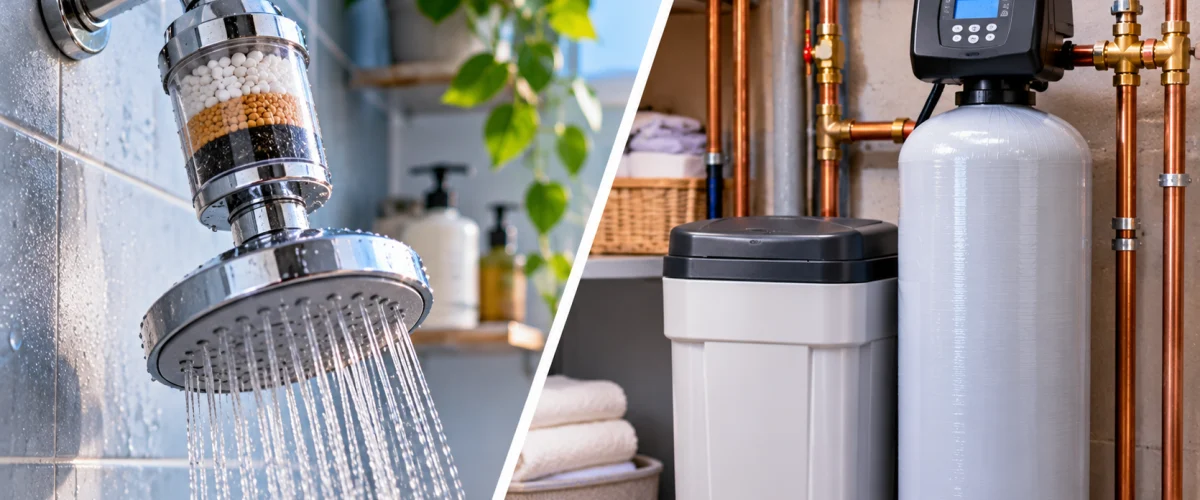
The practical distinction: conventional ion-exchange softening reduces hardness, while shower filtration targets particular substances according to the product’s documented performance. They are not two versions of the same treatment. Do not assume an ordinary shower filter removes the dissolved calcium and magnesium that make water hard.
Certification is a separate matter. A certification supports a claim, for example that a product was verified to reduce free available chlorine; it is not the treatment mechanism and it does not widen what the product does. This comparison covers how each approach works, what a certification can and cannot tell you, and how to test your water before deciding. For products, see our reviews of shower head filters and water softeners. We have not tested any filter or softener; what follows is what the standards bodies, agencies, universities and industry associations say.
✏️ Our Take
Work out the problem first. Hardness points to ion-exchange softening; a chlorine smell points to a product documented for the chlorine you actually have. Whether any treatment is worth it depends on what your water test shows and what you notice, not on a hardness label alone.
Softening vs Shower Filtration
Hardness is water carrying high amounts of dissolved calcium and magnesium (Nebraska Extension). Penn State Extension describes how a softener deals with it: its resin “releases its sodium ions and readily trades them for the calcium and magnesium ions.” Nebraska Extension says ion exchange softening units “can effectively reduce water hardness.” That is the mechanism the softening standard, NSF/ANSI 44, covers: a cation exchange resin regenerated with sodium or potassium chloride.
A shower filter is a different thing. NSF describes shower filters as attaching directly to the pipe just in front of the showerhead and, under NSF/ANSI 177, as “certified to only reduce free available chlorine.” Do not assume a shower filter reduces hardness. Check for model-specific evidence of calcium and magnesium reduction; certification to NSF/ANSI 177 alone does not establish that.
| |
Ion-exchange softener |
Shower filter |
| What it targets |
Hardness: dissolved calcium and magnesium |
Particular substances, according to the product’s documented performance |
| How it works |
Resin trades sodium (or potassium) ions for calcium and magnesium ions; the resin is regenerated with salt |
Varies by product; the maker’s documentation says what the media are meant to do |
| Dissolved calcium and magnesium |
Reduced (the function the softening standard covers) |
Do not assume it is reduced; check for model-specific evidence of calcium and magnesium reduction |
| Free chlorine |
Not what NSF/ANSI 44 certifies; NSF assigns chlorine reduction to NSF/ANSI 42 and 177 |
The NSF/ANSI 177 function, for a product certified to it |
| Chloramine |
WQA says chloramines are difficult to remove by ion exchange resins, among other methods |
Only if the product’s documentation names it; a free-chlorine certification does not by itself cover it. WQA describes activated carbon as the most effective nonchemical method and says performance varies and should be verified. |
| Combination systems |
A product that combines stages can be documented for more than one function. What it does is whatever its own certifications and documentation show, checked function by function. |
What a Certification Does and Does Not Tell You
It supports a claim, not a mechanism. NSF says no federal regulations exist for residential water treatment filters and that the standards are voluntary. A certification shows that a specific claim was verified for a specific product. It does not describe how the product works, and NSF cautions that certification “does not mean that a filter, purifier or treatment system will reduce all possible contaminants.”
“NSF certified” and “certified to an NSF/ANSI standard” are not always the same statement. The first names the certifier; the second names the standard. A product can be certified to an NSF/ANSI standard by NSF or by another accredited certifier. WQA, for example, says its Gold Seal program tests and certifies drinking water treatment units to NSF/ANSI standards and that it is accredited by ANSI and SCC. So when you check a claim, look for the standard and the specific claim in the certifier’s own listing, whichever certifier it is.
Where to check. NSF publishes a list of certified shower filters, and WQA publishes a product finder. A retail listing that does not mention a certification does not show that a product is uncertified, because the listing may simply leave it out, so look in the certifier’s directory and the maker’s own documentation before you conclude either way.
A Testing Path Before You Buy
Step 1: find out what is in your supply. The path depends on where your water comes from.
- Public water system. CDC says utilities add chlorine or chloramine, that water containing chlorine can taste and smell different from water containing chloramine, and that you can find your utility’s disinfectant in its annual water quality report.
- Private well. There is no utility report. EPA says private well owners are responsible for delivering safe drinking water to their households, and that its quality is not regulated by the federal government under the Safe Drinking Water Act. CDC says government officials do not regulate, treat or monitor tap water from private wells, and recommends testing at least once a year for total coliform bacteria, nitrates, total dissolved solids and pH, using a state-certified laboratory. Ask the laboratory whether hardness can be added to the tests. If your well has a treatment system that adds or removes anything, its installer’s or maker’s documentation tells you what it does.
Step 2: test for hardness. Our guide to testing your water for hardness and our review of water test kits cover how. USGS classes hardness, as calcium carbonate, as soft at 0 to 60 mg/L, moderately hard at 61 to 120, hard at 121 to 180 and very hard above 180. Penn State Extension notes that a grain per gallon equals approximately 17 mg/L.
Step 3: decide what, if anything, to treat. A hardness classification describes your water; it does not by itself mean you need treatment. Whether treatment is worthwhile depends on your measured hardness, the practical problems you notice (such as scale or soap residue) and your household’s needs. Nebraska Extension describes hard water as mainly a nuisance for cleaning and plumbing. The paths below are conditional:
- If your test shows high hardness and you are seeing scale or soap residue, the documented route is ion-exchange softening, so look for a softener documented or certified for hardness reduction (the standard is NSF/ANSI 44). A shower filter certified to NSF/ANSI 177 is certified only for free chlorine.
- If your concern is a chlorine smell and your report or treatment documentation points to free chlorine, look for a product certified or documented for free chlorine reduction (shower filter: NSF/ANSI 177; point-of-use or whole-house: NSF/ANSI 42).
- If the disinfectant is chloramine, look for documentation that names chloramine rather than assuming a free-chlorine certification covers it.
- If you have both a hardness and a chlorine or chloramine concern, treat them as two functions. They can be met by separate products, or by one system documented for both. How whole-home units are sized and arranged is for the installer and the system’s documentation; see our review of whole-house water filters for that option.
- If your results are mild and nothing bothers you, these checks do not indicate a need for either product. Whether to treat anything further depends on your own concerns and any further testing.
Frequently Asked Questions
Q: Can a shower filter soften water?
Do not assume a shower filter reduces hardness. Hardness is dissolved calcium and magnesium, and the sources that describe how hardness is reduced describe ion exchange. A shower filter certified under NSF/ANSI 177 is certified only for free available chlorine, so check for model-specific evidence of calcium and magnesium reduction.
Q: Does a softener remove chlorine?
NSF/ANSI 44 is a hardness standard, and NSF assigns chlorine reduction to NSF/ANSI 42 and 177. A softener certified only under 44 is not, on that basis, certified for chlorine. A particular softener’s documentation might claim more, and reading it is how you find out.
Q: Do I need a softener, a shower filter, or both?
It depends on what your checks show and what you notice. A hardness test and, for a public system, your utility’s report tell you which functions are relevant. A hardness classification alone does not establish that treatment is needed, and if neither concern applies you may need neither. If both do, you need two functions, which can come from separate products or from one system documented for both.
Conclusion
Ion-exchange softening reduces hardness. Shower filtration targets particular substances according to a product’s documented performance, and a filter certified under NSF/ANSI 177 is certified only for free available chlorine. Certification supports a claim for a specific product; it is not the treatment mechanism, and you check it in the certifier’s own listing. Test first, treat only what the results and your own experience justify, and check each product against the function you need.
When you are ready to compare products, see our reviews of shower head filters and water softeners. If a salt-free approach interests you, our comparison of the water softener and the water conditioner explains the difference.
Sources
Pages read on 2 November 2026. We did not purchase the full standards; the statements above rely on these public pages.
- NSF, “NSF Standards for Water Treatment Systems” — what NSF/ANSI 42, 44 and 177 cover; voluntary standards; certification does not mean all contaminants are reduced.
- NSF, NSF/ANSI 177 page and NSF/ANSI 44 technical requirements — the scope of each standard.
- WQA, “WQA certifies to NSF/ANSI standards” — certification to NSF/ANSI standards by another accredited certifier.
- Penn State Extension, “Water Softening” (updated 8 September 2025) — how ion exchange softening works; grain-per-gallon conversion.
- Nebraska Extension, “Drinking Water: Hard Water” (G1274, revised 2016) — hardness, ion exchange, and hard water as a nuisance.
- USGS, “Quality of Ground Water” — the hardness classes.
- CDC, “About Water Disinfection with Chlorine and Chloramine” — disinfectants and the annual water quality report.
- EPA, “Private Drinking Water Wells” and CDC, “Guidelines for Testing Well Water” — private well owner responsibility and testing.
- WQA, chloramine fact sheet — activated carbon and chloramine; ion exchange resins; that device performance varies.
✍️ About This Comparison
PTR Editorial Team — Product Comparisons. We compare manufacturer specifications, installation requirements, compatibility and available product documentation to help homeowners choose suitable tools and parts. How we review →