
Guides
19 Oct 2026

Can’t Reach the Faucet Nut? Choose the Right Tool Before You Buy
Not sure which tool fits your faucet nut? Identify the fixing, see how it lets go and check your clearance first. Then choose a tool, or use one you own.
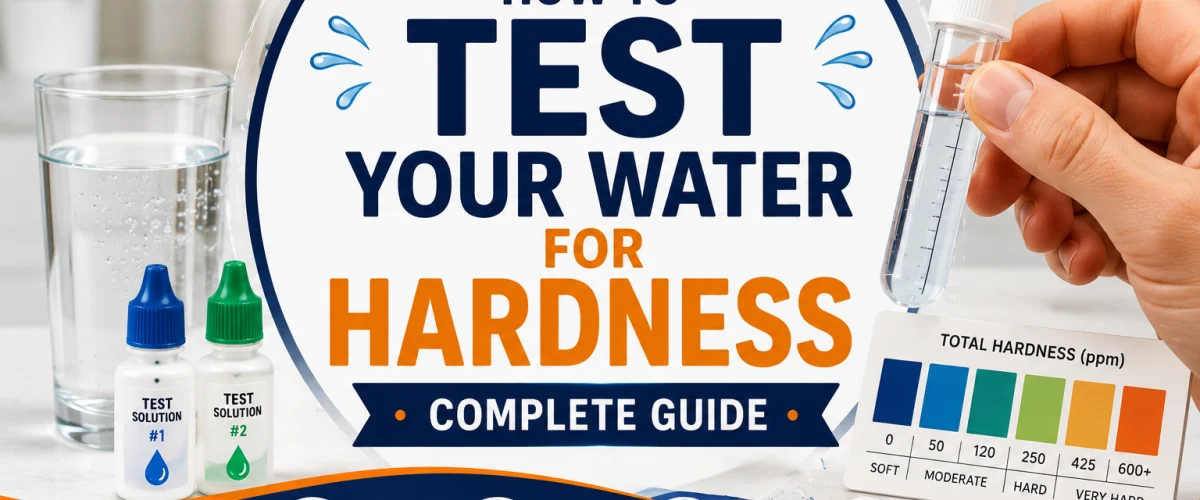
How to test your water for hardness at home — test strips, titration kits, municipal reports & pro tests compared, plus how to read your GPG results.
Please note: Information in this guide is subject to change. If you have concerns about bacteria, lead, or other contaminants beyond hardness, consult a certified water testing lab or your local health department.
Confirming your actual water hardness before buying a softener or conditioner is a five-minute step that prevents an expensive mismatch between the problem you have and the system you end up buying. Chalky buildup around your faucets or dull-feeling laundry is a reasonable signal something’s off, but it doesn’t tell you how hard your water actually is — and that number is what determines whether you need a full-scale softening system, a lighter conditioner, or nothing at all.
This guide covers the fastest home testing methods, from a one-minute test strip to your municipal utility’s free water quality report, plus exactly how to read your results once you have them. If you’ve already confirmed hard water and are comparing technologies, our Water Softener Salt vs Salt-Free Water Softener comparison and 5 Best Water Softeners for Whole House review cover the next steps.
At a Glance
| Difficulty | Easy |
| Time | 5–15 Minutes (test strip method); allow 1-2 weeks if requesting a municipal water report |
| Cost | $ — a test strip kit, or free if using a municipal water quality report |
| Tools Needed | Water hardness test strips or a liquid titration test kit, a clean glass or cup, your municipal water utility’s contact info (optional) |
| Skill Level | Beginner |
✏️ Our Take
Before spending money on a water softener or conditioner, spend five minutes confirming you actually have hard water — and roughly how hard. A simple test strip won’t just tell you yes or no, it’ll tell you where you fall on the hardness scale, which directly affects what kind of system you actually need. Skipping this step is how homeowners end up buying an oversized (and overpriced) system for mildly hard water, or an undersized one that can’t keep up with severely hard water. The test takes less time than reading this guide.
IN THIS GUIDE
A handful of everyday clues usually show up well before anyone thinks to actually test the water. White, chalky mineral buildup — often called scale — tends to accumulate around faucet aerators and showerheads, and inside kettles or coffee makers, where mineral-rich water evaporates and leaves dissolved calcium and magnesium behind. Soap and shampoo that won’t lather well, or that leaves a filmy residue on skin and hair even after rinsing, is another common sign, since dissolved minerals react with soap and interfere with a normal lather.
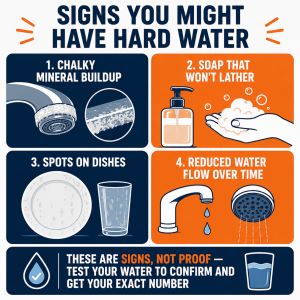
Spots or a cloudy film on dishes and glassware after washing, even straight out of the dishwasher, points the same direction. So does a gradual drop in water flow or pressure over time, as scale slowly narrows the inside diameter of pipes and fixtures. Laundry that feels stiff or scratchy straight out of the dryer, or colors that look duller over time, is another common complaint tied to dissolved minerals interfering with detergent and fabric softener.
None of these signs alone is conclusive — a low water heater temperature setting can also cause dull-feeling laundry, for example, and old pipes can restrict flow even with soft water. Seeing several of these signs together is a strong hint it’s worth testing, but a real number is what actually confirms it rather than a collection of educated guesses.
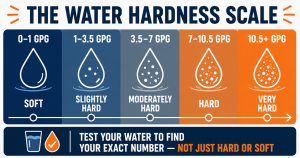
Water hardness in the US is measured in grains per gallon (GPG), based on the concentration of dissolved calcium and magnesium in your water. The general scale runs from 0 to 1 GPG for soft water, 1 to 3.5 GPG for slightly hard water, 3.5 to 7 GPG for moderately hard water, 7 to 10.5 GPG for hard water, and anything above 10.5 GPG is considered very hard.
Knowing your specific number, rather than just a general “hard” or “soft” label, is what actually determines the right system size and type if you decide you need one. A household testing at 4 GPG and one testing at 18 GPG both technically have “hard water,” but they’re facing very different problems that call for very different solutions.
Test strips are the fastest and cheapest testing method available, typically delivering a result in under a minute. Dip the strip into a sample of your tap water, wait the specified time on the packaging — usually 15 to 30 seconds — and compare the color change against the included reference chart to get your reading.
Strips are best used for a quick general reading rather than a precise number, since the color-comparison method leaves some room for interpretation between shades on the chart. For most homeowners deciding whether they have a hardness problem worth addressing, that general reading is more than sufficient.
A liquid titration test kit is more precise than test strips. A liquid reagent is added drop by drop to a water sample until the sample undergoes a color change, typically shifting from red to blue or a similar contrast that’s easy to spot. Each drop generally represents one grain per gallon, so you count the drops needed to reach the color change to get your reading.
This method takes a few minutes longer than a test strip, but the drop-counting approach gives a more accurate, specific number rather than a general color-band estimate — worth the extra few minutes if you want a more reliable figure before deciding on a system.
US water utilities are required to publish an annual water quality report, often called a Consumer Confidence Report, that typically includes a hardness measurement along with other water quality data. If you’re on municipal water, this report may already have your answer without any testing at all. Search your utility’s name plus “water quality report” or “consumer confidence report” online, or call their customer service line directly and ask for the hardness figure.
Water hardness varies dramatically by US region — the Southwest, parts of Texas, and the Upper Midwest tend to have the hardest water in the country, often testing above 10-15 grains per gallon, while the Pacific Northwest and parts of the Northeast generally have naturally soft water. If you’re on a private well, hardness can vary significantly even between neighboring properties depending on the local aquifer, which is exactly why testing your own water matters more than assuming based on your general region. Municipal water customers can often skip physical testing altogether by requesting their utility’s annual water quality report, which typically includes a hardness measurement already.
A certified lab test provides the most accurate and comprehensive results of any method here, covering hardness alongside other potential contaminants like iron, pH imbalance, or bacteria in a single sample. It’s a genuinely more thorough option than any DIY kit, though it comes at a higher cost and typically takes longer to get results back.
A professional test is worth the extra cost primarily for private well users, or for anyone also investigating other water quality concerns beyond hardness alone. Municipal water customers focused purely on hardness will usually get everything they need from a test strip, titration kit, or their utility’s own report — reserve the lab test for situations where hardness is one of several open questions, not the only one.
Turnaround time also matters when choosing between methods. A test strip or titration kit gives you an answer in minutes, a municipal water report can take one to two weeks to arrive after a request, and a lab test typically falls somewhere in between depending on how busy the lab is and whether you mail in a sample or have someone collect it on-site.
Once you have a number, here’s how to interpret it. At 0 to 1 GPG, your water is soft and no softening treatment is needed. At 1 to 3.5 GPG, your water is slightly hard — most households won’t notice significant effects, and softening is optional rather than necessary. At 3.5 to 7 GPG, your water is moderately hard, and scale buildup and reduced soap lathering typically become noticeable enough that a softening system is often worthwhile. At 7 to 10.5 GPG and above, your water is hard to very hard, and a dedicated water softening or conditioning system is strongly recommended to prevent appliance and pipe damage over time.
If you’re weighing true softening against a sodium-free alternative once you know your number, our Water Softener vs Water Conditioner comparison breaks down which approach fits which situation.
For soft to slightly hard water, no action is typically needed beyond your normal maintenance routine. For moderately hard water, it’s worth considering a softening or conditioning system based on your specific concerns — whether you want true softening or a sodium-free approach to scale prevention is a separate decision from whether you need a system at all. For hard to very hard water, a dedicated system is a genuinely worthwhile investment given the appliance protection and general water quality benefits at that level.
If you land in the “worth considering” or “recommended” range, our Water Softener Salt vs Salt-Free Water Softener comparison is the natural next stop for choosing between the two main technology types.
If you’re on a private well and want a full water quality assessment, or you’re ready to have a softening system professionally installed, search PlumberArchive.com — the US plumber directory with 12,000+ verified local plumbers across all 50 states.
Get weekly plumbing tips and DIY guides delivered straight to your Facebook feed.
Once a year is a reasonable baseline for most households, or any time you notice new signs of hardness like fresh scale buildup or a change in how soap lathers. Private well owners should test more consistently, since well water hardness can shift with seasonal changes in the local water table. If you already have a softening system installed, periodic retesting also confirms it’s still performing correctly.
Not always, but it’s common. Well water draws directly from underground aquifers, which often have higher mineral content than treated municipal supplies, though this varies enormously by location and even between neighboring wells drawing from different depths or aquifer sections. Testing your specific well is the only reliable way to know, since regional generalizations are far less accurate for private wells than for municipal systems.
Yes, if you’re on municipal water. Requesting your utility’s annual water quality report (Consumer Confidence Report) is free and typically includes a hardness measurement already, meaning you may not need to buy anything at all. Private well owners don’t have this option and will need a test strip, titration kit, or professional lab test instead.
Water testing above 3.5 grains per gallon is generally considered hard enough that a softening system starts to make practical sense, with water above 7 GPG considered hard and above 10.5 GPG considered very hard. Water below 3.5 GPG is classified as soft to slightly hard, and most households at that level won’t see meaningful benefits from a softening system.
Testing your water takes minutes and prevents an expensive mismatch between your actual problem and whatever system you end up buying. Whether you reach for a test strip, a titration kit, or simply request your utility’s water quality report, the goal is the same: a real number instead of a guess based on chalky faucets or dull-feeling laundry.
Municipal water customers should check their utility’s water quality report first, since it’s free and often already available without any testing on your end. Private well owners will get more value from a physical test strip, titration kit, or a professional lab test, especially if other water quality concerns are also on your mind.
Your specific GPG number, not just a general “hard” or “soft” label, is what determines the right next step. Once you know where you stand, our Water Softener Salt vs Salt-Free Water Softener comparison and 5 Best Water Softeners for Whole House review cover choosing and buying a system, while our Water Softener vs Water Conditioner comparison helps you decide between true softening and a sodium-free alternative.
✍️ About This Guide
PTR Editorial Team — Plumbing Guides. We compare manufacturer specifications, installation requirements, compatibility and available product documentation to help homeowners choose suitable tools and parts. How we review →
Not sure which tool fits your faucet nut? Identify the fixing, see how it lets go and check your clearance first. Then choose a tool, or use one you own.
Check your manual and the drain route first: gravity hose, built-in pump or external pump. Then see whether you need a dehumidifier hose at all.
Explore portable bidets that need no water-line connection, from bottle caps and squeeze bottles to battery-powered handhelds.

