Please note: Cost estimates and regulatory details are based on our research at time of writing and are subject to regional variation. Always test your water hardness and check local ordinances before purchasing either system.
Introduction
Once a homeowner decides they want a genuine water softening solution — not just a scale-prevention conditioner — the next decision is which underlying technology to choose. Salt-based ion exchange and salt-free descaling systems are both marketed as “water softeners,” but the difference between what they actually do to your water is more significant than most buying guides make clear, and it’s a distinction that shapes everything from monthly maintenance to whether the system is even legal in your area.
This comparison covers the practical, cost, and regulatory differences for a US homeowner deciding in 2026. If you’re still unsure whether you need true softening at all versus a non-softening conditioner, our water softener vs water conditioner guide covers that category-level decision first. Once you’ve settled on genuine softening, our roundup of the best water softeners covers our complete lineup of salt-based systems for every household size.
✏️ Our Take
A salt-based water softener actually removes hardness minerals from your water through ion exchange — it genuinely softens water, producing the slippery feel people associate with soft water, but it requires regular salt refills and uses water during its regeneration cycle. A salt-free system doesn’t remove hardness minerals at all — it conditions them so they can’t form scale buildup in pipes and appliances, which protects your plumbing without adding sodium to your water or requiring ongoing salt purchases. The distinction matters more than most buying guides make clear: if you want water that actually feels soft, salt-based is the only option that delivers that. If your main concern is protecting pipes and appliances from scale without adding sodium, salt-free accomplishes that goal without true softening.
How Salt-Based Softeners Work
A salt-based softener uses an ion exchange process. Hard water passes through a resin bed of tiny beads that swap calcium and magnesium ions — the minerals responsible for hardness — for sodium ions. The water that comes out the other side has those hardness minerals physically removed and replaced with a small amount of sodium.
The resin bed can only hold so many exchanged minerals before it needs to be flushed clean. It does this through a periodic regeneration cycle, using a brine solution made from salt — or, as an alternative, potassium chloride pellets. This regeneration is what recharges the resin so it can keep exchanging ions. The end result of a properly functioning salt-based system is genuinely soft water: the classic slippery feel on skin and in water, reduced soap scum, and noticeably easier lathering, all direct results of the removed hardness minerals.
💡 Tip: Potassium chloride pellets can be used instead of sodium-based salt in most salt-based systems, which is worth considering for households on sodium-restricted diets — though potassium pellets typically cost more.
How Salt-Free Systems Work
A salt-free system uses template-assisted crystallization (TAC) or similar media technology to convert hardness minerals into microscopic crystals that no longer bond to surfaces. Nothing is removed from the water — the calcium and magnesium stay exactly where they were — but their structure changes so they can’t form scale buildup in pipes, water heaters, and appliances the way they would otherwise.
Because there’s no ion exchange happening, there’s also no regeneration cycle to run. That means no salt to buy, no brine to flush, and no wastewater discharge at all. The media inside the tank does its job passively as water flows through, with no moving parts, no electrical connection, and no drain requirement.
💡 Tip: Because salt-free systems don’t remove minerals, water tested afterward will still show the same hardness reading as before — this confuses some buyers who expect a lower number, but the point of the system is scale prevention, not measurably reducing hardness.
Does It Actually Soften Water? The Real Difference
This is the single most misunderstood difference between the two categories, and it’s often the deciding factor once buyers understand it clearly. A salt-based system genuinely softens water — yes, in the fullest sense of the word. You get the characteristic slippery feel on skin, reduced soap scum on fixtures and glassware, and noticeably better lathering with soap and shampoo, because the minerals responsible for those effects have actually been removed.
A salt-free system does not soften water in that sense — no matter how effective it is at preventing scale, the water itself is not actually softened. It remains at the same hardness level it started at; only its scale-forming potential has been neutralized. A hardness test performed after installation will read no differently than before, which is expected and by design, not a sign the system is malfunctioning.
⚠️ Warning: If your primary goal is soft-feeling skin and hair, less soap and detergent use, or eliminating hard water spots on dishes and glassware, a salt-free system will not deliver those results — only a true salt-based softener removes the minerals responsible for those effects.
Maintenance and Ongoing Costs
A salt-based softener requires regular salt refills, typically monthly depending on household size and water hardness, plus periodic attention to the resin bed and eventual resin replacement after several years of use. This is a genuine recurring chore — someone in the household needs to keep the brine tank stocked (see our guide to the best water softener salt for what to buy), or the system will stop regenerating properly and hardness minerals will start passing through untreated.
A salt-free system carries far less ongoing maintenance. There’s no salt to buy or haul, and the only recurring task is an occasional cartridge or media replacement, typically measured in years rather than weeks. For households that want a water treatment system they can largely forget about once installed, this is a meaningful practical advantage.
💡 Tip: Factor the ongoing cost of salt into your total cost comparison, not just the upfront system price — a salt-based system that looks cheaper initially can cost more over several years once salt purchases are included.
Water Waste and Environmental Impact
Every regeneration cycle on a salt-based softener uses additional water and discharges briny wastewater, typically into a home’s sewer or septic system. Over a year, this adds up to a meaningful amount of both water consumption and sodium-laden discharge leaving the home. A salt-free system, by contrast, produces no water waste and no wastewater discharge whatsoever — no added sodium enters the local water system at all, since nothing is ever flushed out.
Water hardness varies dramatically by US region — the Southwest, parts of Texas, and the Upper Midwest tend to have the hardest municipal and well water in the country, often exceeding 10–15 grains per gallon, while the Pacific Northwest and parts of the Northeast generally have naturally softer water. In the hardest-water regions, a salt-based system regenerates more frequently to keep up with incoming mineral load, which compounds both the water usage and the discharge volume over time.
💡 Tip: Households on a septic system should pay particular attention to salt-based softener discharge, since high sodium brine can affect septic system bacteria balance over time — this is a genuine consideration, not just an environmental preference.
Local Regulations and Sodium Concerns
Some municipalities restrict or outright ban salt-based softener discharge because of sodium’s impact on wastewater treatment infrastructure and groundwater quality. Some states, including California and parts of Texas, have local ordinances restricting or banning salt-based water softener discharge into municipal sewer and septic systems due to the sodium content, which makes salt-free systems the only legally permitted option in certain areas regardless of personal preference. Checking your local municipality’s rules before purchasing a salt-based system isn’t optional due diligence — it can determine whether the system you’re considering is even legal to install where you live.
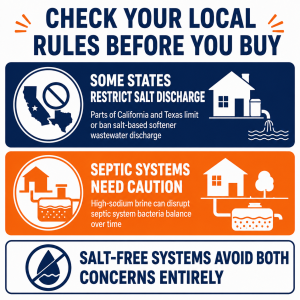
Beyond regulation, salt-based systems add sodium directly to your treated water, which is a genuine health consideration for anyone on a sodium-restricted diet — not just an environmental talking point. The amount is generally modest for most healthy adults, but it’s worth taking seriously if sodium intake is a medical concern in your household. This is one area where the two categories genuinely aren’t interchangeable: a salt-free system sidesteps the sodium question entirely, simply because there’s no salt anywhere in the process to begin with.
💡 Tip: If sodium intake is a medical concern in your household, either choose a salt-free system entirely, or install a separate reverse-osmosis filter at the kitchen tap for drinking and cooking water even if you use a salt-based softener elsewhere in the home.
Which Should You Choose?
The table below maps the most common decision factors to whichever system actually wins on that point.
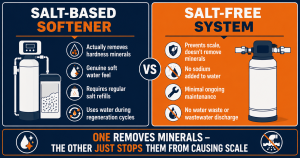
| Factor |
Winner |
| Actually removes hardness minerals |
SALT-BASED |
| No sodium added to water |
SALT-FREE |
| Lower ongoing maintenance cost |
SALT-FREE |
| Produces the classic “soft water” feel |
SALT-BASED |
| No water waste or wastewater discharge |
SALT-FREE |
| Legal in all US municipalities |
SALT-FREE |
| Better for septic systems |
SALT-FREE |
| Best for severely hard water (15+ grains) |
SALT-BASED |
Choose Salt-Based If:
- You want genuinely soft water with noticeable effects on skin, hair, and laundry
- Your local water is severely hard and needs aggressive treatment
- Your municipality permits softener discharge
If you’re still weighing whether you need true softening at all, our water softener vs water conditioner guide covers that decision in more depth.
Choose Salt-Free If:
- You want to protect pipes and appliances from scale without adding sodium
- You’re on a septic system or in a sodium-restricted household
- Your local regulations restrict salt-based discharge
A whole-house filtration system is also worth pairing with either softening approach if contaminants beyond hardness are a concern — our roundup of the best whole-house water filters covers that separate but complementary category.
Need a Professional Water Treatment Installer?
Both salt-based and salt-free systems tie into your main water supply line, and a professional can test your actual water hardness, confirm local discharge rules, and size the right system for your home before you buy.
Find a licensed plumber in your area at PlumberArchive.com — the US plumber directory with 12,000+ verified local plumbers across all 50 states.
Find a trusted plumber near you → PlumberArchive.com
Follow Us on Facebook
Get weekly plumbing tips, honest tool reviews and DIY guides delivered straight to your Facebook feed. We cover water treatment, water quality, and everything in between — written for US homeowners who want to make smart decisions without overspending.
Follow PlumbingToolsReview on Facebook →
Frequently Asked Questions
Q: Does a salt-free water softener actually work?
Yes, but not at the job most people assume it does. A salt-free system works well at preventing hardness minerals from forming scale buildup in pipes, water heaters, and appliances — that’s exactly what it’s designed to do, and it does it effectively. What it doesn’t do is remove those minerals from your water, so it won’t produce the slippery, “soft” feel or the reduced soap scum that a true salt-based softener delivers. If scale protection is your goal, it works. If soft-feeling water is your goal, it won’t get you there.
Q: Is salt-based or salt-free better for a septic system?
Salt-free is generally the better choice for a septic system. Salt-based softener regeneration discharges a high-sodium brine solution, and that sodium load can disrupt the bacterial balance a septic system relies on to break down waste over time. A salt-free system produces no discharge at all, so there’s no equivalent risk. If you’re on a septic system and still want a true salt-based softener, look into models designed with more efficient, lower-volume regeneration cycles, and consider having your septic system inspected more frequently as a precaution.
Q: How much sodium does a salt-based water softener actually add to my water?
The exact amount depends on how hard your incoming water is — harder water requires more ion exchange, which means more sodium is released in place of the removed calcium and magnesium. For most households with moderately hard water, the added sodium is well below levels considered significant for healthy adults. For anyone on a physician-prescribed sodium-restricted diet, though, even a modest addition can matter, which is why a salt-free system or a separate reverse-osmosis filter at the kitchen tap is often recommended in that situation.
Q: Can I switch from a salt-based system to salt-free later?
Yes, and it’s a fairly common switch for homeowners who want to eliminate the salt maintenance routine or who’ve moved somewhere with discharge restrictions. Keep in mind that scale already built up inside pipes and appliances during years of salt-based or untreated use won’t disappear just because you switch systems — a salt-free system prevents new scale, it doesn’t remove existing buildup. It’s worth having key appliances like the water heater descaled around the time of the switch, and expect the water to feel noticeably different afterward, since the hardness minerals are no longer being removed.
Conclusion
The core difference between these two categories isn’t a question of which one is higher quality — it’s whether you want hardness minerals physically removed from your water, or neutralized in place so they stop causing damage. A salt-based system does the former, at the cost of ongoing salt purchases, water use, and wastewater discharge. A salt-free system does the latter, with far less maintenance and no sodium addition, but it will never produce the soft-water feel a salt-based system delivers.
Severely hard water and a genuine preference for the classic soft-water feel point toward salt-based. Sodium concerns, septic systems, and local discharge regulations all point toward salt-free. Neither answer is universally “better” — the right choice depends entirely on what problem you’re actually trying to solve.
If you’re still deciding whether you need true softening versus a lighter-touch conditioner, our water softener vs water conditioner guide covers that first decision. Once you’ve settled on salt-based softening, our roundup of the best water softeners walks through systems suited to every household size and hardness level. And if your concerns extend beyond hardness to contaminants like chlorine or sediment, our guide to the best whole-house water filters covers that complementary layer of treatment.
✍️ About This Comparison
PTR Editorial Team — Product Comparisons. We compare manufacturer specifications, installation requirements, compatibility and available product documentation to help homeowners choose suitable tools and parts. How we review →