Please note: Product availability and information are based on our research at time of writing and are subject to change. Always check Amazon for the latest details before purchasing.
Introduction
A whole-house water filter installs at the main line where water enters your home, treating every fixture — kitchen, bathrooms, laundry, and outdoor spigots — from one central point. That’s a fundamentally different job than filtering water at a single tap, and it means the right system depends heavily on what’s actually in your water supply. Sediment and rust need a different filter than chlorine and chloramine, and both are different problems entirely from the iron and manganese common in private well water.
We reviewed five of the best whole-house water filters available in 2026, covering single-stage, 2-stage, and 3-stage systems built for different combinations of city water and well water concerns. If you’re still deciding whether whole-house filtration is even the right approach for your situation, our whole-house vs under-sink water filter comparison walks through that decision in detail. And if your only concern is drinking water quality at one tap rather than the whole home, our roundup of the best under-sink water filters covers that more targeted, lower-cost alternative. For a lighter-touch, no-installation option, see our picks for the best faucet-mounted water filters.
✏️ Our Take
Choosing the right whole-house filter comes down to one question first: what is actually in your water? City water with chlorine and sediment concerns needs a different system than well water with iron and manganese. Before buying any system, check your local water quality report (available free from your water utility) or get a basic test kit — buying a heavy metals system for a chlorine problem, or a sediment filter for an iron problem, means paying for filtration stages you don’t need and missing the ones you do.
Quick Comparison Table
Full Reviews — 5 Best Whole-House Water Filters
1. GE Whole House Water Filtration System, Reduce Sediment, Rust & More, Install Kit & Accessories Included, GXWH20T — Best Overall
🏆 Best Overall
The GE GXWH20T is the most accessible entry point into whole-house filtration in this roundup. GE Appliances is one of the most recognized and trusted home appliance brands in the US, and this single-stage filter housing comes with the install kit and mounting accessories included, which means fewer separate parts to track down before you can get it running at the main line.
The single-stage design keeps installation straightforward for DIY homeowners, and it reduces sediment and rust effectively at the lowest price tier in this entire lineup. One thing to plan for: the replacement filter cartridges — GE lists FXWTC, FXUSC, FXWPC and FXWSC as compatible options — are sold separately and need to be swapped roughly every 3 months. Factor that recurring cost in before buying, since it’s not included with the housing itself.
- Install kit and accessories included in the box
- Single-stage housing reduces sediment and rust
- Simple design suits DIY installation at the main line
- Lowest price tier in this roundup
- Replacement cartridges (FXWTC, FXUSC, FXWPC, FXWSC) sold separately — plan to replace every 3 months
✓ Pros
GE Appliances is one of the most recognized and trusted home appliance brands in the US
Install kit and accessories included means fewer separate purchases needed
Single-stage design keeps installation simple for DIY homeowners
Lowest price tier in this roundup makes whole-house filtration accessible without a large upfront investment
✗ Cons
Replacement filter cartridges are sold separately — factor this ongoing cost into the total investment before buying
Single-stage filtration addresses sediment and rust but does not treat chlorine, heavy metals or iron the way multi-stage systems do
🛒 Check Price on Amazon — $ →
2. iSpring WGB21B 2-Stage Whole House Water Filtration System, 10″ x 4.5″ Carbon Block and Iron & Manganese Reduction — Best for City Water
🎯 Best for City Water
The iSpring WGB21B steps up to 2-stage filtration, pairing a 10″ x 4.5″ carbon block for taste, odor and chlorine reduction with a dedicated iron and manganese reduction stage — covering the most common city water concerns in a single system. That larger carbon block, sized specifically at 10 inches by 4.5 inches, holds more filtration media than the compact single-stage cartridge in the GE unit above, which is the core trade-off for stepping up a stage.
iSpring is a consistently well-regarded water filtration brand with strong US customer support. The added iron and manganese reduction stage is the main reason for the step up in price from the GE unit above — if your water supply is a municipal city connection with typical chlorine and taste complaints but no iron or manganese issues, that extra stage may be more filtration than you actually need. For a supply with any iron or manganese present, though, it’s the proportionate upgrade over a single-stage system.
- 10″ x 4.5″ carbon block — larger filtration media than the single-stage GE unit above
- 2-stage carbon block plus iron & manganese reduction covers common city water concerns in one system
- Dedicated iron and manganese reduction stage not present on the single-stage GE unit
- Strong US customer support backed by the iSpring brand
- Best suited to municipal water supplies with iron, manganese, taste or odor concerns beyond basic chlorine
✓ Pros
10″ x 4.5″ carbon block provides more filtration media than the single-stage GE unit above
2-stage carbon block and iron reduction covers the most common city water concerns in one system
iSpring is a consistently well-regarded water filtration brand with strong US customer support
Dedicated iron and manganese reduction stage handles contaminants the single-stage GE unit can’t address
✗ Cons
Higher price point than the single-stage GE unit above, without added value if your water supply has no iron or manganese concerns
Iron and manganese reduction is less effective on heavily contaminated well water than a dedicated well water system
🛒 Check Price on Amazon — $$ →
3. Express Water 3-Stage Whole House Water Filter System, Reduces Heavy Metals, Scale, Chloramine, Chlorine, PFAs, Ultimate Protection — Best for Heavy Metals
⭐ Best for Heavy Metals
The Express Water 3-Stage system runs the most comprehensive contaminant coverage in this entire roundup — ACB, KDF and PHO filter stages working together to reduce heavy metals, PFAS, chloramine, chlorine and scale. That’s a meaningfully broader scope than the 1- and 2-stage systems elsewhere in this list, including PFAS reduction that most whole-house systems don’t address at all.
The KDF media stage is specifically effective against heavy metals including lead and mercury, while the polyphosphate (PHO) stage adds scale prevention that protects appliances and pipes simultaneously — a dual benefit beyond filtration alone. This system suits homeowners with documented heavy metal or PFAS concerns from local water quality reports rather than a generic sediment-and-chlorine setup. The trade-offs are the highest price point in this roundup and more physical space required for the 3-stage housing than a single or 2-stage alternative.
- 3-stage ACB, KDF and PHO filtration is the most comprehensive contaminant coverage in this roundup, including PFAS
- KDF media specifically targets heavy metals including lead and mercury
- Polyphosphate stage adds scale prevention alongside contaminant filtration
- Also reduces chloramine and chlorine alongside heavy metals and PFAS
- Suits homes with documented heavy metal or PFAS concerns from local water quality reports
✓ Pros
3-stage ACB, KDF and PHO filtration is the most comprehensive contaminant coverage in this roundup — including PFAS reduction that most systems don’t address
KDF media is specifically effective against heavy metals including lead and mercury
Polyphosphate stage provides scale prevention that protects appliances and pipes simultaneously
Suits homeowners with documented heavy metal or PFAS concerns from local water quality reports
✗ Cons
Premium price point is the highest in this roundup
3-stage system requires more under-sink or utility room space than single or 2-stage alternatives
Filter replacement covers 3 cartridges rather than 1 or 2
💡 Tip: If your local water quality report flags PFAS or heavy metals specifically, this is the only system in our lineup built to address both at once — check the report before defaulting to a cheaper sediment-only option.
🛒 Check Price on Amazon — $$$ →
4. Waterdrop WHF21-PG 2-Stage Whole House Water Filter System, Highly Reduces Lead, Chlorine, Odor and Taste, 5-Stage Filtration Upgrade — Budget Pick
💰 Budget Pick
The Waterdrop WHF21-PG sits at a genuinely accessible mid-range price point while still delivering 2-stage filtration — lead and chlorine reduction that covers the primary concerns for most city water households. A 5-stage filtration upgrade is also available from Waterdrop for this same housing, for households that want broader coverage without switching brands entirely.
Waterdrop is a well-regarded water filtration brand with a strong product track record across its lineup, and the 2-stage design balances cost and coverage effectively for most households. It doesn’t extend to iron, manganese, or broader heavy metals coverage beyond lead, so it’s a better match for a standard municipal water supply than for well water with elevated iron or sediment content — for that, see the iSpring system built specifically for well water below.
- Lead and chlorine reduction covers the primary concerns for most city water users
- 2-stage filtration balances cost and coverage effectively for most households
- A 5-stage filtration upgrade is available from Waterdrop for broader coverage
- Waterdrop is a well-regarded water filtration brand with a strong product track record
- Genuinely accessible mid-range price point relative to other multi-stage systems in this roundup
✓ Pros
Lead and chlorine reduction covers the primary concerns for most city water users
Waterdrop is a well-regarded water filtration brand with a strong product track record
2-stage filtration balances cost and coverage effectively for most households
A 5-stage filtration upgrade is available for broader coverage if needed later
✗ Cons
2-stage system does not include iron, manganese or heavy metals coverage beyond lead
Not suited to well water with higher iron or sediment content
🛒 Check Price on Amazon — $$ →
5. iSpring Whole House Water Filter System, Reduces Iron, Manganese, Chlorine, Sediment, Taste and Odor — Best for Well Water
👷 Best for Well Water
★★★★☆
Well Water Specialist
This iSpring system is specifically designed to handle the higher iron and manganese levels common in private well water — a category of contaminant that city water systems generally don’t need to address at all. Alongside iron and manganese reduction, it also covers chlorine, sediment, taste and odor, making it a complete solution for well water households rather than a bolt-on to a city-water-focused filter.
The iSpring brand reputation is confirmed across multiple listings in this category, including the WGB21B above. For city water users without iron or manganese concerns, this level of well-water-specific filtration is overkill — the iSpring WGB21B or Waterdrop above is the better fit. For households on a heavily contaminated well, this system may still need a dedicated iron filter or softener installed upstream for full effectiveness.
- Specifically designed to handle higher iron and manganese levels common in private well water
- Covers chlorine, sediment, taste and odor alongside iron and manganese in one system
- A complete solution built for well water, not a bolt-on to a city-water-focused filter
- iSpring brand reputation confirmed across multiple listings in this category, including the WGB21B above
✓ Pros
Specifically designed to handle the higher iron and manganese levels common in private well water that city water systems do not address
iSpring brand reputation confirmed across multiple listings in this category
Complete solution for well water — also covers chlorine, sediment, taste and odor
✗ Cons
Well water-focused filtration is overkill for city water users who don’t have iron or manganese concerns
Higher iron/manganese loads may still require a dedicated iron filter or softener upstream of this system
🛒 Check Price on Amazon — $$ →
Whole-House Water Filter Buying Guide
Check your water first — city water vs well water needs completely different systems
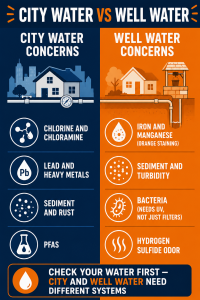
Before comparing any specific product, check what’s actually in your water supply. Municipal city water typically raises concerns about chlorine, chloramine, sediment from aging infrastructure, and in some areas, lead or PFAS. Private well water raises a different set of concerns entirely — iron and manganese are the dominant issues, producing the orange staining on fixtures that a chlorine-focused city water filter won’t touch. Buying a system built for the wrong water type means paying for filtration stages you don’t need while missing the ones that actually matter. Your local water utility can provide a free water quality report, or you can use a basic test kit to confirm what’s present before choosing between the systems in this roundup.
1-stage vs 2-stage vs 3-stage — what each adds
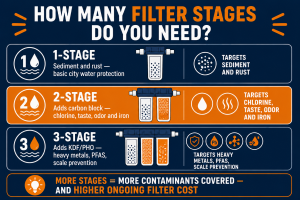
A single-stage system, like the GE GXWH20T, uses one filter housing to address sediment and rust — a good baseline for basic protection, but it doesn’t touch chlorine, heavy metals, or iron. A 2-stage system, like the iSpring WGB21B or Waterdrop WHF21-PG, adds a second filter media — typically carbon block for chlorine and taste, or a dedicated iron/manganese stage — covering a broader set of common concerns in one install. A 3-stage system, like the Express Water 3-Stage, stacks additional filter media (ACB, KDF, and polyphosphate in that case) to address heavy metals, PFAS, and scale prevention simultaneously. More stages mean broader contaminant coverage, but also more cartridges to replace and more physical space required for the housing — match the stage count to what your water quality report actually shows rather than defaulting to the most comprehensive option.
NSF certification numbers for whole-house filters — what to look for
NSF/ANSI certifications aren’t interchangeable — each number backs a specific claim. NSF/ANSI 42 covers aesthetic effects: taste, odor, and chlorine reduction. NSF/ANSI 53 covers health effects, including reduction of contaminants like lead and certain organic chemicals. NSF/ANSI 61 covers the safety of the materials the filter housing itself is made from. When comparing whole-house systems, check which specific certification numbers a product actually carries rather than assuming a general “certified” label covers every claim made in the listing — a system marketed for heavy metal reduction should specifically carry NSF/ANSI 53, not just NSF/ANSI 42.
US regional context: city water vs well water concerns by location
In states with older municipal infrastructure — particularly across the Northeast and Midwest — lead and chloramine in city water are genuine concerns that basic sediment filters don’t address. In rural areas across the South, Midwest and Mountain West where private well water is common, iron and manganese are the dominant filtration concern, producing the characteristic orange staining on fixtures that sediment and carbon filters alone won’t prevent. Knowing which category your home falls into makes the buying decision straightforward: city water households should look at the iSpring WGB21B or Waterdrop WHF21-PG above, while well water households should start with the iSpring iron/manganese system, adding the Express Water 3-Stage if heavy metals or PFAS are also documented in a water quality test. Well water households dealing primarily with sediment and particulates rather than iron and manganese should also see our roundup of the best whole-house sediment pre-filters for well water, a more targeted option than a full iron/manganese system.
Need a Professional Plumber?
Whole-house filter installation involves cutting into your main water line — a job most homeowners hand to a licensed plumber rather than tackling solo. A professional can also confirm what’s actually in your water before you commit to a specific filtration stage count.
Find a licensed plumber in your area at PlumberArchive.com — the US plumber directory with 12,000+ verified local plumbers across all 50 states.
Find a trusted plumber near you → PlumberArchive.com
Follow Us on Facebook
Get weekly plumbing tips, honest tool reviews and DIY guides delivered straight to your Facebook feed. We cover water filtration, water treatment, and everything in between — written for US homeowners who want to make smart decisions without overspending.
Follow PlumbingToolsReview on Facebook →
Frequently Asked Questions
Q: How do I know which whole-house water filter I need?
Start with your water source. If you’re on municipal city water, chlorine, chloramine and sediment are the most common concerns, and a system like the iSpring WGB21B or Waterdrop WHF21-PG addresses both directly. If you’re on a private well, iron and manganese are the dominant issue, which is what the iSpring iron/manganese system in this roundup is specifically built to handle. If a water quality report or test kit shows heavy metals or PFAS regardless of source, the Express Water 3-Stage offers the broadest coverage. Checking a free water quality report from your local utility, or using a basic test kit for well water, is the fastest way to match the filter to the actual problem.
Q: How often do whole-house water filter cartridges need replacing?
Most whole-house filter cartridges need replacement every 3 to 6 months, though the exact interval depends on the filter type and household water usage. The GE GXWH20T, for example, uses replacement cartridges (FXWTC, FXUSC, FXWPC, FXWSC) sold separately from the housing, typically replaced roughly every 3 months. Multi-stage systems like the Express Water 3-Stage involve replacing multiple cartridges on their own schedules rather than a single filter. Whichever system you choose, staying on schedule is what keeps contaminant reduction performance at the level the certification claims.
Q: Will a whole-house filter reduce water pressure?
A properly sized and installed whole-house filter should cause minimal, often unnoticeable pressure loss under normal household use. Pressure drop becomes a real issue mainly when a filter cartridge is overdue for replacement and has become clogged with sediment, or when a system is undersized for the household’s peak water demand (for example, running a shower and washing machine simultaneously). Choosing a system rated for your home’s flow rate and replacing cartridges on schedule are the two biggest factors in avoiding a noticeable pressure drop.
Q: Do I need a plumber to install a whole-house water filter?
Most whole-house systems, including all five in this roundup, install at the main water line, which typically means cutting into the primary supply pipe. While some experienced DIY homeowners handle this themselves — particularly with single-stage systems like the GE GXWH20T that include an install kit — many households hand this job to a licensed plumber to avoid leaks at the connection points and to confirm the system is sized correctly for the home’s water pressure and flow rate. Search PlumberArchive.com for a verified plumber in your area if you’d rather not tackle the main-line cut yourself.
Conclusion
For most homeowners, the GE GXWH20T is the clear starting point — it’s the most in-demand system in this roundup, backed by one of the most trusted names in home appliances, with an install kit included and the lowest price tier here. Just budget for the separate replacement cartridges every 3 months.
If your household is on municipal city water and wants broader coverage than a single-stage system, the iSpring WGB21B is the best-reviewed step up. Households with documented heavy metal or PFAS concerns should look at the Express Water 3-Stage, the most comprehensive system in this lineup. Budget-conscious city water households can consider the Waterdrop WHF21-PG, and anyone on private well water dealing with iron and manganese staining should go straight to the iSpring iron/manganese system.
Whichever system you choose, matching it to what’s actually in your water — rather than the most expensive or most comprehensive option by default — is what determines whether it’s worth the investment. If you’re still weighing whole-house filtration against a simpler single-tap solution, our whole-house vs under-sink water filter comparison walks through that decision, and our roundup of the best under-sink water filters covers the alternative if your concern is limited to one tap. If hardness is part of your water picture alongside filtration, our guide to the best water softeners covers that separate equipment category.
✍️ About This Review
PTR Editorial Team — Product Reviews. We compare manufacturer specifications, installation requirements, compatibility and available product documentation to help homeowners choose suitable tools and parts. How we review →