Comparisons
20 Sep 2026

Utility Pump vs. Sump Pump (2026) — Which Do You Need?
Utility pump vs sump pump: one is portable for occasional jobs, the other a permanent install for ongoing water. See which your basement needs.
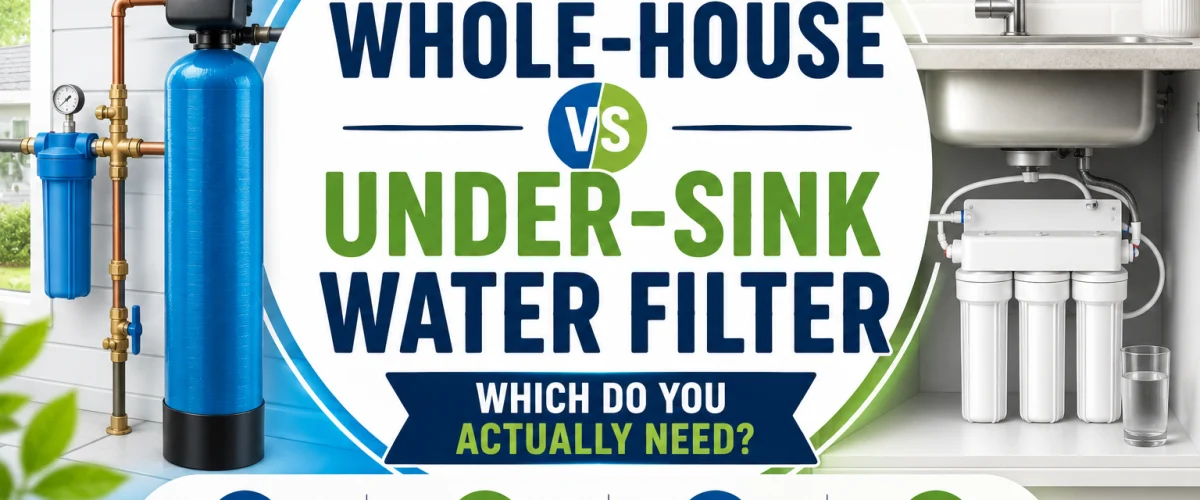
Whole-house vs under-sink water filter — how each works, what each actually filters, real cost differences, and which one your home needs.
Please note: Cost estimates and installation details are based on our research at time of writing and are subject to regional variation. Always test your water quality and consult a licensed plumber or water treatment professional before purchasing either system.
Whole-house filters and under-sink filters are often confused because both genuinely improve water quality — but they do it at completely different points in your home’s plumbing and for different purposes. A whole-house system treats every drop of water entering the home before it reaches a single fixture. An under-sink system treats only the water coming out of one specific tap. Neither is a universally “better” choice; they’re built to solve different problems.
Choosing the wrong one has real costs either way — overspending on whole-house treatment when only your drinking water at the kitchen sink matters, or under-protecting your home’s pipes and appliances when the whole water supply is the actual concern. This guide compares both approaches across how they work, what they actually remove, installation and maintenance, and cost, so you can match the system to the problem you’re actually trying to solve. If you’ve already decided under-sink filtration is right for you, our picks for the best under-sink water filters cover top-rated options. And if hardness rather than contaminants is your concern, that’s a separate issue covered in our water softeners guide.
✏️ Our Take
These two systems solve different problems at completely different points in your home’s water supply. A whole-house filter sits at the main water line where it enters the home, treating every drop of water used anywhere — drinking, cooking, bathing, laundry, and garden. An under-sink filter sits at a single tap, treating only the water from that one fixture. If your concern is drinking water quality at the kitchen sink, an under-sink filter is the targeted, lower-cost solution. If your concern is water quality affecting your skin, hair, appliances, and pipes throughout the whole house, only a whole-house system addresses that.
IN THIS GUIDE
A whole-house filter installs at the main water line where it enters the home — typically right after the main shutoff valve, before the water supply branches off to any individual fixture. Because of this position, every tap, shower, washing machine, dishwasher, and even outdoor faucet in the house receives filtered water. Nothing downstream of the install point is left untreated.
Most whole-house systems use one of a few filtration approaches: sediment pre-filters that physically strain out particulates like sand, rust, and debris; carbon block filters that reduce chlorine, chloramines, and taste/odor issues; or combination cartridge systems that stack sediment and carbon stages together for broader coverage. The specific filtration technology determines exactly what gets removed, so it’s worth checking a system’s certifications rather than assuming “whole-house” alone guarantees comprehensive contaminant removal.
An under-sink filter installs directly beneath a specific sink and connects to the cold water supply line feeding that one fixture only. Every other tap, shower, and appliance in the house continues to receive unfiltered municipal or well water exactly as before — only the water coming out of that treated fixture changes.
Under-sink systems range from simple direct-connect inline filters — which tie into the existing supply line with no dedicated faucet or drilling required — up to full reverse osmosis (RO) systems, which force water through a semi-permeable membrane for far more thorough filtration. Our full roundup of the best under-sink water filters covers both categories in depth, including the installation trade-offs between simple inline filters and tank-based or tankless RO setups.
A whole-house system typically addresses sediment, chlorine, chloramines, and in some configurations certain volatile organic compounds (VOCs) — but the exact list depends entirely on which filter media and stages the specific system uses. Not every whole-house filter targets the same contaminants, so checking the actual certification (NSF/ANSI ratings, for instance) matters more than assuming broad coverage from the “whole-house” label alone.
An under-sink filter can match that same baseline coverage — sediment, chlorine, taste and odor — but a reverse osmosis under-sink system goes considerably further, additionally removing dissolved minerals, certain heavy metals, PFAS, and total dissolved solids (TDS) that no whole-house carbon or sediment filter is designed to touch. That’s the core trade-off: whole-house wins on coverage across every fixture, while under-sink RO wins on filtration depth at the one tap it serves. Neither approach addresses water hardness — that’s a mineral-content issue handled by a completely separate category of equipment, covered in our water softener vs water conditioner comparison.
Whole-house filters install at the main water line, which typically means cutting into the primary supply pipe — a job most homeowners hand to a licensed plumber rather than tackling as a DIY project. Once installed, filter cartridges are generally replaced every 3 to 6 months, though this varies by filter type and household water usage. Because the system treats all water for the entire house, cartridge capacity is sized accordingly.
Under-sink filters connect to the existing supply line under one sink, and many models — particularly direct-connect inline filters — are genuinely DIY-friendly, requiring no cutting of the main line and no professional installation. Cartridge replacement intervals run longer, typically every 6 to 12 months depending on the filter type, since the unit only processes the volume used at a single tap rather than the whole household’s water.
Whole-house systems carry a higher upfront cost, driven largely by professional installation at the main line, and the ongoing cartridge replacement cost covers water used throughout the entire house. That’s a meaningful recurring expense relative to an under-sink system, but it’s spread across every fixture rather than just one.
Under-sink systems have a lower upfront cost overall, and because cartridges only treat the volume used at a single tap, they tend to last longer before replacement is needed relative to what a whole-house system processes in the same period. Adding reverse osmosis to an under-sink setup does introduce ongoing filter costs across multiple stages — RO systems typically use several sequential filter cartridges rather than one — so a full RO under-sink system isn’t necessarily the cheapest option in every case, even though it still tends to cost less overall than treating the whole house.
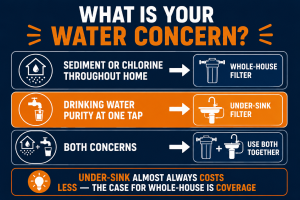
Yes — and it’s a common, genuinely effective combination rather than a redundant one. A whole-house sediment filter paired with an under-sink reverse osmosis system covers both ends of the problem: the whole-house filter protects pipes, water heaters, and appliances throughout the home from particulate damage and general chlorine exposure, while the under-sink RO system delivers high-purity drinking and cooking water specifically at the kitchen tap.
In states with documented municipal water quality concerns — parts of Michigan, Illinois, and older cities across the Northeast — lead and chlorine reduction at the drinking tap is often the primary concern, making an under-sink filter the most targeted fix. In states with high sediment or agricultural runoff issues — parts of the Midwest, Texas and California’s Central Valley — whole-house sediment pre-filtration protects appliances and pipes from particulate damage that an under-sink filter alone wouldn’t address. Homeowners facing both kinds of concerns simultaneously are exactly who benefits most from running both systems together.
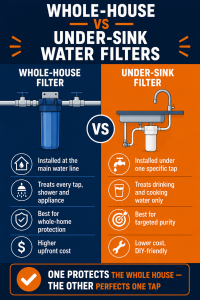
The table below maps the most common decision factors to the system each one favors.
| Concern | Best Choice |
|---|---|
| Drinking water quality only | UNDER-SINK |
| Chlorine affecting skin and hair | WHOLE-HOUSE |
| Sediment damaging appliances | WHOLE-HOUSE |
| Lowest total cost | UNDER-SINK |
| RO-level drinking water purity | UNDER-SINK (RO) |
| Protecting the whole house at once | WHOLE-HOUSE |
| Both concerns present | BOTH TOGETHER |
If hardness minerals are also part of the picture alongside filtration, our guide to the best water softeners covers the separate equipment category that addresses that specifically.
Our full roundup of the best under-sink water filters compares inline direct-connect models against full reverse osmosis systems for exactly this use case.
A whole-house filter installation involves cutting into your main water line — a job best assessed and carried out by a licensed plumber. Even an under-sink system can benefit from professional input if your under-sink plumbing or water pressure is unusual. A professional can also confirm what’s actually in your water before you spend on either system.
Find a licensed plumber in your area at PlumberArchive.com — the US plumber directory with 12,000+ verified local plumbers across all 50 states.
Get weekly plumbing tips, honest tool reviews and DIY guides delivered straight to your Facebook feed. We cover water filtration, water treatment, and everything in between — written for US homeowners who want to make smart decisions without overspending.
Not entirely, no. A whole-house filter treats sediment, chlorine, and similar contaminants across every fixture in the home, which is a genuine improvement to overall water quality. But it typically doesn’t reach the same filtration depth as a dedicated under-sink reverse osmosis system, which additionally removes dissolved minerals, TDS, and certain heavy metals at the specific tap you drink from. If your only goal is protecting the whole house from sediment and chlorine, a whole-house filter alone may be sufficient. If you also want the highest possible drinking water purity, pairing it with an under-sink RO system at the kitchen sink is the more complete approach.
It depends on what problem you’re solving. If chlorine, sediment, or general water quality is affecting multiple areas of your home — dry skin after every shower, sediment clogging appliance screens, chlorine smell throughout the house — a whole-house filter addresses all of that at once, which an under-sink filter simply can’t do since it only treats one tap. If your only concern is the taste and safety of your drinking water at the kitchen sink, a whole-house system is genuinely more than you need, and an under-sink filter delivers the same benefit for that specific use case at a fraction of the cost.
No — an under-sink filter only treats water at the one fixture it’s connected to, so it has no effect on the water reaching your water heater, dishwasher, washing machine, or any other tap in the house. If sediment is damaging appliances or clogging aerators and showerheads throughout the home, that’s specifically a whole-house problem that requires a whole-house sediment filter installed at the main line. An under-sink filter is the wrong tool for that job even if it’s an excellent choice for improving drinking water quality at the kitchen sink.
Possibly, if you have both concerns — contaminants and hardness are two entirely separate water quality issues handled by different equipment. A water filter (whole-house or under-sink) removes or reduces things like chlorine, sediment, and in the case of RO systems, dissolved minerals and heavy metals. A water softener or conditioner addresses hardness specifically — the calcium and magnesium minerals that cause scale buildup and affect how soap lathers. Neither system does the other’s job: a whole-house filter won’t soften hard water, and a softener won’t remove chlorine or sediment. Our water softener vs water conditioner comparison covers that separate decision in detail if hardness is also a concern in your home.
A whole-house filter protects every fixture in your home from sediment and chlorine at once; an under-sink filter delivers higher-purity water at a single tap, often at a meaningfully lower cost. Neither is objectively superior — they solve genuinely different problems, and the right choice comes down to whether your concern is house-wide or specific to your drinking water.
For single-concern situations, cost almost always favors under-sink filtration: it’s cheaper to install, cheaper to maintain, and delivers exactly what most households actually need from a filter — clean, safe drinking and cooking water. For homes facing both a house-wide issue like sediment or chlorine and a desire for the highest possible drinking water purity, combining a whole-house sediment filter with an under-sink RO system is the most complete approach, and the two genuinely complement rather than duplicate each other.
Once you’ve decided which direction fits your home, our roundup of the best under-sink water filters covers top-rated inline and RO options. If hardness is also part of your water quality picture, our guide to the best water softeners and our water softener vs water conditioner comparison cover that separate decision in full.
✍️ About This Comparison
Written by Sarah Mitchell, Home Improvement Editor at PlumbingToolsReview — specializing in helping homeowners make smart buying decisions without overspending. Learn how we test →
Utility pump vs sump pump: one is portable for occasional jobs, the other a permanent install for ongoing water. See which your basement needs.
Pipe repair clamp, tape, or epoxy — which should you use for a leaking pipe? Compare how each works, durability, and when to reach for which.
Not sure if your home has a septic tank or a sewer connection? Learn how to tell which one you have, plus the maintenance and cost differences.

