Comparisons
20 Sep 2026

Utility Pump vs. Sump Pump (2026) — Which Do You Need?
Utility pump vs sump pump: one is portable for occasional jobs, the other a permanent install for ongoing water. See which your basement needs.
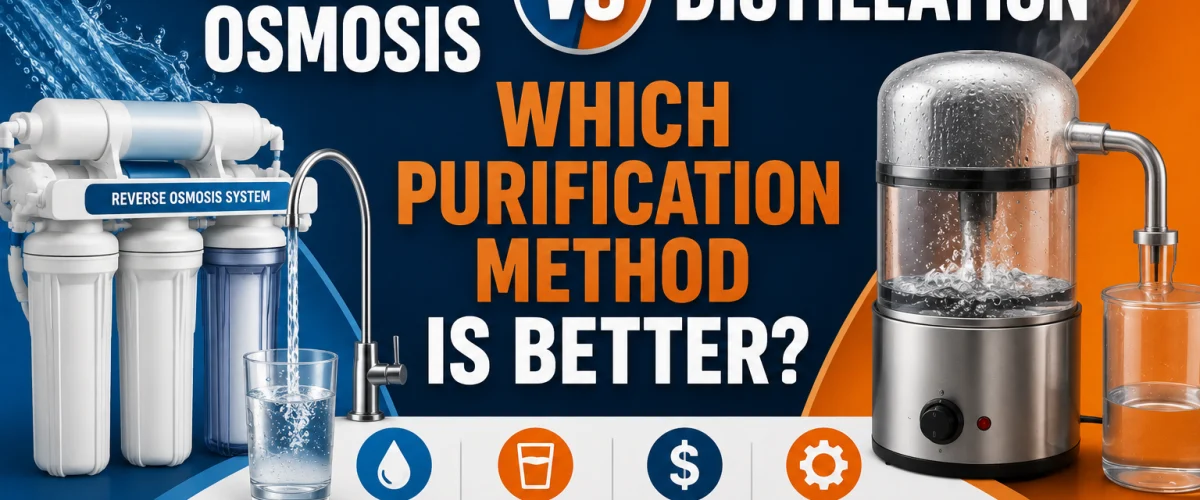
Reverse osmosis and distillation both remove contaminants including lead — but they work very differently. We compare speed, cost, and effectiveness.
Please note: Information in this comparison is based on our research at time of writing and is subject to change. For specific contamination concerns, confirm results with certified testing rather than relying on either method’s general reputation alone.
Reverse osmosis and distillation are both legitimate, thorough water purification methods — a real step up from a basic carbon filter pitcher, which mainly improves taste and odor without addressing the same range of dissolved contaminants. Both are capable of removing lead, heavy metals, and a wide range of other dissolved substances, but they get there through entirely different physical processes, and each comes with real trade-offs in speed, cost, and ongoing maintenance.
Reverse osmosis forces water through a membrane fine enough to block dissolved solids, while distillation boils water and recaptures the steam, leaving contaminants behind entirely. Neither is inherently “better” in every situation — the right choice depends on how much water your household uses daily, how much you’re willing to spend upfront and over time, and how important it is to remove absolutely everything dissolved in the water versus getting fast, continuous output. This comparison walks through how each method actually works, how they stack up on speed, effectiveness, and cost, and which one fits which household.
At a Glance
Reverse Osmosis
Distillation
✏️ Our Take
Reverse osmosis and distillation are both genuine step-ups from a basic carbon filter pitcher — neither is a marketing gimmick, and both are capable of removing lead and a wide range of other contaminants effectively. The real difference is practical: reverse osmosis systems produce filtered water quickly and continuously with periodic membrane changes, while distillation is slower and uses more energy but leaves essentially nothing behind, including minerals that RO systems can sometimes miss depending on membrane condition. Most households lean toward reverse osmosis for everyday convenience, while distillation appeals to buyers prioritizing the most thorough possible removal over speed.
IN THIS GUIDE
The table below maps the most common decision factors to whichever method actually wins on that point, based on everything covered in this comparison.
| Factor | Winner |
|---|---|
| Speed of daily output | REVERSE OSMOSIS |
| Removing dissolved minerals entirely | DISTILLATION |
| Continuous, on-demand production | REVERSE OSMOSIS |
| No membrane to replace | DISTILLATION |
| Lower energy use | REVERSE OSMOSIS |
| Portable, no permanent installation | DISTILLATION |
| No water wasted during the process | DISTILLATION |
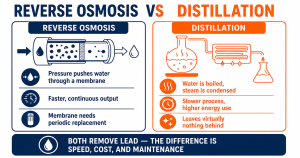
Reverse osmosis pushes water under pressure through a semi-permeable membrane with pores small enough to block dissolved solids, most minerals, and a wide range of contaminants — including lead — while letting water molecules pass through. The membrane itself is the core of the system, typically preceded by one or more pre-filters that remove sediment and chlorine before water ever reaches it, protecting the membrane from premature clogging or damage. Household water pressure is usually enough to drive this process, though some systems add a small booster pump if incoming pressure is on the lower end, since consistent pressure is what keeps the membrane working efficiently over time.
Most residential RO systems are installed under the kitchen sink, connected to a dedicated small faucet mounted at the countertop specifically for drinking and cooking water, separate from the regular tap. This keeps the system’s plumbing contained to one location rather than treating all the water entering the home, which keeps both installation and ongoing cost lower than a whole-house system. Some households do install a whole-house RO system instead, but that’s a larger, more expensive undertaking generally reserved for homes with more significant, whole-supply water quality concerns rather than a simple drinking-water upgrade.
The process produces two streams: a stream of purified water that continues on to the dedicated faucet, and a smaller stream of “reject” water carrying the concentrated contaminants the membrane filtered out, which drains away rather than being used. This reject water is an inherent part of how the membrane process works — some water is always used to flush concentrate away from the membrane surface rather than letting it build up and reduce performance over time.
Distillation takes a fundamentally different approach: rather than filtering water through a physical barrier, it heats water to a full boil in a dedicated chamber. Minerals, heavy metals, and most other dissolved substances have a much higher boiling point than water itself, so they stay behind in the boiling chamber while water itself turns to steam and rises away from them.
That steam is then guided into a separate condensing chamber, typically cooled by a coil or fan, where it returns to liquid form and is collected as purified water. Because the steam carries essentially none of the original contaminants with it, the resulting water has very little dissolved in it at all — not just contaminants, but the beneficial minerals naturally present in tap water too.
Residential distillers are typically countertop units rather than a permanent under-sink installation, since the boiling and condensing chambers need direct access for filling with source water and periodic cleaning. This makes distillation a more self-contained appliance, plugged in and operated on demand, rather than a plumbed-in fixture tied to the home’s water line the way an RO system usually is. That self-contained design is also why distillation travels well — the same unit works in an apartment, a vacation home, or anywhere else without existing under-sink plumbing access.
Reverse osmosis systems, once installed, typically produce purified water continuously and relatively quickly — water flows through the membrane on demand whenever the dedicated faucet is opened, with many systems including a small storage tank that keeps a reserve of already-purified water ready for immediate use rather than waiting on the membrane in real time. This makes RO well suited to regular household demand, including filling large pots or pitchers without a long wait.
Distillation is meaningfully slower per gallon, since every batch requires a full boil-and-condense cycle rather than a continuous flow-through process. A typical countertop unit produces water gradually over several hours per batch rather than instantly on demand, which makes it better suited to households with lower daily volume needs — drinking and cooking water for one or two people, for instance — unless a larger-capacity unit is used to offset the slower per-gallon rate.
For a household that wants water ready the moment a faucet is turned on, reverse osmosis is the more practical fit. For a household comfortable running a countertop unit overnight or during the day to build up a supply, distillation’s slower pace is less of a practical drawback. Larger families, or anyone who cooks with a lot of water daily, tend to notice the speed difference the most, since a distiller’s batch cycle can genuinely lag behind demand if it’s the household’s only source of drinking water.
Both methods are genuinely effective against lead and a wide range of other contaminants when properly maintained — this isn’t a case of one method being a real solution and the other being a lesser alternative. Reverse osmosis effectiveness depends heavily on membrane condition, correct installation, and adequate pre-filtration ahead of the membrane; a degraded or improperly seated membrane can let more through than a fresh, correctly installed one. Our testing for lead guide covers how to confirm whether lead is actually present in your water before or after installing either system.
Distillation is highly effective against most dissolved contaminants, including lead and other heavy metals, precisely because they don’t evaporate along with the water. The one meaningful exception is certain volatile organic compounds, which do have boiling points close enough to water’s that they can evaporate along with the steam and potentially recondense with it, unless the distiller includes supplementary carbon filtration to address that gap specifically. Many residential distillers include exactly this kind of add-on carbon stage for that reason, which is worth checking for if VOCs are a specific concern in your area.
In practice, this means neither method should be assumed effective for a specific concern without checking the exact certification behind it, rather than the general reputation of “reverse osmosis” or “distillation” as categories.
Reverse osmosis systems typically carry a higher upfront cost tied to installation, landing in the $$–$$$ range depending on the system and whether professional installation is used. Ongoing costs include periodic pre-filter and membrane replacement on a schedule set by the manufacturer, plus the continuous cost of the reject water that goes down the drain unused with every gallon purified. Most manufacturers recommend replacing pre-filters roughly every 6 to 12 months and the membrane itself every 2 to 3 years, though actual intervals depend on household water usage and incoming water quality.
Distillation units, particularly basic countertop models, typically have a lower upfront cost, often in the $–$$ range. The ongoing cost trade-off is energy rather than water — bringing water to a full boil for every batch uses meaningfully more electricity over time than an RO system’s pressure-driven process. Distillers also need periodic manual cleaning to remove mineral scale that builds up inside the boiling chamber, since minerals left behind by evaporating water accumulate there directly rather than being flushed away the way an RO membrane’s reject stream carries concentrate off. Skipping this cleaning step doesn’t just reduce output — it can eventually affect how thoroughly the unit purifies water as scale buildup interferes with even heating.
Neither system is a “buy once and forget it” purchase — both have real ongoing costs that are worth factoring in alongside the upfront price tier before deciding.
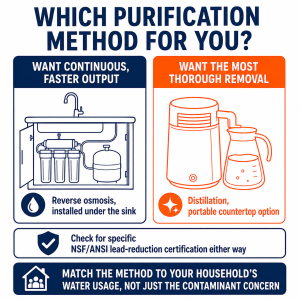
Choose reverse osmosis if your household wants continuous, faster daily output without thinking about it, and you’re comfortable with a one-time under-sink installation. It’s the more practical everyday choice for larger households or anyone who uses a lot of drinking and cooking water throughout the day, since the dedicated faucet delivers purified water on demand rather than requiring you to plan around a batch cycle.
Choose distillation if the most thorough possible contaminant removal matters more to you than speed, your household’s daily volume needs are relatively modest, or you want a portable countertop option without a permanent plumbing installation — useful for renters or anyone who doesn’t want to modify under-sink plumbing at all. It’s also a reasonable choice if you’d rather manage a single self-contained appliance than schedule periodic membrane and pre-filter swaps for a fixed system.
Both are meaningful upgrades over a basic water filter pitcher, which is worth considering first if your main concern is taste and odor rather than a specific contaminant. And if hardness or scale buildup is the actual issue rather than contaminant removal, our water softener vs reverse osmosis comparison covers that different decision — a water softener solves a different problem than either method discussed here.
If you’re considering a permanent under-sink RO installation or want help evaluating your home’s plumbing before choosing a system, search PlumberArchive.com — the US plumber directory with 12,000+ verified local plumbers across all 50 states.
Get weekly plumbing tips and DIY guides delivered straight to your Facebook feed.
Distillation typically removes minerals more completely, since virtually nothing dissolved in the original water carries over into the condensed steam. Reverse osmosis also removes the large majority of minerals, but its effectiveness depends on membrane condition and pore size, meaning a small amount can sometimes pass through depending on the specific membrane and system.
Yes, distilled water is safe to drink, though it lacks the beneficial minerals naturally present in regular tap water, which some people prefer to get from their water rather than food alone. This isn’t a safety concern, but it’s a reason some households alternate distilled water with other sources, or aren’t concerned about it at all since most people get adequate minerals from their diet regardless of water source.
The exact ratio varies by system, but older or less efficient RO units can use several gallons of reject water for every gallon of purified water produced, while newer, more efficient systems have narrowed that gap considerably. This reject water isn’t wasted in the sense of being contaminated beyond use — it’s simply water carrying the concentrated minerals and contaminants filtered out, and some households route it to non-drinking uses like watering plants.
Yes — both methods are more thorough than a basic carbon filter pitcher and can fully replace one for drinking and cooking water. A pitcher filter mainly improves taste and odor and reduces some contaminants, but doesn’t match the broader removal either RO or distillation provides. Our water filter pitchers review is worth a look if a pitcher is a better fit for your budget or living situation in the meantime.
Reverse osmosis and distillation both offer genuine, thorough water purification, and the right choice comes down to daily usage patterns more than which method sounds more effective. Reverse osmosis suits households wanting fast, continuous output from a one-time under-sink install; distillation suits those prioritizing the most complete removal possible, lower daily volume needs, or a portable option without permanent plumbing changes.
Whichever you choose, confirm it carries the specific NSF/ANSI certification relevant to your actual concern — lead reduction in particular — rather than assuming the method alone guarantees it. Both are a meaningful step up from a basic pitcher filter, and either is a reasonable, defensible choice for a household serious about water quality.
Prices and ratings may change. Always check Amazon for current prices.
✍️ About This Comparison
Written by Sarah Mitchell, Home Improvement Editor at PlumbingToolsReview — specializing in helping homeowners make smart buying decisions without overspending. Learn how we test →
Utility pump vs sump pump: one is portable for occasional jobs, the other a permanent install for ongoing water. See which your basement needs.
Pipe repair clamp, tape, or epoxy — which should you use for a leaking pipe? Compare how each works, durability, and when to reach for which.
Not sure if your home has a septic tank or a sewer connection? Learn how to tell which one you have, plus the maintenance and cost differences.

