
Guides
19 Oct 2026

Can’t Reach the Faucet Nut? Choose the Right Tool Before You Buy
Not sure which tool fits your faucet nut? Identify the fixing, see how it lets go and check your clearance first. Then choose a tool, or use one you own.
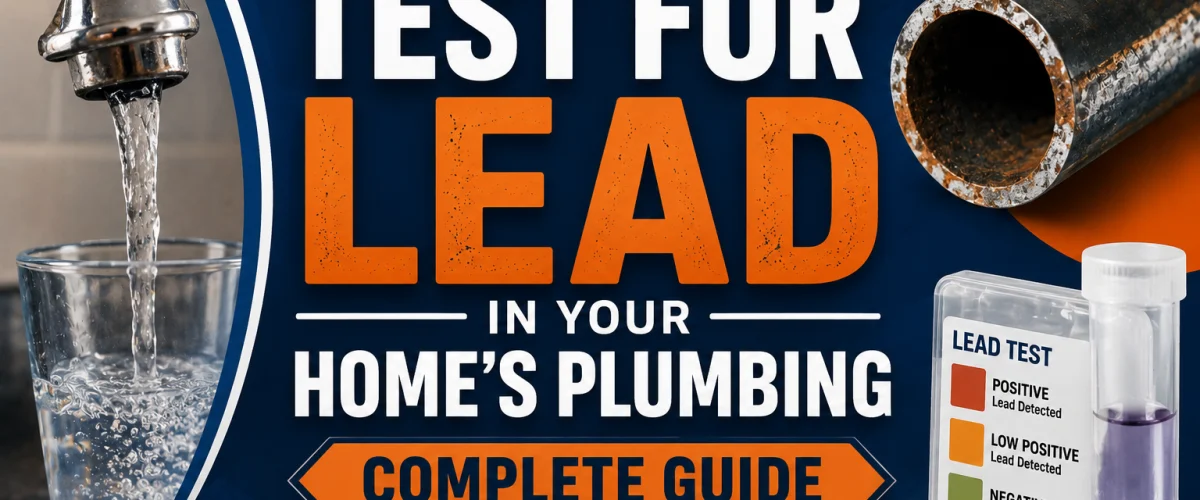
Older homes and older pipes carry a real risk of lead in drinking water. Learn how to test for it accurately and what to do if you find it.
Please note: Information in this guide is based on our research at time of writing and is subject to change. This guide is not a substitute for professional water testing or medical advice — for specific health concerns, consult a doctor, and for confirmed lead contamination, consult a licensed plumber or your local water utility.
Lead exposure through drinking water is a genuine health concern, and it’s one that deserves calm, practical attention rather than alarm. Unlike a clogged aerator or a dripping faucet, lead contamination gives no visible warning — the water looks, tastes, and smells completely normal whether it contains lead or not. That’s exactly why testing exists as a separate step from simply observing your water, and why it’s worth doing rather than assuming your home is fine based on how the water seems.
The reassuring part is that testing for lead is inexpensive, accessible, and doesn’t require specialized knowledge to get started. A basic screening can be done with a kit from a hardware store, and a precise lab reading typically costs a modest amount more. This guide walks through why lead ends up in home plumbing, which homes carry the most risk, the three main ways to test, how to collect an accurate sample, and what to do if a test comes back positive. If scale buildup or hard water spots are your actual concern rather than a health risk, our how to test your water for hardness guide covers that separate issue instead.
At a Glance
| Who Should Test | Homes built before 1986, homes with known or suspected lead service lines, homes with visible old plumbing |
| Testing Options | DIY test kits, certified lab testing, water utility testing programs |
| Cost | $ for DIY kits; $$ for lab testing (more accurate) |
| If Lead Is Found | Filter, flush, or replace the affected plumbing |
✏️ Our Take
Lead doesn’t announce itself — it has no taste, smell, or color, which is exactly why testing matters more than guessing based on how the water looks or tastes. The good news is that testing is genuinely accessible: a basic DIY kit costs very little, and a certified lab test isn’t much more, especially compared to the seriousness of what you’re checking for. If your home was built before 1986, or you’re simply not sure what’s behind your walls, testing is a small, worthwhile step rather than something to put off.
IN THIS GUIDE
Lead doesn’t typically originate at the water treatment plant — it enters drinking water on the way to your tap, through the plumbing materials it passes through. The most significant source is a lead service line, the pipe connecting a home to the municipal water main, common practice in many US cities well into the 20th century. Lead solder used to join copper pipe joints is another major source, standard practice in residential plumbing until it was banned for potable water systems in the US in 1986. Brass fixtures, faucets, and valves can also contain small amounts of lead, even in homes with otherwise lead-free piping.
What makes this worth taking seriously is both the health stakes and the fact that lead gives no sensory warning. Health authorities are clear that no level of lead exposure is considered entirely risk-free, and the concern is particularly significant for children, whose developing nervous systems are more vulnerable, and for pregnant women, since lead can cross to a developing fetus. This isn’t a reason for panic — most homes, especially those built more recently, have no meaningful lead exposure — but it is the reason testing is worth doing rather than skipping, especially with any of the risk factors covered next.
It’s also worth understanding that lead levels in the same home’s water can vary by time of day. Water that has sat motionless in a lead-containing pipe or fixture for hours has more opportunity to pick up lead than water that’s been running, which is part of why sample timing matters as much as the test itself — covered in more depth later in this guide.
Age is the single strongest indicator of risk. Homes built before 1986, when the US banned lead solder and lead pipe in new potable water systems, are far more likely to contain lead somewhere in their plumbing than homes built afterward. This doesn’t mean every pre-1986 home has a lead problem — many don’t — but it does mean age alone is reason enough to test rather than assume the plumbing is lead-free.
Homes known or suspected to have a lead service line connecting to the municipal water main carry a distinct, and often more significant, layer of risk beyond what’s inside the house itself. Many municipalities maintain records of service line material by address, and checking with your water utility (covered in more detail in the water utility testing section below) is often the fastest way to find out whether your home falls into this category.
Visible pipe condition is a useful, though not definitive, clue. A dull gray metal pipe that scratches easily to reveal a shiny silver surface underneath, and that a magnet won’t stick to, is worth investigating further as a possible lead pipe — galvanized steel, which is magnetic, and copper, which has a distinct reddish-brown color, are both far more common and far less concerning. Our how to identify your pipe material guide walks through how to visually distinguish lead, galvanized steel, copper, and PEX if you want to narrow this down before testing.
Finally, homes in areas with documented lead service line issues on record with the local water utility carry elevated risk regardless of the individual home’s own age or condition, since contamination can originate in the shared municipal line before water ever reaches an individual property.
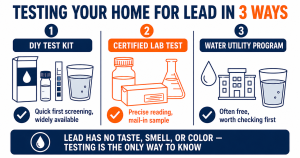
DIY lead test kits are widely available at hardware stores, home improvement retailers, and online, typically priced at the lower end of the cost spectrum for this kind of testing. They’re the most accessible starting point for most homeowners simply because there’s no waiting on a mailed sample or a utility’s schedule — the test happens right at your own sink.
Most kits use a color-change reaction: a test strip or a few drops of reagent are added to a water sample, and the resulting color is compared against a reference chart to indicate whether lead is present, sometimes with a rough concentration range. The appeal is speed and convenience — results are typically available within minutes rather than days, and no water sample needs to leave your house.
The tradeoff is precision. DIY kits are generally less sensitive and less accurate than laboratory analysis, and a color-chart comparison is inherently more subjective than a lab’s instrument-based reading. A DIY kit is genuinely useful as a first screening step — a reasonable way to decide whether further testing is warranted — but it shouldn’t be treated as the final word, particularly if the result is anything other than a clear negative, or if your household includes anyone in a higher-risk group.
Certified laboratory testing is the more accurate option, and the meaningful difference is what kind of answer it gives you. Rather than a simple color-based yes-or-no indication, a lab test returns a precise lead concentration reading, typically expressed in parts per billion, which lets you understand not just whether lead is present but roughly how much — a distinction that matters when deciding how urgently to act.
The process typically involves ordering a sample kit from an EPA-certified laboratory, either directly or through a state or local health department program, collecting your water sample according to the kit’s specific instructions, and mailing it back in the provided packaging. Results are usually available within a couple of weeks, which is a reasonable tradeoff for the added precision compared to an instant DIY result.
Lab testing is worth the extra step and modest added cost in a few specific situations: any home with elevated risk factors from the previous section, any home where a DIY kit returned a positive or ambiguous result, and any household with a pregnant member or young children, where a precise reading is more valuable than a rough screening. For homes with no particular risk factors and a negative DIY screening result, lab testing is a reasonable extra layer of confidence but less strictly necessary.
When choosing a lab, confirm it’s specifically certified for lead analysis in drinking water — most state environmental or health department websites maintain a list of certified labs, and many also offer low-cost or subsidized testing kits directly to residents, which is worth checking before paying full price through a private lab.
Many US water utilities offer free or low-cost lead testing programs to their customers, particularly in service areas with documented lead service line concerns. This is often the most overlooked option simply because homeowners don’t think to ask, defaulting straight to a retail test kit instead. Before purchasing anything, it’s worth a quick call or visit to your utility’s website to check what’s already available to you at no cost.
Beyond testing itself, water utilities can often confirm whether your home’s service line material is already on record — many utilities have mapped service line materials across their distribution area in recent years as part of federal reporting requirements, and this record can answer the service-line question directly without any testing at all.
This option is worth checking first specifically because it may cost nothing, and because a utility’s program is typically run through, or in coordination with, a certified lab, giving you accuracy comparable to paying for lab testing independently. The main limitation, covered in the warning below, is that utility testing usually focuses on the service line and water quality at the point it enters your property, not necessarily what happens to that water once it moves through your home’s own internal plumbing.
However you choose to test, sample collection technique has a real effect on whether the result reflects a realistic worst case or an artificially low reading. A few core principles apply regardless of which testing option you choose:
If you want to test more than one location — a kitchen tap and a bathroom tap a young child uses, for instance — collecting separate samples is worth the modest added cost, since lead levels can genuinely differ between fixtures in the same home.
A positive result is not a reason to panic, but it is a reason to act. The most immediate, accessible step is installing a certified lead-reducing water filter — either a faucet-mounted unit or a filtering pitcher, both widely available and requiring no plumbing modification to start using right away. Look specifically for a filter certified to NSF/ANSI Standard 53 for lead reduction, since not every water filter is rated for this specific contaminant. Our water filter pitchers review covers current options for an interim step.
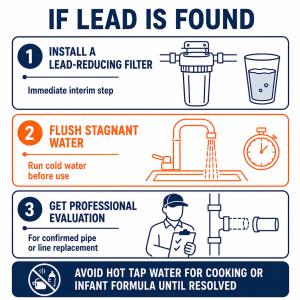
If the elevated reading is more likely tied to stagnant water in the pipes rather than the pipe material constantly leaching lead, flushing the line by running the cold tap for several minutes before drinking or cooking use can meaningfully reduce lead content for that draw. This is a reasonable short-term habit, though not a permanent fix if the underlying pipe material is the actual source.
For a confirmed lead source — a service line, a run of old solder, or a specific fixture — a professional evaluation is the appropriate next step, and the eventual fix is typically replacement of the specific plumbing found to contain lead. A licensed plumber can confirm which sections are affected and scope a replacement plan proportional to what testing actually found, rather than assuming the entire house needs repiping. In the meantime, avoid hot tap water for cooking or infant formula, since hot water draws more lead from pipe material than cold — heating cold water separately on the stove is a simple workaround.
If testing confirms lead in your home’s plumbing, or you need a professional evaluation before deciding on repairs, search PlumberArchive.com — the US plumber directory with 12,000+ verified local plumbers across all 50 states.
Get weekly plumbing tips and DIY guides delivered straight to your Facebook feed.
The most reliable starting points are your home’s age (built before 1986 carries meaningfully more risk) and your water utility’s service line records, which many utilities maintain and will share on request. Visually, lead pipe is dull gray, scratches easily to reveal shiny metal underneath, and won’t attract a magnet — unlike magnetic galvanized steel or reddish-brown copper. Our how to identify your pipe material guide covers this in more detail, though visual inspection alone isn’t a substitute for an actual water test.
DIY kits are a reasonable first screening tool, but they’re generally less precise than certified laboratory testing, since most rely on a color comparison rather than an instrument-based reading. Treat a negative DIY result as reasonably reassuring but not absolutely final, and treat any positive or ambiguous DIY result as a reason to follow up with certified lab testing for a precise concentration reading, especially in a higher-risk household.
No — boiling does not remove lead, and can actually concentrate it slightly as some of the water evaporates while the lead itself remains behind. This is a common misconception carried over from boiling’s effectiveness against certain biological contaminants, but lead is a metal, not a microorganism, and heat alone doesn’t eliminate it. A certified lead-reducing filter or a permanent plumbing fix is required to actually address lead, not boiling.
Annual retesting is a reasonable default for a home with known risk factors, such as a pre-1986 build or a known lead service line, since plumbing conditions and water chemistry can shift over time. Retest sooner than that if you’ve had any plumbing work done that could disturb old solder or pipe material, or if your water utility reports a change to the municipal supply’s treatment or chemistry that could affect how much lead existing pipes leach.
Lead in drinking water gives no visible warning, which is exactly why testing — not guessing — is the right approach for any home with a pre-1986 build, a known or suspected lead service line, or simply uncertainty about what’s behind the walls. A DIY kit is a reasonable, inexpensive first screening step, while certified lab testing or a water utility program give a more precise answer worth pursuing if that initial screening raises any concern. If you’re testing your water for one contaminant, it’s worth checking the others too — our guides to testing for radon and testing for bacteria cover the other common concerns.
If a test does come back positive, the path forward is straightforward: a certified filter for immediate protection, flushing as a short-term habit if stagnant water is the driver, and professional evaluation for a lasting fix. None of this requires alarm — just the willingness to test rather than assume, and to act proportionally to what the results actually show.
Prices and ratings may change. Always check Amazon for current prices.
✍️ About This Guide
PTR Editorial Team — Plumbing Guides. We compare manufacturer specifications, installation requirements, compatibility and available product documentation to help homeowners choose suitable tools and parts. How we review →
Not sure which tool fits your faucet nut? Identify the fixing, see how it lets go and check your clearance first. Then choose a tool, or use one you own.
Check your manual and the drain route first: gravity hose, built-in pump or external pump. Then see whether you need a dehumidifier hose at all.
Explore portable bidets that need no water-line connection, from bottle caps and squeeze bottles to battery-powered handhelds.

