Please note: Information in this comparison is based on our research at time of writing and is subject to change. If you have specific health concerns about your water, consult a certified water testing lab rather than relying on general guidance alone.
Introduction
Water softeners and reverse osmosis systems get confused constantly, and it’s an understandable mix-up — both are commonly installed near a kitchen sink, both get marketed under the broad umbrella of “water treatment,” and both promise to make your water better in some way. But they’re built to solve entirely different problems, and buying one expecting it to do the other’s job is one of the most common and expensive mistakes homeowners make in this category.
This comparison breaks down exactly what each system treats, whether one can substitute for the other, and how to decide which one (or both) actually fits your situation. If you haven’t confirmed whether you have hard water in the first place, our guide to testing your water for hardness is the right starting point, and our Best Water Softeners for Whole House review covers vetted picks once you know you need one.
✏️ Our Take
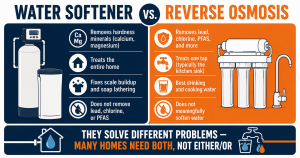
These two systems get confused constantly because they’re both installed near or under a kitchen sink and both make your water “better” — but they solve completely different problems. A water softener removes calcium and magnesium (hardness minerals) that cause scale buildup, dry skin, and poor soap lathering. A reverse osmosis system removes a much broader range of contaminants — lead, chlorine, PFAS, arsenic, and more — but does essentially nothing for hardness on its own. If you have hard water and buy an RO system expecting it to fix scale buildup on your fixtures, you’ll be disappointed. Many households with hard, contaminated water genuinely benefit from both systems working together, not one instead of the other.
What a Water Softener Actually Treats
A water softener removes calcium and magnesium — the dissolved minerals that make water “hard” — typically through an ion exchange process that swaps those minerals for sodium or potassium ions as water passes through a resin bed. Salt-free systems work differently, neutralizing the minerals’ ability to form scale rather than physically removing them, but the end goal is the same: preventing hardness from causing problems throughout your home.
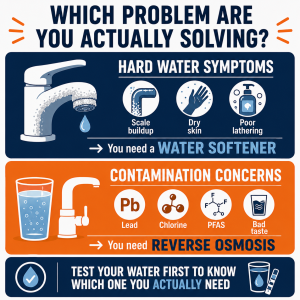
A softener directly addresses scale buildup on faucets and fixtures, dry skin and hair, poor soap and shampoo lathering, and the spotting and film that hard water leaves on dishes and glassware. Because it’s typically installed at the point where water enters the home, a properly sized softener treats every fixture in the house — showers, laundry, the water heater, and every tap — not just the kitchen sink.
The two main softener technologies work differently but aim at the same outcome. Salt-based (ion exchange) systems are the traditional and most effective option for genuinely hard water, physically removing calcium and magnesium from every drop that passes through. Salt-free conditioners use a different approach, crystallizing the minerals so they can’t stick to surfaces and form scale, without actually removing them from the water — a gentler, lower-maintenance option that some households prefer, though it’s generally considered less effective for severely hard water than true softening.
💡 Tip: A softener treats hardness specifically — it does essentially nothing to remove chlorine, lead, or other contaminants, which is the most common misconception homeowners have about what a softener actually does.
What a Reverse Osmosis System Actually Treats
A reverse osmosis (RO) system works on a completely different principle, forcing water through a semi-permeable membrane with pores small enough to filter out a wide range of dissolved contaminants at a molecular level. Water passes through; most of what’s dissolved in it doesn’t, and gets flushed away as wastewater.
That membrane is effective against a genuinely broad list of contaminants a softener doesn’t touch at all — lead, chlorine, PFAS, arsenic, nitrates, and many others depending on the specific system and its filter stages. RO systems are typically installed under a single sink, most often the kitchen, treating drinking and cooking water specifically at that one tap rather than water used throughout the entire home.
Most residential RO systems are multi-stage, pairing the membrane with a sediment pre-filter and one or more carbon filters that handle chlorine and larger particles before water even reaches the membrane, then often a final polishing carbon stage afterward for taste. This layered approach is why RO systems are generally considered the most thorough option for drinking water specifically, even though the tradeoff is limited coverage — a small volume treated well, rather than a whole home treated broadly.
💡 Tip: RO systems do technically reduce a small amount of hardness as a side effect of the filtration process, but the effect is minor and inconsistent — never rely on an RO system as your actual hardness solution.
Can One Replace the Other?
No, and understanding why is the key to this whole comparison. A water softener cannot remove contaminants like lead or PFAS — it’s simply not designed for that purpose, no matter how effectively it treats hardness. The ion exchange process that softens water has nothing to do with filtering out the kind of dissolved contaminants an RO membrane is built to catch.
The reverse is equally true. An RO system cannot meaningfully soften water or prevent scale buildup throughout your home’s plumbing and appliances, since it treats a small volume of water at one tap rather than the full flow of water moving through your pipes, water heater, and fixtures. If contaminant reduction beyond hardness is also a concern for you, our Best Under-Sink Water Filters review covers RO and other under-sink filtration options in more depth.
A useful way to think about it: a softener changes the mineral composition of every drop of water flowing through your home, while an RO system polishes a small stream of that water further at one specific point of use. One operates at the scale of your whole plumbing system; the other operates at the scale of a single glass of water. Neither design choice is a flaw — they’re simply built for different jobs, and expecting either to expand beyond its actual scope is where the confusion (and the disappointment) comes from.
⚠️ Warning: Don’t buy an RO system expecting it to solve a hardness problem, and don’t expect a softener to improve your water’s safety from contaminants — confirm which specific issue you’re trying to solve before choosing either system, or you may end up with the wrong solution entirely.
Installation and Coverage — Whole Home vs Single Tap
A water softener is installed at the main water line, typically where it enters the home, so treated water reaches every fixture — showers, laundry, the kitchen and bathroom sinks, and the water heater. An RO system, by contrast, is installed under a single sink, most commonly the kitchen, treating only the drinking and cooking water drawn from that specific tap.
Households in hard water regions like the Southwest, parts of Texas, and the Upper Midwest often assume an RO system under the sink will also solve their scale and soap-lathering problems, since both are marketed broadly as “water treatment” — but RO systems are typically sized for drinking water at one or two taps, not whole-home hardness treatment, so they won’t address scale buildup on your water heater, pipes, or fixtures throughout the house. A whole-home water softener addresses hardness at the source, while an RO system is best understood as a final polishing step for your actual drinking water.
Installation complexity also differs meaningfully between the two. A whole-home softener ties into your main water line, which typically means a larger unit requiring dedicated space (often a basement, garage, or utility closet) plus a drain line for the ion exchange process and periodic salt refills. An under-sink RO system is comparatively simple, fitting in the cabinet beneath the sink it serves, with a dedicated small faucet at the countertop and filter cartridges that swap out during routine maintenance — a smaller footprint but also, by design, a smaller scope of coverage.
💡 Tip: If you want treated water at multiple taps throughout your home, whole-house RO systems exist but are significantly more expensive and complex to install than the common single-tap under-sink version.
Cost Comparison
A whole-home water softener carries a higher upfront cost ($$-$$$) given its size and whole-house installation, plus ongoing salt costs for salt-based units that need periodic refilling (see our roundup of the best water softener salt for what to buy). A single-tap RO system generally costs less upfront ($-$$) since it only needs to treat one tap’s worth of flow, plus periodic filter and membrane replacement costs to keep it performing correctly.
💡 Tip: Factor in that a softener protects your entire home’s plumbing and appliances from scale damage over time, which can offset its higher upfront cost through extended appliance lifespan — the comparison isn’t just about the sticker price.
Do You Need Both?
Many households with both hard water and contamination concerns — lead pipes in an older home, known PFAS issues in the area, or simply wanting the cleanest possible drinking water — genuinely benefit from running both systems together rather than choosing just one. A softener protects your whole home’s plumbing and appliances from hardness damage, while an RO system gives you the cleanest possible drinking and cooking water at the tap. Neither one covers the other’s job, so together they cover meaningfully more ground than either alone.
There’s also a practical installation benefit to running both: an RO system installed after a whole-home softener actually performs slightly better over time, since softened water reduces mineral scale buildup on the RO membrane itself, extending its usable life between replacements. This isn’t a requirement — RO systems work fine on hard water too — but it’s a genuine side benefit for households that already have or are planning to install both.
💡 Tip: If budget only allows for one system right now, prioritize based on your test results — a softener first if your hardness test came back high, an RO system first if you’re specifically concerned about contaminants like lead in an older home.
Which Should You Choose?
The table below maps the most common decision factors to whichever system actually wins on that point.
| Factor |
Winner |
| Removes hardness minerals |
WATER SOFTENER |
| Removes lead, PFAS, and other contaminants |
REVERSE OSMOSIS |
| Whole-home coverage |
WATER SOFTENER |
| Best drinking water taste and safety |
REVERSE OSMOSIS |
| Lower upfront cost (single-tap systems) |
REVERSE OSMOSIS |
| Protects appliances and pipes from scale |
WATER SOFTENER |
| Best for severely hard water |
WATER SOFTENER |
| Best for known contamination concerns |
REVERSE OSMOSIS |
Choose a Water Softener If:
- Your water testing confirmed moderate to severe hardness
- You’re seeing scale buildup, poor lathering, or appliance strain from hard water
If this describes your situation but you haven’t confirmed your actual hardness level yet, our guide to testing your water for hardness is the right first step before buying anything.
Choose Reverse Osmosis If:
- You’re specifically concerned about contaminants like lead, chlorine, or PFAS
- You want the cleanest possible water at your kitchen tap for drinking and cooking
Need a Professional Plumber?
Whole-home softener installation and under-sink RO setups both involve real plumbing work, and getting the connection point right matters for long-term reliability.
Find a licensed plumber in your area at PlumberArchive.com — the US plumber directory with 12,000+ verified local plumbers across all 50 states.
Find a trusted plumber near you → PlumberArchive.com
Frequently Asked Questions
Q: Will a reverse osmosis system fix hard water?
Not meaningfully. An RO system may reduce hardness slightly as a side effect of filtering water through its membrane, but the effect is minor and inconsistent, and it only treats the single tap it’s installed under rather than your whole home’s water supply. If hardness is your actual concern, a dedicated water softener is the correct tool, not an RO system.
Q: Do I need both a water softener and an RO system?
It depends on your specific water concerns. If you have both confirmed hard water and contamination concerns like lead or PFAS, many households do benefit from running both together, since neither system covers the other’s job. If you only have one issue — just hardness, or just a contaminant concern — you likely only need the corresponding system.
Q: Which is more expensive, a water softener or an RO system?
A whole-home water softener typically has a higher upfront cost than a single-tap RO system, given the difference in scale and installation complexity, plus ongoing salt costs for salt-based units. An RO system costs less upfront but requires periodic filter and membrane replacements. Factor in that a softener also protects your whole home’s appliances from scale damage, which can offset its higher initial cost over time.
Q: Does a water softener make water safe to drink?
A water softener doesn’t meaningfully change your water’s safety, since it’s designed specifically to remove hardness minerals, not contaminants like lead, bacteria, or PFAS. Softened water is generally just as safe to drink as your water was before softening, but if safety and contaminant reduction are your actual concern, a reverse osmosis system or another certified filtration method is the right tool for that job.
Conclusion
A water softener and a reverse osmosis system solve fundamentally different problems and aren’t interchangeable, no matter how similarly they’re marketed. A softener treats hardness throughout your entire home; an RO system treats a broad range of contaminants at a single tap. Confusing the two, or expecting one to do the other’s job, is how homeowners end up disappointed with a system that was never going to solve their actual problem.
Test your water first to know whether hardness, contamination, or both are your actual concern, rather than guessing based on marketing alone. Many households genuinely benefit from running both systems together — a softener protecting the whole home’s plumbing and appliances, and an RO system delivering the cleanest possible water at the kitchen tap.
If you haven’t confirmed your hardness level yet, start with our guide to testing your water for hardness. Once you know what you’re dealing with, our Best Water Softeners for Whole House review and Best Under-Sink Water Filters review cover vetted picks for whichever system — or both — actually fits your situation.
✍️ About This Comparison
PTR Editorial Team — Product Comparisons. We compare manufacturer specifications, installation requirements, compatibility and available product documentation to help homeowners choose suitable tools and parts. How we review →