Please note: Product availability and information are based on our research at time of writing and are subject to change. Always check Amazon for the latest details before purchasing.
Introduction
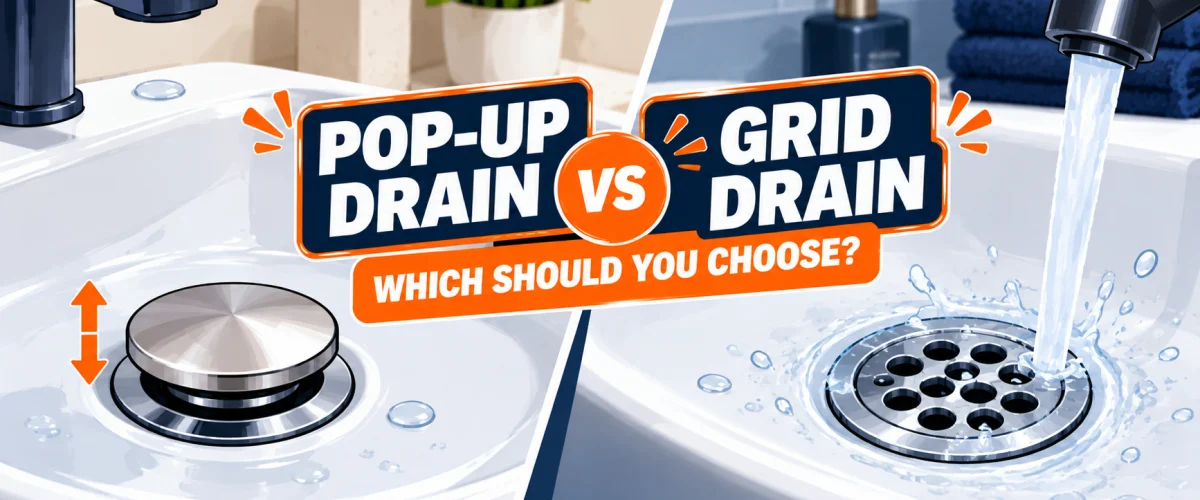
If you’re replacing a bathroom sink drain, you’ll likely land on two very different mechanisms: a pop-up assembly, which seals with a stopper you raise and lower, and a grid drain, a fixed open grate with no moving parts at all. They solve the same basic problem, but they work, look, and maintain differently enough that the choice is worth more than a minute’s thought.
If you’ve already decided on a pop-up, see our pop-up drain assemblies review and our step-by-step install guide.
✏️ Our Take
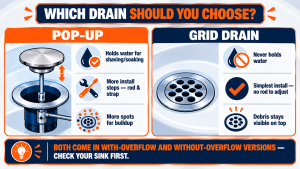
The real decision comes down to one question: do you ever need the sink to hold water? If yes, a pop-up is the only real option. If no, a grid drain is simpler to install, easier to keep clear of debris, and typically cheaper.
How Each One Works
A pop-up drain uses a stopper connected to a pivot rod and a lift rod strap, raised and lowered by a knob behind the faucet or, on push-type models, by pressing the stopper itself. It can hold water in the basin for shaving or soaking, and seals the opening when closed.
A grid drain has no stopper and no rod. It’s a fixed, open grate that sits in the drain opening permanently. Water always drains through it; it can never hold water in the basin. There’s nothing to adjust, align, or replace if a mechanism wears out, because there is no mechanism.
Clog Resistance and Maintenance
This is where the two genuinely diverge. Kingston Brass, a bathroom fixture manufacturer, describes grid drains as designed to “efficiently capture hair, soap scum, and other particles, reducing the likelihood of clogs,” and specifically recommends them for households where people shed a lot of hair. The open grate traps debris at the surface, where it’s easy to see and clear, rather than letting it collect around a stopper and pivot rod further down the assembly.
A pop-up, by contrast, has more places for hair and soap scum to accumulate: around the stopper itself, and on the pivot rod beneath it. It isn’t harder to keep clean, but it has more surface area where buildup happens, and clearing it usually means lifting or removing the stopper rather than just wiping a grate.
Function: Can It Hold Water?
This is the clearest functional tradeoff, and it should usually decide the choice on its own. A pop-up can seal the drain and hold water in the basin, which matters if you shave, soak items, or just prefer a sink that can fill. A grid drain never seals; water runs straight through at all times. If holding water matters to you, a grid drain is off the table regardless of its other advantages.
Look and Feel
Kingston Brass frames push-type pop-ups as the “sleek” and “contemporary” choice for a busy bathroom, with the stopper’s low profile fitting a modern, minimal look. A grid drain’s fixed grate reads a little more utilitarian or industrial by comparison, though it has its own clean, simple look that some buyers prefer precisely because there’s no visible mechanism to clash with a faucet’s styling.
Installation and Retrofit
A grid drain is the simpler install. Listings for Artiwell’s grid-drain line describe no plumber’s putty needed and no rod or strap to connect and adjust, since there’s nothing to connect. A pop-up needs the flange seated with sealant, the pivot rod threaded and clipped, and the lift rod strap positioned and adjusted until the open and close gap is right; our install guide covers that full sequence.
One sizing detail matters for either type: confirm your sink’s overflow configuration before buying. Both pop-up and grid drains are sold in matched with-overflow and without-overflow versions, so this is a question about your specific sink, not a reason to prefer one mechanism over the other. Buying the wrong overflow variant, not the mechanism itself, is what causes a fit problem.
Cost
Comparing the same brand, finish, and overflow configuration, an Artiwell grid drain runs about $16, against roughly $21 for Artiwell’s matched pop-up. The grid drain is the cheaper option by a real margin, not just within normal price noise, though the gap will vary by brand and finish.
A Note on Demand and Availability
Grid drains are a smaller, newer category on Amazon than pop-up assemblies; the listings we checked carry meaningfully fewer ratings than the established pop-up market. That doesn’t mean they’re a poor choice, since the mechanism itself is simple and well-established in plumbing generally, but it’s worth knowing you’re shopping a thinner field of options than you would for a pop-up.
Which Should You Choose?
Choose a pop-up if you need the sink to hold water, even occasionally, or if you want a stopper you can lift out for easy cleaning.
Choose a grid drain if you never need to hold water in the basin, you deal with a lot of hair or soap scum, you want the simplest possible install, or you’d rather not have any moving parts to maintain.
Need a Professional Plumber?
Swapping a bathroom sink drain is a genuine DIY job for almost everyone. But if your inspection turns up a cracked drain body, a damaged flange opening, or a leak elsewhere in the line, that’s worth a plumber’s assessment before you invest more time or materials.
Find a licensed plumber in your area at PlumberArchive.com — the US plumber directory with 12,000+ verified local plumbers across all 50 states.
Find a trusted plumber near you → PlumberArchive.com
Follow Us on Facebook
Get weekly plumbing tips, honest tool reviews and DIY maintenance guides delivered straight to your Facebook feed. We cover toilet repairs, bathroom fixtures, pipe maintenance and everything in between — written for US homeowners who want to handle more themselves.
Follow PlumbingToolsReview on Facebook →
Frequently Asked Questions
Q: Can I replace a pop-up with a grid drain in the same sink?
Usually, yes, as long as the overflow configuration matches your sink. Check whether your current drain is a with-overflow or without-overflow style before buying a replacement.
Q: Is a grid drain harder to find than a pop-up?
The category is smaller and newer, with fewer established brands and listings than pop-up assemblies, though real, credible options exist from several manufacturers.
Q: Does a grid drain clog less than a pop-up?
It tends to trap debris more visibly at the surface, which makes it easier to spot and clear, according to manufacturer guidance. Neither type is clog-proof.
Q: Which is cheaper?
In a same-brand, same-configuration comparison, grid drains run noticeably less than pop-ups, though prices vary by brand and finish.
Conclusion
The real decision comes down to one question: do you ever need the sink to hold water? If yes, a pop-up is the only real option. If no, a grid drain is simpler to install, easier to keep clear of debris, and typically cheaper. Either way, double-check your sink’s overflow configuration before you buy. For the pop-up side, see our pop-up drain assemblies review and installation guide.
✍️ About This Comparison
Written by Sarah Mitchell, Home Improvement Editor at PlumbingToolsReview — specializing in helping homeowners make smart buying decisions without overspending. Learn how we test →