Comparisons
2 Oct 2026

Pop-Up Drain vs Grid Drain: Which Should You Choose?
Pop-up drains seal to hold water; grid drains never close but resist clogs better and cost less. Here's how to choose between them for your bathroom sink.
Test strips, digital meters or send-to-lab testing? Match the method to your situation — screening, ongoing monitoring, or a real health concern.
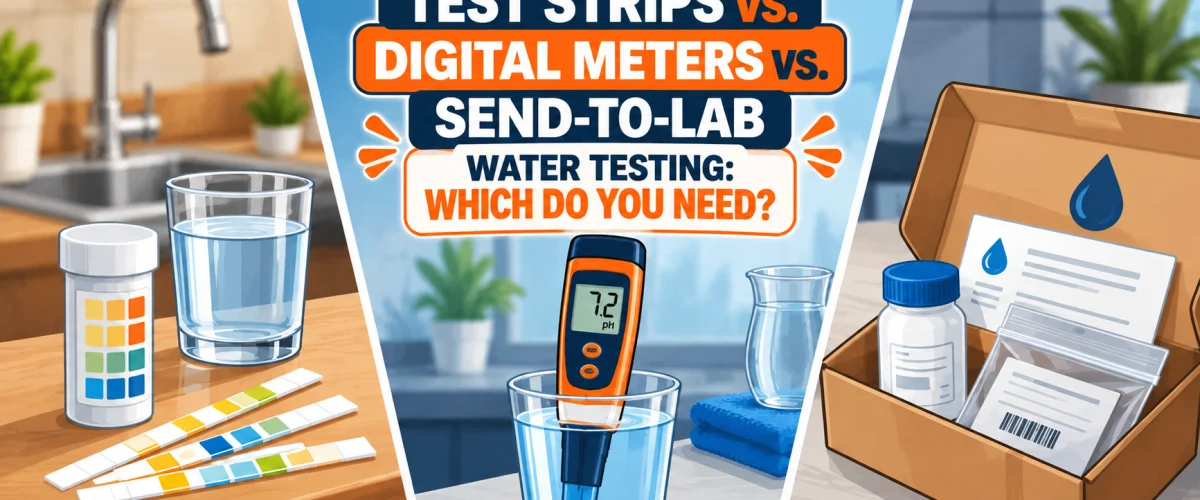
Please note: This comparison covers testing methods in general, not specific products. Specifications and what a given kit or meter measures vary by brand and model, so always check the details of the specific product you’re considering.
When something about your water is in question, the first decision isn’t which product to buy — it’s which method actually answers your question. Test strips, digital meters and send-to-lab testing aren’t three tiers of the same thing; they measure different kinds of information, at different levels of certainty, for different situations.
Our best water test kits roundup compares specific products built around these methods. This comparison does something narrower: it lays out what each method actually does and gives, and matches your situation to the right one. If your specific question is water hardness, our guide to testing your water for hardness already walks through strip, titration and lab options for that one parameter in detail; this comparison stays at the general level, across screening, monitoring and health-related testing.
✏️ Our Take
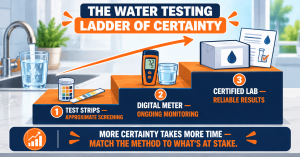
Think of these as a ladder, not a lineup. Test strips are a fast, cheap first look across several parameters, and they’re approximate by design. A digital meter reads one general property, total dissolved solids, precisely and repeatably, but it can’t tell you what those solids are. Send-to-lab testing is the only one of the three that returns results reliable enough for an actual health or safety decision. Screen with a strip or a meter when you’re curious or tracking change; go straight to a lab when the answer has to be right.
IN THIS GUIDE
The table sets the three methods side by side on the factors that decide which one fits your situation. The sections that follow explain the reasoning and walk through specific situations.
| Factor | Test Strips | Digital Meter | Send-to-Lab |
|---|---|---|---|
| Precision | Approximate — a color band, not a number | A single number for dissolved solids as a whole | Instrument-based results for specific contaminants |
| What it covers | Several parameters at once, screened roughly | One general property, not any specific substance | Exactly what the panel tests for, precisely measured |
| Cost | $ | $ (one-time, then reusable) | $$$ to $$$$, depending on the panel |
| Speed | Minutes | Seconds, and repeatable anytime | Days to weeks, since the sample travels to a lab |
| Best for | A first look, or checking several things at once | Tracking change over time, such as a filter’s performance | Any result that has to be right |
Test strips and color-chart kits give an approximate reading across several parameters at once. You dip the strip, wait a set time, and compare the color against a printed chart. That comparison is inherently subjective, since judging a shade against a reference band leaves room for interpretation, and the result is a range rather than a precise concentration. Strips are a screening tool: useful for a first look, not for a final answer.
Digital meters, most commonly total dissolved solids (TDS) meters, measure one general property: the combined amount of everything dissolved in the water, reported as a single number. A meter cannot identify what’s in that number. It cannot detect lead, bacteria, arsenic or any other specific contaminant, and it cannot tell you your water is safe. What it does well is give a precise, repeatable reading of one property, which makes it suited to tracking change over time rather than diagnosing a specific concern.
A meter’s reading also rises with ordinary minerals as easily as with something you’d actually want to know about. Water hardness alone can push the number up without being a health concern, so a rising reading on its own isn’t evidence of contamination. It tells you something changed; it doesn’t tell you what changed or whether it matters.
A titration-based kit, such as the drop-count kits used for water hardness, sits in a similar place to a meter: more precise than a strip for the single parameter it measures, but still a DIY method rather than a certified lab result. Our guide to testing your water for hardness covers this method in detail for hardness specifically.
Send-to-lab testing is the only method here that returns instrument-based, certified results for specific contaminants. You collect a sample following the kit’s instructions and mail it to a lab, and the report comes back naming what was tested for and how much of it, if any, was found. It’s slower and costs more than a strip or a meter, and it’s the reliable route when a result has to be right.
Certainty and cost rise together, and so does the time it takes to get an answer. A strip gives you a same-day, approximate answer to several questions for the lowest cost. A meter gives you an instant, precise answer to one narrow question, the total dissolved solids in the water, and nothing about what’s causing that number. A lab test gives you a certain answer to a specific question, at a higher cost and after a wait for the sample to be analyzed.
The mistake to avoid is treating a screening result as if it settles a health question, or paying for comprehensive lab analysis when a quick screen would have answered the question just as well. Match the method to the stakes: screen first when you’re curious, and go to a lab directly when the answer needs to hold up.
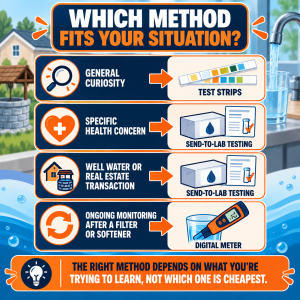
This is the most common reason people test water at all: no symptom, no specific worry, just wanting a baseline sense of what’s coming out of the tap. It’s also the situation where screening tools do their best work, since the stakes are low and the goal is information rather than a decision that depends on the answer.
If you want a general sense of what’s in your tap water, without a specific concern driving the question, a strip or a meter is the right starting point. A multi-parameter strip gives you a broad first look across several common concerns at once, cheaply and in minutes. A TDS meter is the better fit if your interest is narrower, tracking a single number over time rather than screening several parameters at once.
Neither result is a final answer. If anything comes back positive, ambiguous, or otherwise concerning, that’s the point to move to certified lab testing rather than treating the screen as conclusive.
The line here is simple: does the answer change what you do next in a way that matters for someone’s health? If yes, treat it as a lab-testing situation from the start, rather than screening first and hoping for reassurance. A screening result that comes back clear can feel like permission to stop, but a strip or a meter was never built to carry that kind of certainty.
This applies whether the concern is lead in older plumbing, bacteria in a private well, or radon in your water supply. Our guide to testing for lead in your home’s plumbing, guide to testing for bacteria in well water and guide to testing for radon in your home’s water supply each explain what drives the concern for that specific hazard and how to get it properly tested. A strip or a meter cannot rule any of these in or out with the confidence a health decision needs.
This is especially true for a household with an infant, a pregnant member, or anyone with a compromised immune system, where the cost of being wrong is highest and a DIY screen isn’t the appropriate level of certainty.
Your water source changes both your testing obligations and what’s available for free. Municipal customers can access their utility’s Consumer Confidence Report, which the utility is required to publish annually and make available to every customer, covering the contaminants it’s required to test for. That report costs nothing and can answer many general questions before you buy anything. Private well owners have no equivalent free report, since nobody else is testing their well, which is why routine self-testing (and periodic lab testing, especially for bacteria) falls entirely on the owner.
Our well water vs municipal water comparison covers this distinction in full, including what a municipal report does and doesn’t tell you and what a well owner’s testing responsibilities look like by comparison.
This is the situation a TDS meter suits best. Once you’ve installed a water softener, a reverse osmosis system, or another filter, a meter lets you check performance in seconds: measure before and after the system, and a rising number on the treated side is a sign a membrane or cartridge is wearing out. This is tracking change, not diagnosing a health concern, and it’s the job a meter is built for.
A meter isn’t the right tool to confirm the softener or filter is removing a specific contaminant it’s rated for. For that, a lab test of the treated water against the specific claim is the only way to confirm it.
The reasoning is the same as a specific health concern, with an added wrinkle: the result has to satisfy someone else, not just you. A lender, an inspector, or local code sets the requirement, and a self-administered strip result won’t meet it even if it happens to be accurate. Budget the time a lab test takes into the transaction timeline, since it’s slower than a screen and closing dates don’t always allow for a retest if something goes wrong with the sample.
A home purchase involving a private well is not a DIY-strip situation. Lenders and local code frequently require a certified lab test of the well before closing, and a real estate transaction is exactly the kind of result that has to hold up to outside scrutiny, not just satisfy your own curiosity. Strips and meters have no place in this process; go straight to a certified lab, and confirm with your lender or local health department which specific tests are required before you order one.
Work through these questions in order:
Costs here are general comparisons and can change over time.
If a test result points to a problem with your plumbing, or you’re not sure how to interpret a result, a licensed plumber can help you figure out the next step. Find a licensed plumber in your area at PlumberArchive.com — the US plumber directory with 12,151+ verified local plumbers across all 50 states.
Get weekly plumbing tips, honest tool reviews and DIY guides delivered to your Facebook feed.
For a first screen, yes, within their limits: they give an approximate range across several parameters, not a precise number, and reading a color against a chart leaves room for interpretation. Treat a clear result as reassuring, not conclusive, and treat any positive or ambiguous result as a reason to move to certified lab testing.
No. A TDS meter reports total dissolved solids as one number, and it can’t identify what those solids are, so it can’t detect lead, bacteria or any specific contaminant. A low reading doesn’t mean your water is safe, and a high reading doesn’t tell you what’s causing it. Its real value is tracking change, such as confirming a filter or softener is still performing.
You’re paying for instrument-based analysis and a network of certified labs rather than a color chart or a general reading. That’s also why it’s the only method reliable enough for an actual health or safety decision, and it’s the appropriate cost for a result that has to hold up.
Often less urgently than a private well owner, since your utility publishes an annual Consumer Confidence Report covering the contaminants it’s required to test for, and that report is free. But aging pipes, including your own home’s plumbing, can introduce problems the utility’s report won’t catch, so a specific concern such as lead still calls for its own test.
These three methods answer different questions, and the right one depends on what you’re actually trying to find out, not which is objectively best. A test strip is the cheapest, fastest first look across several parameters, approximate by design. A digital meter gives a precise, repeatable read on one general property, useful for tracking change but blind to any specific contaminant. Certified lab testing is the only method that returns results reliable enough for an actual health or safety decision.
Screen first when you’re curious or monitoring a system you already trust, and go straight to a lab when a specific health concern, a real estate transaction, or a lender’s requirement is involved. Once you’ve settled on a method, our best water test kits roundup covers specific products built around each one, and our testing guides for guide to testing for lead in your home’s plumbing, guide to testing for radon in your home’s water supply and guide to testing for bacteria in well water walk through the process for each hazard specifically.
✍️ About This Comparison
Written by Sarah Mitchell, Home Improvement Editor at PlumbingToolsReview — specializing in helping homeowners make smart buying decisions without overspending. Learn how we test →
Pop-up drains seal to hold water; grid drains never close but resist clogs better and cost less. Here's how to choose between them for your bathroom sink.
25-foot vs 50-foot drain snake: compare handling, the cable diameter trade-off and the jobs that justify extra length, plus where 50 feet stops.
Wood vs plastic toilet seats: what molded wood really is, how each is cleaned and how each fails, and how to choose, based on manufacturer guidance.

