Please note: Information in this comparison is based on our research at time of writing and is subject to change. Always confirm your specific sump pump system’s specifications before purchasing a backup unit.
Introduction
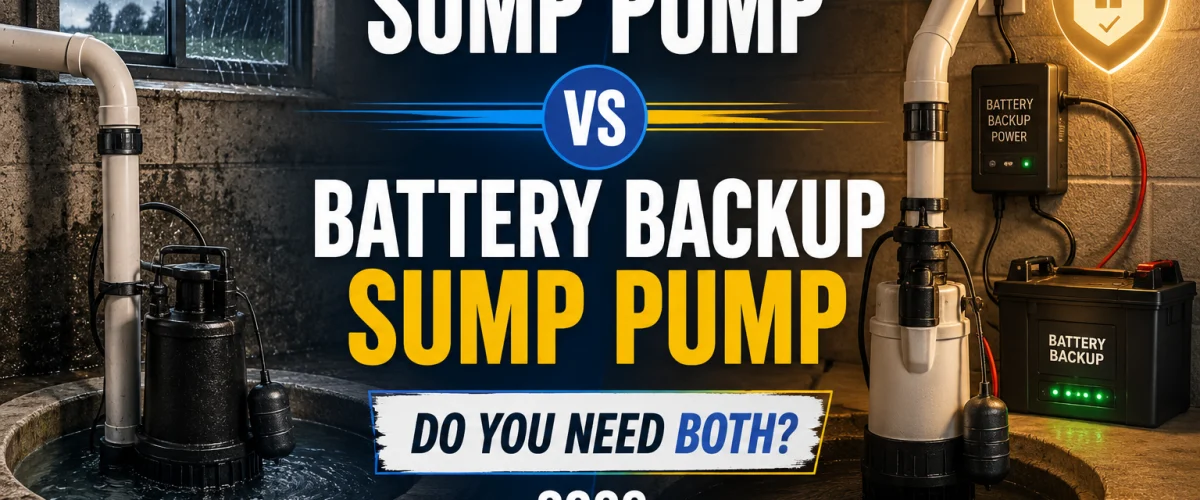
Unlike most comparisons on this site, this isn’t really a question of choosing Product A over Product B. A battery backup sump pump doesn’t replace your primary pump — it’s installed alongside it, wired to its own dedicated battery, and sits idle until the primary system loses power or fails mechanically. Every home with a sump pump already has the first half of this comparison installed; the actual decision is whether the second half, a backup pump layered on top of it, is worth adding.
That distinction matters because a standard AC-powered sump pump does its job well under normal conditions. It’s one specific failure mode — losing power during the exact storms that push the most water toward your foundation — that a battery backup exists to solve. This comparison walks through how each system works, what a battery backup actually protects against, how long it can run on stored charge, and a straightforward framework for deciding whether your home needs that extra layer of protection or whether a single, well-maintained primary pump is enough.
At a Glance
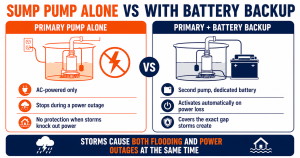
Standard Primary Sump Pump Alone
- AC-powered, runs off household electricity
- Handles normal water intrusion reliably
- Fails during power outages — precisely when storms cause the most water intrusion
Primary + Battery Backup System
- Adds a second pump powered by a dedicated battery
- Activates automatically if the primary loses power or fails
- Runs for a limited time on battery charge, not indefinitely
✏️ Our Take
This isn’t really a choice between two products — it’s a question of whether your primary sump pump alone is enough protection, or whether it’s worth adding a second layer. A standard AC-powered sump pump handles routine water intrusion perfectly well, but it has one significant blind spot: it stops working the moment the power goes out, which is often exactly when heavy storms are pushing the most water toward your foundation. A battery backup system exists specifically to cover that gap. Whether it’s worth the added cost comes down to your home’s flood risk, how often your power goes out during storms, and how much damage a failed pump would cause.
Quick Comparison Table
The table below maps the most common decision factors to whichever setup actually wins on that point, based on everything covered in this comparison.
| Factor |
Winner |
| Lower upfront cost |
STANDARD PUMP ALONE |
| Protection during a power outage |
WITH BATTERY BACKUP |
| Protection if the primary pump fails mechanically |
WITH BATTERY BACKUP |
| Simpler installation and maintenance |
STANDARD PUMP ALONE |
| Peace of mind during severe storms |
WITH BATTERY BACKUP |
| Unlimited runtime with no charge dependency |
STANDARD PUMP ALONE |
| Best fit for high flood-risk homes |
WITH BATTERY BACKUP |
| Lower long-term cost (no battery replacement) |
STANDARD PUMP ALONE |
How a Standard Sump Pump Works
A standard sump pump is an AC-powered pump that sits inside a basin, or sump pit, dug into the lowest point of a basement or crawlspace floor. As groundwater and rainwater naturally drain toward that low point, it collects in the basin rather than spreading across the floor. Inside the basin, a float switch rides on the surface of the rising water, and once the water reaches a set level, the switch triggers the pump to turn on automatically — no manual intervention required.
Once activated, the pump draws water out of the basin and pushes it through a discharge pipe that carries it well away from the foundation, typically to a storm drain, a dry well, or simply a safe distance out into the yard. When the water level in the basin drops back below the float switch’s threshold, the pump shuts itself off automatically and waits for the cycle to repeat the next time water rises.
Under normal conditions, this setup is genuinely reliable. A properly sized, well-maintained standard sump pump handles routine groundwater seepage and everyday rainwater intrusion without issue, cycling on and off as needed for years at a time. If you’re shopping for a primary unit, our sump pump reviews compare current models across price tiers to help you pick one sized correctly for your basin and expected water volume. The entire system, though, depends on one thing that isn’t always guaranteed: a continuous supply of household AC power.
How a Battery Backup System Works
A battery backup sump pump system adds a second, physically separate pump to the same basin as your primary unit, but that second pump is wired to its own dedicated deep-cycle battery rather than to household AC power. This is an important distinction: the backup pump doesn’t share a power source with the primary pump at all, which is exactly what allows it to keep working when the primary loses power completely.
The backup pump’s controller constantly monitors the primary pump. If household power drops out, or if the primary pump fails mechanically or gets overwhelmed by a volume of water it can’t keep up with, the backup pump activates automatically and begins pumping from the same basin using its own discharge line. There’s no manual switch to flip and no need for anyone to be home for it to kick in — the whole point of the system is that it responds on its own, at any hour, without supervision.
Between activations, the battery sits on a continuous trickle charger, topping itself off so it stays at or near full capacity and is ready the moment it’s needed. Most systems are designed to sit in this standby state for months or years without ever running, which is part of why the battery itself is a wear item that needs periodic attention even when nothing has gone wrong. In areas with strong, reliable municipal water pressure, some backup systems offer a water-powered alternative instead of a battery — using the home’s own water pressure to create suction that removes basin water — though this approach depends entirely on water pressure staying available and isn’t a fit for every property or municipal water setup.
The Power Outage Problem
The core rationale for a battery backup comes down to a simple but easy-to-overlook overlap: the weather conditions most likely to flood a basement are also the weather conditions most likely to knock out household power. Severe thunderstorms, hurricanes, and heavy winter storms all combine high rainfall or rapid snowmelt with the kind of wind, ice, and lightning that damages power lines and trips grid outages. These aren’t two unrelated risks that happen to occur separately — they’re frequently the exact same storm system causing both problems at once.
That overlap is precisely what turns a standard sump pump’s single point of failure into a real vulnerability. A pump that works flawlessly for years of routine, low-stakes rainfall can be rendered completely useless during the one event where it matters most, simply because the same storm that’s pushing the most water toward the foundation has also cut the power the pump depends on. The pump doesn’t fail because it’s poorly made or improperly installed — it fails because it was never designed to run without electricity in the first place.
⚠️ Warning: A sump pump with no backup power source provides zero protection during the exact scenario it’s most likely to be needed — a severe storm that knocks out power while also pushing more water toward your foundation.
Runtime and Battery Life Limitations
It’s worth being realistic about what a battery backup actually buys you: it isn’t unlimited runtime, and it isn’t a permanent stand-in for the primary pump. Battery capacity is finite, and exactly how long a backup system can keep running depends on the size of the battery, the condition of its charge going into the outage, and — critically — how frequently the pump needs to cycle on and off to keep up with incoming water. A basin that only needs occasional short pumping cycles will get far more total runtime out of a given battery than one that has to run near-continuously during a heavy storm.
Manufacturers typically rate backup systems for somewhere between several hours and a bit over a full day of intermittent operation on a single charge, though the real-world figure varies significantly based on the specific battery and pump combination and how hard the system is working. This is meant to bridge a gap — covering the length of a typical storm-related power outage — rather than to run indefinitely. If an outage stretches on for multiple days, a battery backup alone, without power restored or a generator brought in, will eventually be depleted just like the primary pump would be without power.
💡 Tip: Battery backup runtime is usually listed in terms of total pump cycles or hours of continuous run time — check this figure against how long your area’s power outages typically last, not just whether the system exists.
Cost Considerations
A battery backup system adds a meaningful amount to the upfront cost of protecting your basement, on top of whatever you’ve already spent on the primary pump itself. The backup pump, its controller, and the deep-cycle battery are all separate components from the primary unit, which puts a complete battery backup system solidly into a higher price tier than the primary pump alone — generally landing in the $$$ to $$$$ range once the full kit and battery are accounted for, compared to the $ to $$ range typical of a standalone primary pump.
That cost doesn’t end at installation, either. The battery itself is a wear component that degrades over time regardless of how often it’s actually called into service, and most manufacturers recommend replacing it on a multi-year cycle to keep the system reliable — an ongoing cost that a standalone primary pump simply doesn’t have. Weighed in isolation, that’s a real additional expense. Weighed against the cost of a flooded, unprotected basement — water-damaged flooring, drywall, stored belongings, and potential mold remediation — the calculation looks very different for a lot of homeowners, which is really the crux of the decision covered in the next section.
Do You Need a Battery Backup?
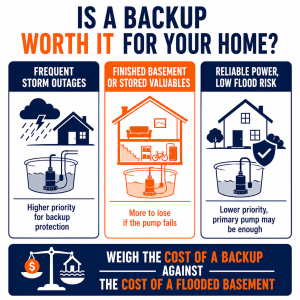
A battery backup is a higher priority for homes in areas that experience frequent storm-related power outages, since that’s precisely the failure mode the system is built to cover. It’s also a higher priority for homes with finished basements, home offices, or valuable stored items at ground level or below, where even a relatively short flooding event can cause disproportionate damage compared to an unfinished utility space. Homes with any history of relying heavily on the sump pump — meaning the basin fills often enough that the pump is doing real, regular work rather than sitting mostly idle — are also better candidates, since a mechanical failure or power loss in that situation is more consequential than in a basement that rarely sees meaningful water.
On the other end, a battery backup is a lower priority for homes with minimal basement flood risk to begin with, such as those on naturally well-drained, elevated ground, or for homes served by highly reliable local power infrastructure with a strong track record of staying online through storms. In those cases, the added cost buys protection against a scenario that’s genuinely unlikely to occur, and the money may be better spent elsewhere — on annual sump pump maintenance, for instance, or on complementary drainage improvements around the foundation.
Battery backup sump pumps are particularly worth considering across much of the US in regions prone to severe thunderstorms, hurricanes, or winter storms — the same weather systems responsible for the heaviest rainfall are frequently also responsible for power grid outages. Homeowners in areas with buried or underground utility lines tend to experience fewer storm-related outages than those with overhead lines, which is worth factoring into how much backup protection actually makes sense for a specific property.
Frequently Asked Questions
Q: Can I add a battery backup to my existing sump pump, or do I need to replace the whole system?
In most cases you can add a battery backup to your existing primary pump without replacing it. Battery backup kits are designed to sit in the same basin alongside a working primary pump and typically connect through the same discharge pipe setup or a secondary line. The main requirements are enough physical space in the basin for a second pump and a suitable spot nearby to mount the battery, so it’s worth measuring your setup before buying a kit.
Q: How long does a sump pump battery backup typically last during an outage?
Most systems are rated for somewhere between several hours and a bit over a full day of intermittent pumping on a single charge, though the real figure depends heavily on the battery’s size and how often the pump has to cycle during the outage. A basin dealing with heavy, continuous water intrusion will drain the battery faster than one only cycling occasionally.
Q: Do I need to replace the backup battery periodically even if it’s never been used?
Yes. Deep-cycle batteries degrade over time regardless of how often they’re actually called into service, and manufacturers generally recommend replacing them on a multi-year schedule to keep the system reliable. A battery that’s been sitting untested for years can fail silently, so periodic testing — not just replacement on a calendar — is worth building into your home maintenance routine.
Q: Is a water-powered backup pump a good alternative to a battery backup?
It can be, but only in the right circumstances. A water-powered backup uses your home’s municipal water pressure to create suction and remove water from the basin, which means it needs no battery and, in theory, no electricity at all. The tradeoff is that it depends entirely on water pressure being available and strong enough to work effectively, and it isn’t compatible with every municipal water system or with well water setups, which is why it’s a situational alternative rather than a universal replacement for a battery backup.
Conclusion
A standard sump pump and a battery backup aren’t competing options — the backup only makes sense once you already have a working primary pump in place. For most homes, the deciding factor is exposure: how often storms in your area knock out power, how much a flooded basement would actually cost you in damage, and how much peace of mind is worth paying for. Homes with frequent storm-related outages, finished basements, or a real history of relying on the sump pump gain the most from adding one. Homes with low flood risk or highly reliable power can reasonably skip it. If you’ve decided a backup makes sense for your home, our roundup of the best battery backup sump pump systems covers the specific models worth buying.
If you’re weighing a sump pump against a French drain, or a sump pump against a sewage ejector pump, those are different questions from the one covered here — see our sump pump vs French drain and sump pump vs sewage ejector pump comparisons for those decisions.
Prices and ratings may change. Always check Amazon for current prices.
✍️ About This Comparison
PTR Editorial Team — Product Comparisons. We compare manufacturer specifications, installation requirements, compatibility and available product documentation to help homeowners choose suitable tools and parts. How we review →