Please note: Product availability and information are based on our research at time of writing and are subject to change. Always check Amazon for the latest details before purchasing.
Introduction
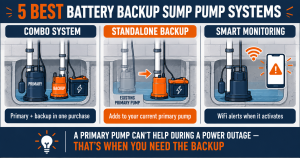
A sump pump only protects a basement while it has power — and the storms and fast snowmelt that drive groundwater into the pit are the same events that take down the grid. A primary pump on a single outlet stops the instant the lights go out, often with hours of runoff still on the way. A battery backup covers that window, running the pit on 12-volt DC power until utility power returns. There are two ways to buy in. An integrated combo system pairs a full-size primary and a DC backup on one base with a single controller — the simplest route for a new install or a full replacement. A standalone backup is a second pump you add alongside a primary you already own, sharing the same pit and taking over only when the primary cannot keep up or cannot run. Still deciding whether you need one? Our comparison of a sump pump vs a battery backup sump pump works through it. Below are five systems worth considering.
✏️ Our Take
A battery backup is judged on how long it holds the pit once the primary drops out, and that comes down to three things: the pump’s flow rate at real-world discharge height, the amp-hour capacity of the battery you pair with it, and whether the controller actually tells you when something is wrong. Combo systems solve the wiring and matching for you and suit a fresh install or an aging primary. Standalone units are the better value when your primary pump is newer and you only need insurance behind it. Whichever you choose, treat the battery as a wear item — plan on replacing it every few years whether or not it has ever been called on, and test the system on a schedule so you find a dead cell before the storm does.
Quick Comparison Table
Full Reviews — 5 Best Battery Backup Sump Pump Systems
1. Wayne Preassembled Primary & Battery Backup Combo — Best Overall
🏆 Best Overall
★★★★★
Combo System · Copper-Wound
The Wayne combo arrives with the primary pump and the 12-volt backup already mounted and plumbed on a shared base, so installation is a matter of setting it in the pit and connecting a single discharge line rather than fitting and aligning two separate pumps. The primary is a 1/2 HP cast-iron unit with a copper-wound motor that moves roughly 4,600 gallons per hour at zero head and still clears close to 2,900 GPH at a typical 10-foot lift — enough to stay ahead of a struggling perimeter drain on its own. The backup sits slightly higher in the pit on its own float, so it only wakes up if the water rises past the level the primary should have handled.
That backup is a 12-volt DC pump rated in the range of 2,500 GPH at low head, controlled by a charger and monitor box that keeps the battery topped up and sounds an audible alarm on backup activation, low battery, or a failed charge. There is no Wi-Fi, so alerts are on-unit only, which suits a basement someone is usually home to hear. The battery is not included; Wayne calls for a group 27 or larger deep-cycle or AGM battery, which is the single biggest factor in how long the system runs. For most homes replacing a tired primary anyway, buying the matched pair in one box is the cleanest path to full coverage.
✓ Pros
Primary and DC backup preassembled on one base — fastest combo to install
Copper-wound 1/2 HP cast-iron primary with strong flow at real discharge heights
Charger and monitor sounds an audible alarm on activation, low battery and charge faults
✗ Cons
Battery sold separately and adds meaningfully to the total outlay
On-unit alarm only — no phone or Wi-Fi notification if no one is home
🛒 Check Price on Amazon — $$$ →
2. WAYNE ESP25n — Best Standalone Backup
🔧 Best Standalone Backup
★★★★☆
12V Standalone · Maintenance-Free
The ESP25n is Wayne’s dedicated 12-volt backup for homeowners who already have a primary pump they are happy with and just want a second line of defense in the same pit. It is a compact unit built around a maintenance-free sealed motor — there is no reservoir to top up and no brushes to service — and it pushes roughly 2,500 GPH at zero head, tapering to somewhere near 1,800 GPH at a 10-foot lift, which is realistic backup-duty flow for a standard residential pit.
Its controller is the strong point: a wall-mounted charger and monitor with status LEDs and an audible alarm that flags backup operation, low fluid in the battery, low battery voltage, and charging problems, so a lead-acid battery going bad announces itself before it strands you. Like the combo, the ESP25n does not include a battery — a group 27 deep-cycle or AGM is the recommended pairing — and there is no app or Wi-Fi. If your existing primary is solid and you want a proven backup without paying for a second primary you do not need, this is the pick. If that primary is also getting on in years, our guide to the best sump pumps covers replacing it.
✓ Pros
Sealed, maintenance-free motor — no reservoir to fill, minimal upkeep
Detailed alarm covers activation, low voltage and charger faults
Drops into an existing pit alongside almost any primary pump
✗ Cons
Battery not included and strongly affects runtime
No Wi-Fi or phone alerts — you have to be in earshot
🛒 Check Price on Amazon — $$$ →
3. Basement Watchdog Special CONNECT (BWSP) — Best with Smart Monitoring
📡 Best with Smart Monitoring
★★★★☆
WiFi Alerts · Dual Float
The Special CONNECT is Basement Watchdog’s standalone backup with a Wi-Fi module built in, and monitoring is the reason to choose it. The CONNECT bridge ties the controller to your home network and pushes phone-app notifications for backup activation, rising water, low battery, and power loss — so you hear about a problem at work or on vacation, not when you next walk downstairs. The pump itself moves up to roughly 3,000 GPH at low head, near the top of the standalone-backup class, and uses a dual-float sensing setup that gives it a second trigger path if the primary float hangs up.
It runs on a sealed motor and pairs with Basement Watchdog’s own standby battery, an AGM maintenance-free type sold separately; the controller continuously reports battery condition and estimated runtime through the app rather than only beeping. The trade is that you are buying into one brand’s ecosystem and relying on your Wi-Fi staying up during the outage — worth putting a small UPS on the router. For a finished basement or a home left empty for stretches, the remote alerts are worth the premium.
✓ Pros
Wi-Fi module sends activation, water-level and battery alerts to your phone
Among the highest flow rates in the standalone-backup category
Dual-float sensing adds a backup trigger if the primary float sticks
✗ Cons
Depends on home Wi-Fi staying powered through the outage
Matched AGM battery is an extra, brand-specific purchase
🛒 Check Price on Amazon — $$$ →
4. Basement Watchdog Combo (CITE-33) — Best Value Combo
💰 Best Value Combo
★★★★☆
Combo System · Value Tier
The CITE-33 brings the combo approach — primary plus DC backup on a shared assembly — in at a lower price tier than the Wayne pairing. The primary is a 1/3 HP cast-iron pump moving around 3,500 GPH at zero head, a step down from a 1/2 HP unit but adequate for most homes with a functioning perimeter drain, and the 12-volt backup mounts above it on the same column with its own float.
Sensing is handled by Basement Watchdog’s dual-float controller with an audible alarm for activation and battery problems; this is the non-Wi-Fi model, so alerts stay on the unit. The battery is separate, with the brand’s standby AGM as the intended match. You give up some primary horsepower and the app connectivity of the Special CONNECT, but you get true combo coverage — two pumps, one controller, one install — at a mid-tier cost, which makes it the practical choice for a standard unfinished basement where someone is usually home.
✓ Pros
Full combo coverage — primary and backup, one controller — at a mid price tier
Dual-float controller with audible alarm on activation and low battery
Cast-iron primary is rebuildable and serviceable in place
✗ Cons
1/3 HP primary has less headroom than a 1/2 HP unit
No Wi-Fi or app alerts on this model; battery still sold separately
🛒 Check Price on Amazon — $$ →
5. Basement Watchdog Emergency (BWE) — Best Budget Standalone
🛟 Best Budget Standalone
★★★★☆
Standalone · Entry-Level
The BWE is the entry point into battery backup — a small standalone 12-volt pump meant to buy time rather than match a primary gallon for gallon. Flow is in the range of 1,000 GPH at a 10-foot lift, up toward 1,700 GPH at zero head, which is enough to hold a modest pit through a typical outage in an area without an aggressive water table.
It uses a single float switch and a basic charger with an audible alarm for activation and low battery — no dual-float redundancy, no app, no runtime estimate. The battery is separate, and because the pump draws less current than the bigger units, a given battery will actually run it longer. For a smaller home, a drier location, or a second pit that needs minimal insurance, it covers the essentials at the lowest cost here. Homes with a high water table or a history of flooding should step up to a higher-capacity unit.
✓ Pros
Lowest-cost way to add real battery backup to a pit
Lower current draw stretches runtime from the same size battery
Simple install and simple operation, with few parts to fail
✗ Cons
Low flow rate — buys time rather than keeping pace with a primary
Single float and basic alarm, with no app or remote alerts
🛒 Check Price on Amazon — $ →
Buying Guide
A battery backup system is only as good as the weakest of three parts — the pump, the battery, and your maintenance habits.
Combo system vs adding a standalone backup
A combo system makes sense when you are starting from scratch or your primary pump is already near the end of its service life — you replace both at once, everything is matched, and there is one controller and one discharge line to deal with. Expect a higher upfront cost and, on a replacement, a longer install because the old primary comes out. Adding a standalone backup is the cheaper and faster route when your primary is newer: the backup drops into the same pit, ties into the existing discharge with its own check valve, and leaves your working pump in place. The downside is two separate pumps to maintain and a small risk of a fitment issue in a crowded pit. If you also need to choose the primary itself, our guide to the best sump pumps covers that side of the decision.
Battery type and testing
Most systems accept either a standard flooded lead-acid deep-cycle battery or a sealed AGM. AGM costs more but is maintenance-free, spill-proof, and tolerates the warm, enclosed spot next to a sump pit better; a flooded battery is cheaper but needs its electrolyte level checked and topped with distilled water. Either way the battery is a consumable — capacity fades over roughly two to five years even if the backup has never once switched on — so replace it on a schedule rather than waiting for a failed test. Test the whole system a few times a year by unplugging the primary and pouring water into the pit until the backup starts, then confirm the alarm sounds. Folding that check into the same seasonal service as winterizing the sump pump keeps it from being forgotten.
GPH capacity and your pit
Backup flow is quoted at zero head, but what matters is the rate at your actual discharge height — the vertical lift from the pit to where the line leaves the house, plus pipe friction. A pump rated 3,000 GPH at zero head may deliver little more than half that at a 10-foot lift. Match the backup to your pit’s inflow during a bad storm and to how long outages usually last where you live: a high water table or frequent multi-hour outages calls for a higher-capacity unit and a large battery; a drier basement can be covered by an entry-level pump.
Frequently Asked Questions
Q: How long will a battery backup run during a power outage?
It depends far more on the battery than the pump. With a healthy, fully charged group 27 deep-cycle or AGM battery, a mid-size backup will typically run intermittently for somewhere between 5 and 12 hours of actual pumping, and considerably longer in clock time since it only runs when the float calls for it. A pit that fills fast drains the battery sooner. A larger battery, or a second battery wired in parallel, extends that runtime proportionally. A worn battery may give only a fraction of its rated time, which is why regular testing matters.
Q: Do I need a special battery or can I use any deep-cycle battery?
You can use a standard group 27 or larger deep-cycle marine or AGM battery in most systems — the brand-name standby batteries are convenient and matched but not mandatory. What you should not use is a car starting battery: those are built for short high-current bursts and degrade quickly under the repeated deep discharges a sump backup puts them through. Whatever you fit, keep it on the system’s own charger so it stays topped up between events.
Q: Can a battery backup pump handle the same water volume as my primary pump?
Usually not, and it is not designed to. Most 12-volt backups move roughly a third to two-thirds of what a 1/2 HP primary does at the same discharge height. The backup’s job is to keep the water below the floor until power returns, not to match the primary gallon for gallon. If your pit inflow is genuinely heavy, choose one of the higher-capacity backups and pair it with a large battery rather than expecting an entry-level unit to keep pace.
Q: How often should I test my battery backup system?
At least every three to four months, and again before any season when you expect heavy rain or snowmelt. Unplug the primary pump, pour water into the pit until the backup float triggers, confirm the pump moves water and the controller alarm sounds, then restore the primary. Check the battery terminals for corrosion at the same time, and on a flooded battery check the fluid level. Plan on replacing the battery every two to five years regardless of how the tests go.
Conclusion — Which Battery Backup Sump Pump Should You Buy?
For the widest coverage from a single purchase, the Wayne Preassembled Primary & Battery Backup Combo is the one to buy. You get a copper-wound 1/2 HP cast-iron primary with genuine capacity at real discharge heights, a matched 12-volt backup on the same base, and a charger and monitor that will not let a failing battery go unnoticed — all in one box that installs in a single session. That combination is why it takes Best Overall.
If your primary pump is newer and still trustworthy, the WAYNE ESP25n adds a proven, low-maintenance backup without paying for a second primary. The Basement Watchdog Special CONNECT is the pick when you want the system to message your phone rather than just beep in an empty house. The Basement Watchdog Combo (CITE-33) delivers true two-pump coverage at a mid price tier, and the Basement Watchdog Emergency (BWE) is the low-cost way to put real backup in a smaller or drier pit. Whichever you choose, budget for a quality deep-cycle battery and a testing routine — the pump is only half of the system.
Prices and ratings may change. Always check Amazon for current prices.
✍️ About This Review
PTR Editorial Team — Product Reviews. We compare manufacturer specifications, installation requirements, compatibility and available product documentation to help homeowners choose suitable tools and parts. How we review →