Please note: Product availability and information are based on our research at time of writing and are subject to change. Always check Amazon for the latest details before purchasing.
Introduction
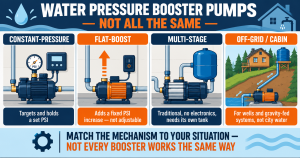
A water pressure booster pump does one job: it raises the water pressure inside your home. That makes it the opposite of the two devices it is most often confused with — a pressure gauge only measures pressure, and a pressure-reducing valve only lowers pressure that is already too high coming in from the street. If your fixtures trickle, your incoming pressure tests low, and the simpler fixes in our guide to increasing water pressure at home have not helped, a booster is the hardware that does the rest. But “booster pump” is not one product. It covers four genuinely different machines: a variable-speed pump that targets and holds a set pressure; a fixed flat-boost pump that adds a set amount on top of whatever comes in; a traditional multi-stage pump that runs off a separate pressure tank; and a small off-grid demand pump for cabins and gravity-fed tanks, not city water. They are priced and installed differently and suit different homes. The five below cover all four.
Disclosure: Select products in this roundup are featured via Amazon Creator Connections in addition to our standard Amazon Associate program. Reviews remain editorially independent.
✏️ Our Take
There is no single “best” booster pump because there is no single problem they solve. A house on municipal water with weak pressure at every tap wants a variable-speed constant-pressure unit that holds a steady PSI without cycling. A house that only needs a modest lift can use a simpler fixed-boost pump — but only if incoming pressure is low enough that adding to it will not push the system past a safe ceiling. A property on a well or a gravity tank is a different job again, better served by a pump matched to that system. Before buying, put a gauge on an outside spigot and read your static pressure. That number, plus whether you are on city water or a well, decides which of these five is right — not the horsepower on the box.
Quick Comparison Table
Full Reviews — 5 Best Water Pressure Booster Pumps
1. Aquastrong Smart 45 — Best Overall
🏆 Best Overall
★★★★★
Variable-Speed · Constant Pressure
The Aquastrong Smart 45 is a variable-speed, constant-pressure booster — the type most homes on municipal water actually want. Instead of switching fully on and off like an old jet pump, its permanent-magnet motor ramps up and down to hold the outlet at a target pressure (45 PSI out of the box, adjustable on the controller) no matter how many taps are open: open one faucet and it idles, open a shower and a kitchen tap and it spins up to keep the pressure flat. A small integrated diaphragm tank absorbs demand spikes and stops the motor short-cycling, so there is no separate pressure tank to plumb in.
In practice that means no pressure sag when someone starts the dishwasher mid-shower, and a quieter, smoother supply than a fixed-speed pump gives. It installs inline on the main after the meter and shutoff, runs on a standard outlet, and self-primes on city water — and on genuinely weak supplies it turns a dribbling second-floor shower into a normal one. It is not for a well with a deep draw, and it is more than a home needing a tiny top-up requires — but for the common case of uniformly low city pressure, it is the most complete, least fussy option here.
✓ Pros
Holds a steady set pressure automatically, even with several fixtures running
Integrated diaphragm tank — no separate pressure tank to buy or plumb
Quiet variable-speed motor and a simple inline install on a standard outlet
✗ Cons
Built for pressurized city water — not a substitute for a well or gravity-fed pump
Overkill and over-budget if all you need is a small pressure top-up on one line
🛒 Check Price on Amazon — $$ →
This Aquastrong listing is featured via Amazon Creator Connections in addition to our standard Amazon Associate program.
2. BT20-30T2-USA w/ Torrium II Controller — Best Professional-Grade
🔧 Best Professional-Grade
★★★★☆
Variable-Speed · Well-Industry Grade
This pairing puts a Franklin Electric Torrium II controller on a BT20-30 multistage pump — the constant-pressure setup pump pros fit when a homeowner wants city-like pressure from a private system. The Torrium II is a true variable-frequency drive: it reads outlet pressure many times a second and modulates motor speed to hold it flat, managing start-up, dry-run shutdown, and anti-cycle timing with only a compact pressure tank. It works on well water and on municipal lines needing a bigger, steadier boost than a consumer unit gives.
It does not take our top spot on position, not performance. It sits a clear price tier above the consumer pumps here, and its strengths — deep-draw capability, dry-run protection, a serviceable multistage wet end — matter most on wells and demanding installs, not a typical city connection. If you are on a well, run a large house, or want equipment a local pump contractor will service, specify this one. For a standard city-water boost, you are paying for headroom you may never use.
✓ Pros
Franklin Electric Torrium II drive holds constant pressure with only a small tank
Built-in dry-run protection and anti-cycle logic — genuine well-industry reliability
Handles deeper draws and larger homes than the consumer variable-speed pumps
✗ Cons
Clearly the most expensive option here — more pump than most city homes need
Multistage wet end plus controller is a more involved install and setup
🛒 Check Price on Amazon — $$$$ →
3. Simer 4075SS-01 — Best Simple / Plug-and-Play
⚡ Best Simple / Plug-and-Play
★★★★☆
Fixed Flat-Boost · Not Adjustable
The Simer 4075SS-01 is the easiest pump here to live with: a compact stainless inline booster that senses flow, switches on, and adds a fixed increase — roughly 20 to 40 PSI depending on flow rate — on top of whatever is already in the line. No controller to program, no separate tank to mount: plumb it into the main, plug it in, and it works. For a house whose incoming pressure genuinely tests low (say the low 30s PSI), it is a clean, low-cost fix.
The catch is in the word “fixed.” This pump is not adjustable — it adds the same boost regardless of what your incoming pressure is doing. If your street pressure is already moderate to high, or climbs overnight, that flat boost stacks on top and can push the home’s plumbing past a safe level, stressing supply lines, the water heater, and fixture valves. It is the right tool only when incoming pressure is reliably low, and even then it is worth pairing with a pressure-reducing valve as a ceiling. It also does not self-regulate for several open fixtures the way a variable-speed unit does.
✓ Pros
Genuinely plug-and-play — no controller, no programming, no separate tank
Compact all-stainless body fits tight mechanical spaces and short pipe runs
Lowest-fuss way to lift a reliably low incoming supply into a normal range
✗ Cons
Fixed, non-adjustable boost — on moderate-to-high incoming pressure it can over-pressurize the home’s plumbing; pair it with a pressure-reducing valve
No constant-pressure regulation, so pressure still dips when several fixtures run at once
🛒 Check Price on Amazon — $$ →
4. Flotec Cast Iron Multistage 3/4 HP — Best Traditional / No Electronics
🔩 Best Traditional / No Electronics
★★★★☆
Multi-Stage Centrifugal · External Tank Required
The Flotec is the old-school answer: a fixed-speed cast-iron multistage centrifugal pump that boosts pressure the mechanical way — no variable-frequency drive, no circuit board, nothing to update. It runs against a separate pressure tank and switch: the switch starts the pump at cut-in and stops it at cut-out, the tank holds the charge between cycles. That is more hardware to mount than an integrated unit, but it is fully serviceable with hand tools and has no electronics to fail in a damp basement.
Its 3/4 HP wet end moves more water than the compact consumer boosters, suiting a larger house or a long run to an outbuilding. The trade-offs are the ones every tank-and-switch system has: pressure cycles between cut-in and cut-out instead of staying flat, the pump is louder, and you must size and pre-charge the tank. For anyone who wants a pump a local shop can rebuild in twenty years with no software in the loop, it is the pick.
✓ Pros
No electronics — fully mechanical, serviceable with hand tools, nothing to update
Cast-iron 3/4 HP wet end moves more water than the compact consumer units
Proven tank-and-switch design that any pump shop can diagnose and rebuild
✗ Cons
Requires a separate pressure tank and switch — more parts to buy, size and mount
Pressure cycles between cut-in and cut-out instead of holding flat, and it runs louder
🛒 Check Price on Amazon — $$$ →
5. PENTAIR SHURFLO Revolution 4008-171-E65 — Best for Off-Grid, Cabins & Well Systems
🏕️ Best for Off-Grid, Cabins & Well Systems
★★★★☆
12V Demand Pump · Off-Grid Use
The SHURFLO Revolution is a different tool from the other four — it is a 12-volt demand pump for off-grid and unpressurized-source systems, not a whole-house booster for municipal water, and it should not be judged against the others on city-water performance. It is built to pull from a gravity tank, cistern, RV tank, or cabin holding tank and deliver a usable ~3 GPM at up to a 55 PSI shut-off, cycling on and off on demand with a built-in bypass that smooths delivery. On the systems it is made for, it is a proven, widely used pump.
It earns a place here for the cabin or outbuilding with no pressurized supply at all — a tank on a stand, a spring line, a seasonal camp — where a full constant-pressure system is more than the power supply can run. It runs from a 12V battery or small solar setup and primes readily. What it will not do is boost a city-water line for a full-size house: the flow is modest and the brush-type motor is not built for near-continuous running.
✓ Pros
Purpose-built for gravity tanks, cisterns, RVs and off-grid cabins
Runs on a 12V battery or solar — no mains outlet or controller needed
Built-in bypass reduces rapid cycling and smooths delivery at the tap
✗ Cons
Not a municipal whole-house booster — modest flow and a low duty cycle by design
Brush-type motor wears under continuous or commercial-style use and needs replacement over time
🛒 Check Price on Amazon — $ →
Buying Guide
Match the pump to your water source and measured incoming pressure — not to a horsepower number. Three mechanisms cover almost every home; a fourth situation calls for something else.
Variable-speed constant-pressure
The variable-speed pump — the Aquastrong, and the Torrium II setup — reads outlet pressure continuously and changes motor speed to hold a target, whether one tap or five are open. Pressure stays flat and the motor rarely hard-starts. It is the right default for a house on municipal water with low pressure everywhere: it costs more and relies on electronics, but it is the closest thing to “set it and forget it.”
Fixed flat-boost
A fixed-boost pump — the Simer — adds a set number of PSI on top of your incoming pressure and cannot be dialed in. It is inexpensive and dead-simple, and it is the correct choice only when your incoming pressure is reliably low.
⚠️ Warning — flat-boost pumps and over-pressurization
A fixed flat-boost pump is not adjustable. If your incoming municipal pressure is already moderate to high (about 50 PSI or more), adding a flat boost on top can drive your home’s plumbing past the 80 PSI that most plumbing codes cap — stressing supply lines, the water heater’s relief valve, and fixture cartridges, and voiding some fixture warranties. Measure your static pressure at an outside spigot first. If it is not genuinely low, choose a variable-speed pump instead, or install the flat-boost pump with one of the best pressure regulator valves set to a safe ceiling downstream.
Traditional multi-stage with an external tank
The multi-stage centrifugal pump — the Flotec — uses a separate pressure tank and switch: the pump fills the tank to cut-out, shuts off, and restarts at cut-in. Pressure cycles across that band rather than staying flat, and you must size and pre-charge the tank. In return you get a fully mechanical pump with nothing to fail electronically, easy rebuildability, and more water flow for larger homes and long runs.
When an off-grid pump is the right tool instead
If there is no pressurized supply to boost — a cabin on a gravity tank, an RV, a cistern, a seasonal camp — a 12V demand pump like the SHURFLO is the match, not a whole-house booster. It makes usable pressure from an unpressurized source on very little power. The other four are not for a tank-fed cabin, and it is not for a full-size city-water house — picking the right category matters more than picking between models.
Frequently Asked Questions
Q: Will a booster pump fix low pressure in just one shower?
Usually it is the wrong fix. If one shower or faucet is weak while the rest of the house is fine, the cause is almost always local — a clogged aerator or showerhead, a half-closed supply stop, a failing mixing cartridge, a kinked flex line — and a whole-house booster will not touch it. Our guide to fixing low water pressure in a shower covers those. Install a booster only when pressure tests low at the main and every fixture is affected.
Q: Do I need an electrician to install one?
For the plumbing, a confident DIYer can usually handle the inline connections, unions, and a check valve on the main. The electrical side depends on the model: a pump that runs off a standard grounded outlet nearby is straightforward, but a new dedicated circuit, or a location with no outlet, is a job for an electrician. Hard-wired or 240V pumps should be wired by a pro. Always fit a shutoff and union on each side of the pump so it can be serviced without draining the house.
Q: Can I install a booster pump on well water?
Yes, but match the pump to the well. A variable-speed constant-pressure system like the Torrium II setup is built for this and is what pump contractors fit. What you should not do is add a simple inline city-water booster downstream of an existing well pump without knowing how the two controls interact — the pumps can fight each other or short-cycle. On a well, the constant-pressure controller should manage the well pump itself, or the system should be specified by a pro.
Q: How much pressure gain should I expect?
Most residential boosters add roughly 20 to 50 PSI, depending on the model and how much water is flowing — the gain drops as flow rises. A variable-speed pump holds your chosen target (commonly 45 to 60 PSI) as far as the incoming supply and the pump’s capacity allow. Measure your static pressure at an outside spigot first so you know your starting point; if you are unsure what is normal, our roundup of the best water pressure gauges explains the ranges.
Conclusion — Which Booster Pump Should You Buy?
For the situation most people mean by “booster pump” — a house on city water where the pressure is just low everywhere — the Aquastrong Smart 45 is the one to buy. Its variable-speed motor holds a steady set pressure with several fixtures running, the integrated tank means nothing extra to plumb, and it installs inline on a standard outlet. That combination makes it the most complete, lowest-hassle pick here.
If you are on a well, run a large house, or want equipment a local pump contractor will service, step up to the BT20-30T2-USA with the Torrium II controller. If your incoming pressure is genuinely low and you want the simplest possible fix, the Simer 4075SS-01 will lift it — just measure first and add a pressure-reducing valve if there is any chance of over-pressurizing. The Flotec Cast Iron Multistage 3/4 HP is the choice when you want a purely mechanical pump and a separate tank. And if your “low pressure” is really no pressure — a cabin, an RV, a gravity tank — the PENTAIR SHURFLO Revolution is the right tool, where a whole-house booster is not.
Prices and ratings may change. Always check Amazon for current prices.
✍️ About This Review
PTR Editorial Team — Product Reviews. We compare manufacturer specifications, installation requirements, compatibility and available product documentation to help homeowners choose suitable tools and parts. How we review →


