
Guides
19 Oct 2026

Can’t Reach the Faucet Nut? Choose the Right Tool Before You Buy
Not sure which tool fits your faucet nut? Identify the fixing, see how it lets go and check your clearance first. Then choose a tool, or use one you own.
How to find and shut off your home's main gas valve in an emergency: valve types, the exact turning procedure, and why only a pro restores service.

Please note: This guide is based on our research at time of writing and is for general safety awareness only. It is not a substitute for your gas utility’s emergency instructions, your local fire department, or a licensed gas professional. This guide covers how to locate and shut off your home’s main gas supply in a genuine emergency — it does not provide instructions for turning gas back on, relighting pilot lights, or performing any gas line repair, inspection, or reconnection, all of which must be handled by your utility or a licensed professional. If you smell gas, follow the emergency steps below immediately and contact your gas utility’s emergency line or 911.
Knowing how to shut off your gas supply before an emergency happens is one of the single most valuable things a homeowner can do — and it takes only a few minutes to learn. Our Gas Line Safety guide covers the broader picture: how to recognize a leak by smell, sound, or sight, and the full emergency response sequence of leaving the building, avoiding anything that could spark, and calling for help from a safe distance. Shutting off the main valve is one step inside that sequence, and it’s the step people tend to feel least confident about, because most homeowners have never actually touched their shutoff valve before the day they need it.
This guide is the deep dive on exactly that step. Where the Gas Line Safety guide gives you an overview of the valve and tells you it exists, this article walks through identifying the different types of shutoff valves and where each one sits, the physical mechanics of turning one off — including the tool you need and precisely what a “quarter turn” looks and feels like — what to expect immediately after the gas is off, and the full explanation of why restoring service afterward is exclusively a job for your utility or a licensed professional. Read it once now, in a calm moment, so none of it is new information the day you actually need it. If you’d rather catch a leak before it ever reaches the point of needing an emergency shutoff, our natural gas and propane leak detector reviews cover the early-warning devices worth installing.
IN THIS GUIDE
At a Glance
| What You Can Do Yourself | Locate your main shutoff valve and physically turn it off in a genuine emergency — a suspected leak, storm or earthquake damage, or on the direct instruction of your gas utility or the fire department. |
| What Requires a Licensed Professional | Turning the gas supply back on, relighting any pilot lights, and any inspection, repair, or reconnection of the gas system itself. |
| Critical First Step | Locate your main shutoff valve today, before you ever need it, and confirm which way it turns. Don’t wait for an emergency to go looking for it for the first time. |
Shutting off your gas is a response to a genuine trigger, not a routine precaution — the valve isn’t something you close overnight or before a trip. The legitimate triggers are: a suspected gas leak, based on the smell, sound, or sight signs covered in our Gas Line Safety guide; a natural disaster such as an earthquake or a major storm that could have damaged buried or exposed lines; visible physical damage to a gas line, meter, or appliance connection, for example after excavation or a vehicle strike near the meter; or direct instruction from your gas utility, the fire department, or another emergency responder on scene.
Outside of those situations, leave the valve alone. We won’t re-cover leak recognition or the full emergency response sequence here — the Gas Line Safety guide linked above walks through both in detail, and it’s worth reading in full before you ever need this one.
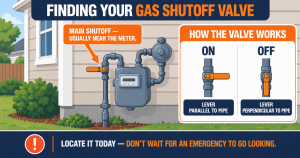
Natural gas homes. The main shutoff valve sits on the supply pipe outside the house, almost always right next to the gas meter, on the pipe coming out of the ground or the side of the building before it reaches the meter. Look for a metal valve with a flat, rectangular tang or a small lever protruding from its side — this is the part a wrench grips to turn it. The valve itself is usually unpainted or gray metal, roughly the width of the pipe it’s mounted on, and it’s typically positioned low, within a couple of feet of the ground, since it sits on the supply-side of the meter rather than up on the meter body itself.
Propane homes. If your home runs on propane instead of natural gas, there is no gas meter, and the shutoff works differently. The shutoff valve is on the tank itself — typically a round handwheel-style valve at the top of the tank, near where the regulator and gauge are mounted. Propane tank valves are usually turned by hand (clockwise to close, the same “righty-tighty” convention as a garden hose bib) rather than with a wrench, though the exact hardware can vary by tank age and manufacturer. If you’re not sure which type your tank uses, this is worth confirming with your propane supplier ahead of time rather than guessing under pressure.
Multi-unit buildings. If you live in a condo, townhome, or apartment with an individually metered gas supply, your shutoff valve is typically near your own meter, which may be grouped together with your neighbors’ meters in a bank along an exterior wall or in a utility area. If meters aren’t individually labeled, or you can’t tell which valve is yours, ask your property manager or the gas utility to identify it before an emergency, not during one.
⚠️ Warning: Only shut off your main gas valve for one of the genuine triggers described above — a suspected leak, disaster damage, visible line damage, or direct instruction from your utility or an emergency responder. This is not a routine maintenance step, and turning the valve off and back on unnecessarily works against the point of this guide, which is treating the main shutoff as an emergency-only action.
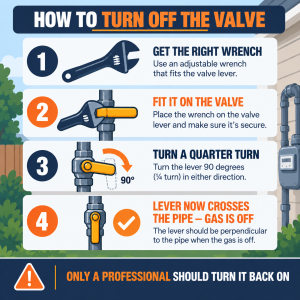
The tool. Most natural gas main shutoff valves need a wrench to turn — either a standard adjustable wrench sized to fit the valve’s tang, or a dedicated gas shutoff wrench (sometimes called a meter wrench), a flat, rectangular tool sold specifically for this purpose and inexpensive enough that many households keep one attached near the meter with a zip tie or a length of wire, precisely so it’s there when it’s needed and nobody has to run to the garage to find one. If you don’t already have one, this is a good first purchase to make on the same day you locate your valve — not something to shop for after you smell gas.
The turn. Natural gas main valves are quarter-turn valves, meaning the full range of motion from fully open to fully closed is just 90 degrees — a quarter of a full circle. Fit the wrench onto the flat tang and turn it a quarter turn in either direction; you’ll feel it stop firmly at each end of that 90-degree range, so you can’t overtighten or force it past where it’s designed to go. The position tells you the state at a glance: when the tang (or the lever, on lever-style valves) sits parallel to the pipe, running in the same direction as the pipe itself, the valve is open and gas is flowing. When it sits perpendicular to the pipe — crosswise, at a right angle to the direction the pipe runs — the valve is closed and gas is shut off. To shut off your gas, turn the tang a quarter turn until it lines up crosswise to the pipe and stops.
That’s the entire mechanical action: locate the tang, fit the wrench, turn a quarter turn until it stops perpendicular to the pipe. There’s no second step, no valve to hold open, and nothing to disconnect. If you find yourself needing more force than a quarter turn or the valve won’t move at all, don’t force it — step back, and treat it the same as any other equipment failure during an emergency: get clear of the building and call your utility’s emergency line, since forcing a stuck valve can damage it in a way that makes the situation worse rather than better.
Once the main valve is closed, gas stops flowing to your entire house immediately — every gas appliance on the property, from the furnace to the water heater to the range, loses its supply at the same moment, not gradually. Any pilot lights that were burning will go out on their own as the residual gas in the lines is used up.
If you shut off the gas because of a suspected leak, your job at that point is done — leave the property (or continue leaving it, if the valve was genuinely on your way out) and follow the rest of the emergency sequence from our Gas Line Safety guide: get to a safe distance, call your utility’s emergency line and 911 if warranted, and wait for a professional to tell you it’s safe to return. Do not go back inside to check whether the smell has faded, whether the hissing has stopped, or whether the shutoff “worked” — closing the valve stops new gas from being added to the building, but it doesn’t clear gas that has already accumulated indoors, and that’s exactly what the professional response is there to assess safely.
Separately from the main valve, most individual gas appliances — a range, dryer, water heater, or furnace — have their own local shutoff valve on the short section of pipe or flexible connector leading into the appliance itself. These are usually small lever-style valves you can turn by hand, no wrench required, and they only cut gas to that one appliance rather than the whole house.
An appliance shutoff is the right tool for a different scenario than the one this guide is about: isolating a single appliance you know or suspect has a problem, or that a technician has asked you to shut off ahead of a repair or replacement visit, without cutting gas to the rest of the house in the process. It is not a substitute for the main valve in a genuine whole-house emergency. If you smell gas broadly, aren’t sure which appliance (if any) is the source, or the trigger is something like disaster damage rather than one appliance acting up, use the main shutoff, not an individual appliance valve — narrowing your response to a single appliance when you don’t actually know the source is how a real emergency gets treated like a minor one.
Shutting the main valve off is a simple, mechanical, one-direction action — that’s exactly why it’s the one piece of hands-on gas work this guide treats as appropriate for a homeowner. Turning it back on is a fundamentally different task, not because the wrench motion is harder, but because of everything that has to happen correctly around that motion before it’s safe.
When gas has been shut off, the lines between the valve and every appliance in the house fill with air instead of gas. Restoring service isn’t as simple as reopening the valve — that air has to be purged from the system first, every connection and appliance has to be checked for leaks while the system is under pressure, and any pilot lights that went out have to be relit in a specific, deliberate sequence, one appliance at a time, with the technician confirming each one is burning correctly before moving to the next. Skipping or rushing any part of that sequence is exactly how unburned gas can accumulate inside a house undetected — the same failure mode this entire guide exists to help you avoid, created this time by an improperly handled restart rather than an original leak.
⚠️ Warning: Never attempt to turn your gas supply back on yourself, and never attempt to relight a pilot light after a shutoff, even if it looks like a simple push-button igniter. Most gas utilities will not restore service to a home unless one of their own technicians does it in person, and that policy exists for exactly the reasons above — treat it as the correct default rather than an inconvenience to work around.
Knowing roughly what to expect can make the restoration process feel less like a mystery. When a utility technician or licensed professional arrives to turn your gas back on, they’ll typically open the main valve themselves and purge the air out of the supply lines at an appropriate point in the system. From there, they systematically check every accessible connection and appliance for leaks — often using a soap-solution test or a combustible gas detector — before moving on to relighting pilot lights one appliance at a time, in a set order, confirming proper ignition and flame behavior at each one. Depending on how many gas appliances your home has, this can take longer than homeowners often expect; it’s a thorough, checked process rather than a quick valve turn, and that thoroughness is the entire point.
Given how much of this specific topic sits on the professional side of the line, it’s worth stating the division plainly rather than leaving any of it implied.
Safe for the homeowner: locating your main shutoff valve and any individual appliance shutoff valves; physically turning the main valve off in a genuine emergency, using the correct wrench and the quarter-turn procedure described above; keeping a gas shutoff wrench accessible near the valve; and knowing your gas utility’s (or propane supplier’s) emergency contact number ahead of time. That is the complete list — nothing past it is a homeowner task, even in an emergency.
Always a licensed professional or your utility:
Turning the main gas supply back on after any shutoff, for any reason.
Purging air from the lines and leak-testing every connection and appliance before service is restored.
Relighting any pilot light, on any appliance, in any order other than the technician’s own checked sequence.
Repairing, replacing, or servicing the shutoff valve itself, a gas line, or a fitting, if anything about it looks damaged, stuck, or is leaking around the stem.
Disconnecting or reconnecting any gas appliance, even at an individual appliance shutoff, as part of a repair, replacement, or move.
If you need any of that work done, verify a current state or local gas fitting or plumbing license before hiring, and confirm liability insurance is in place — the same standard covered in more detail in our Gas Line Safety guide applies here without exception.
US Regional Context: Most gas utility companies across the US offer free emergency shutoff and restoration service — dispatching a technician to a reported leak or emergency doesn’t carry a standalone charge in the way a routine service call might, since utilities have a direct safety interest in responding quickly. The number to call for that service is worth saving in your phone now, alongside 911, rather than searching for it during a crisis; check a recent gas bill or your utility’s website for the 24/7 emergency line, and if your home runs on propane, save your specific supplier’s emergency number as well, since it will likely be a different company than your electric or water utility. Availability of a live emergency dispatcher, response times, and exact restoration procedures can vary somewhat by utility and by state, so treat your own provider’s stated process as the authoritative one for your home.
✏️ Our Take
If you take one thing from this guide, make it this: go find your main gas shutoff valve today, confirm which way it turns, and keep a wrench sized to fit it somewhere you’d actually grab it under stress — tied near the meter is hard to beat. That five-minute task, done now, is worth more than anything else in this article, because it’s the only piece of this that has to happen before an emergency to be useful at all. Everything downstream of the shutoff — restoring service, relighting pilots, any actual repair — is correctly out of your hands, and that’s not a limitation of this guide, it’s the safest possible design for how gas systems are meant to work.
Prices and ratings may change. Always check Amazon for current prices.
Restoring gas service, relighting pilots, or any gas line repair or reconnection calls for a licensed gas fitter or plumber and, in most areas, a permit and inspection. Search PlumberArchive.com — the US plumber directory with 12,151+ verified local plumbers across all 50 states.
Get weekly plumbing tips and DIY guides delivered straight to your Facebook feed.
Most natural gas main shutoff valves need a wrench that fits the flat tang on the valve — either a standard adjustable wrench or a dedicated gas shutoff wrench made specifically for this job. Many households keep one attached near the meter with a zip tie or wire so it’s there when needed. Propane tank valves are typically a handwheel you turn by hand instead. Confirm which type your home has now, rather than during an emergency.
A natural gas main valve is a quarter-turn valve. When the tang or lever sits parallel to the pipe, gas is flowing; turn it a quarter turn (90 degrees) until it sits perpendicular, or crosswise, to the pipe, and it stops firmly — that’s fully closed. There’s no in-between position to worry about and no way to overtighten it past that stop.
No. Restoring service safely requires purging air from the lines, pressure- or leak-testing every connection and appliance, and relighting pilot lights in a specific checked sequence — steps that need training and equipment a homeowner doesn’t have. Most gas utilities won’t restore service to a home unless one of their own technicians does it in person, and that’s the correct standard to follow rather than a formality to work around.
If you have reason to believe the event may have damaged gas lines or appliances — visible damage, a fallen water heater, or instruction from an emergency responder — shutting off the main valve is a reasonable precaution even without an obvious smell, since some leaks take a little time to become noticeable. If there’s no visible damage and nothing seems wrong, it’s also reasonable to leave the valve alone and monitor for the smell, sound, or sight signs of a leak covered in our Gas Line Safety guide. Either way, shutting off the gas is never something to delay evacuating for if you do smell gas.
The main valve, near your meter or propane tank, cuts gas to the entire house at once and is the one to use in a genuine whole-house emergency. An individual appliance shutoff valve, located on the line right before a single appliance like a range or water heater, only cuts gas to that one appliance — useful for isolating a known single-appliance issue or ahead of a repair visit, but not a substitute for the main valve when you’re not sure of the source or the situation affects more than one appliance.
The entire homeowner side of an emergency gas shutoff comes down to preparation done in advance: know where your main valve is, whether it’s meter-mounted or on a propane tank; keep the right wrench within reach of it; and understand that the shutoff motion itself is a simple, quarter-turn action you can execute confidently under stress once you’ve located the valve and practiced identifying open versus closed. Everything that happens afterward — purging the lines, leak-testing, relighting pilots, and any actual repair — belongs to your gas utility or a licensed professional, without exception, every time. Do the five-minute preparation now, and you’ll have done the entire job this guide covers correctly.
✍️ About This Guide
PTR Editorial Team — Plumbing Guides. We compare manufacturer specifications, installation requirements, compatibility and available product documentation to help homeowners choose suitable tools and parts. How we review →
Not sure which tool fits your faucet nut? Identify the fixing, see how it lets go and check your clearance first. Then choose a tool, or use one you own.
Check your manual and the drain route first: gravity hose, built-in pump or external pump. Then see whether you need a dehumidifier hose at all.
Explore portable bidets that need no water-line connection, from bottle caps and squeeze bottles to battery-powered handhelds.

