Comparisons
20 Sep 2026

Utility Pump vs. Sump Pump (2026) — Which Do You Need?
Utility pump vs sump pump: one is portable for occasional jobs, the other a permanent install for ongoing water. See which your basement needs.
CSST vs black iron gas pipe compared: flexibility, installation time, the lightning/bonding safety consideration, cost, and code acceptance.
Please note: This comparison is based on our research at time of writing and is for general informational purposes only. It is not installation guidance. Gas pipe installation, modification, and connection work must always be performed by a licensed, qualified professional — this article is meant to help you understand your options and have an informed conversation with a contractor or inspector, not to guide DIY gas work. Local code requirements vary; always confirm with your local building department and a licensed professional before any project.
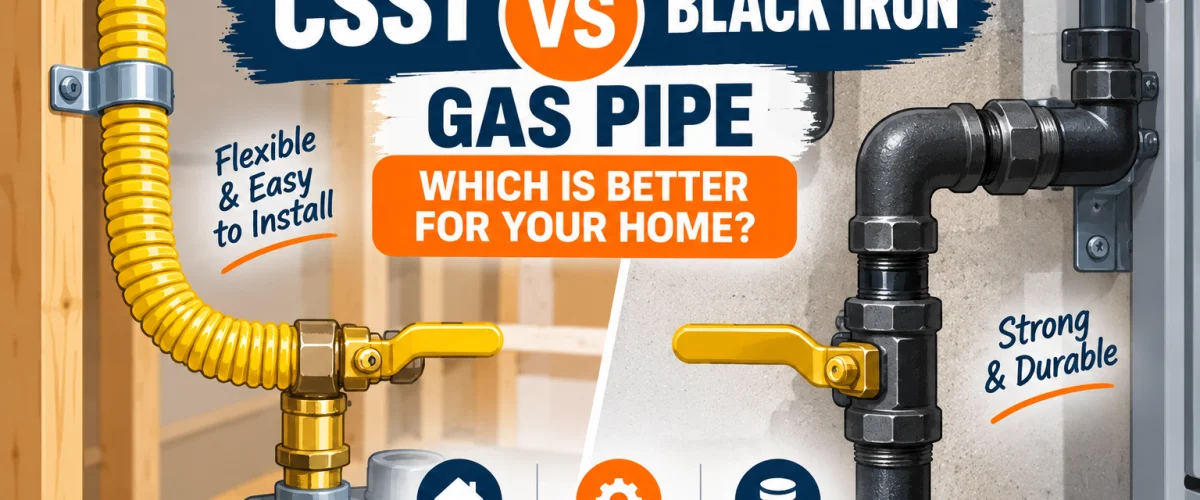
If you’re planning new construction, a renovation, or an appliance relocation that involves gas piping, you’ve likely run into two very different materials: CSST and black iron pipe. CSST, short for Corrugated Stainless Steel Tubing, is a flexible, coiled stainless steel tubing that has become common in newer construction and renovations over the past couple of decades — it bends around obstacles the way electrical cable does, rather than requiring a rigid, jointed path. Black iron pipe is the traditional material, a rigid threaded steel pipe that has carried residential gas for generations and remains the default in a great many homes, especially older ones. Neither material is something a homeowner installs or modifies themselves — gas line work requires a licensed professional in virtually every US jurisdiction — but understanding what each material actually is, and where each tends to shine, makes it much easier to follow along with a contractor’s recommendation or ask the right questions during an inspection or safety conversation. That’s the purpose of this comparison: background knowledge for the conversation, not a how-to for the work itself.
IN THIS GUIDE
At a Glance
CSST
Black Iron Pipe
CSST is manufactured as a continuous, flexible length of thin corrugated stainless steel, usually shipped in coils and covered with a protective polymer jacket (commonly yellow, though black and other colors exist depending on manufacturer and application). The corrugations — a series of ridges running along the tubing — are what give it its flexibility; a solid stainless tube of the same wall thickness wouldn’t bend nearly as easily. CSST connects to fittings and appliances using mechanical or flare-style connectors rather than pipe threads, and a single run can often travel from a manifold or branch point to an appliance with few or no intermediate joints.
Black iron pipe, by contrast, is rigid steel pipe manufactured in fixed lengths, joined using threaded connections cut into the pipe ends and matching threaded fittings — elbows, tees, couplings — at every point where the run needs to change direction or branch. It’s the same basic joining method that’s been used for residential gas piping for the better part of a century, which is part of why it remains so familiar to contractors and inspectors alike. There’s no bending it around an obstacle; the path has to be planned and built joint by joint.
This is where the two materials diverge the most in practice. Because CSST is flexible, a licensed installer can often run it through framing cavities, around obstructions, and up through multiple floors with far fewer fittings than an equivalent black iron run would need — every fitting on a gas line is also a potential connection point that has to be cut, threaded or flared, and pressure-tested, so fewer fittings generally means less labor time and fewer places where an installation error could occur. For a contractor working on new construction or a renovation with a lot of framing already open, this speed advantage is one of the biggest reasons CSST has become so widely adopted.
Black iron pipe demands more precision and more time at every stage. Each section has to be measured, cut to length, threaded (either on-site with a pipe threader or ordered pre-cut to spec), and assembled with the correct fitting for each turn, using pipe joint compound or thread sealant rated for gas service. None of this is difficult work for an experienced professional, but it is inherently slower than routing a continuous flexible line, and a complex run with many direction changes multiplies the number of joints — and the labor time — accordingly.
Black iron pipe has an exceptionally long track record — it has been used in residential gas systems for many decades, and properly installed black iron piping in good condition can remain in reliable service for the life of a home. Its main long-term vulnerabilities are corrosion (particularly where it contacts damp masonry or soil without proper protection) and the integrity of its threaded joints over time, both of which a routine inspection can catch.
CSST’s adoption in US residential construction is more recent, but it has now been in widespread use for a few decades as well, and stainless steel itself is highly corrosion-resistant, which is an advantage in damp environments like crawl spaces. When installed correctly, both materials are considered durable, code-accepted options for the life of a typical home — the meaningful differences between them show up less in raw material lifespan and more in installation-sensitive factors, which is exactly what the rest of this comparison covers.
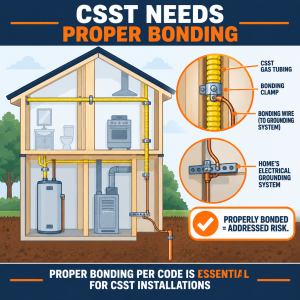
This is the single most important safety fact to understand about CSST, and it deserves a plain, factual explanation rather than either alarm or omission. CSST’s thin corrugated wall — the same design that makes it flexible — is thinner than the wall of a rigid black iron pipe. In documented incidents, a nearby lightning strike has been able to transfer enough electrical energy through a home’s grounding and bonding system to arc through improperly bonded CSST, puncturing the tubing wall and creating a gas leak at the point of the strike’s electrical path. This is a real, well-documented phenomenon, and it’s the reason CSST manufacturers, code bodies, and the CSST industry itself have specific, well-established bonding requirements.
The key point homeowners should understand is that this risk is directly and effectively addressed by proper electrical bonding, done according to the manufacturer’s installation instructions and current code requirements. Bonding connects the CSST system to the home’s electrical grounding system with a dedicated bonding conductor, sized and installed per code, which gives any stray electrical energy — from a nearby strike or another source — a low-resistance path to ground that doesn’t have to pass through the tubing wall itself. Modern CSST products and current codes require this bonding as standard practice, and a correctly bonded CSST installation is considered a safe, code-compliant system by the same authorities that document the original risk.
Comparing cost between CSST and black iron isn’t as simple as comparing a per-foot material price, because labor time is such a significant part of the total project cost for either material. CSST’s material cost per foot can run higher than black iron pipe, but its faster, lower-labor installation — fewer fittings, less on-site cutting and threading — often offsets some or all of that difference in the final bill, particularly on runs with several direction changes or obstacles to route around.
Black iron pipe itself tends to be less expensive per foot, but a run with many joints requires more labor hours for cutting, threading, assembling, and pressure-testing each connection, which can narrow or even reverse the apparent material-cost advantage once labor is factored in. The honest answer is that the better value between the two depends heavily on the specific project — its layout, the number of fittings required, and what a given installer is fastest and most experienced working with — which is a conversation worth having directly with your contractor rather than assuming one material is categorically cheaper.
Both CSST and black iron pipe are accepted materials under most modern US plumbing and fuel gas codes when installed correctly by a licensed professional, and neither should be treated as the “wrong” choice in a general sense. That said, code adoption isn’t perfectly uniform: some local jurisdictions have added specific bonding or grounding amendments for CSST beyond the baseline manufacturer instructions, some older code cycles in certain areas are stricter about CSST than the current national model codes, and individual inspectors can have strong, experience-based preferences for one material over the other even where both are technically permitted.
Because of this variation, the only reliable way to know what applies to your specific project is to confirm with your local building department and a licensed professional before work begins — not to assume that what was true in a different state, or in an older renovation you’ve seen, still applies to your address today.
CSST’s flexibility is often the deciding factor in an existing home. Running a new gas line to a relocated range, a new fireplace, or an outdoor grill connection in a home that’s already built out frequently means threading a line through finished walls, joist bays, or ceiling cavities without tearing the house apart to do it. A flexible line that a professional can fish through an existing cavity — much like electrical wiring — can dramatically reduce the amount of demolition and patching a project requires compared to planning a rigid, jointed black iron path through the same finished space.
That’s a major reason CSST is so often the material of choice for appliance relocations and additions in homes that are already built, even when the rest of the home’s gas piping is black iron. It doesn’t mean black iron can’t be extended into an existing structure — it’s done all the time — but it typically requires more access points and more careful planning around the existing framing. If you’re planning this kind of project and also need to know how to respond in a gas emergency during or after the work, our guide on how to shut off gas to your home in an emergency is worth reading alongside this one.
There’s no universally “better” material between the two — both are legitimate, code-accepted choices when installed correctly by a licensed professional. The table below covers situations that commonly come up; treat every row as a starting point for a conversation with your installer, not a decision to make on your own.
| Situation | Likely Better Fit |
|---|---|
| New construction with open framing | CSST — flexible routing and fewer fittings often suit an open-framing build well; discuss with your installer |
| Retrofitting an existing finished home | CSST — its flexibility can reduce demolition through finished walls and framing; confirm feasibility with your installer |
| Minimizing installation time and labor cost | CSST is often faster to install, but ask your installer for a project-specific labor estimate for both options |
| Area with frequent lightning activity | Either material can work — if CSST is used, confirm proper bonding is part of the installation and verified at inspection |
| Working with an installer who specializes in one material | Whichever material your installer has the most experience with — expertise often matters more than the material itself |
| Matching existing piping for an addition | Often black iron, to keep the system consistent — but ask your installer whether mixing materials makes sense for your project |
✏️ Our Take
Both CSST and black iron pipe are legitimate, code-accepted gas piping materials when installed correctly by a licensed professional — neither is a compromise choice, and neither is a straightforward “always better” answer. What matters far more than which material gets chosen is whether the installation was done right: proper electrical bonding for CSST, and proper threading and sealing at every joint for black iron. The right material for your project usually comes down to the specifics — the layout, whether you’re building new or retrofitting, local code, and what your installer is most experienced working with — so treat this comparison as background for that conversation, not a decision to make without one.
Prices and ratings may change. Always check Amazon for current prices.
Gas pipe installation and modification always require a licensed professional. If you’re planning a project involving CSST or black iron gas piping, search PlumberArchive.com — the US plumber directory with 12,151+ verified local plumbers across all 50 states.
Get weekly plumbing tips, honest tool reviews and DIY guides delivered straight to your Facebook feed.
CSST and black iron pipe solve the same basic problem — safely delivering gas throughout a home — through very different approaches: one flexible and fast to route, the other rigid and time-tested. Both are legitimate, code-accepted materials in the hands of a licensed professional, and the right one for your home depends on your project’s layout, whether you’re building new or retrofitting an existing space, local code requirements, and your installer’s own expertise. If you haven’t already, it’s worth reading our guide to gas line safety for homeowners for the broader safety picture, and keeping our guide on shutting off gas in an emergency bookmarked regardless of which material is behind your walls.
✍️ About This Comparison
Written by Sarah Mitchell, Home Improvement Editor at PlumbingToolsReview — specializing in helping homeowners make smart buying decisions without overspending. Learn how we test →
Utility pump vs sump pump: one is portable for occasional jobs, the other a permanent install for ongoing water. See which your basement needs.
Pipe repair clamp, tape, or epoxy — which should you use for a leaking pipe? Compare how each works, durability, and when to reach for which.
Not sure if your home has a septic tank or a sewer connection? Learn how to tell which one you have, plus the maintenance and cost differences.

