Please note: Product availability and information are based on our research at time of writing and are subject to change. Always check Amazon for the latest details before purchasing.
Introduction
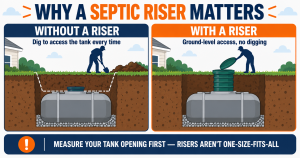
A septic riser is a hollow cylinder, usually two feet or less across, that bolts or seals onto the access opening in a buried septic tank lid and extends straight up to ground level, where a bolt-down cover caps it. Without one, every pump-out, effluent filter cleaning, or routine check means locating the buried lid and digging down to it — often a foot or more of soil and sod. With a riser in place, the cover sits flush with the lawn and the pumper truck or inspector simply lifts it. Our guide to maintaining a septic system covers why that easy access matters: routine pumping and inspection are the two things that most reliably prevent an expensive drain field failure, and a system nobody can reach without a shovel tends to get inspected less often than it should. Before you buy a riser kit, measure the existing opening in your tank lid — risers are sold in fixed diameters and are not universal, so a 20-inch riser will not seat on a 12-inch opening no matter how it is trimmed. The five septic tank riser kits below, from the two manufacturers that dominate this category, cover the diameter and height combinations most residential tanks need.
✏️ Our Take
There is no single best septic tank riser kit for every tank, because the right one is decided by your existing hardware, not by brand. Tuf-Tite and Polylok are both established, purpose-built riser manufacturers, and the honest differences between their products here come down to diameter, height and wall profile — not construction quality. Get the diameter wrong and the riser will not seal to your tank’s access port; get the height wrong and the cover either sits proud of the lawn or falls short of grade and still needs digging out. Measure your tank’s opening and the depth to grade first, then use the comparison below to match a kit to those numbers. Sizing correctly matters more than which of these two brands you choose. Once you’ve picked the right size, our how to install a septic tank riser kit guide walks through the installation itself.
Quick Comparison Table
Full Reviews — 5 Best Septic Tank Riser Kits
1. Tuf-Tite 20″ x 12″ Riser — Best Overall
🏆 Best Overall
★★★★★
20-inch diameter · 12-inch height · structural foam polyethylene · corrugated wall
The Tuf-Tite 20-inch riser matches the access opening most residential septic tanks are actually built with, which is why it earns the top spot rather than any single standout feature. Its corrugated, structural-foam polyethylene wall is molded to seat over a tank’s factory 20-inch riser ring or knockout, and the 12-inch height suits the common one-foot burial depth many tanks sit at. A full 20-inch opening is wide enough for a pumper truck’s hose and for a technician to reach in and inspect the outlet baffle, which is the whole point of stepping up from a smaller inspection port. The kit pairs with Tuf-Tite’s matching bolt-down or snap lid, sold separately, and the riser can be trimmed at the factory-scored rings if your burial depth falls between the standard 6-inch increments.
Because 20 inches is the de facto standard on tanks built in recent decades, this is the size to measure for first. It gives full-service access for pumping, baffle inspection and effluent filter servicing through one port, so a single riser can cover everything the tank needs. The tradeoff is footprint: a 20-inch circle in the lawn is more visible than a smaller inspection riser, and it costs more than the 16-inch and 12-inch kits below.
✓ Pros
Matches the 20-inch opening built into most residential septic tanks made in recent decades
Wide enough for a full pump-out hose and hands-on baffle inspection, not just a peek port
Factory-scored rings allow trimming to match your specific burial depth
✗ Cons
Only fits tanks with a 20-inch access opening — measure before ordering
Lid sold separately, and the larger surface footprint is more visible in the lawn
🛒 Check Price on Amazon — $$$ →
2. Tuf-Tite 16″ x 12″ Riser — Best Fit
✅ Best Fit
★★★★★
16-inch diameter · 12-inch height · structural foam polyethylene · corrugated wall
The 16-inch Tuf-Tite riser is built for the other common factory opening size — many tanks, particularly older or smaller-capacity models, use a 16-inch knockout rather than a 20-inch one. Construction mirrors the 20-inch riser: the same corrugated structural-foam polyethylene wall, the same 12-inch standard height with scored trim rings, and compatibility with Tuf-Tite’s own bolt-down lids and gasket kits. Buyers consistently single this size out for how cleanly it seats on a stock 16-inch opening without needing an adapter ring, and for arriving with none of the warping or out-of-round issues that turn up occasionally with cheaper risers.
It is not the pick for a 20-inch tank — forcing a 16-inch riser onto a larger opening leaves a gap sealant will not reliably close. But for the tanks it is built for, this is the riser with the fewest reported fit complaints, which is why it takes the Best Fit spot over the otherwise similar 20-inch model.
✓ Pros
Seats cleanly on a stock 16-inch tank opening with no adapter ring needed
Consistent, round manufacturing with few fit complaints reported
Same durable corrugated construction as the larger Tuf-Tite risers, at a lower price tier
✗ Cons
Will not fit a 20-inch opening — confirm your tank’s port size before ordering
Slightly tighter working room for a technician’s hands during baffle inspection
🛒 Check Price on Amazon — $$ →
3. Polylok 24″ x 6″ Low-Profile Riser — Best Low-Profile
📏 Best Low-Profile
★★★★☆
24-inch diameter · 6-inch height · structural foam polyethylene · low-profile wall
Most risers step up in height to reach a foot or more of burial depth; the Polylok 24-inch low-profile riser does the opposite. At just 6 inches tall, it is built for shallow-buried tanks, where the lid sits only a few inches under the lawn and a standard 12-inch riser would leave the cover sitting proud of grade. The 24-inch diameter is the widest of the five kits here, giving full access on tanks with an oversized opening while the short body keeps the finished installation nearly flush with the soil.
This is a specialty size, not a default choice: measure the actual depth from lid to grade first, since a too-short riser still leaves the cover buried. For the shallow-tank scenario it solves, nothing else in this lineup fits as cleanly, and the wide 24-inch mouth doubles as full pump access rather than just an inspection port.
✓ Pros
The only 6-inch option here — keeps the finished cover close to flush on shallow-buried tanks
24-inch diameter gives full pump-out access, not just an inspection port
Same structural-foam polyethylene build quality as Polylok’s taller risers
✗ Cons
Only works if your tank is buried shallow — too short a riser still leaves the lid buried
May need to be paired with a second riser section if depth is underestimated
🛒 Check Price on Amazon — $$ →
4. Tuf-Tite 12″ x 12″ Riser — Best Compact
📦 Best Compact
★★★★☆
12-inch diameter · 12-inch height · structural foam polyethylene · corrugated wall
The 12-inch Tuf-Tite riser is not sized for full pump-out access — at this diameter a pumper’s hose has to work harder and a technician cannot easily reach inside. What it is built for is bringing a smaller point to grade: an effluent filter housing, a distribution box lid, or a dedicated inspection port that a homeowner wants to check without excavating. The 12-inch height matches the other Tuf-Tite risers here and uses the same factory-scored trim rings, so it can be shortened to fit a shallower burial depth on these smaller fixtures.
Many septic systems need two riser sizes: a large one on the tank’s main access for pumping, and a small one like this over the effluent filter or D-box for its own service schedule. Buying a 12-inch riser for your tank’s primary pump-out port would be the wrong call, but for the fittings it is designed around, its size is exactly the point.
✓ Pros
Right-sized for effluent filter housings and distribution box lids, not oversized for the job
Lowest price of the five kits here, with the same durable Tuf-Tite construction
Small footprint disturbs less lawn than a full-diameter riser
✗ Cons
Too narrow for a full pump-out hose — not a substitute for a main tank access riser
Only useful if your tank has a matching 12-inch secondary fitting to build up from
🛒 Check Price on Amazon — $ →
5. Polylok 24″ x 12″ Round-Wall Riser — Best Large Capacity
🪣 Best Large Capacity
★★★★☆
24-inch diameter · 12-inch height · structural foam polyethylene · smooth round wall
Where the other four risers here use a corrugated, ribbed wall, Polylok’s 24-inch round-wall riser uses a smooth cylindrical profile instead. Combined with the largest diameter and a full 12-inch height, it is built for tanks buried deeper than average that also have an oversized 24-inch opening — the widest and tallest combination in this lineup. Some installers prefer the smooth wall because certain adapter rings, gasket kits and lid styles seal more predictably against a round surface than a corrugated one.
This is the riser for a deep-set tank that also happens to have the largest factory opening — a combination that is not universal, so confirm both numbers before ordering. It is the most material for the money of the five kits, which puts it at the top of the price range, but for the specific tank it is sized for, it delivers full pump and inspection access in a single, tall, wide riser rather than requiring a stacked or extended assembly.
✓ Pros
Largest diameter and full 12-inch height in one piece — no stacking needed on deep tanks
Smooth round wall seals more predictably with many adapter rings and gasket kits
Full 24-inch opening supports both pumping and hands-on baffle inspection
✗ Cons
Highest price of the five kits, reflecting the larger amount of material
Overkill for a shallow tank or a standard 20-inch opening — measure first
🛒 Check Price on Amazon — $$$$ →
Buying Guide
Start by measuring, not by picking a size that sounds reasonable. Uncover your tank’s existing access opening — the factory knockout or riser ring molded into the lid — and measure its inside diameter with a tape measure. The five kits above cover 12, 16 and 24-inch openings; a riser sized for the wrong opening will not seal against the lid no matter how much sealant or adapter foam gets packed around it. If your tank uses an odd or non-standard opening, a universal adapter ring can bridge a small mismatch, but there is no substitute for buying the correct diameter when one exists.
Height comes next. Measure straight down from the tank lid to the finished grade you want the cover to sit at, then choose a riser section — or stack sections — that matches that depth as closely as possible. Most riser bodies, including the Tuf-Tite kits above, have factory-scored trim rings so you can cut them shorter with a reciprocating saw rather than being locked into fixed heights. A cover that ends up sitting proud of the lawn is a trip hazard and an eyesore; one that falls short still needs digging out, which defeats the purpose of installing a riser at all.
Beyond the riser body, most installations need a few accessory items: a gasket kit or butyl sealant for the riser-to-lid joint, a stainless steel screw kit to fasten the cover, and sometimes an adapter ring when the tank’s opening and the riser’s base do not match exactly. For most homeowners with an accessible, shallow-buried tank, installing a riser is a reasonable DIY project — dig around the opening, seal the riser to the lid, backfill, and bolt on the cover. The one place to be careful is the tank’s existing seal: any crack or gouge in the lid or gasket area while digging can undo the tank’s watertightness, so work around it rather than pry against it. A drain camera is worth having on hand once the riser is in, to check the inlet and outlet baffles through the new access point without opening the tank fully. If your property also runs a sewage or effluent ejector pump ahead of the tank, easier riser access makes it simpler to keep an eye on that basin during the same visit.
Need a Professional Plumber?
Some installs are more involved than a straightforward riser swap — a deeply buried tank, a cracked lid, or an opening that does not match anything on the shelf. If that is not a job you want to take on, search PlumberArchive.com — the US plumber directory with 12,151+ verified local plumbers across all 50 states.
Find a trusted plumber near you → PlumberArchive.com
Frequently Asked Questions
Q: Do I need a permit to install a septic riser?
It depends on your local health department or septic authority, and requirements vary by county and state. Some jurisdictions treat a riser as routine maintenance needing no permit, since it does not change the tank’s function or capacity; others require notification or inspection, particularly if it is installed alongside other septic work. A quick call to your local environmental health office before digging will confirm whether a permit applies.
Q: Can I install a septic riser myself?
For a tank that is shallow-buried and easy to reach, yes — it is a reasonable weekend DIY project with a shovel, a gasket kit and a saw to trim the riser to height. The part that requires care is the tank’s existing seal: avoid prying on or gouging the lid and gasket area while digging, since damaging that seal can let groundwater in or odors escape. If the tank is buried deep, the opening is an odd size, or the lid shows cracking, have an installer or septic contractor handle it instead.
Q: What size riser do I need?
Measure two things before buying: the inside diameter of your tank’s existing access opening, and the depth from the tank lid to the grade you want the finished cover at. Diameter has to match what your tank was built with — 12, 16, 20 and 24 inches are the common sizes, and there is no universal fit. Height can usually be adjusted by trimming a riser section at its factory-scored rings, or by stacking sections for a deeper burial. Guessing at either measurement is the most common reason a riser kit gets returned.
Q: Do septic risers need to be secured or locked?
Yes. A riser brings what used to be a buried, hard-to-reach opening up to where children, pets and lawn equipment can all reach it, so the cover should be bolted down or fitted with a locking or child-safety lid rather than left as a loose cap. Beyond safety, a securely fastened cover also keeps rainwater and groundwater out of the tank, which protects the system’s treatment capacity. Most riser and lid kits, including the ones above, include or support a stainless steel screw-down fastening system for exactly this reason.
Conclusion — Which Septic Riser Kit Should You Buy?
Measure your tank’s access opening and burial depth before choosing anything from this list — that single step decides which riser will actually seal and sit flush, far more than any difference in brand. For most homeowners with a standard residential tank, the Tuf-Tite 20″ x 12″ Riser is the safest default choice: it matches the most common factory opening size, its 12-inch height covers a typical burial depth with room to trim, and its full 20-inch mouth supports both pumping and hands-on inspection through one access point.
If your tank uses the smaller 16-inch opening instead, the Tuf-Tite 16″ x 12″ Riser is the better match and our Best Fit pick for how cleanly it seats without an adapter. Choose the Polylok 24″ x 6″ Low-Profile Riser for a shallow-buried tank, the Tuf-Tite 12″ x 12″ Riser for a secondary point like an effluent filter or distribution box, and the Polylok 24″ x 12″ Round-Wall Riser for a deep-buried tank with the largest factory opening. Whichever size matches your tank, a correctly installed riser pays for itself the first time a pump-out does not require a shovel.
Prices and ratings may change. Always check Amazon for current prices.
✏️ Our Take
Every riser kit in this category comes from one of two established, purpose-built manufacturers — Tuf-Tite or Polylok — so quality is not the variable that should drive your decision. Diameter and height are. Confirm your tank’s opening size and depth to grade before you buy, and any of the five kits above will do the one job a riser exists to do: bring dig-free access to the surface.
✍️ About This Review
PTR Editorial Team — Product Reviews. We compare manufacturer specifications, installation requirements, compatibility and available product documentation to help homeowners choose suitable tools and parts. How we review →