
Guides
19 Oct 2026

Can’t Reach the Faucet Nut? Choose the Right Tool Before You Buy
Not sure which tool fits your faucet nut? Identify the fixing, see how it lets go and check your clearance first. Then choose a tool, or use one you own.
How to maintain a septic system: your pumping schedule, what not to flush, drain field care, the truth about additives, and the warning signs of failure.
Please note: This guide is based on our research and hands-on experience at time of writing and is for general information only. Septic regulations, inspection requirements, and pumping intervals vary by state and county — always follow your local health department’s rules and your system’s own specifications, and use a licensed septic professional for pumping, inspection, and any repair work.
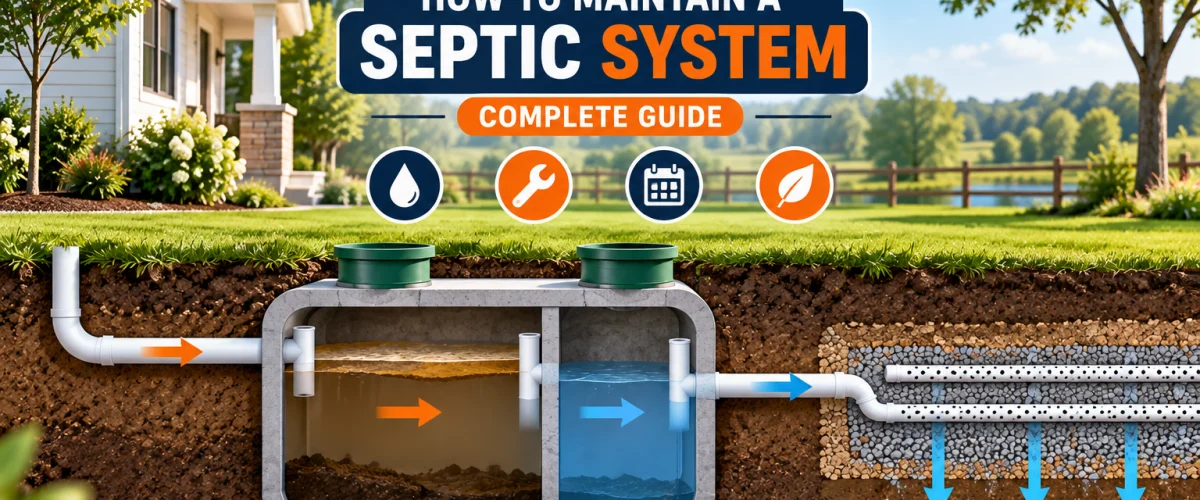
A septic system is a small, self-contained sewage treatment plant buried in your yard. Everything that leaves the house through the main drain line flows into a watertight septic tank, where gravity does the first stage of treatment: heavy solids settle to the bottom as sludge, fats and oils float to the top as scum, and the relatively clear liquid in the middle — called effluent — flows out the far end. From there the effluent drains into the drain field (also called a leach field): a network of perforated pipes in gravel-filled trenches, where the liquid seeps out, percolates down through the soil, and is filtered and broken down by natural bacteria before it reaches groundwater. In a home where a basement bathroom or laundry sits below the tank’s inlet, gravity can’t do that job, so those fixtures drain into a sealed basin and a sewage ejector pump lifts the waste up to the main line — the one mechanical part many septic homes have.
The system runs on biology and gravity, with no moving parts in a conventional gravity-fed design, so it is easy to forget it exists — until it fails, and the failures are expensive. A tank that is never pumped lets the sludge layer build until solids carry out into the drain field and clog the soil pores permanently; once a field is biologically failed it usually can’t be cleaned, only replaced, and a replacement field routinely runs well into five figures. A collapsed tank, a backed-up main line, or a saturated field surfacing sewage in the yard land in the same range. Against that, routine upkeep is close to free: a pump-out every few years, a short list of things you keep out of the drains, and some attention to how much water you send down at once. Easy access matters here too — if your tank’s lid is buried and hard to reach, our septic riser kit reviews and our how to install a septic tank riser kit guide cover adding one, which makes routine pump-outs and inspections far less of a chore.
This guide covers the whole maintenance picture for a conventional residential septic system: working out your real pumping interval, what must never go down the drain and why, the water-use habits that keep the field alive, drain field care, an honest look at whether additives do anything, the warning signs that mean you need help now, and what a professional inspection checks. Most of it is knowledge and habit rather than tools — and the hands-on parts all belong to a licensed septic contractor, as this guide makes clear.
IN THIS GUIDE
At a Glance
| Skill Level | Homeowner awareness, not hands-on repair. Keeping a septic system healthy is mostly observation, scheduling, and mindful water use. Anything that involves opening the tank, measuring the sludge layer, or working on the drain field is a licensed professional’s job — never open or enter a septic tank yourself, as the gases inside are toxic and the lids can fail under body weight. |
| Tools Needed | Almost none for the homeowner’s part — a calendar or maintenance log and a copy of your system’s “as-built” diagram showing tank and field locations. Pumping and inspection require a professional with a vacuum truck, tank-measuring tools, and often a camera; not equipment a homeowner buys or rents. |
| Time Needed | An ongoing schedule, not a one-time project. Day to day it costs nothing but habit. A professional pump-out takes an hour or two every 3–5 years for a typical household; a professional inspection is a short visit every 1–3 years depending on your system type and local rules. |
| Critical First Step | Find out your tank’s capacity in gallons and be honest about your household’s size and water use. Those two facts — not a generic “every three years” — set how often your tank actually needs pumping. A 1,000-gallon tank serving two people and the same tank serving a family of six with a garbage disposal are on completely different schedules. |
There is no single correct pumping interval, and any source that gives you one flat number is oversimplifying. The tank needs pumping when the combined sludge and scum layers take up roughly a third of its volume. Past that point, wastewater no longer has the room or the settling time it needs, and solids start escaping into the drain field — the one outcome you are paying to prevent. How fast you reach that point depends on a handful of variables.
Tank size. A 1,000-gallon tank is the common minimum for a three-bedroom house; older homes sometimes have 750- or 900-gallon tanks, newer or larger homes 1,250 or 1,500. A smaller tank uses up its sludge budget faster and needs pumping sooner, all else equal.
Household size. More people means more solids and more water per day. A single occupant might go 7–10 years between pump-outs on a standard tank; a household of five or six can need it every 2–3.
Garbage disposal use. A disposal can raise the solid load reaching the tank by 30–50 percent, because food scraps that would otherwise go in the trash now have to be settled and digested. Heavy disposal users often pump a year or two sooner than they otherwise would.
What goes down the drain. Homes that stay disciplined about grease, wipes, and non-flushables build sludge more slowly than homes that don’t.
As a working guideline, a typical three- or four-person household on a 1,000-gallon tank has the tank pumped every 3 to 5 years. Smaller households with larger tanks can stretch well beyond that; larger households, smaller tanks, or heavy garbage-disposal use pull it in toward every 2 to 3 years. The only way to dial in your own number is to have the tank inspected and the sludge depth measured on the first couple of visits, then space future pump-outs to match how fast your system actually loads. Many county health departments publish a sizing table for exactly this.

⚠️ Warning: A kitchen garbage disposal and a septic system are an awkward pairing. Ground food waste is high in solids and slow to break down, so it settles as sludge and drives pumping frequency up significantly — often by a full year or more between pump-outs. If you have a disposal and a septic system, use it sparingly, scrape plates into the trash or a compost bin first, and budget for more frequent professional pumping.
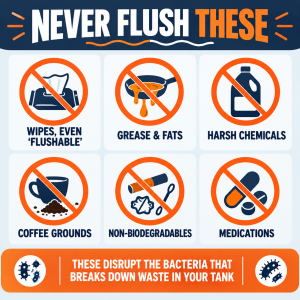
A septic tank works because a stable population of anaerobic bacteria digests the organic solids that settle out of your wastewater. Anything that kills those bacteria, will not break down, or physically clogs the system undermines it — and the tank cannot tell the difference between sewage and everything else you send down a drain. It just has to deal with all of it.
“Flushable” wipes, paper towels, and facial tissue. Toilet paper is engineered to fall apart in water within seconds. Wipes — baby wipes, cleaning wipes, and the ones marketed as “flushable” — are not; they stay intact, snag on pipe joints, and knit together with hair and grease into ropes that block the main line or the tank inlet. Paper towels and tissue are in between: sturdier than toilet paper and slow to break down, so they add to the scum and sludge that has to be pumped. In a septic toilet, only human waste and toilet paper belong.
Grease, fats, and cooking oil. Poured down the drain warm, they travel as a liquid and then cool and solidify — coating pipe walls, thickening the scum layer, and eventually reaching the drain field, where they clog soil pores that can never be un-clogged. Grease also floats, so it never settles or digests in the tank; it only accumulates. Wipe greasy pans into the trash and pour cooled fat into a can.
Bleach, drain cleaners, and harsh chemicals in quantity. A normal amount of household cleaning product — a cup of bleach in a load of laundry, a routine toilet-bowl cleaner — is diluted enough by the time it reaches the tank that the bacteria recover. The danger is volume and concentration: caustic drain opener poured down a slow drain, or leftover paint, solvent, pesticide, or a gallon of bleach dumped at once, can sterilize the tank, and a tank with no live bacteria stops treating anything until the colony rebuilds over weeks. Photo chemicals, automotive fluids, and bulk pharmaceuticals belong at a hazardous-waste drop-off, not the drain.
Coffee grounds, eggshells, and fibrous food scraps. These do not break down anaerobically in any useful timeframe. Coffee grounds in particular are dense and drop straight to the sludge layer, filling the tank faster with material the bacteria cannot process. They go in the trash or compost.
Non-biodegradable items. Cigarette butts, dental floss, cotton swabs, menstrual products, condoms, cat litter (including “flushable” litter), diapers, and cloth rags do not decompose. They occupy tank volume permanently and are a common cause of inlet and outlet blockages. Every one of them has a trash can as its correct destination.
💡 Tip: Keep a simple septic log — a note in your phone or a page in a house binder — recording every pump-out date, the sludge and scum depths the pumper reports, any repairs, and a sketch or photo of where the tank lids and drain field are. When you sell the house, or when a new pumping company shows up, that record is worth far more than trying to remember “sometime around 2022,” and it lets your real pumping interval emerge over two or three cycles.
Every gallon that goes down a drain in your house ends up in the septic tank, and from there in the drain field. The tank needs wastewater to sit still long enough for solids to separate; the field needs time to absorb each batch of effluent before the next one arrives. Sudden, heavy water use defeats both — send 300 gallons through in an hour and you push effluent out of the tank before solids have settled, and flood the field faster than the soil can accept it.
Spread laundry out. A single load uses 15–40 gallons; four loads back to back on a Saturday is a small flood as far as the tank is concerned. One or two loads a day across the week keeps the flow even and lets the system recover between surges.
Fix leaks promptly. A running toilet flapper can pass 200 or more gallons a day straight into the septic system, silently, around the clock. A dripping faucet or a leaking softener adds up the same way. Chronic over-loading keeps the drain field permanently saturated, and a saturated field cannot treat effluent — it just passes it through or backs it up. Fixing a silent leak is often the single biggest thing a homeowner can do for a struggling system.
Use efficient fixtures and appliances. Low-flow toilets, faucet aerators, and high-efficiency washing machines cut the daily hydraulic load without changing how you live. Less water in means more settling time in the tank and a longer-lived field.
Watch water softener discharge. A water softener regenerates by flushing its resin bed with brine, and depending on the model that backwash — often 40 to 100 gallons of salty water per cycle — may be plumbed to the septic system. There is genuine debate about how much harm this does: the salt is hard on drain-field soil structure and the extra volume adds hydraulic load, and some jurisdictions prohibit routing softener discharge to a septic system at all. If you are on septic and adding or replacing softening equipment, ask about a demand-initiated (metered) softener that regenerates less often, routing the discharge to a separate dry well where code allows, or a salt-free conditioner with no backwash at all. Our comparisons of salt vs salt-free water softeners and electronic descalers vs salt-based softeners lay out the trade-offs.
The drain field is the most expensive and least replaceable part of the system, and the easiest to damage without realizing it. It needs oxygen in the soil, unobstructed pipe, and no compaction. Protect it like this.
Keep weight off it. Never drive or park vehicles, trailers, or equipment on the drain field, and don’t build sheds, decks, patios, or pools over it. Weight compacts the soil, collapses the gravel structure, and can crush the distribution pipes. Compacted soil also loses the air pockets the treatment bacteria depend on.
Don’t pave or cover it. Asphalt, concrete, and even heavy plastic sheeting seal the surface and stop the field breathing and evaporating moisture. The field needs an open, permeable surface above it.
Plant grass, and only grass. A healthy stand of turf over the field is ideal — it takes up moisture and nutrients, prevents erosion, and poses no threat to the pipes. Keep trees and large shrubs well away: willow, poplar, silver maple, and other water-seeking species send roots straight into field pipes and joints, and root intrusion is a leading cause of field failure. A common rule of thumb is to keep a tree at least as far from the field as it is expected to grow tall.
Divert surface water away. Roof downspouts, sump pump discharge lines, driveway runoff, and slopes that shed rainwater onto the field keep it saturated and unable to accept effluent. Route all of it well clear of the field, and don’t set irrigation to water the lawn above the field.
Walk down the septic aisle of any hardware store and you’ll find monthly-dose packets, flushable pods, and liquid treatments promising to “boost bacteria,” “break down solids,” “clean your drain field,” or let you skip pumping. It is worth being clear-eyed about these.
The consensus among university extension programs, the US EPA, and most state health departments is that a properly functioning septic system does not need additives. A healthy tank already holds all the bacteria it needs — every flush reseeds it from the human gut — and independent studies have generally found no measurable benefit from biological or enzyme additives in normal operation. The tank fills with sludge at essentially the same rate with or without them, so they do not extend your pumping interval, and no additive can rehabilitate a drain field that has already failed.
There are narrower cases where a bacterial additive is sometimes suggested — restarting a tank after a large chemical spill sterilized it, or a system coming back into use after sitting empty for months — but even then the tank normally re-establishes its own population within a few weeks of ordinary use. If you choose to use something in a case like that, a plain bacterial or enzyme product is the low-risk option.
What to actually avoid is the other category: chemical additives — particularly those containing hydrogen peroxide, sulfuric acid, or other harsh compounds — and organic solvents. Marketed as “drain field openers” or “root killers,” they can kill the tank’s bacteria outright, corrode the tank and pipes, and carry solvents and untreated material into the field and groundwater. Several states restrict or ban them. The short version: skip the additive aisle, put the money toward a pump-out on schedule, and treat any product that promises you’ll “never pump again” as a warning sign, not a feature.
Septic problems rarely arrive without warning. Catching them early — while it is a pump-out or a small repair rather than a field replacement — means knowing what to watch for.
Slow drains throughout the house. One slow sink is a local clog. Every drain running slow, especially the lowest ones, points to the tank or the line between the house and tank being full or blocked.
Sewage odor. A rotten-egg or sewage smell indoors near drains, outdoors near the tank, or over the drain field means gases are escaping where they shouldn’t — a full tank, a failing field, or a venting fault.
Gurgling pipes. Air pulled back through the plumbing as drains struggle to clear — audible in toilets and sink drains — is an early sign of the system backing up.
Standing water or spongy ground over the drain field. Effluent the soil can no longer absorb rises to the surface. The ground feels wet or squishy underfoot, or you see actual pooling, often with a smell. That is a field failing or overloaded.
Unusually lush, green grass over the field. A bright, fast-growing stripe over the trenches while the rest of the lawn is ordinary means effluent is surfacing near the top and fertilizing the grass — the field is saturated and not draining down as it should.
Sewage backing up into the house. Waste coming up in the lowest drains or a basement floor drain is the emergency version. Stop using water and call a septic professional immediately.
Any one of these warrants a service call. Two or more together, or any sign of sewage at the surface or indoors, is urgent.
Pumping empties the tank; inspection tells you the condition of the whole system. The two often happen on the same visit, but they are not the same thing. A conventional gravity system should be inspected at least every 3 years and the tank pumped every 3 to 5, as covered above. Systems with mechanical or electrical parts — pump chambers, aerobic treatment units, mound and drip systems, effluent filters — should be inspected every year, and many states require an annual or biennial inspection under a maintenance contract for those designs.
Beyond pumping, a professional checks:
Sludge and scum depths, measured before pumping, to calibrate your interval.
Tank integrity — cracks, corrosion, root intrusion, leaking seams, and whether the lid and risers are secure and sealed.
Inlet and outlet baffles or tees, which keep scum from leaving the tank and clogging the field; they corrode and break and are a cheap fix if caught early.
The effluent filter, if fitted, which is cleaned or replaced.
Liquid level in the tank — too high suggests a field or outlet problem, too low suggests a leak.
The drain field — checked for wet spots, odor, ponding, and lush growth.
Pumps, floats, alarms, and the control panel in systems that have them, including testing the high-water alarm itself.
Septic maintenance splits cleanly into what a homeowner can and should do, and what always belongs to a licensed septic professional. The DIY side is real, but narrow.
Safe for the homeowner: tracking and scheduling pump-outs; keeping records and system diagrams; managing what goes down the drains; spreading out water use and fixing leaks fast; keeping vehicles, structures, pavement, and the wrong plants off the drain field; diverting surface water; and watching for the warning signs above. None of that involves opening anything.
Always a licensed professional:
Pumping the tank — a vacuum truck and a licensed hauler who disposes of the septage legally. Not a rental-equipment job.
Opening or entering the tank — septic tanks contain hydrogen sulfide and methane and are oxygen-deficient. They are lethal to enter, and lids can crack under a person’s weight. Leave the lid to the professional.
Inspection — measuring sludge, checking baffles and integrity, and evaluating the field take training and tools.
Any repair — baffles, filters, risers and lids, the line to the tank, root intrusion, and anything involving the drain field or a new tank.
Diagnosing a backup or a wet field — if drains are backing up or effluent is surfacing, that is a service call, not a project.
A home with the sewage ejector or grinder pump described in the introduction has one more mechanical component to keep on the radar — its floats, check valve, and motor all fail eventually, and a failed ejector pump backs waste up into the basement fixtures it serves.
US Regional Context: Roughly one in five US households — more than 20 million homes — treats its wastewater with a septic system rather than a municipal sewer, and the share is far higher in rural and exurban areas with no sewer main. Those same areas usually draw drinking water from a private well, which is why a failing drain field is also a water-quality concern: surfacing or under-treated effluent can reach a nearby wellhead. If your system shows warning signs and you are on a well, it is worth testing your well water for bacteria, and our overview of well water vs municipal water covers being your own utility on both ends. Maintenance rules are local, not national: many county health departments require an inspection at property transfer, some mandate pumping on a registered schedule, and systems with pumps or advanced treatment often must stay under a maintenance contract. Check your county health department’s septic page for the rules where you live.
✏️ Our Take
Almost every septic failure that ends in a five-figure repair traces back to something ordinary that was skipped for years: a tank that was never pumped, wipes and grease going down the drain, a running toilet nobody fixed, a truck parked on the field, or a homeowner who trusted an additive instead of a pump-out. The system itself is simple and durable. Keep solids and chemicals out of it, keep the water load steady and modest, keep weight and roots off the field, and have a licensed professional pump and inspect it on a schedule that matches your household. Do those few things consistently and a septic system runs quietly for decades.
Pumping, inspection, backups, and any drain-field or tank work all call for a licensed septic contractor or plumber. Search PlumberArchive.com — the US plumber directory with 12,151+ verified local plumbers across all 50 states.
Get weekly plumbing tips and DIY guides delivered straight to your Facebook feed.
For a typical three- or four-person household on a 1,000-gallon tank, every 3 to 5 years. Larger households, smaller tanks, and heavy garbage-disposal use pull that in toward every 2 to 3 years; smaller households with larger tanks can go longer. There is no universal number — the tank needs pumping once sludge and scum fill about a third of it. Have the sludge depth measured on the first few visits to find your real interval.
For a normally functioning system, the evidence says no. Extension programs, the EPA, and most health departments agree a healthy tank already has the bacteria it needs, reseeded with every flush, and studies show no measurable benefit from biological or enzyme additives in routine use. They don’t slow sludge buildup or extend your pumping interval, and nothing in a bottle revives a failed drain field. Chemical “drain field openers” are worse — they can kill the tank’s bacteria and corrode the system. Spend the money on pumping instead.
“Flushable” and baby wipes, paper towels, and large amounts of tissue; grease, fats, and cooking oil; bleach, drain cleaner, solvents, paint, pesticides, and other harsh chemicals in quantity; coffee grounds, eggshells, and fibrous food scraps; and anything non-biodegradable — floss, cotton swabs, cigarette butts, menstrual products, cat litter, diapers, wet wipes of any kind. Each one either kills the bacteria that make the tank work, refuses to break down and fills the tank, or clogs the pipes and the drain field.
Usually slow drains throughout the house and gurgling from toilets and sink drains, then a sewage odor indoors or in the yard. Outside, watch for soggy or spongy ground over the drain field, actual pooling of water there, and a strip of unusually lush, fast-growing green grass following the trench lines. Sewage backing up into the lowest drains is the emergency stage — stop running water and call a septic professional right away.
It is not ideal. Ground food waste is high in solids and slow to digest, so it settles as sludge and can raise your pumping frequency by a year or more. You can keep one on a septic system, but use it sparingly, scrape plates into the trash or compost first, expect to pump more often, and have the tank checked more frequently to stay ahead of the load.
A conventional septic system has no moving parts and, treated well, no real reason to fail within your ownership of the house. The maintenance is almost entirely restraint and routine: keep wipes, grease, harsh chemicals, and non-flushables out of the drains; spread water use across the week and fix leaks fast; keep vehicles, buildings, pavement, and thirsty trees off the drain field; ignore the additive aisle; and put a professional pump-out and inspection on a schedule sized to your tank and household — every 3 to 5 years for a typical home, sooner for a big household or a garbage disposal. The homeowner’s job is observation and habit; pumping, inspection, and every repair belong to a licensed septic professional. Get those boundaries right and the system takes care of itself.
Prices and ratings may change. Always check Amazon for current prices.
✍️ About This Guide
PTR Editorial Team — Plumbing Guides. We compare manufacturer specifications, installation requirements, compatibility and available product documentation to help homeowners choose suitable tools and parts. How we review →
Not sure which tool fits your faucet nut? Identify the fixing, see how it lets go and check your clearance first. Then choose a tool, or use one you own.
Check your manual and the drain route first: gravity hose, built-in pump or external pump. Then see whether you need a dehumidifier hose at all.
Explore portable bidets that need no water-line connection, from bottle caps and squeeze bottles to battery-powered handhelds.

