Comparisons
20 Sep 2026

Utility Pump vs. Sump Pump (2026) — Which Do You Need?
Utility pump vs sump pump: one is portable for occasional jobs, the other a permanent install for ongoing water. See which your basement needs.
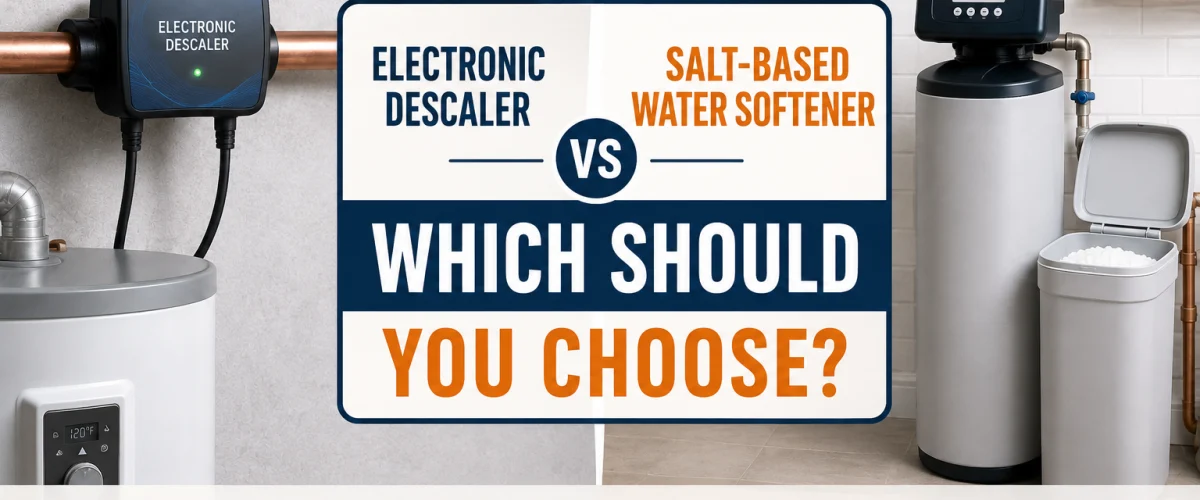
Electronic descalers and salt-based softeners both address hard water, but they work in fundamentally different ways — here's how to choose between them.
Please note: Product information referenced here is based on our research at time of writing and is general in nature. Always check a specific product’s label before use.
Electronic descalers and salt-based water softeners both get marketed as answers to hard water, which makes it easy to assume one is simply a newer, better version of the other. It isn’t that simple. These are two fundamentally different technologies solving related but distinct problems: an electronic descaler uses an electrical or magnetic signal to change how mineral particles behave in your water, while a salt-based softener performs true ion exchange, physically removing calcium and magnesium from the water as it flows through.
That distinction matters more than price or brand when you’re deciding between them. An electronic descaler never actually changes your water’s mineral content — a hardness test taken before and after installing one will typically read the same. A salt-based softener does change it, which is why softened water feels different and why appliances stop scaling almost entirely rather than just scaling more slowly. This comparison walks through how each technology works, what it actually does to your water, and which one fits your situation.
At a Glance
Electronic Descaler
Salt-Based Water Softener
✏️ Our Take
The most important thing to understand before choosing between these two is that they don’t do the same job. An electronic descaler reduces the visible effects of hard water — scale buildup on fixtures and appliances — without changing the water’s actual mineral content. A salt-based softener performs true ion exchange, removing calcium and magnesium from the water itself, which is why softened water feels noticeably different and why scale buildup stops almost entirely rather than just slowing down. If you want genuinely soft water throughout your home, a salt-based system is the only option here that delivers that. If your priority is reducing scale and appliance buildup without salt, plumbing changes, or ongoing maintenance, an electronic descaler is a legitimate, lower-commitment option — just go in knowing it’s solving a different problem.
IN THIS GUIDE
Here’s how electronic descalers and salt-based softeners stack up on the factors that actually drive the decision.
| Factor | Electronic Descaler | Salt-Based Softener |
|---|---|---|
| Typical cost | $$ | $$ – $$$ |
| Removes hardness minerals | No — alters mineral behavior only | Yes — true ion exchange |
| Plumbing modification | None — wraps around existing pipe | Yes — dedicated install point |
| Ongoing maintenance | Minimal | Salt refills, periodic regeneration |
| Water hardness test result | Unchanged | Measurably lower |
| Adds sodium to water | No | Trace amounts, in most systems |
| Best for | Renters, scale reduction on a budget | Genuinely soft water, very hard water regions |
Electronic descalers typically use capacitive or inductive technology built into a compact control unit connected to one or two cables that wrap around the outside of your incoming water pipe. There’s no cutting, no drilling into the pipe, and no contact with the water itself — the entire installation happens on the outside of existing plumbing, which is why it’s one of the more accessible upgrades a homeowner can make in an afternoon.
Once powered on, the unit sends an electronic signal — capacitive units use a varying electrical field, inductive units use electromagnetic pulses — through the pipe wall and into the water flowing past. The signal is theorized to alter how dissolved calcium and magnesium particles behave physically as they move through the plumbing, changing the way they form crystalline structures. Rather than bonding tightly to pipe walls, heating elements, and fixture surfaces as hard scale, the altered minerals are thought to stay more loosely suspended and pass through the system with less adhesion.
Because the mechanism works from outside the pipe, installation compatibility comes down mostly to pipe material and diameter rather than plumbing layout — most units handle copper, PVC, iron, and composite pipe up to a manufacturer-specified diameter. Our water softener reviews cover several electronic descaler models alongside true softeners, since both technology types show up in that roundup.
A salt-based water softener takes a completely different physical approach. Incoming water passes through a tank filled with resin beads coated in sodium ions. As calcium and magnesium molecules in the hard water contact the resin, an ion exchange reaction swaps them for sodium — the hardness minerals attach to the resin bed, and sodium is released into the water that continues on to your fixtures. This is a genuine chemical exchange, not a behavioral change, which is the core reason softened water measures differently on a hardness test.
The resin bed has a finite capacity, so the system needs to periodically regenerate — flushing a concentrated saltwater brine solution through the tank to strip the accumulated calcium and magnesium off the resin and wash it down a drain, recharging the resin with fresh sodium ions in the process. This regeneration cycle is why every salt-based system needs a dedicated brine tank alongside the main resin tank, and why the salt supply needs periodic refilling.
Because water needs to be redirected through the resin tank, installation typically requires a dedicated plumbing point on the main supply line — a bigger commitment than an electronic descaler’s wrap-around setup, and one that’s usually worth having a plumber handle or at least review.
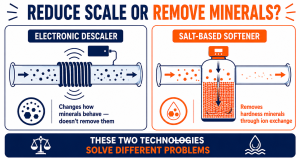
This is the distinction that matters most, and it’s the one most easily glossed over in marketing copy. An electronic descaler does not change your water’s mineral content or its hardness level as measured by a water test. The calcium and magnesium are still dissolved in the water in the same quantities as before — the technology only affects how those minerals behave physically once they’re in the plumbing, not how much of them are present.
A salt-based softener, by contrast, measurably reduces water hardness because the minerals are actually removed from the water through ion exchange and replaced with sodium. If you tested your water’s hardness before and after installing each system, the descaler’s reading would stay essentially flat while the softener’s reading would drop significantly. That’s not a flaw in the descaler — it isn’t designed to remove minerals — but it’s an important expectation to set correctly before you buy. Our how to test your water for hardness guide walks through doing that test yourself, before and after installing either type of system.
Renters and anyone who can’t modify their plumbing are the clearest fit. Because a descaler wraps around the outside of an existing pipe with no cuts or dedicated install point, it can be removed entirely when you move out, leaving no trace on plumbing you don’t own — something a salt-based system’s dedicated tank and installation point simply can’t offer.
Households primarily concerned with appliance scale rather than water feel are another strong fit. If your main goal is protecting a water heater, dishwasher, and washing machine from mineral buildup rather than changing how the water feels on your skin, a descaler addresses that goal directly without the added complexity of a salt-based system.
Anyone wanting to avoid adding sodium to their water should also lean toward a descaler, since most salt-based systems introduce trace sodium during the ion exchange process. And for budget-conscious households who want a lower-commitment first step — no dedicated tank, no ongoing salt purchases, and a shorter learning curve to install — a descaler is a reasonable place to start before considering a bigger investment.
Households in genuinely hard water regions wanting measurably softer water are the clearest case for a salt-based system. When water hardness is severe enough that scale forms quickly and visibly, only a true ion-exchange system reliably keeps pace, since it’s removing the minerals rather than just changing how they behave.
Anyone prioritizing skin and hair feel, or soap and detergent efficiency, is also better served by a salt-based system — these are among the most common reasons people seek out softened water specifically, and they’re effects tied directly to the water’s actual mineral content changing, not just scale prevention on surfaces.
Homeowners willing to handle salt refills and periodic system maintenance in exchange for the more complete solution round out the case for a salt-based softener. It’s a bigger commitment than a descaler in both upfront installation and ongoing upkeep, but for households that want the full effect of soft water throughout the home, it’s the only technology here that actually delivers it.
Electronic descalers have minimal ongoing cost and maintenance once installed. There’s no salt to buy, no tank to monitor, and no regeneration cycle to manage — beyond the initial purchase, most units simply run continuously with negligible electricity use and little to no further attention required.
Salt-based softeners carry real ongoing costs by comparison. Salt needs periodic refilling, and the system itself benefits from occasional maintenance checks to keep the resin bed and regeneration cycle working properly over the long term. None of this is expensive on its own — salt is inexpensive and widely available — but it’s a recurring task a descaler simply doesn’t require.
On price tier, electronic descalers generally cost less upfront than salt-based systems, which typically require a larger initial investment for the resin tank, brine tank, and installation. The trade-off is straightforward: descalers cost less and need less upkeep, while salt-based systems cost more up front and require ongoing attention in exchange for a genuinely more complete solution to hard water.
Choose an electronic descaler if you want to reduce scale buildup without salt, plumbing changes, or a dedicated resin tank — particularly if you’re renting, working with a tight budget, or your main concern is protecting appliances rather than changing how your water feels.
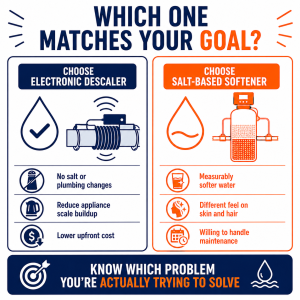
Choose a salt-based softener if you want measurably softer water and are willing to handle the maintenance that comes with it — periodic salt refills, occasional system checks, and a larger upfront installation. It’s the only technology in this comparison that actually changes your water’s mineral content rather than just how those minerals behave in your plumbing.
It’s also worth being clear about what this comparison isn’t: it’s a different question from our salt vs salt-free water softener comparison, which weighs two types of true softening technology against each other rather than descaling technology against true softening as a category. If you’ve already decided you want genuine mineral removal and are choosing between salt-based and salt-free softening methods, that comparison covers the right question — this one is for the earlier decision of whether you need true softening at all.
Salt-based softener installation typically involves a dedicated plumbing point on your main supply line — often worth having a licensed professional handle or review. Search PlumberArchive.com — the US plumber directory with 12,000+ verified local plumbers across all 50 states.
Get weekly plumbing tips, honest tool reviews and DIY guides delivered straight to your Facebook feed. We cover water treatment, maintenance, and everything in between — written for US homeowners who want to make smart decisions without overspending.
No. An electronic descaler doesn’t remove hardness minerals from your water, so a hardness test taken after installation will typically read about the same as before. The technology targets how minerals behave physically as scale, not how many of them are dissolved in the water — only a true ion-exchange system will produce a measurably lower hardness reading.
Softened water contains slightly elevated sodium from the ion exchange process, which is a minimal increase for most healthy adults. Anyone on a sodium-restricted diet should consult a physician or keep one unsoftened tap, typically the kitchen cold line, for drinking and cooking. Electronic descalers don’t add sodium at any stage, so they don’t raise this consideration at all.
Yes, in most cases. Because the cables wrap around the outside of the pipe with no cutting or drilling involved, installation is typically a DIY-friendly task that takes well under an hour. A salt-based softener’s plumbing installation point is a bigger job that many homeowners choose to have a licensed plumber handle instead.
Not in the sense of a single unit performing both electronic descaling and salt-based ion exchange simultaneously — they’re distinct mechanisms that aren’t typically combined in one product. Some households do run both in sequence for different purposes, such as a salt-free conditioner paired with filtration, but that’s a different technology pairing from combining a descaler with true ion exchange in one device.
Electronic descalers and salt-based softeners aren’t competing versions of the same product — they’re different technologies aimed at different outcomes. A descaler is the lower-commitment choice for reducing scale buildup without salt or plumbing changes, while a salt-based softener is the only option here that measurably removes hardness minerals and delivers genuinely soft water throughout the home. Match the technology to what you actually want to happen to your water, not just to your budget, and the right choice becomes clear.
Prices and ratings may change. Always check Amazon for current prices.
✍️ About This Comparison
Written by Sarah Mitchell, Home Improvement Editor at PlumbingToolsReview — specializing in helping homeowners make smart buying decisions without overspending. Learn how we test →
Utility pump vs sump pump: one is portable for occasional jobs, the other a permanent install for ongoing water. See which your basement needs.
Pipe repair clamp, tape, or epoxy — which should you use for a leaking pipe? Compare how each works, durability, and when to reach for which.
Not sure if your home has a septic tank or a sewer connection? Learn how to tell which one you have, plus the maintenance and cost differences.

