Comparisons
2 Oct 2026

Pop-Up Drain vs Grid Drain: Which Should You Choose?
Pop-up drains seal to hold water; grid drains never close but resist clogs better and cost less. Here's how to choose between them for your bathroom sink.
Bradford White vs Rheem water heaters compared — trade-only vs retail availability, Defender Safety System, warranty terms and which brand suits you best.
Please note: Product availability, pricing and warranty terms are based on our research at time of writing and are subject to change. Always confirm the exact specifications on the model you are purchasing before buying.
Bradford White and Rheem are both well-established American water heater manufacturers — but they occupy very different positions in the market, and that difference affects which one is actually available to you depending on how you buy and who installs it. Bradford White is the brand most often specified by licensed plumbers working through wholesale supply houses. Rheem is the brand homeowners encounter at Home Depot and can purchase and sometimes self-install directly. That distribution gap is the most important practical difference between the two brands, and it shapes almost everything else about this comparison.
This guide compares Bradford White and Rheem directly across company background, distribution model, tank and tankless performance, warranty terms, pricing, and installer reputation — so you can make a confident decision whether you’re working with a plumber or shopping independently. Before choosing a brand, make sure you have the right size unit for your household with our water heater sizing guide. If you’re also considering AO Smith alongside these two, our Rheem vs AO Smith comparison covers that head-to-head separately.
✏️ Our Take
Bradford White is the brand most plumbers specify for their own customers — it’s sold almost exclusively through wholesale supply houses and professional installers rather than retail shelves, which says something about how the trade views it. Rheem is the brand homeowners encounter directly at Home Depot and can buy and even self-install. Both make genuinely reliable water heaters — the real difference is how you access each brand and who typically installs them.
IN THIS GUIDE
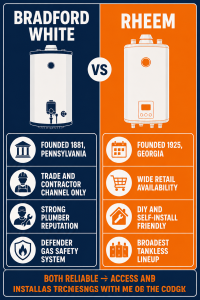
Bradford White was founded in 1881 and is headquartered in Ambler, Pennsylvania — making it one of the oldest water heater manufacturers in the United States. The company is privately held and has maintained a consistent focus on the professional plumbing trade throughout its history. Bradford White manufactures in the United States with major production facilities across New Jersey, Tennessee and Indiana. Its privately held status means it doesn’t face the same quarterly earnings pressure as publicly traded competitors, which the company has historically used to argue for consistent long-term investment in domestic manufacturing quality.
Rheem was founded in 1925 and is headquartered in Atlanta, Georgia. Rheem is part of a broader HVAC and water heating conglomerate with significant retail presence across the US market. The brand manufactures both water heaters and HVAC equipment and distributes through retail channels — primarily Home Depot — as well as through licensed contractors. Rheem also manufactures domestically and has invested in both tank and tankless product development, particularly in the residential condensing tankless category.
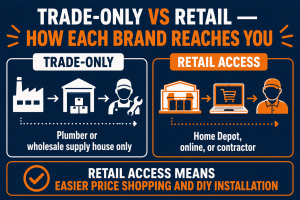
Bradford White units are sold almost exclusively through licensed plumbing contractors and plumbing wholesale supply houses — the professional distribution channel that serves the trade rather than the general public. If you walk into a Home Depot or Lowe’s, you will not find Bradford White on the shelf. To purchase one, you either work with a licensed plumber who sources it through their supply house, or you locate a wholesale supply house in your area that sells to the public — which some do, though it requires an extra step most retail shoppers don’t expect.
Rheem is sold through Home Depot locations nationwide, online retailers, and contractor channels. This dual-channel presence makes Rheem far more accessible to homeowners who want to purchase directly, compare prices online before buying, or pick up a unit for same-day installation during an emergency replacement. The retail availability also makes pricing more transparent — Rheem’s shelf prices are published and easily compared, while Bradford White pricing typically comes bundled into a contractor quote where it’s harder to see the unit cost in isolation.
Both Bradford White and Rheem offer a full lineup of gas and electric tank water heaters across all common US residential capacities — 30, 40, 50, and 80 gallon being the most widely stocked. Both brands organize their products into entry, mid, and premium residential tiers, and both offer comparable recovery rates and energy efficiency ratings at equivalent tiers. Neither brand holds a meaningful performance advantage over the other on a straight capacity and recovery rate comparison at the same price tier.
Where Bradford White differentiates on gas tank models is the Defender Safety System — a design feature on Bradford White’s FVIR (Flammable Vapor Ignition Resistant) gas models that addresses the risk of igniting flammable vapors that settle near floor level in utility rooms and garages. The system uses a sealed combustion chamber and a special mesh screen to prevent ignition of external vapors. This feature matters in applications where flammable materials may be stored near the water heater — a common concern in garages and utility rooms. Rheem’s equivalent gas models also meet FVIR requirements as required by US code, but Bradford White’s implementation of the Defender system is a specifically marketed differentiator.
Rheem’s premium residential tank tier — the Performance Platinum series — steps up energy factor, first-hour rating, and warranty length over their baseline models and is the appropriate comparison point against Bradford White’s equivalent mid-to-upper residential offerings. At that tier, the two brands perform comparably for a typical US household.
Rheem has a significantly wider residential tankless lineup than Bradford White, with multiple GPM (gallons per minute) options across both condensing and non-condensing gas models. This breadth is a genuine advantage when trying to match a tankless unit precisely to your household’s peak demand — more flow rate options mean a better chance of selecting the right unit without oversizing or undersizing. Rheem’s condensing tankless models are among the more retail-accessible condensing options in the US market and are widely stocked through Home Depot in major metro areas.
Bradford White’s residential tankless range is smaller and less commonly stocked outside professional supply channels. The units Bradford White does produce in the tankless category are competent, but the narrower lineup means less flexibility in flow rate matching, and sourcing them requires the same wholesale supply house access as their tank models. For homeowners committed to going tankless, the combination of Rheem’s wider model range and retail accessibility generally makes it the more practical choice to shop. Both brands require annual descaling maintenance for their tankless units — our guide to the best water heater flush tools covers the isolator valve kits and descaling equipment needed for DIY tankless servicing.
Rheem residential tank water heater warranties typically range from 6 years on entry-tier models up to 12 years on premium-tier models, with the warranty length tied to the product tier rather than the installation method. Rheem’s published warranty terms are straightforward to find and compare, and the warranty is generally available regardless of whether a licensed professional or an experienced DIYer performs the installation — though self-installation requirements vary by local code and should be confirmed separately.
Bradford White warranties vary by model and tier, following a similar 6 to 12-year range across their residential lineup. A meaningful difference in Bradford White’s warranty terms is that certain models carry conditions related to professional installation — Bradford White’s distribution model means the company can more tightly link warranty coverage to installer credentials than a retail brand can. If a Bradford White unit is installed incorrectly or by someone outside the licensed plumbing trade, the warranty coverage on that specific model may be affected in ways that Rheem’s retail-friendly warranty terms typically are not.
Bradford White tank models typically fall in a similar $$ to $$$ price tier as Rheem’s equivalent lines — at the same capacity and feature tier, the unit cost difference between the two brands is generally modest. However, Bradford White pricing is significantly less transparent than Rheem’s because it doesn’t appear on a retail shelf with a published price. The unit cost arrives as part of a contractor quote, where it may be bundled with labor, materials, and permit fees into a single installation price. This makes an apples-to-apples unit price comparison genuinely difficult without getting a contractor quote that breaks out the unit cost specifically.
Rheem’s published retail pricing through Home Depot gives homeowners a clear starting reference point for unit cost alone. This transparency makes it easier to compare pricing across tiers, to budget accurately before getting installation quotes, and to understand what portion of a total project cost represents the unit versus labor. For homeowners who prefer price transparency before committing, Rheem’s retail model has a practical advantage that has nothing to do with the unit’s quality.
Bradford White’s reputation among licensed plumbers is one of the strongest of any water heater brand in the US market. Many professional plumbers actively prefer to install Bradford White over retail-available alternatives — the most commonly cited reasons are consistent parts availability through wholesale supply houses, reliable build quality, and strong technical support from the brand through professional channels. A plumber who has installed dozens or hundreds of water heaters over a career often develops strong brand preferences based on accumulated hands-on experience with failure rates, part sourcing, and customer satisfaction over time.
Rheem is equally well-regarded in professional installation circles but carries a more mixed association — it’s equally the brand professional plumbers install when specified, and the brand DIYers attempt to self-install from Home Depot. That association doesn’t affect the unit’s quality, but it means Rheem carries more variability in installation quality across the population of installed units than Bradford White does. A professionally installed Rheem performs on a par with a professionally installed Bradford White; a self-installed Rheem introduces more variability.
US regional note: Bradford White manufactures in the United States with major facilities in New Jersey, Tennessee and Indiana, and the brand has particularly strong distribution and brand loyalty in the Northeast and Mid-Atlantic regions where it built its original reputation. Rheem has broader nationwide retail availability through Home Depot, making it more consistently accessible regardless of region.
For most homeowners, the choice between Bradford White and Rheem resolves around one central question: are you working with a licensed plumber, or are you purchasing independently? The head-to-head table below shows where each brand has a genuine practical edge.
| Scenario | Winner |
|---|---|
| DIY buyer wanting retail access | Rheem (Home Depot availability) |
| Working with a licensed plumber who specifies Bradford White | Bradford White (trade preference) |
| Wide tankless GPM options needed | Rheem (broader tankless lineup) |
| Gas safety feature priority (FVIR) | Bradford White (Defender Safety System) |
| Price transparency before buying | Rheem (published retail pricing) |
| Trade and contractor reputation | Bradford White (preferred by licensed plumbers) |
| Warranty flexibility for DIY install | Rheem (less installer-contingent terms) |
Water heater installation — particularly gas connections, venting, and tankless conversions — involves work that most homeowners are not equipped to handle safely without a license. A professional installation also protects your warranty: both Bradford White and Rheem have warranty terms that can be affected by installation quality, and a licensed plumber is the correct resource for ensuring both the unit and the installation are covered.
Find a licensed plumber in your area at PlumberArchive.com — the US plumber directory with 12,000+ verified local plumbers across all 50 states.
Get weekly plumbing tips, honest brand comparisons and DIY maintenance guides delivered straight to your Facebook feed. We cover water heater maintenance, brand comparisons, pipe repairs and everything in between — written for US homeowners who want to make smarter decisions without overspending.
In most cases you cannot buy a Bradford White unit directly from a retail store — Bradford White sells almost exclusively through licensed plumbing contractors and wholesale supply houses, not through consumer retail channels like Home Depot or Lowe’s. Some wholesale supply houses will sell to members of the public who walk in, but this varies by location and the purchasing process is more involved than buying off a retail shelf. The most practical path to a Bradford White unit for the majority of homeowners is through a licensed plumber who has an established supply relationship with a local wholesale house. If you specifically want Bradford White, the simplest approach is to request it from your plumber when getting installation quotes and ask them to source it through their supply channel.
Bradford White is not categorically better than Rheem, nor is Rheem categorically better than Bradford White — both are established American manufacturers producing reliable water heaters across a full range of residential capacities and configurations. Bradford White has a stronger reputation specifically among licensed plumbers, and many contractors actively prefer installing it. Rheem has broader retail availability, a wider tankless lineup, and more transparent published pricing. At equivalent product tiers, with professional installation, both brands perform comparably over their rated service lives. The “better” brand for any individual homeowner depends almost entirely on their purchasing situation: working with a plumber who recommends Bradford White, or shopping independently where Rheem’s retail availability is a genuine practical advantage.
The preference many plumbers express for Bradford White is typically based on three factors: consistent build quality that has delivered predictable results across years of professional installations, strong parts availability through wholesale channels that makes warranty repairs and service calls more manageable, and the Defender Safety System on gas models that addresses flammable vapor ignition risks in a way that plumbers can explain clearly to customers. Bradford White’s trade-only distribution model also means the brand’s customer base is almost exclusively professionally installed units, which produces a cleaner failure-rate picture compared to brands where DIY installation variability enters the data. Plumbers who have strong Bradford White preferences have generally formed them through hands-on experience rather than marketing.
Warranty terms vary by model, but Bradford White’s warranty on certain units does include conditions tied to professional installation. Because Bradford White distributes through the trade rather than retail, the company can more tightly link warranty coverage to licensed-installer credentials than a retail brand that expects some portion of its units to be self-installed. Before purchasing a Bradford White unit through any channel, confirm the exact warranty terms on that specific model and whether self-installation would affect coverage. This is especially relevant if you’re sourcing a unit through a wholesale supply house without a licensed contractor involved in the installation. For comparison, Rheem’s retail-positioned warranty terms are generally more accommodating of DIY installation, though local code requirements for permits and licensed installation still apply regardless of warranty terms.
Both Bradford White and Rheem are reliable choices from well-established American water heater manufacturers. At equivalent product tiers with professional installation, neither brand has a meaningful performance or longevity advantage over the other — homeowners who choose carefully between the two are unlikely to make a wrong decision on quality grounds alone. The comparison is genuinely close on the hardware itself.
What separates the two brands in practice is distribution and access. Bradford White is the trade favorite — the brand licensed plumbers specify, wholesale supply houses stock, and professional installers have built decades of hands-on experience with. Rheem is the retail and DIY-accessible option — the brand on the Home Depot shelf, with published pricing, a wider tankless lineup, and warranty terms designed for a broad consumer audience. The right choice depends on which of these two worlds your purchase lives in.
If you’re working with a plumber who recommends Bradford White, trust the recommendation — they have direct experience with local supply, installation, and long-term performance that no comparison guide can substitute for. If you’re shopping independently and want transparency, comparison-friendly pricing, and broad retail availability, Rheem is the more practical starting point. Either way, size the unit correctly before buying using our water heater sizing guide, and maintain it with annual flushing — our guide to the best water heater flush tools covers both tank and tankless maintenance. If you’re also comparing Rheem against AO Smith, our Rheem vs AO Smith comparison covers that head-to-head in the same format. And if you’re troubleshooting an existing unit from either brand rather than shopping for a new one, our guide to diagnosing a water heater with no hot water walks through the most common causes.
✍️ About This Comparison
PTR Editorial Team — Product Comparisons. We compare manufacturer specifications, installation requirements, compatibility and available product documentation to help homeowners choose suitable tools and parts. How we review →
Pop-up drains seal to hold water; grid drains never close but resist clogs better and cost less. Here's how to choose between them for your bathroom sink.
Test strips, digital meters or send-to-lab testing? Match the method to your situation — screening, ongoing monitoring, or a real health concern.
25-foot vs 50-foot drain snake: compare handling, the cable diameter trade-off and the jobs that justify extra length, plus where 50 feet stops.

