Introduction
Choosing the wrong size water heater is one of the costliest plumbing mistakes a homeowner can make. A unit that is too small leaves you fighting for hot water during the morning rush — cold showers when the third person steps into the bathroom after two long showers have already drained the tank. A unit that is too large heats dozens of gallons of water you never use, running up your energy bill every single month.
This guide walks you through the exact calculations for sizing both tank and tankless water heaters for any household. Whether you are replacing an aging unit or planning a new installation, you will find the right numbers here. If you are still weighing which type to buy, see our tankless vs tank water heater comparison first. Already decided on tankless? Jump to our picks for the best tankless water heaters.
Please note: Sizing guidance in this article is based on industry standards at time of writing. Water heater output varies by model, installation conditions, and local groundwater temperatures. Always check manufacturer specifications and consult a licensed plumber for your specific installation.
⚡ AT A GLANCE
| Difficulty |
Easy — no tools needed |
| Time |
15–30 Minutes to calculate |
| Cost |
Free to assess |
| Tools Needed |
Measuring tape, household headcount, peak hour estimate |
| Skill Level |
Beginner |
💬 Our Take
“Buying a water heater that is too small is one of the most common and frustrating home improvement mistakes — you end up with cold showers during peak morning use. The sizing calculation is genuinely simple once you know your household’s peak hour demand. Most 3–4 person families need a 50-gallon tank or a tankless unit rated at 7–9 GPM. Do the math before you buy.”
Why Water Heater Size Matters
An undersized water heater runs out of hot water during peak household use — typically between 6 and 9 AM when multiple people are showering, the dishwasher is running, and a load of laundry is cycling simultaneously. Once the tank is depleted, a standard electric unit can take 60–90 minutes to fully recover. The result is cold water mid-shower and frustration every single morning.
An oversized unit wastes energy in the opposite direction. It keeps 80 gallons of water heated around the clock — including the eight hours overnight when no one in the house is using any hot water at all. That standby heat loss adds up significantly on your monthly energy bill over the 8–15 year lifetime of a typical unit.
For tankless water heaters, undersizing has an immediate effect: a unit rated too low cannot keep pace with simultaneous demand. Two showers running at once while the dishwasher cycles will push a borderline-sized tankless unit into cold-water blending — where it mixes in cold water to compensate for insufficient heating output. Getting the size right saves money every month and eliminates one of the most common sources of household frustration.
💡 Tip: The most common mistake is buying the same size as the old unit without checking if it was actually adequate — many homes have been running undersized for years.
Tank Water Heater Sizing by Household
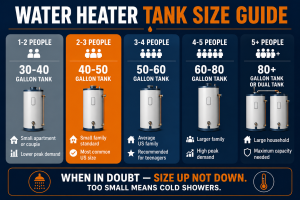
The simplest starting point for a tank water heater is matching storage capacity to your household size. Use this table as your baseline — then refine it using the First Hour Rating calculation in the next section.
| Household Size |
Recommended Tank Size |
| 1–2 people |
30–40 gallon tank |
| 2–3 people |
40–50 gallon tank |
| 3–4 people |
50–60 gallon tank |
| 4–5 people |
60–80 gallon tank |
| 5+ people |
80 gallon tank or dual-tank setup |
These figures assume average shower lengths and typical household routines. They are starting points — not ceilings. A household with high hot-water habits (long showers, frequent baths, back-to-back morning routines) should size toward the upper end of each range or move to the next bracket up.
💡 Tip: These are starting points — a family with teenagers who take long showers needs the upper end of each range.
How to Calculate First Hour Rating (FHR)
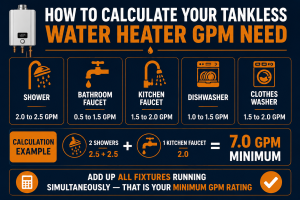
The First Hour Rating (FHR) is the most accurate way to size a tank water heater. It tells you exactly how many gallons of hot water the unit can deliver in the first hour of peak use, starting from a full, heated tank. FHR accounts for both the stored hot water and how quickly the burner or heating element replenishes the tank as it depletes.
Every tank water heater sold in the US must display its FHR on the yellow EnergyGuide label — look for the figure in the top-right corner. The number you need to match is your peak hour demand — the total gallons your household uses during the busiest single hour of the day.
Use these standard figures to calculate your peak hour demand:
| Activity |
Approximate Hot Water Used |
| Shower (per person) |
10 gallons |
| Bath |
20 gallons |
| Dishwasher cycle |
6 gallons |
| Clothes washer cycle |
7 gallons |
Add up whichever activities happen simultaneously during your household’s busiest hour. A family of four where two people shower, the dishwasher runs, and someone does a load of laundry at the same time uses 10 + 10 + 6 + 7 = 33 gallons. Look for a water heater with an FHR at or above that number.
💡 Tip: Check the yellow EnergyGuide sticker on any water heater — the FHR number in the top right corner tells you exactly how much hot water it delivers in the first hour.
Tankless Water Heater Sizing — GPM Explained
Tankless water heaters heat water on demand — there is no storage tank to deplete. Instead of gallons of capacity, you size a tankless unit by its GPM rating (gallons per minute) — the continuous flow rate of hot water it can produce at a given temperature rise.
To size correctly, you need to identify how many fixtures your household might run at the same time during peak demand. Each fixture has a standard flow rate:
| Fixture |
Typical GPM |
| Shower |
2.0–2.5 GPM |
| Bathroom faucet |
0.5–1.5 GPM |
| Kitchen faucet |
1.5–2.0 GPM |
| Dishwasher |
1.0–1.5 GPM |
| Clothes washer |
1.5–2.0 GPM |
If you plan to run two showers and a kitchen faucet simultaneously, your required GPM is at minimum 2.5 + 2.5 + 2.0 = 7.0 GPM. That is the baseline rating you need to look for. See our guide to the best tankless water heaters for a breakdown of models at each GPM level.
💡 Tip: Add up the GPM of all fixtures you might run simultaneously at peak — that is the minimum GPM rating you need.
How to Calculate GPM for Your Home
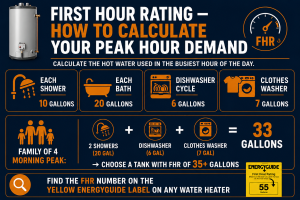
Follow these four steps to find the exact GPM rating your home requires from a tankless water heater:
Step 1: List every fixture you might use simultaneously during peak demand. Think through a typical weekday morning — how many people are showering, what appliances are running, which faucets are in use. Account for your worst-case scenario, not your average day.
Step 2: Add up the GPM values for each simultaneous fixture. Use the upper end of each fixture’s range to be conservative. Two showers at 2.5 GPM each plus a kitchen faucet at 2.0 GPM equals 7.0 GPM total minimum demand.
Step 3: That total is your required minimum GPM rating. Never buy a tankless unit rated below this number — you need a unit at or above your calculated peak simultaneous demand.
Step 4: Factor in your local temperature rise. A tankless heater must raise incoming groundwater to your desired output temperature — typically 120°F. The colder your incoming water, the harder the unit has to work, and the lower its effective GPM output becomes in practice.
Temperature rise = your desired hot water temperature minus your local groundwater temperature. In Minnesota in January, incoming groundwater can drop to 37°F — meaning you need an 83°F temperature rise to deliver 120°F water at the tap. In Miami, the same groundwater stays around 77°F in winter — a rise of only 43°F. The same unit delivers significantly more usable GPM in Florida than in Minnesota.
In cold-climate states like Minnesota, Wisconsin, and Michigan where incoming groundwater temperatures drop below 40°F in winter, tankless water heaters need a higher GPM rating than in warmer states like Texas or Florida. Cold incoming water requires more energy to heat to the target temperature, reducing effective output. Always factor your local groundwater temperature into any tankless sizing calculation.
⚠️ Warning: In cold-climate states a tankless unit rated at 7 GPM may only deliver 5 GPM in winter due to cold incoming water temperature — always upsize by at least 20% in cold climates.
Electric vs Gas Sizing Differences
The fuel type of your water heater affects the tank size you need. Gallons of storage are the same regardless of fuel — but gas and electric units recover at very different rates, and that changes the effective capacity each tank delivers in practice.
Gas water heaters heat water significantly faster than standard electric units. A gas burner can raise water temperature quickly enough that a smaller tank comfortably serves the same household that would need a larger electric tank. A gas 40-gallon tank can serve a 2–3 person household that would require a 50-gallon electric tank to achieve the same peak performance.
Standard electric resistance heaters recover more slowly. Once depleted, the electric element takes 60–90 minutes to reheat a full tank. This means you need greater storage capacity to buffer against peak demand. If you are switching from gas to electric resistance heat, size up by one bracket in the household sizing table above.
Heat pump water heaters (also called hybrid electric) are the exception. They extract heat energy from ambient air rather than generating it directly, making them far more efficient than standard electric units — with recovery rates that approach gas performance. If you are upgrading to a heat pump model, you do not need to upsize the tank the way you would with a standard electric unit.
For a full breakdown of running costs, installation requirements, and performance differences between fuel types, see our electric vs gas water heater comparison.
💡 Tip: If switching from gas to electric — size up by one category. Electric recovery rate is slower so the larger tank compensates.
Common Sizing Mistakes to Avoid
These are the most frequent errors homeowners make when sizing a new water heater — and each one costs money over the lifetime of the unit.
Buying the same size as the old failed unit. If your previous water heater was undersized, replacing it like-for-like just repeats the same problem. Many households have been quietly running an undersized unit for a decade. The old unit failing is the best opportunity to right-size — do not waste it by defaulting to identical specs.
Not accounting for teenage shower habits. A household with teenagers uses dramatically more hot water than the same headcount without. Teenagers take longer showers and they tend to cluster them — three back-to-back 15-minute showers before school will deplete a mid-range tank instantly. Size for how your household actually behaves, not how it theoretically should.
Ignoring cold-climate groundwater temperatures. If you live in a cold-climate state and are sizing a tankless unit, the manufacturer’s rated GPM is typically tested at a 35°F temperature rise. Your actual rise in winter may be double that. A unit that meets your GPM requirement on paper may fall well short on a January morning in Wisconsin.
Choosing tankless without calculating GPM first. Tankless units are marketed by their GPM rating, but many buyers pick a number that sounds plausible without actually calculating their simultaneous fixture demand. There is no substitute for the four-step calculation above — guessing leads to undersizing.
Buying for current household size, not future needs. If you expect to add household members in the next few years — children, elderly parents moving in, a returning college student — size for that future occupancy now. A water heater lasts 10–15 years. Buying for today’s smaller household and replacing in four years is an unnecessary expense.
⚠️ Warning: If you plan to add household members in the next 5 years — size for future occupancy, not current. Replacing a water heater twice is expensive.
Need a Professional Plumber?
Water heater installation and replacement involves gas lines, electrical connections, and local code requirements — sometimes a professional is the right call. If you need a licensed plumber in your area, search PlumberArchive.com — the US plumber directory with 12,151+ verified plumbers across all 50 states.
Find a trusted plumber near you →
Frequently Asked Questions
Q: What size water heater do I need for a family of 4?
A family of four typically needs a 50–60 gallon tank water heater, or a tankless unit rated at 7–9 GPM. The right answer depends on your household’s peak hour habits — how many showers run simultaneously, whether you run the dishwasher and laundry at the same time, and whether any family members take unusually long showers. Use the FHR calculation method above to get a precise figure for your specific household. If you are in a cold-climate state and considering tankless, add 20% to your calculated GPM requirement to account for reduced winter output.
Q: Is a 40-gallon water heater enough for 3 people?
A 40-gallon gas water heater can work for 3 people with moderate hot water usage, but it sits at the lower end of the recommended range. If any household member takes long showers, or if showers and appliances tend to overlap in the morning, a 50-gallon unit is the safer choice. For a standard electric resistance heater (which recovers more slowly than gas), 3 people are generally better served by a 50-gallon tank. Check the FHR on any unit you are considering — that number tells you definitively whether it matches your household’s peak demand.
Q: What GPM tankless water heater do I need for a 3-bedroom home?
A 3-bedroom home typically requires a tankless unit rated at 7–9 GPM for whole-house use. This assumes a family of 3–4 people with two potential simultaneous showers plus kitchen or bathroom fixture use. In cold-climate states where incoming groundwater drops below 40°F in winter, size toward 9–10 GPM to maintain adequate output during the coldest months. In warmer states like Texas or Florida, 7 GPM is usually sufficient. Always calculate your actual simultaneous fixture demand using the four-step method above rather than relying on a bedroom count estimate alone. If the real problem is just one distant bathroom or a detached garage that never gets hot water quickly, sizing up your whole-house unit may not be the fix — see our point-of-use vs whole-house water heater comparison to decide which setup actually solves it.
Q: Does a bigger water heater use more energy?
A larger tank water heater does use slightly more energy than a smaller one — not because it heats more water per use, but because it has greater standby heat loss. A bigger tank has more surface area through which heat escapes to the surrounding air, so the heating element or burner cycles on more often to maintain temperature. This is why right-sizing matters on both ends: too small means you run out of hot water, too large means you pay for heat you never use. Modern water heaters with good insulation minimize standby losses, but the principle still applies. For the lowest standby losses of all, a tankless unit only heats water when you actually call for it — there is no stored water losing heat overnight.
Conclusion
Sizing a water heater correctly is a straightforward calculation once you know what numbers to use. For a tank unit, calculate your peak hour demand and match it to the FHR on the yellow EnergyGuide label. For tankless, add up the GPM of every fixture that might run simultaneously and use that as your minimum rating — then add 20% if you are in a cold-climate state.
When in doubt, size up rather than down. A slightly oversized unit costs a little more to run than necessary. An undersized unit costs you in cold showers, frustration, and a replacement purchase far sooner than you planned. Most 3–4 person families land at a 50-gallon tank or a tankless unit in the 7–9 GPM range — but do the math for your specific household before you buy.
Ready to compare your options? See our guide to the best tankless water heaters for reviewed models at every GPM level, or read our full tankless vs tank water heater comparison to decide which technology is right for your home.
✍️ About This Guide
PTR Editorial Team — Plumbing Guides. We compare manufacturer specifications, installation requirements, compatibility and available product documentation to help homeowners choose suitable tools and parts. How we review →