Comparisons
2 Oct 2026

Pop-Up Drain vs Grid Drain: Which Should You Choose?
Pop-up drains seal to hold water; grid drains never close but resist clogs better and cost less. Here's how to choose between them for your bathroom sink.
Chemical vs mechanical drain cleaning — which method works best for your blockage? Compare costs, safety, pipe compatibility and environmental impact to choose the right drain cleaning approach for grease, hair and solid clogs.
Blocked drains are one of the most common plumbing problems in any US home — and when one strikes, you face a choice: reach for a bottle of chemical drain cleaner or pick up a drain snake. Both methods work, but they work on different types of clogs, in different situations, and with very different risk profiles. Choosing the wrong one wastes time and money; choosing the right one clears the blockage in minutes.
This guide covers exactly how each method works, when to use each one, how they compare on cost and safety, and which you should reach for first depending on your specific situation. For product recommendations, see our roundups of the best drain unblockers and best drain snakes.
Please note: Drain cleaning guidance in this article is based on standard residential plumbing practice. Results vary depending on pipe material, clog type, and product formulation. Consult a licensed plumber for persistent or recurring blockages.
💬 Our Take
“This is not really an either-or decision — both methods have their place and experienced homeowners use both. Chemical drain cleaners are the right first response for grease and soap clogs in bathroom and kitchen drains. Mechanical tools — plungers and drain snakes — are essential when hair or solid debris is the cause, or when chemicals have already failed. Knowing which to reach for first saves time and money.”
IN THIS GUIDE
Chemical drain cleaners are liquid or gel products that dissolve or break down the material causing a blockage. There are three distinct types, each using a different chemical process:
Caustic cleaners use sodium hydroxide (lye) or potassium hydroxide as the active ingredient. These are the most powerful and fastest-acting chemical cleaners — sodium hydroxide generates heat when it contacts water and converts grease into a soap-like substance that washes away. They are effective on grease, soap scum, and soft organic matter. Most major commercial drain cleaning gels fall into this category.
Oxidizing cleaners use bleach, peroxides, or nitrates to break down organic material through a chemical oxidation reaction. They are less caustic than sodium hydroxide products but work on a similar range of clogs — hair, grease, and organic matter. They are slightly slower to act.
Enzymatic cleaners use live bacteria or enzyme cultures that digest organic waste over time. They are far gentler than caustic or oxidizing cleaners — they do not generate heat or react aggressively with pipe materials. They are not effective for treating an existing blockage quickly, but work well as a preventive maintenance treatment applied monthly to keep drains flowing freely.
All three types share a fundamental limitation: they cannot dislodge a solid physical blockage. A chemical cleaner poured onto a drain blocked by a clump of hair, a small object, or a build-up of mineral scale will simply sit in the standing water without reaching the obstruction.
Mechanical drain cleaning uses physical force — air pressure, rotating cable, or high-pressure water — to break up, dislodge, or retrieve whatever is blocking the pipe. There is no chemical reaction; the method works by direct physical contact with the obstruction.
Plungers create suction and pressure at the drain opening. A cup plunger handles sinks and tubs; a flange plunger is designed specifically for toilets. Plunging works by alternating pressure waves that can dislodge a soft clog sitting near the drain entrance. It is the right first tool for most toilet blockages and many sink clogs.
Drain snakes (also called drain augers) are flexible cables fed manually into the drain pipe. The cable tip can break through a clog or hook around it to retrieve it — particularly effective for hair clogs, which form a physical mass that chemicals cannot dissolve quickly. Hand-cranked models handle most residential blockages; powered models tackle tougher situations. See our full guide to the best drain snakes for current recommendations.
Motorized drain augers are heavier-duty versions of the drain snake, typically used by plumbers or for main sewer line blockages. They can reach 50–100 feet into the drainage system and power through compacted debris that a hand snake cannot shift.
Hydro jetting is a professional service that blasts high-pressure water (up to 4,000 PSI) through the drain line. It removes grease, mineral scale, and debris buildup across the entire pipe interior — the most thorough mechanical cleaning method available, but requires a professional and specialized equipment.
Chemical drain cleaners perform best in a specific set of situations. Using them outside these conditions is not just ineffective — in some cases it actively makes the problem worse or creates a safety hazard.
Chemical cleaners work best for:
The key phrase is slow drain. If water is draining — even sluggishly — a caustic or oxidizing cleaner has a path to reach the buildup and work on it. If the drain is completely blocked with standing water, the chemical cannot reach the clog and simply pools in the pipe, potentially causing damage over time.
Mechanical tools are essential whenever the blockage involves a solid physical obstruction that a chemical cannot dissolve — and in several situations where chemical cleaners are not safe to use at all.
Mechanical cleaning is the right choice for:
The last point deserves particular attention. In older homes in the Northeast and Midwest with cast iron or galvanized steel drain pipes, chemical drain cleaners should be used sparingly — strong caustic chemicals accelerate corrosion in aging metal pipes. Mechanical cleaning is strongly preferred in these homes. In homes with modern PVC drain pipes, both methods are safe when used as directed.
Over the long run, mechanical tools are significantly cheaper — but the upfront calculation looks different depending on how often you deal with blocked drains.
Chemical cleaners: A bottle of enzymatic drain maintainer or standard drain gel sits in the $ price tier (under $30 per bottle). A single bottle may treat multiple slow drains, but recurring blockages require repeated purchases — particularly if the root cause (hair buildup, grease accumulation) is not addressed. Households that reach for a chemical cleaner every month are spending more than they realize over the course of a year.
Mechanical tools: A quality plunger is a $ one-time purchase. A reliable hand-crank drain snake sits in the $ to $$ tier depending on length and quality. Both tools last for years with basic maintenance. Once purchased, there is no ongoing cost per use — the tool pays for itself quickly.
The cost advantage of mechanical tools becomes clear after just a few uses. A drain snake in the $$ tier handles every hair clog in your shower drain indefinitely — something a series of chemical cleaner purchases handles only temporarily.
This is one of the clearest distinctions between the two methods — and one that is often underestimated by homeowners reaching for a bottle under the sink.
Chemical cleaner risks:
Mechanical tool risks:
For most homeowners — particularly those with children in the home — mechanical tools are the meaningfully safer option for routine drain maintenance.
Environmental impact is an increasingly important factor for US homeowners — particularly those on septic systems, where what goes down the drain has a direct and measurable effect on system health.
Caustic and oxidizing chemical drain cleaners enter the municipal water supply or septic system after use. In municipal systems, they are diluted by wastewater treatment processes, but they still contribute chemical load to the treatment facility. The manufacturing and packaging of single-use chemical products also has an environmental footprint that mechanical tools do not.
The impact on septic systems is more immediate and serious. Caustic chemicals kill the beneficial bacteria inside a septic tank that break down waste — damaging the biological process that makes the system work. A single heavy dose of sodium hydroxide drain cleaner can significantly set back a healthy septic ecosystem. Repeated use compounds this effect over time.
Enzymatic drain cleaners are the exception: they are biodegradable and septic-safe by design, since the enzyme cultures they introduce are compatible with the biological process already happening in the tank.
Mechanical cleaning has essentially zero environmental impact — no chemicals introduced to water, no ongoing product consumption, no packaging waste after the initial tool purchase.
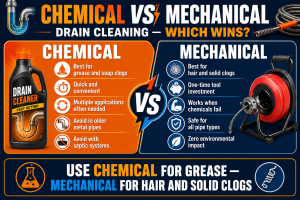
Here is the head-to-head breakdown across every key decision factor:
| Situation | Best Method |
|---|---|
| Grease clog in kitchen sink | Chemical ✓ |
| Hair clog in shower drain | Mechanical ✓ |
| Solid object in drain | Mechanical ✓ |
| Toilet blockage | Mechanical ✓ |
| Regular monthly maintenance | Chemical — enzymatic only ✓ |
| Older cast iron or galvanized pipes | Mechanical ✓ |
| Septic system home | Mechanical ✓ |
| Long-term cost | Mechanical ✓ |
| Safety for households with children | Mechanical ✓ |
| Speed (when it works) | Chemical ✓ |
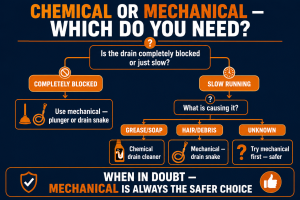
Choose chemical drain cleaners if:
See our guide to the best drain unblockers for recommendations across all three chemical cleaner types.
Choose mechanical tools if:
See our guide to the best drain snakes for hand-crank and motorized recommendations at every price tier.
If chemical and mechanical methods have both failed, or if multiple drains in your home are blocked at once, the issue is likely in the main sewer line — beyond DIY reach. Search PlumberArchive.com — the US plumber directory with 12,151+ verified plumbers across all 50 states.
Get weekly plumbing tips, honest tool reviews, and DIY guides delivered to your Facebook feed.
It depends on the type of clog. For a slow-draining kitchen sink where grease buildup is the likely cause, a caustic or enzymatic chemical cleaner is a reasonable first step — pour it in, wait the recommended time, and flush with hot water. For a shower drain that is visibly backed up with hair, go straight to a drain snake or hair removal tool — chemical cleaners are largely ineffective on compacted hair. For a toilet blockage, always start mechanical: plunge first, and if that fails, use a toilet auger. Never put chemical drain cleaners into a toilet.
Yes, but with important precautions. If a chemical cleaner has been applied and has not cleared the blockage, you can follow up with a drain snake — but flush the drain thoroughly with water first to dilute and remove as much of the chemical residue as possible before inserting the snake. Caustic drain cleaning chemicals can cause skin burns if they splash back while you are working with the snake. Wear rubber gloves and eye protection, and never plunge aggressively after applying a chemical cleaner for the same reason.
No. Caustic chemical drain cleaners — sodium hydroxide products — are safe for modern PVC and ABS plastic drain pipes when used as directed, but they should be avoided in homes with older cast iron or galvanized steel drain pipes. These pipes are already subject to corrosion over their lifespan, and repeated exposure to strong caustic chemicals accelerates that process. If your home was built before the 1980s and has not had its drain system updated, assume you have metal pipes and stick to mechanical cleaning methods or biodegradable enzymatic products only.
For preventive maintenance, monthly treatment with an enzymatic drain cleaner in kitchen and bathroom drains is a practical routine — these products keep organic matter from accumulating between uses without posing any risk to pipes, septic systems, or household safety. For mechanical maintenance, running a hand snake through shower drains every two to three months proactively removes hair before it accumulates into a full blockage. If a drain is running slowly despite regular maintenance, investigate the cause — persistent slow drainage can indicate a partial obstruction deeper in the system or a venting issue that routine cleaning will not fix.
Chemical and mechanical drain cleaning are not competing methods — they are complementary tools for different jobs. The decision rule is straightforward: use chemical cleaners for grease and soap clogs in slow-running drains; use mechanical tools for hair, solid debris, toilet blockages, or any situation where chemicals have already failed.
On the long-term view, mechanical tools win clearly on cost, safety, and environmental impact. A plunger and a drain snake handle the majority of household drain blockages indefinitely, with no recurring cost and no chemical exposure risk. Reserve caustic chemical cleaners for the specific situations where they genuinely outperform mechanical methods — slow grease clogs in PVC-piped modern homes — and avoid them entirely if you have older metal pipes or a septic system.
For product recommendations, see our roundup of the best drain unblockers for chemical options and the best drain snakes for mechanical tools at every price point. For a practical application of these methods on the most common household blockage, see our guide to how to unclog a kitchen sink.
✍️ About This Comparison
PTR Editorial Team — Product Comparisons. We compare manufacturer specifications, installation requirements, compatibility and available product documentation to help homeowners choose suitable tools and parts. How we review →
Pop-up drains seal to hold water; grid drains never close but resist clogs better and cost less. Here's how to choose between them for your bathroom sink.
Test strips, digital meters or send-to-lab testing? Match the method to your situation — screening, ongoing monitoring, or a real health concern.
25-foot vs 50-foot drain snake: compare handling, the cable diameter trade-off and the jobs that justify extra length, plus where 50 feet stops.

