Please note: Product availability and information are based on our research at time of writing and are subject to change. Always check Amazon for the latest details before purchasing.
Introduction
RIDGID is one of the most recognized names in professional plumbing tools — but the brand is far more than just pipe wrenches. Alongside the heavy-duty tools that made the brand famous, RIDGID manufactures a range of specialty hand tools designed to solve specific problems that standard wrenches and pipe cutters simply can’t handle. A close quarters tubing cutter reaches spaces a full-size cutter never will. A proper pipe reamer turns a rough cut into a watertight joint. An angle stop wrench gets a grip where nothing else fits.
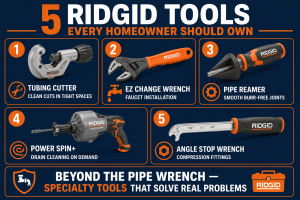
This review covers five RIDGID specialty plumbing tools selected for the specific jobs they’re built to solve — from tubing cuts in cramped cabinet spaces to clearing blockages with a power spinner compatible with any standard drill. Each tool is reviewed for what it actually does and where it earns its place in a toolkit that already has the basics covered.
✏️ Our Take
RIDGID is best known for pipe wrenches, but the brand makes specialty tools that solve problems a standard wrench or cutter can’t. A close quarters tubing cutter reaches spaces a full-size cutter never will, and a proper pipe reamer is the difference between a watertight joint and a slow leak six months later. These five tools fill the gaps in a toolkit that already has the basics covered.
Quick Comparison Table
Full Reviews — 5 Best RIDGID Plumbing Tools
1. RIDGID CC247 40617 Model 101 Close Quarters Tubing Cutter — Best Overall
🏆 Best Overall
★★★★★
1/4″–1-1/8″ Copper · Close Quarters
The RIDGID Model 101 Close Quarters Tubing Cutter is the standout pick in this roundup thanks to a genuinely useful design most standard cutters can’t match. Where a standard full-size tubing cutter requires clearance that cabinet interiors and wall cavities simply don’t provide, the compact profile of the Model 101 fits into the restricted spaces that define real residential plumbing work. It handles copper tubing from 1/4-inch to 1-1/8-inch — the range that covers the large majority of residential supply line work.
RIDGID’s build quality keeps this cutter in service through repeated use without the cutting wheel dulling prematurely or the tool body flexing under load. If your toolkit already has a standard full-size pipe cutter, the Model 101 is the companion tool that covers all the jobs the full-size cutter can’t reach.
- Cuts copper tubing from 1/4-inch to 1-1/8-inch capacity
- Compact close quarters design — works in cabinet and wall spaces a standard cutter can’t reach
- Produces clean square cuts essential for proper compression and flare fittings
- RIDGID build quality holds up through repeated professional use
- $ price tier — accessible for a tool of this caliber
✓ Pros
Compact design works in tight cabinet and wall spaces standard cutters can’t reach
Produces clean square cuts on copper tubing essential for proper fittings
RIDGID build quality holds up to repeated professional use
✗ Cons
Limited to smaller tubing diameters up to 1-1/8 inch — larger pipe needs a different cutter
Close quarters design trades some leverage for compactness
💡 Tip: Always follow a clean tubing cutter cut with a pipe reamer — even a sharp cutter leaves a small inner burr that can restrict flow or cause fitting problems. The RIDGID Model 223S reamer below is the natural companion to this tool.
🛒 Check Price on Amazon — $ →
2. RIDGID 57003 EZ Change Plumbing Wrench — Top Pick
⭐ Top Pick
The RIDGID 57003 EZ Change Plumbing Wrench earns its top pick designation by solving one of the most common frustrations in residential plumbing: the faucet connector nut that sits in the dark recess beneath a sink, out of reach of anything in a standard toolkit. Purpose-built for under-sink faucet installation and removal, this wrench reaches the nuts on faucet connectors and supply lines without requiring the contorted arm position that standard tools demand. The result is significantly faster faucet work with less stripped hardware.
For anyone who has ever wrestled with a faucet nut using an adjustable wrench in a confined cabinet space, the design logic is immediately apparent. It won’t replace a general-purpose wrench for everything else — but for under-sink faucet work specifically, it is the right tool for the job. A compact enough profile to store in any basic tool bag without adding meaningful weight or bulk.
- Purpose-built for faucet nuts that standard wrenches can’t reach in tight under-sink spaces
- Significantly speeds up faucet installation and removal compared to improvised tools
- Compact enough to store in a basic tool bag without bulk
- $ price tier — appropriate for a single-task specialty tool
✓ Pros
Purpose-built for faucet nuts that standard wrenches can’t reach
Speeds up faucet installation and removal significantly
Compact enough to store in a basic tool bag
✗ Cons
Single-purpose tool — only useful for faucet connector nuts
Not a replacement for a full basin wrench on larger jobs
💡 Tip: This tool pairs well with the RIDGID angle stop wrench below — together they cover the two most common under-sink jobs: faucet connector nuts and angle stop valves.
🛒 Check Price on Amazon — $ →
3. RIDGID 29983 Model 223S Inner/Outer Tubing and Pipe Reamer — Staff Pick
🎯 Staff Pick
Essential Tool
The RIDGID Model 223S is the most often overlooked tool in residential plumbing — and the one whose absence causes the most invisible problems. Every tubing cutter cut, no matter how clean, leaves a small burr on the inner and outer edges of the pipe. Fitting a compression or flare fitting over a burred pipe end results in a joint that will eventually weep or fail. The Model 223S removes both inner and outer burrs in one pass across 1/4-inch to 1-1/4-inch stainless steel and copper tubing, with 45 cutting edges that maintain their sharpness through extended use.
Often after learning the hard way what an unfinished pipe end does to a fitting six months after installation, experienced plumbers and serious DIYers learn to reach for this tool every time. The Model 223S is the correct companion to the RIDGID Model 101 close quarters cutter above: one tool cuts, the other finishes. Treating reaming as optional is how a clean-looking joint becomes a slow leak.
- Handles 1/4-inch to 1-1/4-inch stainless steel and copper tubing
- 45 cutting edges deliver a smooth burr-free finish on every cut
- Works on both inner and outer pipe edges in a single tool
- Essential companion tool after using any tubing cutter
- $ price tier for a professional-grade finishing tool
✓ Pros
45 cutting edges deliver a smooth burr-free finish on every cut
Works on both inner and outer pipe edges in one pass
Essential companion tool after using any tubing cutter
✗ Cons
Easy to overlook as unnecessary until you experience a poor-fitting joint from burred pipe ends
Adds an extra step to the cutting process
⚠️ Warning: Skipping the reaming step is the single most common cause of fitting leaks on newly cut copper pipe. A compression fitting seated on a burred pipe end will appear fine on installation and develop a slow drip weeks or months later — always ream before fitting.
🛒 Check Price on Amazon — $ →
4. RIDGID 57043 POWER SPIN+ Power Spinner Drain Cleaner — Best Value
💰 Best Value
The RIDGID POWER SPIN+ bridges the gap between a manual drain snake and a full-size drum drain machine. It operates using a standard power drill as its motor — which means any homeowner who already owns a drill gets powered drain-clearing capability without purchasing a dedicated machine. The handheld design requires no separate power source or dedicated storage space, and at its price point it sits far below the cost of an entry-level drum machine. For households that deal with recurring drain snake situations — slow bathroom drains, routine sink maintenance — the POWER SPIN+ handles the job at an accessible price.
The POWER SPIN+ is best suited to routine maintenance and moderate blockages rather than serious sewer-line obstructions — that distinction matters when setting expectations. For recurring household drain problems that are beyond a plunger but don’t justify a service call, this is the right tool at the right cost.
- Drill-compatible operation — works with any standard power drill
- Handheld design needs no separate motor or dedicated power source
- Far more affordable than a full drum drain machine for routine maintenance use
- Compact enough for under-sink storage between uses
- $ price tier for drill-powered drain clearing
✓ Pros
Handheld design needs no separate motor or power source beyond a drill
Far more affordable than RIDGID’s full drum-style drain machines
Compact enough for under-sink storage
✗ Cons
Less powerful than RIDGID’s full drum-style drain machines for serious blockages
Best suited to routine maintenance rather than major clogs
💡 Tip: The POWER SPIN+ handles most household bathroom and kitchen drain blockages at a fraction of the cost of a plumber callout — it is best used as a first response tool before escalating to professional service for serious obstructions.
🛒 Check Price on Amazon — $ →
5. RIDGID 27023 Model 2002 One Stop 2-in-1 Wrench for Angle Stops — Pro Choice
👷 Pro Choice
Professional Grade
The RIDGID Model 2002 is the Pro Choice pick because it solves a specific and recurring problem that professionals encounter on almost every plumbing service call: the stubborn angle stop valve under a sink that will not move with a standard adjustable wrench. The 2-in-1 design handles both angle stops and straight stops as well as compression couplings — consolidating what would otherwise require two or three tools into a single compact wrench that fits where a standard tool doesn’t.
The design is intentionally focused — it does not pretend to replace an adjustable wrench for general use, but for angle stop valve work specifically, it is the correct tool. Homeowners who replace angle stops more than once will recognize the value immediately; those who do so regularly will understand why this earns a permanent place in a professional toolkit.
- 2-in-1 design handles angle stops, straight stops and compression couplings
- Designed specifically for stubborn compression fittings under sinks
- Combines two wrench functions into a single compact tool
- Saves carrying multiple wrenches for angle stop valve work
- $ price tier for a professional-grade specialty wrench
✓ Pros
Combines two wrench functions into a single compact tool
Designed specifically for stubborn compression fittings under sinks
Saves carrying multiple wrenches for angle stop work
✗ Cons
Specialty design means it won’t replace a general adjustable wrench for other jobs
Best value realized only if you frequently work on angle stop valves
💡 Tip: Angle stop valves that haven’t been turned in years are prone to seizing. If you encounter a stuck valve during a faucet replacement, this wrench gives you the right grip geometry to break it free without damaging the valve body or the supply line.
🛒 Check Price on Amazon — $ →
Buying Guide — Choosing the Right RIDGID Specialty Plumbing Tool
Specialty Tools vs General-Purpose Tools
Every toolkit starts with general-purpose tools — an adjustable wrench, a standard pipe cutter, a set of pliers. These cover the majority of residential plumbing tasks adequately. Specialty tools earn their place when a general-purpose tool physically cannot do the job, or when doing the job correctly requires geometry or precision that a general tool cannot deliver.
The five RIDGID tools in this review fall firmly into the specialty category. The close quarters tubing cutter isn’t better than a standard cutter — it reaches where a standard cutter can’t. The EZ Change wrench isn’t a replacement for an adjustable wrench — it fits where an adjustable wrench won’t. The pipe reamer doesn’t cut anything — it finishes what the cutter started. Treating specialty tools as optional extras is a reasonable position until the first time a standard tool fails to reach the fitting you’re working on. If threading pipe is part of your work, our roundup of the best pipe threading tools covers that adjacent specialty category.
Why a Tubing Cutter Beats a Hacksaw
A hacksaw can cut copper tubing, but it leaves a rough, uneven cut with significant burring on both the inner and outer edges. More importantly, it leaves metal shavings inside the pipe that travel downstream into valves and fittings. A tubing cutter — even a compact close quarters model like the RIDGID Model 101 — produces a clean, square, perpendicular cut that compression and flare fittings seat against correctly.
For supply line work, an uneven or angled cut is the root cause of many compression fitting failures. In restricted spaces where a hacksaw is the only option that physically fits, the compromise is forced — but wherever a tubing cutter can access the pipe, it produces a categorically better result. The investment in a close quarters cutter pays for itself the first time it prevents a leaking fitting on inaccessible pipework.
Why Reaming Matters After Every Cut
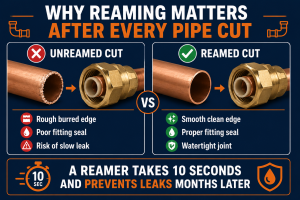
The inner burr left by a tubing cutter is not visible to the eye once a fitting is seated — which is precisely why it causes problems. A small burr on the inner edge of a pipe restricts flow and, more critically, catches scale and debris that builds up over time into a partial blockage. On the outer edge, a burr prevents a compression sleeve from seating squarely, which creates the conditions for a slow leak that develops weeks or months after installation.
Reaming takes less than ten seconds per cut. The RIDGID Model 223S handles both inner and outer edges in a single tool, so there is no additional equipment to source or carry. Skipping it is a common shortcut — and the source of a disproportionate number of fitting failures that appear unrelated to the cut quality at the time of installation.
US Manufacturing and RIDGID Warranty
RIDGID tools are designed and engineered in the United States, with many models backed by a lifetime warranty against manufacturing defects — a meaningful difference for homeowners in any region who plan to keep a tool in service for decades rather than replacing it after a few uses. A tubing cutter or specialty wrench that carries a lifetime warranty is not a consumable — it is a one-time purchase for a tool category that most homeowners will use only occasionally but rely on completely when the job comes up.
For tools in the specialty category — where the right tool is the only tool for the job — that warranty backing is more significant than it would be for commodity items. Confirm warranty terms for the specific model you’re purchasing, as coverage can vary between product lines.
💡 Tip: Specialty tools sit unused for long stretches between jobs — which makes build quality and corrosion resistance more important, not less. A tool stored in a garage in Texas humidity or a New England winter needs to perform the first time it’s picked up after six months of storage. RIDGID’s material and build standards are the right baseline for tools expected to last decades.
Need a Professional Plumber?
Some plumbing jobs — gas line work, drain line repairs, or anything requiring a permit — are beyond the scope of DIY regardless of how good your toolkit is. A licensed plumber brings the right insurance, permitting knowledge, and liability coverage for the jobs that require it, alongside the full complement of specialty tools for professional-grade results.
Find a licensed plumber in your area at PlumberArchive.com — the US plumber directory with 12,000+ verified local plumbers across all 50 states.
Find a trusted plumber near you → PlumberArchive.com
Follow Us on Facebook
Get weekly plumbing tips, honest tool reviews and DIY maintenance guides delivered straight to your Facebook feed. We cover pipe tools, drain clearing, faucet repairs and everything in between — written for US homeowners who want to handle more themselves without overspending.
Follow PlumbingToolsReview on Facebook →
Frequently Asked Questions
Q: Are RIDGID plumbing tools worth the extra cost over budget brands?
For specialty tools that you will use infrequently but depend on completely when a job arises, yes — the quality difference between RIDGID and budget-tier alternatives is most apparent precisely when a tool is used hard or stored for long periods between uses. Budget tubing cutters dull faster and produce less consistent cuts; budget reamers lose their edge quickly; budget specialty wrenches flex under load. For tools in the $ price tier, the gap between RIDGID and a no-name alternative is not large in absolute dollar terms — but the difference in performance and durability over a working lifetime is significant. The lifetime warranty that RIDGID offers on many hand tools is the clearest signal of the manufacturer’s confidence in the product.
Q: What is a tubing reamer used for?
A tubing reamer removes the burrs left on the inner and outer edges of a pipe after it has been cut with a tubing cutter. Every cut — even a clean one — leaves a small amount of raised metal at both edges. The inner burr restricts flow and catches debris that builds up over time; the outer burr prevents a compression fitting sleeve from seating squarely, which can cause leaks at the joint. The reamer cleans both edges before fitting installation, which is why plumbers treat reaming as a non-optional step in the cut-and-fit process. The RIDGID Model 223S handles both inner and outer edges in a single tool — making the step faster and requiring no additional equipment beyond the reamer itself.
Q: Can I use the RIDGID POWER SPIN+ without a drill?
No — the POWER SPIN+ is a drill-powered tool that requires a standard chuck drill to operate. It does not have its own motor. This is the design trade-off that makes it compact, affordable, and storable compared to a full drum drain machine. If you already own a power drill, the POWER SPIN+ adds powered drain-clearing capability without purchasing a dedicated machine. If you do not own a drill, you would need to factor in that cost alongside the POWER SPIN+ itself — or consider a manual drum drain snake instead.
Q: Does RIDGID offer a warranty on hand tools?
RIDGID offers a lifetime warranty against manufacturing defects on many of its hand tools, including a range of tubing cutters and specialty plumbing hand tools. Warranty coverage can vary between specific product lines and model generations — always confirm the warranty terms on the exact model you are purchasing rather than assuming all RIDGID hand tools carry identical coverage. RIDGID’s warranty also requires that tools be used for their intended purpose; damage from misuse or abuse is excluded. For most homeowners purchasing specialty tools that will see light to moderate use across a decades-long tool life, the RIDGID warranty represents a meaningful long-term value assurance.
Conclusion
RIDGID’s specialty plumbing hand tools earn their place through focused design rather than broad appeal. Each of the five tools in this review is the right answer to a specific problem that a standard wrench or cutter cannot solve — and for the jobs they are designed for, no general-purpose alternative comes close to the same result.
The RIDGID Model 101 Close Quarters Tubing Cutter is the clear choice for the majority of readers — its close-quarters design solves the specific problem a standard cutter can’t fit the space to solve. The RIDGID Model 223S Pipe Reamer is the staff pick that makes every cut it follows more reliable — the most important step that most homeowners skip, and the most common source of fitting failures six months after installation.
For under-sink faucet work, the RIDGID EZ Change Wrench is the top pick for reaching connector nuts that nothing else fits. The RIDGID POWER SPIN+ is the best value for households that want powered drain-clearing capability without a full drum machine — leveraging a drill you already own. And the RIDGID Model 2002 Angle Stop Wrench earns its Pro Choice designation as the tool that professionals carry specifically for the stubborn angle stop valve under a sink that a standard wrench cannot safely grip.
All five are available at the $ price tier and backed by RIDGID’s manufacturing standards. The right investment for any homeowner is the two tools most likely to apply to the plumbing work ahead of them — and for most households, the tubing cutter and reamer together are the single highest-impact pair in this roundup.
✍️ About This Review
PTR Editorial Team — Product Reviews. We compare manufacturer specifications, installation requirements, compatibility and available product documentation to help homeowners choose suitable tools and parts. How we review →