Comparisons
2 Oct 2026

Pop-Up Drain vs Grid Drain: Which Should You Choose?
Pop-up drains seal to hold water; grid drains never close but resist clogs better and cost less. Here's how to choose between them for your bathroom sink.
Sump pump vs French drain — how each works, when to choose one over the other, and why most effective waterproofing systems use both. 2026 guide.
Please note: Cost estimates and installation details are based on our research at time of writing and are subject to regional variation. Always consult a licensed waterproofing contractor before undertaking basement drainage work.
Basement flooding and water intrusion are among the most common and costly problems US homeowners face — and the moment water appears where it shouldn’t, the first questions tend to be the same ones: do I need a sump pump, do I need a French drain, and what’s the difference? The short answer is that sump pumps and French drains solve related but distinct water management problems. A French drain redirects groundwater before it can enter your home. A sump pump removes water that has already made it in. Choosing between them — or understanding why you might need both — depends on where your water problem is actually coming from.
This guide compares both systems across how they work, when each is the right solution, what each costs to install, and how they work together in a complete waterproofing setup. If you’re dealing with active flooding right now and need to know which sump pumps to consider, our picks cover our full lineup. And if a slow leak has already caused moisture damage, our guide to the best water leak detectors covers the tools that catch water intrusion early before it becomes a larger problem.
✏️ Our Take
A sump pump and a French drain solve related but different problems — and the most effective basement waterproofing systems actually use both together rather than choosing one or the other. A French drain manages where water goes; a sump pump gets it out of the house entirely. If your basement floods because water has nowhere to drain to, you likely need both, not a choice between them.
IN THIS GUIDE
A sump pump is installed in a pit — the sump basin — dug at the lowest point of a basement or crawl space floor. As groundwater rises around the foundation or seeps in through cracks and the basement floor, it collects in the pit rather than spreading across the floor. When the water level in the pit reaches a set threshold, a float switch activates the pump automatically. The pump then moves the collected water out through a discharge pipe that directs it away from the home’s foundation — typically to a drainage ditch, dry well, storm drain, or a low-lying area of the yard well away from the house.
Because a sump pump is an active mechanical system, it requires electricity to operate. A standard sump pump is plugged into a dedicated outlet near the sump basin and runs only when activated by the float switch. The key vulnerability in this design is the power dependency: a storm that causes flooding will often also cause a power outage, which disables the pump exactly when it’s needed most. This is why battery backup units exist as a companion system — a battery-backed pump or a standalone backup pump takes over automatically when grid power fails.
A French drain is a passive drainage system — a trench filled with gravel and a perforated pipe that collects and redirects groundwater before it can build up pressure against a foundation or seep into a basement. Water moving through the surrounding soil naturally migrates into the gravel-filled trench and then into the perforated pipe, which carries it away from the foundation along a path that follows grade. The system works entirely by gravity, with no mechanical components and no electricity required.
French drains can be installed in two configurations. An exterior French drain is installed outside the foundation, typically at the base of the footing, and intercepts groundwater before it reaches the wall. This is the most effective configuration for preventing water from ever contacting the foundation but requires significant excavation around the full perimeter of the home. An interior French drain (also called a drain tile system) runs along the inside perimeter of the basement floor, below the slab. It collects water that has already passed through the foundation wall and channels it to a central collection point — almost always a sump pump pit.
A sump pump is the right solution when you have water that needs to be actively removed from inside the home — not redirected before it arrives, but eliminated after it has already entered. The clearest indication is a basement that floods or accumulates standing water after heavy rain or during snowmelt. Once water is inside, the only way to remove it systematically is a pump. A French drain alone in this situation addresses some of the source water but doesn’t remove what’s already in the building.
A high water table is the other primary sump pump scenario. Homes built in areas with naturally high groundwater — which rises seasonally or after significant rainfall — experience hydrostatic pressure pushing upward through the basement floor and inward through foundation walls. This pressure is independent of surface water runoff and cannot be fully managed by surface-level grading or gutter improvements alone. A sump pit that intercepts this rising groundwater and pumps it away is the appropriate technical response. If you need a temporary solution for water removal during flooding while a permanent system is being installed, our guide to the best utility pumps covers portable submersible options for emergency water removal.
A French drain addresses the problem before it reaches the house — it’s the right solution when groundwater or surface water is consistently migrating toward the foundation due to grading, soil type, or landscaping that directs water toward the house rather than away from it. If water pools along the foundation after rain, if a neighbor’s lot drains toward your property, or if a slope above the house funnels water downhill and against the basement wall, a French drain positioned to intercept this water upstream of the foundation is the targeted fix.
Damp basement walls without active flooding or standing water often indicate moisture migrating through the wall due to sustained soil saturation against the exterior. In this scenario, an exterior French drain at the foundation footing — waterproofing the wall and providing a drainage path for the saturated soil — is the most effective long-term solution. This is distinct from the sump pump scenario where water is already on the floor; here the goal is to keep the wall dry by removing the groundwater pressure against it from the outside.
Sump pump installation — including the excavation and construction of the sump pit and the pump unit itself — typically falls in a $$ to $$$ price tier when professionally installed. The pump unit alone is generally in the $ to $$ range depending on pump capacity and whether a battery backup is included. The labor cost for pit excavation and plumbing the discharge line represents a meaningful portion of the total project cost. Once installed, ongoing costs are low — a submersible pump is a durable mechanical component with a lifespan measured in years, and electricity consumption is minimal since the pump only runs when the float switch is triggered.
French drain installation costs vary more widely depending on the configuration and scope. An interior drain tile system along a single basement wall is the least expensive French drain option, falling in a comparable range to a sump pump installation. A full-perimeter interior system is more costly, and an exterior French drain — which requires excavating several feet down along the entire foundation perimeter — is significantly more expensive, often placing it in the $$$ to $$$$ tier for a full-perimeter installation on a typical US home. Exterior systems also involve restoring landscaping and grading after excavation, which adds to the total project cost.
Sump pump installation requires breaking through the existing basement floor to excavate the sump basin — typically a hole of around 18 to 24 inches in diameter and 24 to 36 inches deep at the lowest point of the basement. The basin is lined with a perforated bucket or liner that allows groundwater in while keeping soil out, and the pump unit sits inside. The discharge pipe is routed through the basement wall to daylight outside the foundation, sloped to drain away from the house. This is a half-day to full-day professional job for a competent plumber or waterproofing contractor.
Interior French drain installation requires cutting and removing a strip of the basement floor along the foundation walls — typically 12 to 18 inches wide — excavating the trench, laying gravel and perforated pipe, and repouring the concrete over the system. This is significantly more disruptive than sump pump installation alone, taking several days and generating substantial concrete dust and debris. The trench work runs the perimeter of the basement, making it a more involved project even before the pipe is connected to the sump pit.
Exterior French drain installation is the most disruptive of all three options. It requires excavating the soil from the surface down to the foundation footing along the full perimeter — often six or more feet deep on a full basement — laying a drainage membrane and perforated pipe at the footing level, and then backfilling and restoring the landscaping above. This is a multi-day project with heavy equipment involved in most cases, and it affects the yard and any plantings or hardscaping near the foundation.
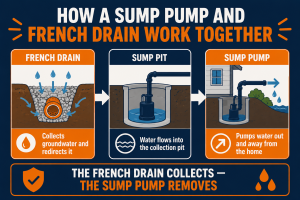
Yes — and in professional basement waterproofing, using both is the standard approach rather than a premium option. The two systems are designed to work in sequence: the French drain collects and channels groundwater from around and beneath the basement floor toward a central point, and the sump pump receives that collected water and removes it from the building. Each system is doing the job the other can’t. A French drain without a sump pump collects water but has nowhere to send it if there’s no gravity exit path. A sump pump without a drain tile system to feed it has to wait for water to collect on the floor before it can act.
The combined system is why waterproofing contractors almost always quote both together when the scope of the problem warrants it. An interior drain tile system running the full perimeter of the basement, feeding into a properly sized sump pit with a primary pump and battery backup, is the most complete and reliable residential basement waterproofing solution available. It addresses both the path water takes into the basement (via the drain tile interception) and the removal of that water once collected (via the pump). A well-calibrated water leak detector installed near the sump pit provides an additional layer of protection, alerting you if the pit level rises unexpectedly — which can indicate a pump failure or an unusually high water table event.
The right answer depends on the specific nature of your water problem. The head-to-head table below maps the most common basement water scenarios to the solution each one calls for.
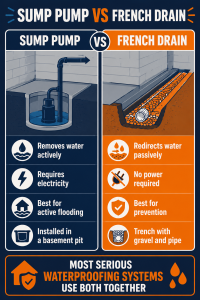
| Scenario | Best Choice | Why |
|---|---|---|
| Active flooding right now | SUMP PUMP | Immediate water removal — a French drain won’t eliminate water already inside |
| Preventing future water intrusion | FRENCH DRAIN | Intercepts water before it reaches the foundation |
| No electricity available | FRENCH DRAIN | Gravity-based, no power required |
| Damp walls without standing water | FRENCH DRAIN | Exterior drain relieves hydrostatic pressure against foundation walls |
| Standing water collecting in one spot | SUMP PUMP | Efficiently removes water pooling at the lowest point |
| Complete long-term waterproofing | BOTH TOGETHER | Most effective setup — French drain feeds the sump pit, pump removes the water |
| Lower cost for an isolated minor issue | SUMP PUMP | No perimeter excavation needed — pit installation is a smaller scope project |
Our guide to the best sump pumps covers our complete picks, including battery backup models, pedestal and submersible designs, and the right capacity for different basement sizes. If losing power during a storm is a real concern in your area, our sump pump vs battery backup sump pump comparison covers that decision separately.
US regional note: Homes in the Midwest and Northeast with older basements and high water tables often need both systems working together, while homes in drier climate states like Arizona, Nevada and parts of Texas may only need basic grading and gutter management rather than either system, since groundwater intrusion is a much smaller risk in those regions. If you’re in a milder climate state and experiencing water intrusion, confirm the source — surface water grading is often the culprit rather than a high water table, and the fix may be as simple as regrading the yard away from the foundation rather than installing either drainage system.
Sump pump installation and French drain systems both involve breaking through the basement floor or excavating around the foundation — jobs that affect your home’s structure and drainage that are best assessed by a licensed professional before any work begins. A waterproofing contractor can diagnose the source of your water intrusion, identify whether it’s a surface water, groundwater, or hydrostatic pressure problem, and recommend the right system for your specific situation.
Find a licensed plumber in your area at PlumberArchive.com — the US plumber directory with 12,000+ verified local plumbers across all 50 states.
Get weekly plumbing tips, honest tool reviews and DIY guides delivered straight to your Facebook feed. We cover basement waterproofing, sump pumps, drain systems and everything in between — written for US homeowners who want to make smart decisions without overspending.
Many homes benefit most from having both systems — but not every home needs both, and the right answer depends on the specific nature of your water problem. If water enters your basement through the walls due to sustained soil saturation and you don’t have anywhere for it to go once inside, a French drain that intercepts the water and channels it to a sump pit with a pump is the complete solution. If you only have occasional minor seepage in one corner with no standing water on the floor, a sump pump alone may be sufficient for now. The key diagnostic question is whether you’re dealing with water that needs to be redirected before it enters (French drain territory) or water that needs to be removed after it’s already inside (sump pump territory). If both are true — which is common in older homes with high water tables — both systems are the right long-term answer.
Yes, but only if the French drain has a gravity exit point. An exterior French drain that can slope to daylight — draining to a ditch, a low area of the yard, or a storm drain connection well below the drain’s starting elevation — works entirely by gravity and needs no pump. Many rural and suburban exterior French drain installations work this way successfully. The limitation is when no gravity exit is available: on flat lots, in urban environments where runoff must be managed on-site, or in basement interiors where the drain sits below the surrounding grade on all sides. In those cases, the collected water has to go somewhere, and a sump pump pit is the standard answer. Interior drain tile systems almost always connect to a sump pump because there is typically no gravity exit point available inside a basement.
Sump pump installation (including the pit excavation and pump unit) typically falls in a $$ to $$$ tier when professionally installed — a more contained project scope than a full French drain system. An interior French drain (drain tile system) running the basement perimeter is a step above that in cost, reflecting the greater extent of floor cutting and installation labor involved. An exterior French drain — which requires excavating several feet deep along the full foundation perimeter and restoring the landscaping afterward — is significantly more expensive, often in the $$$ to $$$$ range for a typical US home. Regional labor rates vary considerably and affect all three cost tiers. Get itemized quotes from at least two licensed waterproofing contractors before committing to any system, and ask them to specify whether they’re proposing interior or exterior drainage and why.
If a primary sump pump loses power during a storm and no backup system is in place, the sump pit will continue to fill and eventually overflow onto the basement floor — exactly the scenario the pump was installed to prevent. This is the most common cause of sump pump failure leading to basement flooding, and it happens regularly during the severe storms that produce the most water intrusion. The solution is a battery backup sump pump — a separate pump unit powered by a large lead-acid or lithium battery that activates automatically when the primary pump loses power. A quality battery backup system provides enough runtime to get through most typical power outages. Some systems also connect to the home’s water supply and use water pressure as a backup activation mechanism. If your primary pump doesn’t have a battery backup, adding one is one of the highest-value improvements you can make to an existing sump pump installation.
Sump pumps and French drains solve related but distinct water management problems — and framing them as a choice between two competing options misses the most important insight: they’re designed to work together. A French drain collects and channels groundwater toward a collection point; a sump pump removes that collected water from the home. The most effective basement waterproofing systems use both in sequence, with the drain tile feeding the sump pit and the pump eliminating what the drain collects.
If you’re making a choice based on your specific situation right now: active flooding calls for a sump pump first, since it provides immediate water removal. Persistent damp walls without standing water call for a French drain, since the problem is soil saturation pressing against the foundation rather than water already on the floor. A complete waterproofing project — particularly in high water table regions like the Midwest and Northeast — calls for both systems together, properly sized and connected.
Before committing to either system, get professional quotes that diagnose the source of your water intrusion specifically. What looks like a sump pump problem may be a grading problem; what looks like a French drain problem may have a hydrostatic pressure component that only a pump can address. Our guide to the best sump pumps covers our top picks for every scenario once you’re ready to move forward. For temporary emergency water removal during evaluation, our picks for the best utility pumps cover portable submersible options that don’t require a permanent pit installation, and our utility pump vs sump pump comparison covers when a portable pump is enough versus when you need the permanent system. And for early detection of water intrusion between inspections, the best water leak detectors provide an alert layer that catches problems before they escalate.
✍️ About This Comparison
PTR Editorial Team — Product Comparisons. We compare manufacturer specifications, installation requirements, compatibility and available product documentation to help homeowners choose suitable tools and parts. How we review →
Pop-up drains seal to hold water; grid drains never close but resist clogs better and cost less. Here's how to choose between them for your bathroom sink.
Test strips, digital meters or send-to-lab testing? Match the method to your situation — screening, ongoing monitoring, or a real health concern.
25-foot vs 50-foot drain snake: compare handling, the cable diameter trade-off and the jobs that justify extra length, plus where 50 feet stops.

