Reviews
4 Oct 2026

5 Best Bathroom & Shower Caulks (2026) — Expert Reviews
Compare five bathroom and shower caulks by surface, joint movement, paintability and water-ready time, using each maker's data sheet.
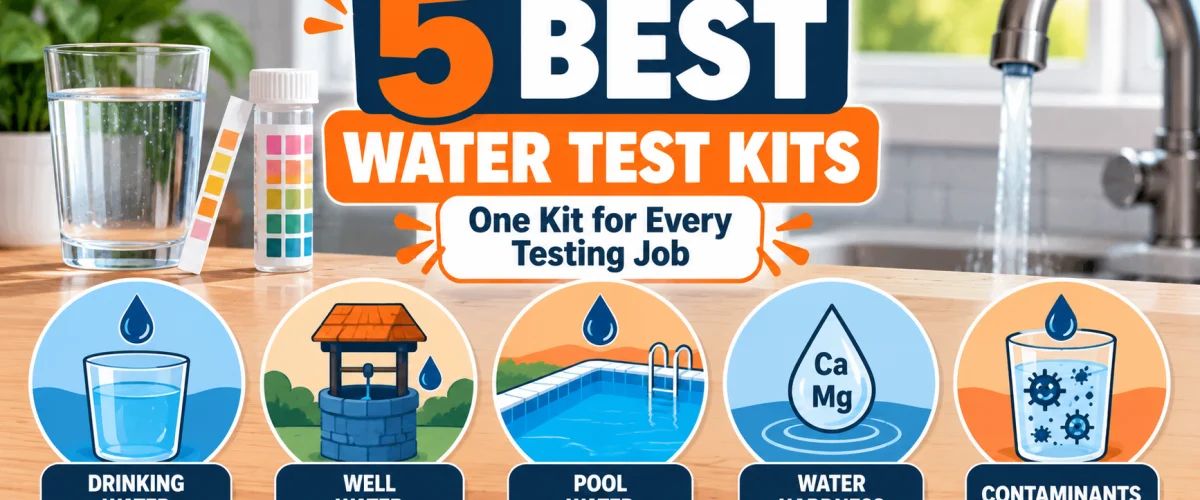
Compare 5 water test kits for 2026 — one per job: screening strips, well bacteria, hardness, dissolved solids and send-to-lab analysis.
Please note: Product availability and information are based on our research at time of writing and are subject to change. Always check Amazon for the latest details before purchasing. Reviews remain editorially independent.
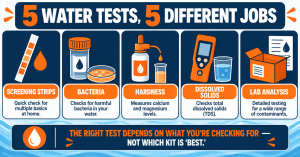
There is no single water test kit that does every job, and that’s the honest starting point for this roundup. A strip gives a rough look at several things, a bacteria kit answers one question about one hazard, a titration kit measures hardness precisely, a meter reads dissolved solids and nothing else, and only a send-to-lab kit returns laboratory results. So instead of ranking five products against each other, we’ve picked one kit for each job: find the question you’re actually trying to answer, then buy the kit built for it. Our guides on how to test your water for hardness, how to test for lead in your home’s plumbing, how to test for radon in your home’s water supply and how to test for bacteria in well water explain how and why to test; this roundup covers what to test with.
⚠️ Warning
At-home kits are screening tools. If you have a specific health concern — illness in the household, an infant, a pregnancy, or a private well near farming or a septic system — a certified lab is the reliable route, and any positive or unclear kit result is a reason to follow up with one. None of the at-home kits below replaces certified lab testing, and a clear result from a kit doesn’t guarantee your water is safe.
✏️ Our Take
Start with the question, not the product. Curious what’s in your tap water? Strips are the cheapest first look. On a private well, run a bacteria test and consider a lab kit. Worried about scale? Titration gives a softener decision its number. The TDS meter is a different tool entirely: it tracks dissolved solids and filter performance and cannot screen for any contaminant. And when a result affects your health, a certified lab settles it, not a color chart.
IN THIS GUIDE
| Product | Rating | Best For | Price |
|---|---|---|---|
| Bestprod 21-in-1 | ★★★★☆ | Best for Overall Screening | $ |
| Safe Home DIY Bacteria Test | ★★★★★ | Best for Well Water Bacteria | $ |
| Hach Total Hardness 5-B | ★★★★★ | Best for Accurate Hardness Testing | $$ |
| HoneForest TDS Meter | ★★★★★ | Best for Dissolved Solids Monitoring | $ |
| Tap Score Advanced Home Water Test | ★★★★★ | Best for Comprehensive Lab Analysis | $$$$ |
Full Reviews — 5 Best Water Test Kits, One for Every Job
🔍 Best for Overall Screening
The Bestprod 21-in-1 is the kit to buy when your question is simply “what’s in my water?” rather than “is X in my water?” Its listing describes a multi-parameter test strip plus two separate bacteria tests, with the named parameters including hardness, lead, iron, copper, chlorine, fluoride and pH. Testing is dip-and-read: add water, set a timer, and compare the strip against the color guide printed on the bottle, which lines up with each result. A data sheet is included for logging readings over time.
This is a screening tool, not a substitute for certified lab testing, and that distinction matters. Color-chart strips give you a rough band rather than a precise concentration, and judging a shade against a chart is subjective. That’s how our guide on how to test for lead in your home’s plumbing treats DIY kits: a reasonable first step for deciding whether to test further, not the final word. A clear result is reassuring but not conclusive, and anything positive, ambiguous or worrying should be followed up with a certified lab.
✓ Pros
Screens for many common concerns in one kit, including hardness, chlorine, iron and copper
Includes a data sheet so readings can be logged and compared over time
Low price tier makes it easy to test more than one tap or retest later
✗ Cons
Color matching is subjective and reports ranges, not precise numbers — not a substitute for certified lab results
The “21-in-1” count includes the two bacteria tests, and a strip is a screen for each item rather than a lab analysis of it
💡 Tip: If the lead result isn’t a clear negative, or you’re testing a private well, don’t stop at the strip. Our guides on how to test for lead in your home’s plumbing and how to test for bacteria in well water explain the certified-lab follow-up.
🧫 Best for Well Water Bacteria
Bacteria is the concern a strip or meter can’t speak to reliably, and the test private well owners most need. Safe Home’s kit is a dedicated coliform test: you collect a sample, incubate it, and read a color-based presence-or-absence result. The listing says it detects 50 species of coliform bacteria including E. coli, that positive results can appear in as little as six hours and may take up to 72 hours depending on incubation conditions, and that each kit ships sterilized.
Presence or absence is exactly what it delivers and nothing more: it doesn’t count bacteria, identify which species are present, or test for any other contaminant. Consistent with our guide on how to test for bacteria in well water, a DIY kit is a first indication, not a substitute for certified lab testing. If it shows bacteria, confirm with a certified lab or your health department before acting, and it doesn’t replace a private well’s annual lab test.
✓ Pros
A dedicated coliform test that includes E. coli, made for wells and other freshwater sources
Listing describes results in as little as six hours, so you can check quickly after a storm or well work
Single-purpose and inexpensive, so retesting doesn’t feel like a big commitment
✗ Cons
Presence or absence only — no count, no species, and nothing about other contaminants
A positive result, or a clear one on a well you’re worried about, still calls for certified lab confirmation
🎯 Best for Accurate Hardness Testing
When you need an actual hardness number — to size a water softener, set an existing one, or check that it’s still working — titration beats strips. The Hach 5-B measures total hardness as calcium carbonate by drop-count titration: you add reagent to your sample one drop at a time, count the drops until the color changes, and convert the count into grains per gallon. The listing gives a range of 1–30 gpg and notes that 1 gpg equals 17.1 mg/L, the same conversion used in our guide on how to test your water for hardness.
Two reagents, a measuring tube, a square sample bottle and a scoop come in the box, and the listing says a kit contains approximately 100 tests, so it covers repeated checks like verifying a softener over a season. The limits are real: it measures hardness and nothing else, so it says nothing about bacteria, lead or any other contaminant, and precision depends on you measuring the sample and counting drops carefully.
✓ Pros
Titration returns a specific number rather than a color band
Approximately 100 tests per kit, enough for repeat checks
Reads in grains per gallon, with the mg/L conversion stated in the listing
✗ Cons
Measures hardness only — no help with bacteria, metals or any other contaminant
Takes a few minutes and careful drop-counting; the wrong sample size skews the result
🛒 Check Price on Amazon — $$ →
📟 Best for Dissolved Solids Monitoring
This is a different kind of tool from the other four, and it belongs here for a specific reason: it measures total dissolved solids (TDS) — the combined amount of everything dissolved in the water, from minerals to salts — as a single number, along with electrical conductivity and temperature. It cannot tell you what those dissolved solids are. It is not a contaminant test: it does not detect lead, bacteria, nitrates or any other specific substance, and many harmful contaminants occur in amounts too small to move the reading at all.
What it’s good for is tracking change. Measure your tap, then measure the output of a reverse osmosis system or filter, and a rising number on the filtered side is a sign the membrane or cartridge is wearing out. The listing names RO/DI monitoring and filter replacement among its uses, and specifies a 0–9990 ppm range, ±2% full-scale accuracy, automatic temperature compensation and factory calibration. The listing pitches the meter as a drinking-water check; we’d put it more narrowly. A low number means less dissolved material, not clean or safe water, and a high number doesn’t identify a problem. Hard water alone raises TDS without being a health concern.
✓ Pros
Instant readout of total dissolved solids, conductivity and temperature from one pen
Useful for comparing before-and-after readings to track an RO system or filter over time
Factory calibrated, so there’s no setup, and it sits in the lowest price tier
✗ Cons
Measures dissolved solids in general, not any specific contaminant — a good reading says nothing about lead, bacteria or nitrates
Reports a single total, so it can’t separate harmless minerals from harmful dissolved substances
⚠️ Warning
A TDS reading is not a contamination screen. A low number doesn’t mean your water is safe, and a high number doesn’t tell you what’s in it. For lead, see our guide on how to test for lead in your home’s plumbing and use a lab; for bacteria, use a bacteria test and our guide on how to test for bacteria in well water, then confirm with a certified lab.
🔬 Best for Comprehensive Lab Analysis
When a strip result raises a question, or a result has to be right, this is the option that takes the guesswork out. You collect a water sample at home following the included instructions, mail it back with the prepaid return label, and a laboratory analyzes it. The listing says the analysis covers 116 analytes, including heavy metals such as lead, arsenic, copper and mercury, coliform and E. coli bacteria, disinfection byproducts, nitrates, pH, hardness and alkalinity, with samples handled by a network of certified labs.
Results come back as an online report that explains each finding and offers treatment recommendations. It’s intended for either utility or well water, and the listing points to wells near farming or industrial activity and homes built before 1986. Radon isn’t among the listed analytes and PFAS is sold as a separate test, so for radon start with our guide on how to test for radon in your home’s water supply. It’s also the most expensive kit here and slower than any at-home option, since the sample has to travel.
✓ Pros
Broad analysis in a single sample — metals, bacteria, nitrates, disinfection byproducts and hardness
Lab-analyzed results with a report that explains findings rather than a color chart
Includes sampling materials, instructions and prepaid return shipping
✗ Cons
Highest price tier in the roundup
Radon isn’t in the listed analytes and PFAS is a separate test; results also take longer than any at-home kit, and the sample must be collected carefully and shipped promptly
🛒 Check Price on Amazon — $$$$ →
Start by naming the job. “What’s in my water?” is a screening question that strips answer cheaply. “Is there bacteria in my well?” needs a dedicated bacteria test. “How hard is my water?” is a titration question. “Is my filter still working?” is what a TDS meter is for. And “I need a real answer about lead, metals or nitrates” means a lab. The kit that matches your question matters more than the most capable one.
Well and city water are different cases. Municipal customers can often start with their utility’s own water quality report, as our hardness guide notes, while private well owners carry the testing themselves: bacteria testing, an annual lab test, and extra tests after well work or flooding, as our bacteria guide covers. Whatever you buy, collection technique decides the result, so use the supplied container, follow the fill instructions exactly, respect any shipping window, and check expiration dates on strips and reagents.
A test tells you what’s in your water — it doesn’t install a filter, soften the supply or fix the plumbing that may be causing the problem. If your results point to hard water, lead from old pipes, or you’d rather not handle well or treatment work yourself, search PlumberArchive.com — the US plumber directory with 12,000+ verified local plumbers across all 50 states.
Get weekly plumbing tips, honest tool reviews and DIY guides delivered to your Facebook feed.
It depends on the type. Strips and color-chart kits are approximate, so treat them as a screen. Titration, like the Hach kit, is more precise for the single parameter it measures. A lab, like the Tap Score kit, gives instrument-based results for specific contaminants and is the most reliable route. Match the kit to how much certainty the situation needs.
Sometimes. A clear strip result is reassuring but not conclusive, particularly for lead or bacteria. If you’re on a private well, have young children or a pregnant household member, or live in a home built before 1986, a certified lab is still the better answer. Our guides on how to test for lead in your home’s plumbing and how to test for bacteria in well water explain when the extra step is worth it.
No. A TDS meter reports total dissolved solids, everything dissolved in the water, as one number. It can’t identify what those solids are, so it can’t detect lead, bacteria, nitrates or any other specific contaminant. A low reading isn’t automatically safe and a high one isn’t automatically harmful, since hard water alone raises the number. Its real use is tracking change, such as whether a reverse osmosis system or filter is still performing.
Most health departments recommend testing private well water for bacteria at least once a year, plus extra testing after well work, flooding or unexplained illness in the household. A home kit like the Safe Home test is a useful check between lab tests, but it doesn’t replace the annual certified lab test.
There’s no single best water test kit, only the right kit for the job in front of you. For an overall first look, the Bestprod 21-in-1 is the most useful starting point: broad, quick and inexpensive, as long as you treat it as a screen and follow up on anything that isn’t a clear negative.
On a private well, add the Safe Home DIY Bacteria Test for a fast coliform check between annual lab tests. For a firm number before a softener decision, choose the Hach Total Hardness 5-B. The HoneForest TDS Meter suits anyone running a filter or reverse osmosis system, but it measures dissolved solids in general, not contaminants, and can’t tell you water is safe.
And when the result really matters, the Tap Score Advanced Home Water Test is the send-to-lab kit that answers with laboratory analysis. Start with the question, pick the kit built for it, and step up to a lab when the stakes call for it.
Prices and ratings may change. Always check Amazon for current prices.
✍️ About This Review
PTR Editorial Team — Product Reviews. We compare manufacturer specifications, installation requirements, compatibility and available product documentation to help homeowners choose suitable tools and parts. How we review →
Compare five bathroom and shower caulks by surface, joint movement, paintability and water-ready time, using each maker's data sheet.
The 5 best replacement shower hoses for 2026: stainless steel, PVC, and extra-long options for every bathroom, including accessibility-length picks.
Compare 5 garbage disposal air switches — wired, dual-outlet, plug-in and budget options, with an honest look at what each listing actually says.

