Comparisons
2 Oct 2026

Pop-Up Drain vs Grid Drain: Which Should You Choose?
Pop-up drains seal to hold water; grid drains never close but resist clogs better and cost less. Here's how to choose between them for your bathroom sink.
One runs on a schedule you set, the other reacts to moisture in the air automatically — here's how timer and humidity sensor switches actually compare for a bathroom exhaust fan.

Please note: Information in this comparison is based on our research at time of writing and is general in nature. Always confirm a specific switch model’s wiring requirements before purchasing.
Replacing a standard bathroom fan switch is a small project, but the switch you choose actually reflects a bigger decision: how hands-on do you want to be about running your exhaust fan? A timer switch keeps you in charge — you decide when the fan turns on and exactly how long it runs, every single time. A humidity sensor switch takes that decision out of your hands entirely, watching the actual moisture level in the room and turning the fan on and off automatically based on real conditions rather than a fixed estimate.
Neither approach is more “correct” than the other, and both can do a perfectly good job of clearing a steamy bathroom. What separates them is control philosophy: manual and predictable versus automatic and condition-based. This guide compares the two directly — how each one actually works, what it means for energy use and mold prevention, and which type fits your household’s habits best.
At a Glance
Timer Switch
Humidity Sensor Switch
✏️ Our Take
A humidity sensor switch is the better fit for most households, simply because it removes the guesswork and the risk of forgetting to turn the fan on or off — it responds to actual moisture levels rather than a fixed time estimate. Timer switches still have a real place, though: they’re generally simpler, often less expensive, and give you direct control if you prefer setting your own run time rather than trusting a sensor’s threshold. Neither option is objectively better at moving air once running — the difference is entirely in how each one decides when to turn on and off.
IN THIS GUIDE
Here’s how timer switches and humidity sensor switches stack up on the factors that actually matter when choosing between them.
| Factor | Timer Switch | Humidity Sensor Switch |
|---|---|---|
| How it’s triggered | Manually, by you | Automatically, by rising humidity |
| Run duration | Fixed preset you choose | Variable, based on actual conditions |
| Shuts off | When the preset time expires | When humidity returns to baseline |
| Typical price tier | $ | $–$$ |
| Energy use over a typical week | Can run longer than needed | Generally lower, runs only as needed |
| Requires you to remember to use it | Yes | No |
| Best suited for | Predictable, short showers; direct control preference | Variable shower habits; multi-person households |
A timer switch is, at its core, a manually-triggered countdown. You press it — either a physical dial, a button, or a digital keypad depending on the model — and it runs the fan for a preset interval, commonly somewhere between 10 and 60 minutes, before shutting off automatically. The switch has no awareness of what’s actually happening in the bathroom; it simply counts down and cuts power once the time is up. Some models let you adjust the duration on the fly or restart the countdown mid-cycle, but the underlying mechanism is the same: a fixed amount of time, chosen by you, every time.
A humidity sensor switch works on an entirely different principle. Instead of counting down a preset interval, it continuously monitors the ambient humidity in the room using a built-in sensor, and automatically triggers the fan once humidity rises above a set threshold — often adjustable during or after installation. The fan then keeps running until humidity drops back down to a normal baseline, at which point the switch shuts it off on its own. No countdown, no manual trigger, no guessing how long a given shower will take to clear.
Some humidity sensor models also include a manual override or a separate manual mode, which is useful for situations that have nothing to do with moisture — clearing an odor, for example, where you want the fan running even though humidity levels haven’t actually spiked. This blends a bit of the timer switch’s direct control into an otherwise automatic device, and it’s worth checking for if you want the best of both approaches in a single switch.
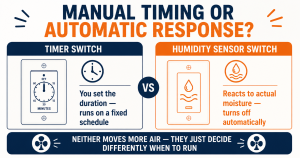
A timer switch runs for its full preset duration regardless of actual need, which means it can easily run longer than necessary. A quick five-minute shower followed by a 30-minute timer setting means the fan keeps running for another 25 minutes after the room has already cleared. Multiply that across every use over a week, and the wasted run time adds up, even though each individual instance seems minor.
A humidity sensor switch, by contrast, generally uses less total run time over a typical week, since it only operates while genuinely needed. A quick shower that clears in eight minutes gets roughly eight minutes of fan run time, not whatever preset duration happens to be dialed in. Over the course of a week or a month, this translates to modest energy savings and, just as importantly, less overall wear on the fan motor itself, since it isn’t running through unnecessary extra minutes on every use.
The gap in efficiency isn’t dramatic on any single use, but it compounds. A household that showers daily and consistently over-sets a timer “just in case” will see a more noticeable difference over months of use than a household that’s disciplined about setting an accurate, minimal duration every time. In practice, though, few people are that consistent about fine-tuning a timer setting, which is exactly where a humidity sensor switch’s automatic behavior tends to pull ahead.
A timer switch requires an active decision every time you use it: you have to remember to turn it on, and you have to choose an appropriate duration for that particular shower or bath. For some people, this is exactly the point — it gives you direct, deliberate control over exactly how long the fan runs, without any automation second-guessing your judgment. If you like knowing precisely what the fan is doing and why, a timer switch delivers that.
A humidity sensor switch removes that decision entirely. It operates automatically without any action required on your part, which is particularly convenient in households with kids who won’t reliably remember to flip a switch, frequent guests unfamiliar with the bathroom’s setup, or simply anyone in the household who’s forgotten to run the fan before. Once installed and configured, it just works in the background every time humidity rises, with no daily thought required.
The tradeoff is that a humidity sensor switch’s convenience depends on trusting its automation to behave the way you’d want. Most people find that trust is well placed once the sensitivity is dialed in correctly, but it’s a genuinely different experience from a timer switch’s simple, predictable, manually-controlled operation. Which one feels more convenient really depends on whether you’d rather make the call yourself every time or hand that decision off entirely.
A humidity sensor switch has a genuine advantage here, since it responds directly to actual moisture conditions in the room rather than an estimated time interval. If a shower runs unusually long, if the bathroom door was left closed and steam built up more than usual, or if multiple people showered back-to-back, a humidity sensor switch will simply keep running until humidity actually clears — regardless of how long that takes. It reacts to what’s really happening, not what you guessed would happen when you set a timer.
A timer switch can still provide adequate moisture control, but it’s fundamentally an estimate rather than a direct response to conditions. If you consistently set a generous duration — long enough to cover even your longest, steamiest showers — a timer switch can clear moisture just as effectively most of the time. The risk is on the days that don’t match your usual pattern: a longer shower than normal, a guest unfamiliar with how long the fan needs to run, or simply forgetting to reset the timer for a longer duration when circumstances call for it.
For households specifically concerned about mold and mildew — whether due to a humid climate, a bathroom with limited natural ventilation, or a past mold issue — a humidity sensor switch’s condition-based response is the more reliable long-term choice. It doesn’t require you to correctly predict how long each shower will need in advance; it simply keeps working until the room is actually dry.
Both switch types are generally installed the same way — as a single-pole switch replacement in your existing switch box, with broadly similar wiring complexity between the two. Neither one is inherently a harder install than the other; the specific product you choose matters more than which control mechanism it uses.
Some humidity sensor models require a neutral wire to power their internal sensor electronics, depending on the specific product — but this isn’t unique to humidity sensor switches. Some timer switches, particularly digital models with a display or programmable settings, require a neutral wire as well, while simpler mechanical timer switches often don’t. Checking your switch box’s existing wiring before purchasing either type is equally important regardless of which mechanism you ultimately choose, since a neutral-wire requirement can rule out certain products before you’ve even opened the box. For a detailed walkthrough of what this looks like in practice, our how to wire a bathroom fan timer switch guide covers the process step by step.
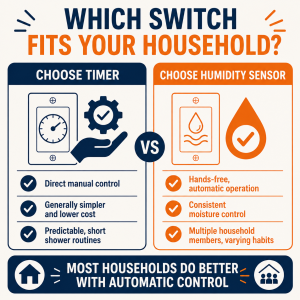
Choose a humidity sensor switch for most households, especially where convenience and consistent moisture control matter more than saving a few dollars upfront. It’s a particularly strong fit for bathrooms used by multiple people with varying shower habits, households with kids who won’t reliably operate a manual switch, or anyone who’s tired of forgetting to turn the fan on — or off — themselves.
Choose a timer switch if you prefer direct manual control and like knowing exactly how long the fan will run every time, want the generally simpler and lower-cost option, or have a bathroom with fairly predictable, short shower durations where a preset time reliably does the job. If you’re comparing specific models rather than just the underlying mechanism, our timer switch reviews and humidity sensor switch reviews compare the top options in each category by price tier and features.
And if you haven’t settled on the fan itself yet, that’s a separate decision worth getting right first — our bathroom exhaust fan reviews cover the fans themselves, while our exhaust fan sizing guide walks through calculating the right CFM for your bathroom’s size, since neither switch type can compensate for a fan that’s simply undersized for the room.
If you’re not comfortable working inside a switch box, or you run into wiring that doesn’t match what you expected, search PlumberArchive.com — the US plumber directory with 12,000+ verified local plumbers across all 50 states.
Get weekly plumbing tips, honest tool reviews and DIY guides delivered straight to your Facebook feed.
Generally, yes, though the difference is modest rather than dramatic. A humidity sensor switch runs only as long as humidity actually stays elevated, while a timer switch runs for its full preset duration regardless of whether the room has already cleared. Over a single use, the gap might only be a few minutes, but across a week or month of regular use, a humidity sensor switch typically accumulates less total run time — and therefore uses somewhat less electricity — than a timer switch that’s routinely set for more time than actually needed.
Many models can. A number of humidity sensor switches include a manual override or a separate manual mode, letting you run the fan on demand for reasons unrelated to moisture, such as clearing an odor. This isn’t universal across every product, though, so if manual control matters to you as a backup option, check the specific model’s features before purchasing rather than assuming every humidity sensor switch includes it.
A humidity sensor switch has the edge here, since it responds to actual moisture conditions rather than a fixed time estimate. It will keep running through an unusually long or steamy shower until humidity genuinely clears, rather than shutting off on a preset schedule regardless of conditions. A timer switch can still provide solid mold prevention if you consistently set a generous enough duration, but it depends on your estimate matching reality, which won’t always hold true on longer or more humid days.
Not inherently. Both timer switches and humidity sensor switches are typically installed as a single-pole switch replacement with broadly similar wiring complexity. The bigger factor is the specific product you choose rather than which control mechanism it uses — some models of either type require a neutral wire, while others don’t. Checking your switch box’s existing wiring before purchasing is a good idea regardless of which type you’re leaning toward.
Timer switches and humidity sensor switches both move the same air through the same fan — the real difference is entirely in how each one decides when to turn on and off. A timer switch keeps that decision in your hands, offering simple, predictable, manually-controlled operation at a generally lower cost. A humidity sensor switch hands that decision off to the room itself, automatically responding to real moisture conditions and typically using somewhat less energy in the process. For most households, especially those with variable shower habits or multiple people sharing a bathroom, a humidity sensor switch’s automatic, condition-based operation makes it the easier choice to live with day to day. If you’d rather set your own rules and keep things simple, a timer switch remains a perfectly practical option.
Prices and ratings may change. Always check Amazon for current prices.
✍️ About This Comparison
PTR Editorial Team — Product Comparisons. We compare manufacturer specifications, installation requirements, compatibility and available product documentation to help homeowners choose suitable tools and parts. How we review →
Pop-up drains seal to hold water; grid drains never close but resist clogs better and cost less. Here's how to choose between them for your bathroom sink.
Test strips, digital meters or send-to-lab testing? Match the method to your situation — screening, ongoing monitoring, or a real health concern.
25-foot vs 50-foot drain snake: compare handling, the cable diameter trade-off and the jobs that justify extra length, plus where 50 feet stops.

