Reviews
23 Sep 2026

5 Best Natural Gas & Propane Leak Detectors (2026) — Expert Reviews
Compare 5 top natural gas & propane leak detectors for 2026 — plug-in alarms vs handheld sniffers, tested for accuracy, price and home safety.
A bathroom fan timer switch stops it running long after you've left — we compare five top picks by wiring, mechanism, and interval range.

Please note: Product availability and information are based on our research at time of writing and are subject to change. Always check Amazon for the latest details before purchasing.
A bathroom exhaust fan timer switch solves a small but genuinely annoying problem: remembering to turn the fan off, or running it far longer than a shower or bath actually needed. Instead of a standard on/off switch, a timer switch lets you set a fixed run duration and walk away — the fan shuts itself off once that window ends, cutting down on wasted electricity and unnecessary noise without you having to think about it.
We compared five timer switch options covering both mechanical and digital designs, neutral-wire and no-neutral-wire installations, and a range of interval options from quick 5-minute presets to a full 4-hour setting. Whether you’re replacing a basic switch during a bathroom update or specifically chasing lower energy use, this lineup covers the realistic range of what’s available. If you haven’t settled on a fan yet, our bathroom exhaust fan reviews and bathroom exhaust fan sizing guide are worth checking first, since choosing the right fan and CFM rating is a separate decision from choosing how you control it.
✏️ Our Take
A bathroom exhaust fan timer switch solves a genuinely common problem: forgetting to turn the fan off, or running it far longer than actually needed after a shower. The main decision points are wiring compatibility (some switches need a neutral wire at the box, others don’t — check your existing wiring before buying), mechanism (a simple mechanical dial has no electronics to fail, while digital models offer preset buttons and sometimes a locator light), and the range of timer intervals offered relative to how you actually use your bathroom. Installation is a straightforward switch swap for anyone comfortable with basic electrical work, though hiring an electrician is always a reasonable option.
IN THIS GUIDE
| Product | Rating | Best For | Price |
|---|---|---|---|
| Leviton DT160-1LW Countdown Timer Switch BEST OVERALL |
★★★★★ | No-neutral installs, general bathroom use | $$ |
| BN-LINK Spring Wound Mechanical Timer | ★★★★★ | Budget-friendly, no-electronics reliability | $ |
| ENERLITES 4-Hour Countdown Timer Switch | ★★★★★ | Extended run times up to 4 hours | $$ |
| Leviton DT130-1LW Countdown Timer Switch | ★★★★★ | Quick bathroom visits, shorter intervals | $$ |
| Legrand Radiant Digital Countdown Timer Switch | ★★★★★ | Digital interface, easy-to-find locator light | $$ |
🏆 Best Overall
Single Pole, No Neutral Required, 10-20-30-60 Min Presets
The Leviton DT160-1LW earns the top spot on the strength of exceptional buyer demand and a no-neutral-wire installation — a genuine advantage for older homes where the switch box doesn’t have a neutral wire run to it, which can otherwise rule out digital timer options entirely. It’s backed by Leviton’s established reputation in electrical switches, and it handles both the bathroom fan and household lights from the same single-pole switch.
Four preset intervals — 10, 20, 30, and 60 minutes — cover the range most households actually use, from a quick vent-out to a longer run after a bath. It’s a straightforward, no-frills design without a digital display, relying on labeled preset buttons instead, which keeps the operation simple and the price reasonable for a switch backed by this level of brand trust.
✓ Pros
Exceptional buyer demand confirms this is a trusted, widely purchased choice
No-neutral-wire installation makes it compatible with older homes that lack a neutral wire at the switch box
Backed by Leviton’s established reputation in electrical devices
4 preset intervals cover the most common use durations
✗ Cons
Maximum 60-minute setting won’t suit situations needing longer run times
No digital display — relies on labeled preset buttons only
🛒 Check Price on Amazon — $$ →
💰 Best Budget
Spring Wound Mechanical, No Neutral Required, 1-Min Intervals up to 60 Min, 20A 1HP
The BN-LINK spring-wound timer is the clear budget pick in this lineup, and it backs that low price up with exceptional buyer demand rather than a compromise on reliability. Instead of digital electronics, it uses a simple spring-wound mechanical dial — a design with nothing to fail over time beyond the mechanism itself, which is a real appeal for anyone who prefers straightforward hardware over circuitry.
You turn the dial to your desired run time and it counts down in 1-minute increments up to a full 60 minutes, giving finer control than most preset-button switches offer. It doesn’t require a neutral wire, rated for exhaust fans and heaters up to 20A/1HP, and ETL certified — a lot of capability for the lowest price point among the popular options in this category.
✓ Pros
Exceptional buyer demand confirms dependable performance at the lowest price point in this roundup
Spring-wound mechanical design has no electronics to fail over time
1-minute interval precision offers fine control over run time
No neutral wire required for installation
✗ Cons
Manual dial-turning operation lacks the preset-button convenience of digital models
Mechanical spring mechanism may wear over years of heavy use
🎯 Best Extended Duration
Neutral Wire Required, 5-10-30-60 Min + 2-4 Hour Range, UL Listed
The ENERLITES 4-Hour timer stands out for offering the widest interval range in this lineup by a wide margin, stretching from a quick 5-minute setting all the way up to a full 4 hours. Solid buyer demand backs it up, and it benefits from ENERLITES’ broader traction in the timer switch category — this isn’t a one-off product but part of an established lineup.
Presets at 5, 10, 30, and 60 minutes cover typical bathroom use, while the 2-4 hour range extends the switch’s usefulness well beyond a standard bathroom fan into situations like running a space heater or a whole-house fan for an extended period. An LED indicator confirms at a glance that the timer is actively counting down, and it’s UL listed for safety certification.
✓ Pros
Widest timer range in this lineup, extending up to 4 hours for situations needing extended run time
Backed by ENERLITES’ established presence in timer switches
LED indicator confirms the timer is actively running
UL listed for safety certification
✗ Cons
Requires a neutral wire, unlike the no-neutral options in this lineup
Longer maximum duration may be more range than most bathroom fan uses actually need
🛒 Check Price on Amazon — $$ →
⭐ Best for Shorter Intervals
Single Pole, No Neutral Required, 5-10-15-30 Min Presets
The Leviton DT130-1LW is built around a tighter interval spread — 5, 10, 15, and 30 minutes — that suits quick bathroom visits better than a switch topping out at an hour. Strong buyer demand backs it, and it carries the same established Leviton reputation as the DT160-1LW above, just tuned toward shorter run times rather than longer ones.
Like the DT160, it requires no neutral wire, which keeps installation straightforward in older homes without a neutral run to the switch box. The tradeoff for that tighter interval focus is a lower ceiling — 30 minutes maximum, versus 60 on the DT160-1LW above — so this is the better fit specifically for households that don’t need the fan running much longer than a quick shower actually takes.
✓ Pros
Tighter interval spacing suits quick bathroom visits without over-running the fan unnecessarily
Backed by Leviton’s established reputation in electrical devices
No-neutral-wire installation matches the DT160-1LW’s compatibility advantage
Straightforward preset-button operation
✗ Cons
Lower maximum setting (30 minutes) than most other options in this lineup
Same lack of digital display as the DT160-1LW
🛒 Check Price on Amazon — $$ →
👷 Best Digital Display
Digital Preset, Neutral Wire Required, 10-20-40-60 Min, Locator Light
The Legrand Radiant timer, built on the Pass & Seymour platform, is the digital standout in this lineup. Strong buyer demand and Legrand/Pass & Seymour’s established reputation in electrical devices back up a clean digital preset interface, with four settings — 10, 20, 40, and 60 minutes — selected at the press of a button rather than a mechanical dial or unlabeled toggle.
The standout feature here is a built-in locator light, which keeps the switch faintly illuminated so it’s easy to find in a dark bathroom — a genuine convenience feature none of the other four options in this lineup include. It does require a neutral wire, so it’s worth confirming your switch box wiring before buying, but for anyone who wants a modern digital feel plus that locator light, it’s the clear pick.
✓ Pros
Locator light makes the switch easy to find in a dark bathroom, a genuine convenience feature this lineup’s other options lack
Backed by Legrand/Pass & Seymour’s established reputation
Digital preset interface offers a clean, modern operating experience
4 preset intervals cover common use durations
✗ Cons
Requires a neutral wire, unlike the no-neutral Leviton and BN-LINK options in this lineup
Maximum 60-minute setting matches rather than exceeds the other digital/mechanical options
🛒 Check Price on Amazon — $$ →
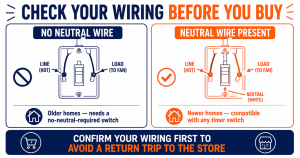
The single most important thing to check before buying a timer switch is whether your existing switch box has a neutral wire. Some timer switches, including two of the five in this lineup, are specifically designed to install without one, using the existing hot and load wires alone. Others, like the ENERLITES and Legrand models here, require a neutral wire to power their internal electronics. Buying a neutral-required switch for a box that doesn’t have one means the installation simply won’t work as wired, so this is worth confirming with a quick look inside the switch box (or asking an electrician) before you order anything.
Timer switches split into two basic mechanisms. Mechanical spring-wound dials, like the BN-LINK option in this lineup, use no electronics at all — you turn the dial to your desired time and it counts down and shuts off on its own, with nothing to fail beyond the physical spring mechanism itself over years of use. Digital models, like the Legrand Radiant here, use preset buttons and sometimes additional features like an LED indicator or a locator light, offering a more modern feel and often finer preset options. Neither mechanism is objectively better — a mechanical dial appeals to anyone who prefers simple, durable hardware, while a digital model appeals to anyone who wants preset convenience and extra features.
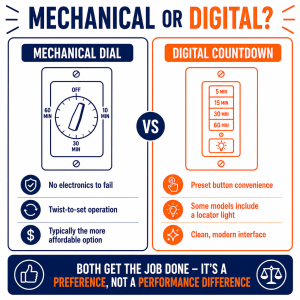
Think about how your bathroom actually gets used before picking an interval range. A household that mostly takes quick showers is well served by a switch with shorter presets, like the Leviton DT130-1LW’s 5-to-30-minute range, since there’s little benefit to a fan running an hour after a five-minute shower. A household with longer baths, multiple people showering back-to-back, or humidity concerns in a poorly ventilated bathroom might prefer a switch with a higher ceiling, like the ENERLITES model’s up-to-4-hour range. Most households land somewhere in the middle, which is exactly where switches like the Leviton DT160-1LW’s 10-to-60-minute range and the Legrand Radiant’s 10-to-60-minute range both sit.
Installing a timer switch is generally a single-pole switch swap: turn off power at the breaker, remove the existing switch, connect the new switch’s wires to match the old configuration (accounting for whether a neutral connection is needed), and secure it back into the box. It’s a manageable project for anyone comfortable with basic electrical work and a non-contact voltage tester to confirm the power is off, though hiring an electrician is always a reasonable option if you’re not confident working with household wiring or if your switch box setup looks unusual.
If you’re not comfortable working inside a switch box, or your bathroom’s electrical setup looks unusual, it’s worth having a licensed electrician take a look. Search PlumberArchive.com — the US plumber directory with 12,000+ verified local plumbers across all 50 states.
Get weekly plumbing tips, honest tool reviews and DIY guides delivered to your Facebook feed.
With power off at the breaker, remove the existing switch plate and look inside the box. A neutral wire is typically bundled white wires connected together with a wire nut, separate from the switch itself, often tucked toward the back of the box. If you only see the wires directly connected to the existing switch and no separate white bundle, your box likely doesn’t have a neutral available, which points you toward a no-neutral-required model. If you’re not confident identifying it yourself, a licensed electrician can confirm in a couple of minutes.
For anyone comfortable with basic electrical work, installing a timer switch is generally a straightforward single-pole switch swap — turn off power at the breaker, disconnect the old switch, match the new switch’s wiring to the old configuration, and secure it in the box. It typically takes less time than a full fixture replacement. That said, if you’re not confident working with household wiring, or you’re unsure whether your box has a neutral wire, hiring an electrician is a reasonable and inexpensive way to avoid any uncertainty.
A timer switch runs the fan for a fixed duration that you set manually, then shuts off on its own regardless of bathroom conditions. A humidity sensor switch works differently — it monitors moisture levels in the air and turns the fan on and off automatically based on actual humidity, without you setting a duration at all. Our humidity sensor switch reviews cover that automatic-control category in detail if you’d rather have the fan respond to conditions than to a preset timer.
Some models, including the Leviton switches in this lineup, are designed to control both a fan and household lights from the same switch. Others are built specifically for fan control alone. Check the specific product listing for your chosen model to confirm what it’s rated to control before wiring it into a combined fan-and-light circuit, since not every timer switch is built for both loads.
For most households, the Leviton DT160-1LW is the easiest recommendation — no-neutral-wire flexibility, Leviton’s established reputation, and a preset range that covers typical bathroom use. If price is the deciding factor, the BN-LINK spring-wound timer delivers dependable, no-electronics reliability at the lowest cost in this lineup, while the ENERLITES 4-Hour model is the one to choose if you specifically need longer run times.
Households with quick, frequent bathroom visits should look at the Leviton DT130-1LW and its tighter interval spacing, and anyone who wants a modern digital feel plus the convenience of a locator light should go with the Legrand Radiant. Whichever you choose, confirm your switch box’s neutral wire situation first — it’s the detail most likely to determine which of these five options actually fits your installation.
Prices and ratings may change. Always check Amazon for current prices.
✍️ About This Review
Reviewed by James Carter, Senior Tool Reviewer at PlumbingToolsReview — 15 years of hands-on experience in residential plumbing and tool testing. Learn how we test →
Compare 5 top natural gas & propane leak detectors for 2026 — plug-in alarms vs handheld sniffers, tested for accuracy, price and home safety.
5 septic tank riser kits compared for 2026 — Tuf-Tite and Polylok risers by diameter and height, so you can bring tank access to grade level.
The 5 best sewage and effluent ejector pumps for 2026, expert-reviewed: grinder, standard solids-handling and light-duty effluent pumps compared.

