Comparisons
20 Sep 2026

Utility Pump vs. Sump Pump (2026) — Which Do You Need?
Utility pump vs sump pump: one is portable for occasional jobs, the other a permanent install for ongoing water. See which your basement needs.
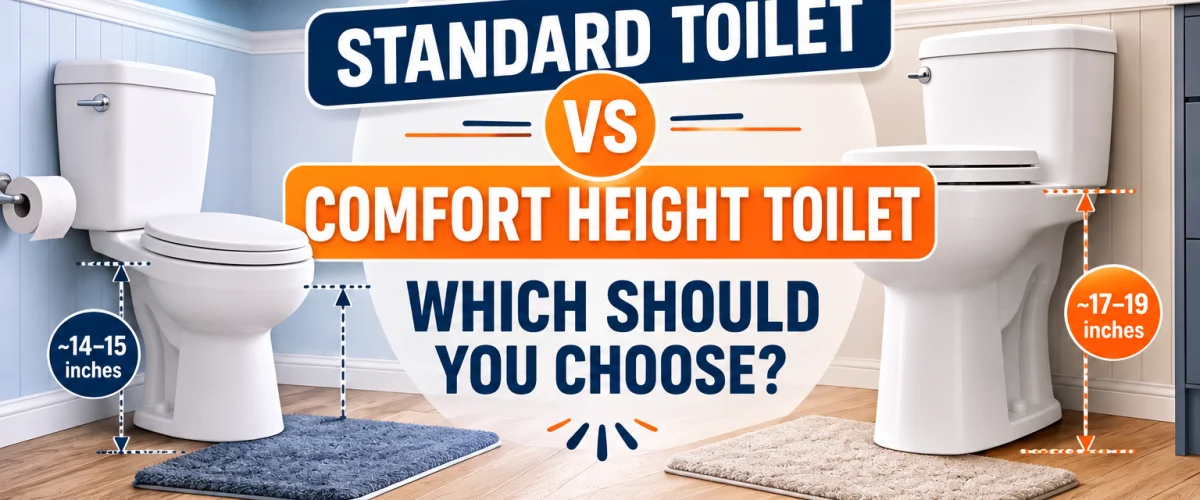
A few inches of seat height make a real difference in daily comfort — here's how standard and comfort height toilets actually compare.
Please note: Information in this comparison is based on our research at time of writing and is general in nature. Always confirm a specific toilet model’s exact seat height before purchasing.
If you’ve shopped for a replacement toilet recently, you’ve likely run into two height categories listed right alongside bowl shape and flush type: standard height and comfort height. Once you understand what actually separates them, this turns out to be a genuinely simple decision. The entire difference comes down to a few inches of seat height, and how that height affects comfort and ease of use for whoever is actually sitting down and standing up.
This isn’t a performance question or a quality question the way comparing flush mechanisms or bowl materials might be. It’s a physical fit question, closer to picking the right height of dining chair or office chair for your body than to comparing two competing technologies. Neither height is better built or more durable than the other — they’re simply sized differently, and the right one depends on who uses the bathroom day to day. This guide breaks down exactly what separates standard and comfort height toilets, who tends to benefit most from each, and how to decide with confidence.
At a Glance
Standard Height
Comfort Height
✏️ Our Take
For most adults, comfort height has become the default recommendation, and it’s why the majority of new toilets sold today are built to this taller standard — it more closely matches the height of a standard chair, which makes sitting down and standing up noticeably easier, particularly for taller adults, seniors, or anyone with knee or hip considerations. Standard height isn’t obsolete, though; it can genuinely suit shorter adults and households with young children more comfortably. The right choice comes down to who’s actually using the toilet day to day, not one height being objectively better for everyone.
IN THIS GUIDE
Here’s how standard and comfort height toilets stack up on the factors that actually matter when deciding between them.
| Factor | Standard Height | Comfort Height |
|---|---|---|
| Typical cost | $–$$ | $–$$$ |
| Seat height | Roughly 14–15 inches | Roughly 17–19 inches |
| Best fit for | Shorter adults, young children, matching older fixtures | Taller adults, seniors, mobility considerations |
| How common in new construction | Becoming less common | Increasingly the default |
| ADA-compliant options available | Generally no | Yes, in specific models |
| Flush technology, bowl shape, construction options | Same range as comfort height | Same range as standard height |
| Best for | Shorter households, households with young children | Most adult households, especially with accessibility needs |
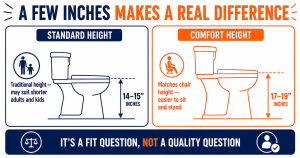
Standard height toilets measure roughly 14 to 15 inches from the floor to the top of the seat. This has been the traditional toilet height for decades, and it’s the dimension most older US homes were originally built and plumbed around. If you grew up with a toilet that felt noticeably low compared to a dining chair, there’s a good chance it was a standard height model.
Comfort height toilets, sometimes called chair height or ADA height, measure roughly 17 to 19 inches from the floor to the seat. That’s a difference of only a few inches on paper, but it meaningfully changes the angle of the knees and hips both when sitting down and when standing back up. A taller seat means less of a drop to sit and less distance to rise from, which is the entire physical basis for why comfort height exists as a separate category in the first place.
Neither measurement is arbitrary — both correspond to real, standardized ranges that manufacturers build to consistently, which is why you’ll see “comfort height” or “chair height” listed as a spec on nearly every toilet product page today. The measurement itself is taken the same way for both categories: from the finished floor to the top edge of the seat, with the lid up, rather than to the rim of the bowl underneath it. That consistency is what makes it possible to compare models across brands using this single number. Our comfort height toilet reviews cover several models built specifically to this taller standard, if you’ve already decided that’s the category you need.
Taller adults are often the first group to notice the difference. A standard height toilet can feel uncomfortably low for someone with longer legs, forcing the knees up higher than they would sit in a normal chair. Comfort height closes that gap, letting a taller person sit and stand in a position much closer to what they’d experience with ordinary furniture.
Seniors and anyone with knee, hip, or general mobility considerations tend to benefit even more directly. Standing up from a lower seat requires more effort from the legs and more strain on the joints than standing up from a taller one — the same reason many seniors prefer taller dining chairs or recliners with a higher seat. For a household where that kind of daily strain is a real concern, comfort height can make a noticeable practical difference, not just a comfort one.
There’s also a forward-looking case for comfort height: households who want to plan for long-term accessibility, even if it isn’t a pressing need today. Replacing a toilet isn’t something most people do often, so choosing comfort height now can mean not having to revisit the decision later if mobility needs change down the road.
Shorter adults are the clearest case for sticking with standard height. A comfort height toilet can feel uncomfortably tall if your feet don’t rest fully flat on the floor while seated, which changes posture and can make the experience feel awkward rather than easier. The same logic that makes comfort height a benefit for taller users works in reverse for shorter ones.
Households with young children who use the toilet independently are another common case. A taller comfort height seat can be genuinely difficult for a small child to climb onto and get down from safely without a step stool or extra assistance, while a standard height toilet sits much closer to a manageable height for a child on their own.
There are also situational reasons that have nothing to do with body size — matching an existing bathroom’s fixture height for a cohesive look, for instance, particularly if you’re replacing just one toilet in a home where every other bathroom still has standard height fixtures and a height mismatch would be noticeable.
Comfort height and ADA compliance are related but not identical concepts, and it’s worth understanding the distinction before you shop. Comfort height simply describes the taller seat measurement — roughly 17 to 19 inches. ADA-compliant toilets meet specific, more detailed measurement and clearance requirements beyond just seat height, covering things like the exact height range, surrounding clearance space, and other accessibility standards defined by the Americans with Disabilities Act.
In practice, this means every ADA-compliant toilet is built to comfort height, but not every comfort height toilet is automatically labeled or certified as ADA-compliant. The distinction matters specifically for households or situations where genuine accessibility compliance is a hard requirement — a rental property subject to accessibility regulations, for example, or a household with a specific medical need for certified accessible fixtures — rather than just a general comfort preference.
If ADA compliance specifically is a requirement for your situation, don’t assume a toilet qualifies just because it’s marketed as comfort height. Check the specific product listing or manufacturer specification sheet for an explicit ADA-compliant designation before purchasing. Our comfort height toilet reviews note which models carry that specific designation alongside general comfort height sizing.
It’s also worth noting that ADA guidelines cover more than the toilet itself — grab bar placement, surrounding clearance space, and door widths are all part of full accessibility compliance for a bathroom. A comfort height or ADA-compliant toilet is one piece of that picture, not a complete accessibility solution on its own, so a household with more extensive accessibility needs may want to look at the bathroom as a whole rather than treating the toilet as the only variable that matters.
It’s worth being clear about what seat height doesn’t change. Height has no meaningful effect on flush performance, water efficiency, or how well the toilet clears waste — those factors come down to the flushing mechanism and bowl engineering, not how tall the fixture stands off the floor.
Both standard and comfort height toilets are available across a similar range of flush technology, bowl shape options like round versus elongated, and construction types like one-piece versus two-piece designs. In other words, choosing a height doesn’t lock you into a smaller pool of options on any of those other fronts — you can find nearly any combination of features at either height. That means height can be decided on its own, based purely on who’s using the toilet, without worrying that it will limit your choices elsewhere.
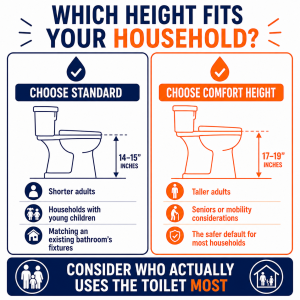
For most adult households, comfort height is the safer default, especially if accessibility is a consideration now or might become one in the future. It’s comfortable for the large majority of adult users, it’s what most manufacturers are building toward, and it tends to be easier to shop for given how common it’s become.
Choose standard height specifically if your household includes young children who use the toilet independently, or if the adults using it are shorter and find comfort height’s taller seat uncomfortable rather than helpful. In those specific cases, standard height is genuinely the better physical fit, not just a legacy option.
If you’re replacing a toilet in a household with genuinely mixed needs — a mix of adult heights, for instance, with no single group clearly dominant — comfort height is generally the safer default, since most adults find it comfortable and it accommodates a wider range of users without much downside. Before finalizing a purchase, it’s also worth confirming your existing floor drain dimensions line up with the model you’re considering; our how to measure a toilet rough-in guide walks through that separate but equally important step. And whichever height you land on, the seat itself is worth a look too — our toilet seat reviews cover options if you’re upgrading the seat alongside the toilet or considering a replacement seat rather than a full new fixture.
If you’re replacing a toilet and want help confirming rough-in measurements or handling the installation itself, search PlumberArchive.com — the US plumber directory with 12,000+ verified local plumbers across all 50 states.
Get weekly plumbing tips, honest tool reviews and DIY guides delivered straight to your Facebook feed.
Comfort height toilets typically measure about 3 to 5 inches taller than standard height models — roughly 17 to 19 inches to the seat compared to roughly 14 to 15 inches. That difference sounds small on paper, but it noticeably changes the angle of the knees and hips both when sitting down and when standing back up, which is why it makes a real practical difference for many users despite being only a few inches.
Not inherently. Price differences between individual toilet models come down to factors like flush technology, bowl material, construction type, and brand — not seat height itself. You can find both standard and comfort height toilets across a similar range of price tiers, from budget-friendly to premium, so height alone shouldn’t be treated as a cost factor when comparing models.
In most cases, yes — the height difference is in the bowl and seat, not the rough-in measurement or the way the toilet connects to your existing plumbing. As long as the new toilet’s rough-in matches what your home already has, switching from standard to comfort height (or the reverse) is generally a straightforward swap. It’s still worth confirming your rough-in measurement before buying, since that’s a separate fit requirement from seat height.
They’re closely related but not automatically identical. Comfort height describes the general taller seat measurement, roughly 17 to 19 inches, while ADA-compliant toilets meet more specific measurement and clearance requirements beyond seat height alone. Every ADA-compliant toilet is built to comfort height, but not every comfort height toilet carries an official ADA-compliant designation — check the specific product listing if certified compliance is a requirement for your situation.
Standard and comfort height toilets aren’t competing on quality or performance — they’re sized differently to suit different users, much like choosing the right height of chair. Comfort height, at roughly 17 to 19 inches, has become the default recommendation for most adult households, particularly where taller adults, seniors, or mobility considerations are involved. Standard height, at roughly 14 to 15 inches, still makes genuine sense for shorter adults and households with young children. Think about who actually uses the toilet day to day, confirm your rough-in measurement before buying either option, and the right choice becomes straightforward rather than a guess.
Prices and ratings may change. Always check Amazon for current prices.
✍️ About This Comparison
Written by Sarah Mitchell, Home Improvement Editor at PlumbingToolsReview — specializing in helping homeowners make smart buying decisions without overspending. Learn how we test →
Utility pump vs sump pump: one is portable for occasional jobs, the other a permanent install for ongoing water. See which your basement needs.
Pipe repair clamp, tape, or epoxy — which should you use for a leaking pipe? Compare how each works, durability, and when to reach for which.
Not sure if your home has a septic tank or a sewer connection? Learn how to tell which one you have, plus the maintenance and cost differences.

