Comparisons
2 Oct 2026

Pop-Up Drain vs Grid Drain: Which Should You Choose?
Pop-up drains seal to hold water; grid drains never close but resist clogs better and cost less. Here's how to choose between them for your bathroom sink.
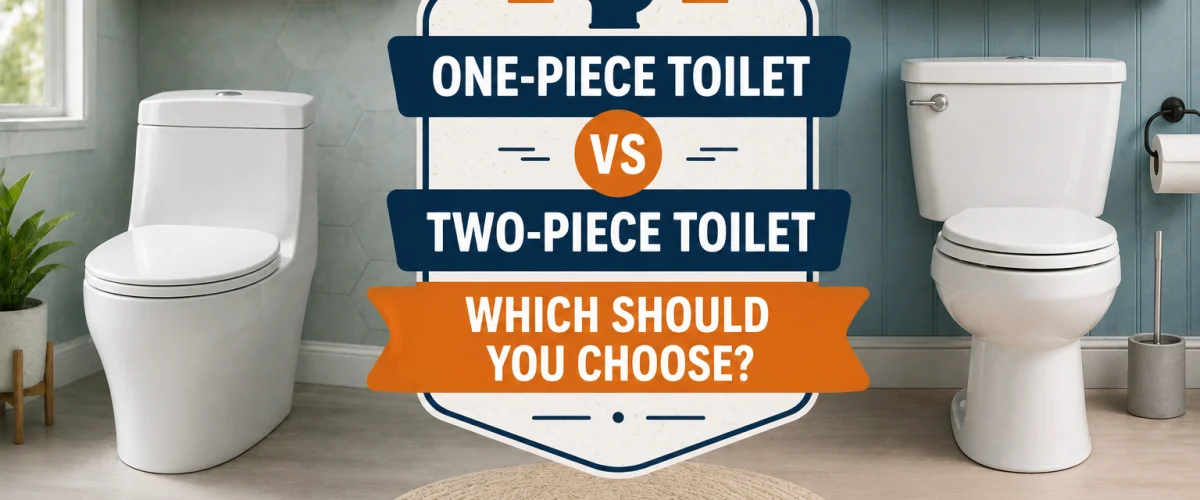
One solid unit or two connected pieces — here's how one-piece and two-piece toilets actually compare on cleaning, installation, and price.
Please note: Information in this comparison is based on our research at time of writing and is general in nature. Always confirm a specific toilet model’s construction type and dimensions before purchasing.
Shop for a new toilet and you’ll quickly run into a choice that has nothing to do with flush power, bowl shape, or water efficiency: one-piece or two-piece. It’s a question of how the toilet is actually built. A one-piece toilet is manufactured as a single fused ceramic unit, tank and bowl cast and fired together with no seam between them. A two-piece toilet is made as two separate components — a tank and a bowl — that are bolted together on-site during installation, the way most toilets in US homes have been built for generations.
This is a construction and design distinction, not a performance one. It shapes how easy the toilet is to clean around, how it gets installed, what it costs, and how it looks in your bathroom — but it says almost nothing about how well it flushes. This guide breaks down exactly what separates one-piece and two-piece toilets, where each one has a genuine advantage, and how to decide which construction style fits your bathroom and your budget.
At a Glance
One-Piece
Two-Piece
✏️ Our Take
The one-piece versus two-piece decision comes down to what you’re prioritizing: two-piece toilets remain the most common choice in US homes because they’re generally more affordable and easier to transport and install, while one-piece toilets appeal to homeowners who want a sleeker look and fewer seams to clean around. Neither style is inherently better at flushing — that comes down to the specific model’s flushing mechanism, not whether it’s one piece or two. If budget and easy replacement matter most, two-piece is the practical default. If a streamlined look and easier cleaning are the priority and the higher price fits your budget, one-piece is worth the upgrade.
IN THIS GUIDE
Here’s how one-piece and two-piece toilets stack up on the factors that actually matter when deciding between them.
| Factor | One-Piece | Two-Piece |
|---|---|---|
| Typical cost | $$–$$$$ | $–$$$ |
| Construction | Tank and bowl fused as a single ceramic unit | Tank and bowl manufactured separately, bolted together on install |
| Seam at tank-bowl connection | None | Yes, requires occasional attention when cleaning |
| Ease of installation | Fewer steps, but heavier as a single unit | Lighter individual pieces, more steps to assemble |
| Tank replaceable independently | No | Yes, in most cases |
| Appearance | Sleeker, lower-profile, modern | Traditional, widest style range |
| How common in US homes | Growing but still a smaller share | The dominant, most widely stocked style |
| Flush technology, bowl shape, water efficiency | Same range as two-piece | Same range as one-piece |
The distinction between one-piece and two-piece toilets is purely about how the fixture is manufactured, not how it performs. A one-piece toilet is cast and fired as a single ceramic unit, with the tank and bowl formed together in the same piece of porcelain before it ever leaves the factory. There’s no seam, no bolts joining the tank to the bowl, and no gasket between them because there’s nothing separate to join in the first place.
A two-piece toilet, by contrast, has its tank manufactured as a separate ceramic component from the bowl. The two pieces ship separately and are joined together during installation, typically with a pair of tank bolts and a rubber or foam gasket sealing the connection between the tank’s outlet and the bowl’s water inlet. This is the traditional manufacturing method, and it’s why two-piece toilets have been the standard in US homes for so long — it’s simply a more straightforward, lower-cost way to produce a toilet.
What this construction difference doesn’t do is dictate anything about how the toilet actually functions. Flush technology — gravity-fed, pressure-assisted, dual flush, or otherwise — is a separate engineering choice that applies equally to both construction styles; our dual flush vs single flush toilet comparison covers that decision on its own. The same is true of bowl shape, whether round or elongated, and water efficiency ratings. You can find nearly any combination of flush type and bowl shape in either a one-piece or a two-piece build, which means the one-piece versus two-piece decision can be made independently of those other factors rather than treated as a package deal.
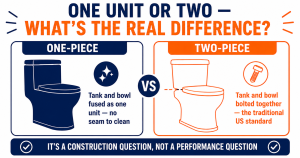
This is where the construction difference has the most day-to-day impact. Because a one-piece toilet has no seam where the tank meets the bowl, there’s no narrow gap in that specific spot for dust, grime, or mildew to accumulate in over time. The back of the toilet is one continuous surface, which makes it a little faster to wipe down during routine cleaning and removes one of the trickier spots to reach with a cloth or brush.
A two-piece toilet has a visible seam at the tank-bowl connection, and that seam does require occasional attention — dust and moisture can settle into the joint if it’s skipped during regular cleaning. It’s a minor extra step rather than a major maintenance burden, but it’s a real, ongoing difference between the two styles that shows up every time you clean the bathroom.
Two-piece toilets do offer one maintenance advantage in return: if the tank or the bowl is ever damaged, cracked, or simply needs replacing, it can often be swapped out independently rather than replacing the entire fixture. A one-piece toilet is a single fused unit, so damage to either half generally means replacing the whole toilet. For a toilet that sees heavy use over many years, that repairability difference is worth weighing alongside the cleaning advantage.
Two-piece toilets ship as two separate, noticeably lighter components. That makes each individual piece easier for one person to carry, maneuver through a doorway, and position in a tight bathroom — a real practical advantage if you’re installing it yourself without help. The tradeoff is a couple of extra installation steps, since the tank still has to be bolted to the bowl and the gasket seated correctly before the toilet is ready to use.
A one-piece toilet is a single, heavier unit from the moment it arrives. There’s no tank-to-bowl assembly step once it’s in position, which simplifies the installation itself, but getting a solid, one-piece ceramic fixture into place in the first place is more physically demanding than moving two lighter components separately. That weight difference matters more in some situations than others — a narrow bathroom doorway, a tight corner, or a flight of stairs can all make a one-piece toilet considerably harder to maneuver alone.
For most straightforward, ground-floor bathroom replacements, either style is manageable for a confident DIYer or a professional installer. The weight and maneuverability difference becomes more relevant specifically when the installation path is tight or awkward, which is worth thinking through before deciding whether to tackle the job solo.
Two-piece toilets are generally the more affordable option, and they remain widely available across every price tier, from budget-friendly builder-grade models to premium two-piece fixtures with higher-end flush technology. That range makes it easy to find a two-piece toilet that fits almost any budget without compromising on core features.
One-piece toilets typically carry a price premium tied to their more complex manufacturing process — casting and firing a single, larger piece of ceramic with tight tolerances is a more demanding production process than manufacturing a tank and bowl separately. That premium has narrowed somewhat in recent years as one-piece models have become more mainstream and more brands have entered that segment, but two-piece toilets still tend to dominate the budget-friendly end of the market.
For most homeowners replacing a toilet on a set budget, two-piece remains the safer bet for stretching that budget further. If a one-piece toilet’s look or cleaning advantage is worth the extra cost to you, the premium is generally smaller today than it was even a few years ago.
One-piece toilets have a lower-profile, more streamlined silhouette that reads as more modern in a bathroom. Without a visible seam or the slightly boxier shape a separate tank can create, a one-piece toilet tends to sit more quietly in a contemporary bathroom design, which is part of why it’s a popular choice in newer builds and remodels aiming for a sleek, minimal look.
Two-piece toilets have a more traditional profile, and because they’re the most common style manufactured, they’re also available in by far the widest range of specific shapes, tank designs, and finishes. If you’re trying to match an existing bathroom’s style, or you simply prefer the classic look of a distinct tank sitting atop the bowl, two-piece gives you far more options to choose from at every price point.
Appearance preference here is genuinely subjective, and it’s worth seeing both styles in person or in detailed product photos before deciding, rather than assuming one is objectively better looking. What reads as sleek and modern to one homeowner can read as plain to another, and the “traditional” two-piece look is exactly what plenty of homeowners want in a classic-style bathroom.
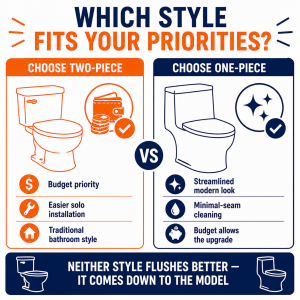
Choose a two-piece toilet if budget is a priority, if you’re installing it yourself and want lighter, easier-to-handle components, or if you want your new toilet to match a traditional bathroom look. It’s also the more practical choice if you’d like the option to replace just the tank or bowl independently down the road rather than the whole fixture.
Choose a one-piece toilet if a streamlined, modern appearance is a priority, if you want one less seam to think about when cleaning, and if the higher price fits comfortably within your budget. It’s a genuinely worthwhile upgrade for homeowners who care about bathroom aesthetics or want to minimize cleaning effort, not a purely cosmetic splurge.
For most standard toilet replacements, two-piece remains the practical default — it’s affordable, widely available, and easy to install or service. One-piece is worth the upgrade specifically when style or low-maintenance cleaning genuinely matter to you and the budget allows for it. If you’re also weighing seat height as part of this replacement, our toilet height comparison covers that separate decision, since construction type and seat height can be mixed and matched independently. And whichever style you land on, be sure to confirm your existing floor drain dimensions first — our how to measure a toilet rough-in guide walks through that step.
If you’re replacing a toilet and want help confirming rough-in measurements or handling the installation itself, search PlumberArchive.com — the US plumber directory with 12,000+ verified local plumbers across all 50 states.
Get weekly plumbing tips, honest tool reviews and DIY guides delivered straight to your Facebook feed.
Not necessarily harder, but different. A one-piece toilet has fewer assembly steps once it’s in position, since there’s no tank to bolt to the bowl, but it’s a single heavier unit that can be more physically demanding to carry and maneuver into place, especially alone in a tight bathroom. A two-piece toilet ships as two lighter, easier-to-carry components, but requires bolting the tank to the bowl and seating a gasket correctly as an extra step. Most confident DIYers can handle either, but a two-piece toilet is generally the easier option for a solo installer.
No. Flush performance comes down to the specific model’s flushing mechanism, bowl engineering, and water efficiency design — not whether the tank and bowl are fused into one piece or bolted together as two. You can find strong and weak flushing models in both construction styles, so flush performance should be evaluated model by model rather than assumed based on one-piece versus two-piece construction.
In most cases, yes. Because the tank and bowl are separate manufactured components on a two-piece toilet, a damaged or outdated tank can often be replaced on its own, provided a compatible replacement tank is available for that specific bowl model. This is one of the practical advantages of two-piece construction. A one-piece toilet doesn’t offer this option, since the tank and bowl are fused into a single unit — damage to either half generally means replacing the entire fixture.
Two-piece toilets remain the most common style in US homes by a wide margin. They’re the traditional manufacturing method, they’re generally less expensive, and they’re stocked more widely by hardware stores and home improvement retailers. One-piece toilets have grown more popular in recent years, particularly in newer construction and remodels aiming for a modern look, but they still represent a smaller share of the overall US market.
One-piece and two-piece toilets aren’t competing on flush performance — they’re built differently, and that construction difference shapes cleaning, installation, price, and appearance rather than how well the toilet actually flushes. Two-piece toilets remain the practical default for most US homeowners thanks to their lower price, lighter individual components, and wide availability. One-piece toilets are a worthwhile upgrade specifically for homeowners who want a sleeker, more modern look and fewer seams to clean around, and who have the budget for the premium. Think about what you’re actually prioritizing — cost and ease, or streamlined style — and the right construction type becomes a straightforward choice.
Prices and ratings may change. Always check Amazon for current prices.
✍️ About This Comparison
PTR Editorial Team — Product Comparisons. We compare manufacturer specifications, installation requirements, compatibility and available product documentation to help homeowners choose suitable tools and parts. How we review →
Pop-up drains seal to hold water; grid drains never close but resist clogs better and cost less. Here's how to choose between them for your bathroom sink.
Test strips, digital meters or send-to-lab testing? Match the method to your situation — screening, ongoing monitoring, or a real health concern.
25-foot vs 50-foot drain snake: compare handling, the cable diameter trade-off and the jobs that justify extra length, plus where 50 feet stops.

