Please note: Information in this guide is based on our research at time of writing and is subject to change. This guide is not a substitute for professional water testing or medical advice — for specific health concerns, consult a doctor, and for radon test results or treatment decisions, consult a certified testing lab, your state radon program, or a qualified water treatment professional.
Introduction
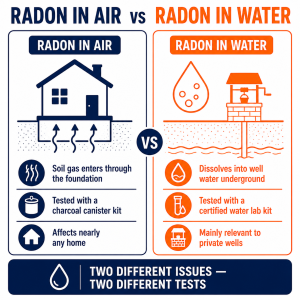
Radon most often comes up as a soil gas — something that seeps through the ground and enters a home through foundation cracks, gaps around pipes, or a sump pit, which is why most homeowners associate radon testing with a charcoal canister in the basement. Radon can also dissolve directly into groundwater, though, and enter a home through the water supply rather than the soil. This is a distinct pathway with its own testing method, and it’s almost exclusively relevant to homes on a private well.
Municipal water systems draw primarily from surface water sources — reservoirs, lakes, and rivers — where radon has ample opportunity to release into open air before it reaches a treatment plant, and municipal supplies are treated and monitored in ways that address this differently than an individual homeowner would need to. Private wells draw directly from groundwater, where radon has had no such opportunity to dissipate, which is why well water is the source where radon actually warrants a homeowner’s attention. This is a different contaminant with a different source and test method than our how to test for lead in your home’s plumbing guide, which covers lead entering water from pipe and fixture materials rather than groundwater — and it’s separate again from our how to test your water for hardness guide, which covers mineral content rather than a health-related contaminant. This guide walks through how radon in water differs from radon in air, who needs to test for it, and the full process from choosing a lab to understanding your results.
At a Glance
| Who This Applies To |
Primarily homes on a private well — not typically a concern for municipal water customers |
| Testing Method |
Certified laboratory water test — distinct from the charcoal canister kits used for household air |
| Where to Test |
Directly at the well or the point where water first enters the home, before any treatment system |
| EPA Guidance |
Informational reference only — always confirm current action levels with a certified lab or your state radon program |
✏️ Our Take
Radon in water is a narrower issue than radon in air, and it’s easy to conflate the two — but if your home is on a private well, it’s worth understanding the difference. Water testing requires a certified lab rather than the DIY charcoal canisters used for household air testing, and the sample has to be collected carefully at the right point in your plumbing to get an accurate result. The good news is that testing itself is straightforward and inexpensive relative to the peace of mind it provides — and if a result does come back elevated, treatment options exist and a water treatment professional can walk you through them.
Radon in Water vs Radon in Air — What’s the Difference
Radon in indoor air typically enters a home through soil gas, seeping up through foundation cracks, gaps around pipes, or a sump pit, driven by the pressure difference between the soil beneath a home and the air inside it. This is the pathway most radon mitigation systems — sub-slab depressurization, sealed sump lids, and similar approaches — are designed to address, and it’s the source behind the vast majority of elevated indoor radon readings nationwide.
Radon in water works differently. Rather than seeping through soil, radon gas dissolves directly into groundwater as that water sits in contact with radon-producing rock underground, particularly in areas with granite, shale, or other bedrock types known for higher natural radon potential. When that water is drawn up through a well and used in the home — running a faucet, taking a shower, running a dishwasher — some of the dissolved radon releases into the surrounding air, similar to how carbonation escapes from a shaken soda can once it’s opened.
This distinction matters for two reasons. First, the two problems require different tests: air testing uses a charcoal canister or electronic monitor placed in the lowest lived-in level of the home, while water testing requires a sample sent to a certified laboratory. Second, they call for different mitigation approaches — air mitigation typically involves a venting system that redirects soil gas before it enters the home, while water mitigation means treating the water itself, most commonly through aeration or activated carbon filtration, covered later in this guide. A home can have an air radon problem, a water radon problem, both, or neither — understanding which applies to your situation is the point of the testing process covered ahead.
Who Actually Needs to Test Their Water for Radon
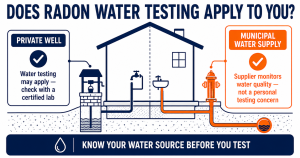
Water testing for radon is primarily relevant to homes served by a private well. Municipal water suppliers generally draw from surface water sources like reservoirs, lakes, and rivers, where radon has substantial opportunity to release into open air well before treatment and distribution — and municipal utilities are already subject to their own water quality monitoring obligations that address contaminants differently than an individual homeowner would need to. If your home receives water from a municipal utility, radon in your water supply is not typically something you need to test for individually.
Private wells are a different situation. Well water is drawn directly from underground aquifers, often in direct contact with the same rock radon originates from, with no equivalent surface exposure step to let dissolved radon dissipate before it reaches your tap. This is why well water testing guidance from the EPA and state radon programs is directed almost entirely at private well owners.
Some homeowners genuinely don’t know which category they fall into, particularly after a recent move, or in a home where the water source was never clearly documented. Confirming your source type is the necessary first step before deciding whether the rest of this guide applies to your situation, covered in Step 1 below.
💡 Tip: If your home is connected to a municipal water supply, radon in water is generally not a personal testing concern — the municipal supplier is responsible for water quality monitoring. This guide is primarily relevant to homes with a private well.
Step 1: Determine If Water Testing Applies to You
Before ordering any test, confirm that water testing is actually relevant to your home. This is a quick step, but skipping it means potentially testing for something that doesn’t apply to your situation.
- Confirm your water source. Check a recent water bill, well permit, or property record. If you pay a monthly water utility bill, you’re very likely on municipal water.
- Check existing well documentation if you’re on a private well. Well completion reports, typically filed with your state or county when the well was drilled, sometimes include testing history that already addresses radon.
- Ask the previous homeowner or check real estate disclosures. A prior radon test — for water or air — may already be on file in your closing paperwork, or available simply by asking.
- Consider your region’s general radon potential as background context. Some geological areas have naturally higher radon potential due to underlying bedrock, and your state’s radon program can offer useful context — though local variation can be significant, so this is context, not a substitute for an actual test.
Step 2: Choose a Certified Water Testing Lab
Once you’ve confirmed water testing applies to your home, the next step is selecting a lab equipped for this specific test. Not every water lab handles radon, and not every radon test handles water — this step is about finding the right combination.
- Look specifically for radon-in-water certification, not just general water quality testing. A lab that tests for bacteria, nitrates, or hardness isn’t necessarily equipped for radon analysis.
- Check your state health department’s list of certified labs. Many state health and radon programs maintain a list of labs certified for radon-in-water testing — typically the most reliable starting point.
- Order a water-specific radon test kit, not an air test kit. The two use different collection containers and lab processes — an air kit will not produce a valid result on a water sample.
- Confirm turnaround time and sample handling requirements before ordering. Some labs require the sample within a specific window after collection, since radon can begin off-gassing immediately.
- Ask about cost upfront. Radon-in-water lab testing is generally inexpensive relative to many other water tests, though pricing varies by lab and region.
⚠️ Warning: Radon-in-water testing requires a different test kit and lab process than the charcoal canister tests sold for household air testing. Using the wrong test type will not give an accurate or valid result — confirm the kit is specifically labeled for water testing before collecting a sample.
Step 3: Collect the Water Sample Correctly
Sample collection matters more here than for many other water tests, since radon can begin escaping from a sample the moment it’s exposed to open air. A carefully collected sample gives an accurate reading; a rushed one can understate the actual level present.
- Sample directly from the well or the point where water first enters the home. Collect before any softener, filtration, or treatment equipment, since those alter radon content and won’t reflect the source.
- Choose an outdoor spigot close to the well, or an indoor tap near where the main line enters the house. Your kit instructions will typically specify a preferred collection point.
- Run the water briefly beforehand only if your kit instructs it. Requirements vary between kits — follow the exact instructions for your specific test.
- Fill the sample container carefully, avoiding excess agitation or splashing. Turbulence introduces air and can cause radon to escape before the container is sealed.
- Seal the container immediately, following the kit’s sealing method. Any gap gives dissolved radon an ongoing chance to off-gas before the lab receives it.
- Ship the sample back promptly, within the window specified by your lab. Radon has a short half-life, and a delayed sample can return an artificially low reading.
Step 4: Understanding Your Results
Your lab report will return a radon concentration, typically expressed in picocuries per liter (pCi/L) — the same unit used for radon in air, though the two scales aren’t directly comparable, covered in the next section.
The EPA has published guidance on suggested action levels for radon in water over the years, though it’s worth treating this as general informational context rather than a single fixed number to measure your result against. Guidance has evolved, varies depending on whether a state also addresses radon in indoor air as part of a combined program, and a certified lab or your state radon program is the authoritative source for the figure that applies to your results today — not a general guide like this one.
Rather than interpreting a number in isolation, the most reliable path is discussing your result directly with the lab that ran your test or your state radon program. Both can explain where your result falls relative to current guidance and what it means for your situation — a more useful conversation than comparing your number against a figure that may be outdated by the time you read it.
US Regional Context: Radon potential varies significantly by region across the US due to underlying geology, with some states maintaining their own radon programs and testing resources beyond general EPA guidance. Homeowners on private wells, particularly in areas with known higher radon potential, can typically find state-specific guidance and certified lab referrals through their state health department’s radon program.
Step 5: What to Do If Radon Levels Are Elevated
An elevated result is not a reason for alarm — it’s a reason to move to treatment. Established methods exist for radon in water, and this is a well-understood problem with well-understood solutions.
Aeration systems are among the most common approaches, introducing air into the water and venting the released radon gas outdoors before the water continues into the home’s plumbing. Granular activated carbon (GAC) filtration is another established option, adsorbing radon onto carbon media as water passes through. Each approach carries different tradeoffs around installation, maintenance, and suitability, depending on your well and water chemistry.
Choosing between these options is a decision to make with a qualified water treatment professional rather than a DIY project. A professional can evaluate your well, water chemistry, and household needs, and recommend a system sized correctly for your situation. If you’re also evaluating broader whole-house treatment for other concerns — sediment, taste, or general water quality — our whole-house water filter reviews cover current options, though standard filtration is not a substitute for a radon-specific aeration or GAC system.
Treating radon in your water may also reduce its contribution to indoor air, since less radon-carrying water moving through your home means less available to release during everyday use — a connection covered next.
How Radon in Water Relates to Radon in Air
If your home has already tested high for radon in indoor air, water is worth checking as a possible contributing factor, particularly on a private well. While soil gas is the dominant source of elevated indoor radon in most homes nationwide, water use — showering, running faucets, dishwashers and washing machines — can release measurable additional radon into indoor air on top of whatever is entering through the foundation.
The two problems can exist entirely independently. A home can have elevated air radon from soil gas with no water issue at all, elevated water radon with normal air readings, both simultaneously, or neither. Testing each separately is the only way to know which situation applies to your home, since one problem doesn’t reliably predict the other.
This is why the distinction covered earlier matters for choosing the right next step. An air mitigation system addresses soil gas, not water-borne radon, and a water treatment system addresses the water supply itself — treating the wrong pathway won’t resolve a problem from the other one. If you suspect both may be contributing, testing both independently gives you the complete picture.
Frequently Asked Questions
Q: Can I test my water for radon myself without a lab?
Radon-in-water testing requires laboratory analysis rather than a DIY color-chart or strip test of the kind used for some other contaminants. Collection is something you do yourself, following your kit’s instructions, but the sample is then sent to a certified lab for analysis — there isn’t a reliable at-home equivalent the way there is for household air with a charcoal canister.
Q: How often should well water be tested for radon?
There’s no universal schedule, but retesting periodically is reasonable for private well owners, particularly after any change to the well itself — a new pump, a repair, or a noticeable change in water characteristics. Your state radon program or certified lab can offer guidance suited to your region and well type, since local geology and construction both factor into how often retesting makes sense.
Q: Does boiling or filtering water reduce radon levels?
Boiling releases dissolved radon into the air rather than eliminating it, simply moving the gas from water to air in your kitchen. Standard water filters, including basic carbon pitcher filters, are generally not designed or certified for radon reduction. Addressing elevated radon requires a system built for that purpose, such as aeration or granular activated carbon filtration installed as a whole-house system, discussed in Step 5 above — not a filter pitcher or boiling.
Q: If my water tests high for radon, does that mean my home’s air will also test high?
Not necessarily. Water use contributes some radon to indoor air, but soil gas entering through the foundation is typically the larger factor, and the two sources don’t move in lockstep. A home can have elevated water radon with a normal air reading, or the reverse. The only way to know your home’s actual indoor air level is to test air separately, using a charcoal canister or electronic monitor, rather than assuming one result predicts the other.
Conclusion
Radon in water is a manageable, well-understood issue with an established path from testing to treatment — not a cause for alarm. If your home is on a private well, confirming your water source, choosing a lab certified for radon-in-water testing, and collecting your sample carefully are the steps that get you an accurate answer. If a result comes back elevated, aeration and activated carbon systems are proven treatment options, and a qualified water treatment professional can help you choose the right one for your well and household. Municipal water customers can generally set this concern aside, since it’s handled through utility-level monitoring.
Prices and ratings may change. Always check Amazon for current prices.
✍️ About This Guide
Written by Mike Reynolds, DIY Home Improvement Writer at PlumbingToolsReview — former residential contractor helping US homeowners tackle plumbing repairs with confidence. Learn how we test →


