Comparisons
2 Oct 2026

Pop-Up Drain vs Grid Drain: Which Should You Choose?
Pop-up drains seal to hold water; grid drains never close but resist clogs better and cost less. Here's how to choose between them for your bathroom sink.
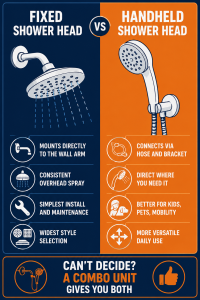
Fixed vs handheld shower head — compare daily use, installation, cleaning and cost to find out which type suits your bathroom and household best.

Please note: Information in this guide is based on our research at time of writing and is subject to change. Always consult a licensed plumber for diagnosis of serious plumbing issues before attempting repairs.
Fixed vs handheld is one of the few shower fixture decisions that actually changes how a shower feels to use every single day — far more than most other bathroom fixture choices, where the difference is mostly cosmetic. Both types deliver water competently, but they solve different problems and suit different households, which is exactly why neither one is universally “better.”
This guide compares fixed and handheld shower heads across the factors that actually matter for a buying decision: daily use, installation, cleaning, and water pressure. The right choice depends on your household’s habits, your bathroom’s layout, and who actually uses the shower. For specific model recommendations once you’ve settled on a type, our guide to the best shower heads covers strong options in both categories, and our guide to installing a shower head walks through the installation process step by step.
✏️ Our Take
Fixed shower heads are the simpler, lower-maintenance choice — they install once, stay in place, and suit anyone who just wants a consistent overhead spray without thinking about it. Handheld shower heads add genuine daily utility that a fixed head can’t match: rinsing pets, bathing young children, cleaning the shower walls, and directing water exactly where it’s needed when mobility matters. The two aren’t mutually exclusive — a combo unit gives you both, with the handheld on a slide bar and a fixed overhead position, which is the most popular choice for a primary bathroom renovation right now.
IN THIS GUIDE
A fixed shower head mounts directly onto the shower arm that extends from the wall, and it stays in that one position for the life of the fixture. There’s no hose, no holder bracket, and no moving the head itself — the entire unit is one solid piece that threads onto the arm and delivers water from a single, permanently set overhead position.
Because the spray pattern and angle are fixed at installation, there’s no adjusting direction mid-shower without physically moving your body under it. That’s a limitation for some use cases, but it’s also exactly why fixed heads are the simpler option overall — fewer moving parts means fewer parts that can wear out, develop leaks, or need occasional attention. A fixed head is essentially install-and-forget. Our guide to the best shower heads covers strong fixed models across a range of spray patterns and finishes.

How a Handheld Shower Head Works
A handheld shower head connects to the shower arm through a flexible hose rather than mounting directly onto it, and it sits in a holder bracket mounted to the wall or the arm itself when not in use. The hose is what makes the type — it’s the component that lets the head be lifted off the bracket entirely and directed anywhere in the shower by hand, rather than being locked into one fixed overhead position.
Most handheld models also include multiple spray settings accessible through a selector dial on the head itself — options like a full massage jet, a gentle rain-style spray, or a concentrated rinse setting, switchable without leaving the shower. That combination of mobility and adjustable spray is the core value proposition of a handheld unit over a fixed one.
A fixed shower head delivers a consistent overhead experience with no decisions to make once the water’s on — step under it, and it just works. That simplicity is exactly what suits a quick daily shower routine, where nobody wants to think about aiming a hose or picking a spray setting before their morning coffee.
A handheld shower head earns its keep in the situations a fixed head simply can’t handle well: rinsing shampoo out precisely without getting it in your eyes, bathing young children who need water directed carefully rather than dumped from overhead, rinsing a dog in the tub, and cleaning the shower enclosure itself without having to awkwardly maneuver a bucket or sponge under a fixed spray. For users with limited mobility, being able to sit and direct water exactly where it’s needed is a functional advantage a fixed head cannot replicate. If your shower head is leaking rather than simply due for an upgrade, our guide to fix a leaking shower head covers diagnosis and repair before you consider a full replacement.
Installing a fixed shower head is about as simple as bathroom fixture work gets: remove the old head, wrap the shower arm threads with two to three layers of PTFE tape, and screw on the new head hand-tight plus a quarter turn. Most people complete this in about 5 minutes with nothing more than an adjustable wrench on hand for backup.
A handheld installation starts with the same thread connection at the shower arm, but adds one extra step: mounting the holder bracket to the wall or clamping it onto the shower arm itself, depending on the model. Wall-mounted brackets typically use adhesive mounting or small screws, while arm-clamp brackets need no drilling at all. Either way, neither installation type requires turning off the main water supply to the house — just the shower valve itself while you’re working. Our step-by-step guide to installing a shower head covers the full process for both types in detail.
A fixed shower head is the lower-maintenance option here too — there’s just one unit to descale and wipe down periodically, and no hose or bracket hardware to account for. A vinegar soak every few months keeps the nozzles clear, and that’s essentially the entire maintenance routine.
A handheld unit has more surface area to think about. The hose itself, and the folds or coils it naturally sits in when hung on the bracket, create additional areas where mineral deposits and residual moisture can accumulate compared to a single solid fixed unit. It’s not a significant burden, but it is genuinely more maintenance than a fixed head requires, and it’s worth factoring in if low-maintenance is a priority for your household.
Flow rate — measured in gallons per minute (GPM) — is determined by the specific shower head model you buy, not by whether it’s fixed or handheld as a category. Both types are manufactured across the same GPM range, so assuming one category is inherently more powerful than the other is a mistake that leads people to compare the wrong thing when shopping.
The one real physical difference is hose length on handheld models: a very long hose introduces a small amount of friction loss along its length, which can produce a slightly reduced pressure at the head compared to the same water pressure delivered through a short, direct fixed connection. In practice this difference is minor for standard hose lengths and only becomes noticeable with unusually long hoses combined with already-marginal household water pressure.
In states with water restriction ordinances — California, Arizona, Colorado and parts of the Southwest — both fixed and handheld shower heads sold after 2018 must meet strict federal and state flow rate limits. Handheld models in these regions increasingly come with a pause button that lets users temporarily stop flow while lathering, which adds a practical water-saving function neither type had as standard a decade ago.
A combo unit sidesteps the fixed-vs-handheld decision entirely by including both: a fixed overhead head and a handheld unit on the same fitting, typically with the handheld resting in a holder mounted along a slide bar so its height can be adjusted independently of the fixed head above it.
This is the most popular configuration for a primary bathroom renovation right now, since it gives every household member both positions without anyone having to compromise — quick daily showers under the fixed head, full flexibility with the handheld whenever it’s needed. A combo unit typically connects to the existing shower arm through a built-in diverter valve that routes water to one head or the other, or in some models, both simultaneously. If you’re switching from a single fixed head to a combo setup, our guide to replacing a shower valve or diverter covers installing that diverter valve as part of the swap.
The table below matches common priorities to the type that wins on that specific factor:
| Priority | Best Choice |
|---|---|
| Quick daily showers only | Fixed |
| Bathing young children or pets | Handheld |
| Accessibility or mobility needs | Handheld |
| Widest style and finish selection | Fixed |
| Easiest cleaning routine | Fixed |
| Most versatile overall | Handheld |
| Want both without compromising | Combo |
Choose Fixed if:
Choose Handheld if:
Choose Combo if:
If you’re planning a combo unit installation, dealing with unusual rough-in plumbing, or running into anything beyond a straightforward swap, a licensed plumber is the right call. Getting a professional involved before a small upgrade becomes a bigger repair is always the lower-cost outcome.
Find a licensed plumber in your area at PlumberArchive.com — the US plumber directory with 12,000+ verified local plumbers across all 50 states.
Get weekly plumbing tips, honest tool reviews and DIY maintenance guides delivered straight to your Facebook feed. We cover bathroom upgrades, fixture comparisons, drain maintenance and everything in between — written for US homeowners who want to handle more themselves.
Yes, this is a straightforward DIY swap for most homeowners. Remove the fixed head from the shower arm, wrap the arm threads with fresh PTFE tape, and connect the handheld’s hose fitting in its place. Then mount the holder bracket — either a wall-mounted bracket secured with adhesive or screws, or a clamp-style bracket that attaches directly to the shower arm with no drilling required. No plumbing knowledge beyond basic hand tools is needed, and the whole job typically takes 15 to 20 minutes.
Not inherently. Flow rate and pressure are determined by the specific model’s GPM rating, not by whether it’s fixed or handheld as a category — both types span the same range. The one real factor is hose length on a handheld: an unusually long hose introduces a small amount of friction loss that can slightly reduce pressure at the head. For standard hose lengths, this difference is negligible. Compare GPM ratings between the specific models you’re considering rather than assuming either category performs better.
A combo shower head is a single fitting that includes both a fixed overhead head and a handheld unit on a slide bar, connected through a built-in diverter valve that routes water to one, the other, or sometimes both at once. It’s the most popular setup for a primary bathroom renovation because it eliminates the need to choose — every household member gets the option that suits them without compromising on either type.
Handheld is the clear choice for mobility needs. Being able to sit on a shower seat or bench and direct the spray exactly where it’s needed — rather than having to stand and position your body under a fixed overhead stream — is a functional accessibility feature, not just a convenience. Mounting the handheld on an adjustable slide bar lets the height be set to match a seated or standing user, and the on/off pause button found on many models adds further control for anyone who needs to stop and rest mid-shower.
Fixed shower heads suit simple daily use and make matching existing bathroom hardware aesthetics easy — they’re the lowest-maintenance option with the widest style selection. Handheld shower heads win on versatility, accessibility, and the everyday tasks a fixed head can’t handle well: bathing kids and pets, cleaning the shower, and directing water precisely for anyone with mobility needs.
If you can’t decide between the two, a combo unit gives you both without compromise, and it’s increasingly the default choice for a primary bathroom renovation for exactly that reason. Whichever type you land on, our guide to the best shower heads covers strong options across both categories, our guide to installing a shower head walks through the installation steps in detail, and if your current fixture is already dripping rather than simply due for an upgrade, our guide to fix a leaking shower head covers diagnosis and repair first.
✍️ About This Comparison
PTR Editorial Team — Product Comparisons. We compare manufacturer specifications, installation requirements, compatibility and available product documentation to help homeowners choose suitable tools and parts. How we review →
Pop-up drains seal to hold water; grid drains never close but resist clogs better and cost less. Here's how to choose between them for your bathroom sink.
Test strips, digital meters or send-to-lab testing? Match the method to your situation — screening, ongoing monitoring, or a real health concern.
25-foot vs 50-foot drain snake: compare handling, the cable diameter trade-off and the jobs that justify extra length, plus where 50 feet stops.

