Comparisons
2 Oct 2026

Pop-Up Drain vs Grid Drain: Which Should You Choose?
Pop-up drains seal to hold water; grid drains never close but resist clogs better and cost less. Here's how to choose between them for your bathroom sink.
One sits on a dish and lasts for weeks, the other pumps out a controlled amount every time — here's how bar soap and liquid soap dispensers actually compare for a bathroom.

Please note: Information in this comparison is based on our research at time of writing and is general in nature. Always check specific product packaging and manufacturer claims before purchasing.
Bar soap versus liquid soap is a decision most households make without much thought, often just sticking with whatever they grew up using. But it’s worth a genuine second look, because this isn’t really the hygiene-purity question people sometimes make it out to be — both forms clean effectively when used normally, and the actual differences that matter come down to far more practical territory: mess, cost per use, container waste, and plain personal preference.
This comparison steps back from any specific dispenser or product and looks at the underlying choice itself — bar soap sitting on a dish versus liquid soap pumped from a dispenser — since that decision shapes everyday convenience more than which particular brand or bottle you end up buying. If you’ve already decided on liquid soap and want to compare dispenser mechanisms, our soap dispenser reviews cover manual pump, touchless, and deck-mounted options — a different question from the one this article addresses, since that roundup assumes liquid soap and compares dispenser types, while this comparison looks at the soap form itself.
At a Glance
Bar Soap
Liquid Soap in a Dispenser
✏️ Our Take
Liquid soap in a dispenser is the more convenient everyday choice for most bathrooms — it’s mess-free, requires no dish to clean, and portions out a consistent amount with each pump. Bar soap remains a genuinely practical option too, particularly for anyone prioritizing lower cost per use or minimal packaging waste, and a well-drained soap dish largely solves the mushiness complaint people associate with it. The hygiene gap between the two is smaller than commonly assumed — both are effective when used normally. This really comes down to which tradeoffs matter more to your household: a slightly higher cost and more packaging for liquid soap’s convenience, or a small amount of dish maintenance for bar soap’s lower cost and waste.
IN THIS GUIDE
Here’s how bar soap and liquid soap stack up on the factors that actually matter for a bathroom.
| Factor | Bar Soap | Liquid Soap |
|---|---|---|
| Mess and portioning | Can leave residue on a dish without good drainage | Controlled, mess-free pump each time |
| Typical cost per use | Generally lower | Generally higher |
| Extra hardware needed | A dish or holder | A dispenser or pump bottle |
| Shared-bathroom hygiene | Bar is physically shared between users | No shared physical contact |
| Typical packaging | Minimal to none with many brands | Plastic bottle or dispenser, refillable in some cases |
| Ongoing maintenance | Occasional dish cleaning | Occasional refilling; none for the dispenser itself |
| Best suited for | Lower cost, minimal packaging, personal preference | Shared bathrooms, mess-free convenience |
Liquid soap in a dispenser offers controlled, consistent portioning with a simple pump — press once, get roughly the same amount every time, with nothing left behind on the counter or sink afterward. There’s no separate holder required beyond the dispenser or bottle itself, and no residue to manage between uses. For a lot of households, this simplicity is the single biggest reason liquid soap wins out as the everyday default.
Bar soap works differently, and it requires a dish or holder to sit on between uses. Without good drainage, a bar can develop a soft, slightly sticky residue that clings to the dish and the countertop underneath it — the exact complaint that drives a lot of people toward liquid soap in the first place. That said, this is a solvable problem rather than an inherent flaw in bar soap itself. Many users find bar soap genuinely simple and low-maintenance once a well-draining dish is actually in place, since the mushiness issue is really about drainage rather than something wrong with the soap.
There’s also a usage-pattern difference worth noting: liquid soap dispenses a fixed amount whether you need a little or a lot, while a bar of soap naturally scales to how much lather you actually work up by hand. Neither is clearly better here — it’s simply a different interaction, and which one feels more convenient is largely a matter of habit and preference rather than one being objectively easier to use.
Bar soap is generally less expensive per use than liquid soap. Liquid formulas typically cost more per ounce to manufacture and package, and each pump from a dispenser dispenses a controlled but sometimes generous amount — often more product per handwash than the equivalent amount of lather worked up from a bar. A single bar, by contrast, tends to stretch across a comparable number of uses at a noticeably lower per-wash cost in most everyday comparisons.
Over months of regular use in an active household — multiple people washing hands and showering daily — this cost difference can add up to a meaningful amount over the course of a year, even though the gap on any single purchase looks small. A household replacing bar soap every few weeks is typically spending less over that same stretch than one refilling a liquid dispenser at a comparable frequency, though the exact numbers depend heavily on which specific products are being compared.
That said, this gap varies significantly by brand and formula on both sides. A premium bar soap can cost more per use than a budget liquid soap, and bulk or concentrate refills for liquid soap can narrow the price gap considerably compared to buying a new full bottle every time. Treat “bar soap is cheaper” as a general tendency rather than a fixed rule, and check unit pricing on the specific products you’re actually considering before assuming the cost difference will play out a particular way for your household.
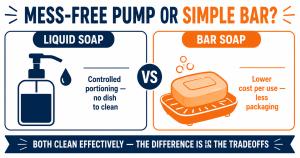
The common concern about bar soap harboring more bacteria than liquid soap has been studied, and the practical hygiene difference for normal household use turns out to be smaller than commonly believed. Soap’s actual cleansing action — the mechanism that lifts dirt, oils, and germs off skin during handwashing — works similarly regardless of whether the soap is in bar or liquid form. The physical act of washing, including adequate time and friction, does far more for hygiene outcomes than which soap format is sitting by the sink.
Where liquid soap does have a slight edge is in shared or high-traffic bathrooms, simply because there’s no shared physical bar being handled by multiple people in sequence. A bar of soap picks up contact from every person who uses it between rinses, while a liquid dispenser delivers each person a fresh, un-touched portion with every pump. This is a real, if modest, difference — not a reason to avoid bar soap outright, but a genuine consideration specifically for bathrooms with a lot of different users passing through.
It’s also worth noting that bar soap in a single-person or family bathroom, where the same small group of people uses it repeatedly, doesn’t carry the same consideration that a shared or public-facing bathroom does. Context matters more here than the soap form itself.
Many bar soaps use minimal or entirely plastic-free packaging — a simple paper wrapper or box rather than a plastic bottle — which genuinely appeals to households actively trying to reduce plastic waste in the bathroom. This isn’t universal across every bar soap brand, but it’s a common and easy-to-find option compared to liquid soap’s packaging norms.
Liquid soap typically comes in a plastic bottle or dedicated dispenser, and each replacement bottle adds to that footprint over time in a way a wrapped bar simply doesn’t. Refill options — concentrate pouches or bulk refill stations, where available — can meaningfully reduce this impact if used consistently, since they cut down on the amount of new plastic packaging purchased with each refill. The benefit only holds, though, if a household actually follows through and buys the refill rather than a new full bottle each time out of convenience, which in practice doesn’t always happen.
Neither option is perfectly free of environmental tradeoffs — bar soap production and liquid soap manufacturing both carry their own resource and ingredient considerations beyond just the packaging question. But on the specific matter of end-of-life plastic waste sitting in a bathroom trash can or recycling bin, bar soap generally has the lighter footprint of the two, particularly with brands that skip plastic wrapping entirely.
Choose liquid soap in a dispenser for most shared or high-traffic bathrooms, households prioritizing mess-free convenience above all else, or anyone who simply prefers the pump experience over handling a bar. If you’re setting up a dispenser for the first time, our deck-mounted soap dispenser installation guide covers mounting one through a sink or counter hole for a clean, built-in look.
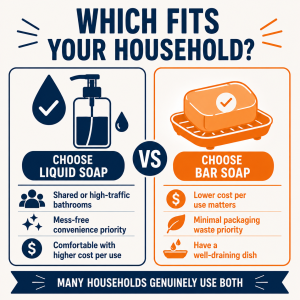
Choose bar soap for lower cost per use, reduced packaging waste, or simple personal preference — especially when paired with a well-draining dish, which resolves most of the practical complaints people have about it. Bar soap is also a perfectly reasonable choice for a single-person or family bathroom without a specific shared-hygiene concern driving the decision.
Many households genuinely use both rather than picking one exclusively — keeping liquid soap at a shared main sink where multiple people wash hands throughout the day, and bar soap in a shower or a guest bathroom that sees lighter, more occasional use. There’s no rule requiring a single household-wide choice, and splitting the decision by location often captures the best of both. If you’re refreshing other small bathroom accessories at the same time, our toilet paper holder installation guide covers another quick, low-cost bathroom update worth tackling in the same trip to the hardware store.
Soap choice isn’t a plumbing decision, but if you’re installing a new dispenser and run into a stuck fitting, an unexpected leak, or a countertop that needs professional drilling, search PlumberArchive.com — the US plumber directory with 12,000+ verified local plumbers across all 50 states.
Get weekly plumbing tips, honest tool reviews and DIY guides delivered straight to your Facebook feed.
Not meaningfully, for most normal household use. The practical hygiene difference between bar and liquid soap is smaller than commonly assumed, since soap’s actual cleansing action works similarly in both forms — proper handwashing technique matters far more than which soap format you use. The one setting where liquid soap has a genuine, if modest, edge is a shared or high-traffic bathroom, where a bar of soap gets handled by multiple different people between rinses and a liquid dispenser delivers each person an untouched portion instead.
Use a dish or holder with proper drainage — raised ridges, a slotted design, or a similar feature that keeps the bar from sitting in standing water between uses. Most of the softening and residue people associate with bar soap comes down to poor drainage rather than a flaw in the soap itself. Letting the bar air-dry fully between uses, rather than leaving it in a puddle on a flat dish, makes a substantial difference in how long it holds its shape and firmness.
Bar soap generally has a lighter packaging footprint, since many brands use minimal or entirely plastic-free wrapping compared to liquid soap’s typical plastic bottle or dispenser packaging. Liquid soap can narrow this gap with refill pouches or bulk refill options, but only if a household actually uses them consistently rather than buying a new full bottle each time. Neither option is entirely free of environmental tradeoffs once you account for manufacturing and ingredients beyond packaging alone, but on the specific question of plastic waste, bar soap tends to come out ahead.
Absolutely, and many households already do. A common approach is keeping liquid soap at a shared main sink where multiple people wash hands throughout the day, while using bar soap in the shower or in a guest bathroom that sees lighter use. There’s no requirement to pick one form exclusively for the entire household — splitting the decision by location or by which bathroom sees the most traffic often works better than forcing a single choice everywhere.
Bar soap and liquid soap both clean effectively, and the choice between them comes down to which practical tradeoffs matter most to your household rather than any real hygiene gap. Liquid soap in a dispenser wins on mess-free convenience and is the stronger choice for shared or high-traffic bathrooms, while bar soap wins on cost per use and packaging waste, with a well-draining dish solving most of its common downsides. Plenty of households split the difference by location rather than choosing one form for the entire home — and either way, the decision is a genuinely low-stakes one you can revisit anytime without much cost or hassle.
Prices and ratings may change. Always check Amazon for current prices.
✍️ About This Comparison
PTR Editorial Team — Product Comparisons. We compare manufacturer specifications, installation requirements, compatibility and available product documentation to help homeowners choose suitable tools and parts. How we review →
Pop-up drains seal to hold water; grid drains never close but resist clogs better and cost less. Here's how to choose between them for your bathroom sink.
Test strips, digital meters or send-to-lab testing? Match the method to your situation — screening, ongoing monitoring, or a real health concern.
25-foot vs 50-foot drain snake: compare handling, the cable diameter trade-off and the jobs that justify extra length, plus where 50 feet stops.

