Comparisons
2 Oct 2026

Pop-Up Drain vs Grid Drain: Which Should You Choose?
Pop-up drains seal to hold water; grid drains never close but resist clogs better and cost less. Here's how to choose between them for your bathroom sink.
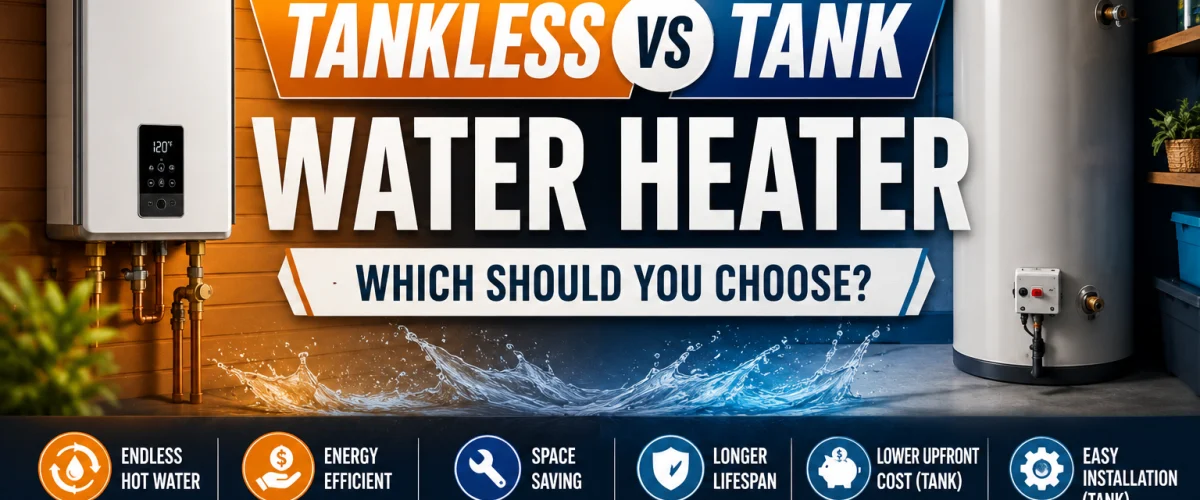
Tankless vs tank water heater — which should you choose in 2026? We compare upfront cost, energy efficiency, hot water supply, lifespan, and installation requirements to help you make the right decision for your home.
Please note: Cost estimates and product information in this guide are based on our research at time of writing and are subject to change. Always consult a licensed plumber for installation advice specific to your home.
Replacing a water heater is one of the biggest home improvement decisions a homeowner faces — and choosing between a tankless and a tank water heater is the first question that comes up. Both systems reliably deliver hot water, but they work in entirely different ways and suit different households, budgets, and long-term goals.
If your old unit has failed or you’re planning a renovation, now is the perfect time to evaluate whether upgrading to tankless makes sense — or whether sticking with a traditional tank system is the smarter choice for your situation. This guide covers cost, energy efficiency, hot water supply, lifespan, and installation requirements so you can make the right call for your home.
If you’ve already decided to go tankless, see our guide to the best tankless water heaters for our top picks across every budget. And if you’re experiencing low pressure at your fixtures, check our guide on how to increase water pressure — that’s a separate issue neither system will automatically fix.
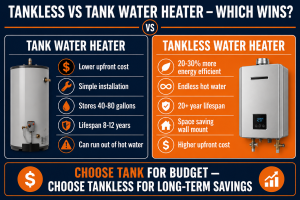
A traditional tank water heater maintains a large reservoir of hot water — typically 40 to 80 gallons — at a set temperature around the clock. Cold water enters at the bottom of the tank, is heated by a gas burner or electric element, and sits ready at the top waiting to be used. Turn on a hot tap anywhere in your home and hot water flows immediately — no wait, as long as the tank hasn’t been depleted.
The trade-off is that the tank is constantly heating water whether you need it or not. This continuous heating creates what’s known as standby energy loss — heat that escapes through the tank walls into the surrounding air, forcing the heater to fire up again to maintain temperature throughout the day and night.
A tankless water heater (also called an on-demand or instantaneous water heater) stores no water at all. Instead, it heats water in real time as it passes through a heat exchanger inside the unit when you open a hot water tap. The moment you close the tap, the unit shuts off completely — using no energy until the next demand.
Tankless units are significantly smaller than tank heaters and are typically wall-mounted. They deliver a continuous stream of hot water that never runs out — but their output rate is limited by their flow capacity, measured in gallons per minute (GPM).
A standard tank water heater typically costs between $300 and $600 for a mid-range gas or electric model. Higher-capacity units or high-efficiency models cost more, but for most households a mid-range tank heater covers everyday needs comfortably.
A tankless water heater carries a significantly higher upfront cost — typically $800 to $2,000 or more for a whole-home unit. Whole-home gas tankless units tend to cost more than electric models, though gas typically delivers higher flow rates for larger households.
Installing a tank water heater is a straightforward swap in most homes and typically costs between $150 and $300 for labor. Most licensed plumbers can complete the job in a couple of hours, and upgrades to your existing gas line or electrical panel are rarely needed.
Installing a tankless water heater is more complex and typically costs between $500 and $1,500 for labor. Gas tankless units often require a larger-diameter gas supply line to handle the higher BTU demand — adding both cost and time. Electric tankless units may require an electrical panel upgrade to handle the significant amperage draw.
Over the life of the unit, operating costs are where the two systems diverge most clearly. Tank heaters carry higher monthly energy bills due to standby heat loss. Tankless heaters operate 20–30% more efficiently for most households, delivering meaningful savings on utility bills over time — though those savings take years to offset the higher upfront cost.
A tank water heater keeps 40–80 gallons of water hot 24 hours a day, seven days a week — regardless of whether you’re using it. Heat naturally escapes through the tank walls into the surrounding air, a process called standby heat loss. The heater must then fire up repeatedly throughout the day and night to reheat the water and maintain temperature. Even well-insulated modern tank heaters experience this continuous energy drain.
A tankless unit heats water only when a tap is opened — and shuts off completely when it’s closed. There is no standby heat loss because there is no stored water to keep warm. According to the US Department of Energy, Energy Star-certified tankless water heaters can be up to 34% more energy efficient than tank heaters in homes that use under 41 gallons of hot water per day.
For households with higher hot water use, the efficiency advantage narrows somewhat, but tankless remains more efficient in virtually all residential scenarios when correctly sized for the household’s demand.
A tank heater delivers hot water immediately and reliably — up to the capacity of the tank. For a typical 50-gallon tank, there’s plenty of hot water for a shower, a dishwasher cycle, and some laundry running in sequence. But if multiple people shower back-to-back while the dishwasher and washing machine are also running, you can deplete the tank — leaving the last user with cold water and a wait of 20–40 minutes for the tank to reheat.
A tankless unit can never run out of hot water in the traditional sense — it heats water continuously on demand, so there’s no tank to deplete. You can shower for an hour and the water will still be hot. This is one of the most compelling advantages for larger families or households with high simultaneous demand.
The limitation of tankless is flow rate, not supply. A single whole-home tankless unit has a maximum GPM rating — typically 7–11 GPM for a gas unit. If simultaneous demand exceeds that rate (two showers plus a dishwasher and washing machine all running together), water temperature may drop. Correct sizing is critical.
A well-maintained tank water heater typically lasts 8–12 years. The main failure mode is corrosion — the anode rod inside the tank sacrifices itself to prevent rust, and once it’s depleted, the tank itself begins to corrode. Annual inspection and replacement of the anode rod every few years significantly extends tank life. Sediment builds up at the bottom over time too, reducing efficiency and accelerating corrosion; an annual flush helps prevent this.
A properly maintained tankless water heater can last 20 years or more — nearly twice the lifespan of a tank unit. There’s no tank to corrode, and the heat exchanger is built to withstand decades of use. Most manufacturers offer longer warranties on tankless units as a result.
In hard water areas, mineral scale can build up inside the heat exchanger over time, reducing efficiency and eventually causing failure. Annual descaling — flushing the heat exchanger with a descaling solution — keeps a tankless unit running cleanly. In areas with soft water, maintenance demands are minimal.
Installing a tank water heater is generally a straightforward like-for-like swap in most homes. Your existing gas line, flue venting, and electrical connections are typically already sized appropriately for a standard tank unit. A licensed plumber can usually complete the job in 2–3 hours. Permits may be required depending on your state or municipality, but the process is routine and well understood.
Gas tankless water heaters fire at full burner capacity every time hot water is needed — a significantly higher BTU demand than tank heaters. This often means your existing gas supply line needs to be upgraded to a larger-diameter pipe capable of carrying the higher gas volume. In some homes, this adds several hundred dollars to installation and requires a permit and inspection.
Venting also differs. Most tankless gas units use a direct vent (sealed combustion) system with separate intake and exhaust pipes run through an exterior wall, rather than the vertical flue used by traditional tank heaters — adding installation complexity.
Whole-home electric tankless water heaters draw significant current — often 120–150 amps — to heat water on demand. Many older homes have electrical panels rated at 100–200 amps total, meaning a whole-home electric tankless unit could require a panel upgrade to accommodate the load. A qualified electrician should assess your panel capacity before any purchase decision is made.
| Category | Tank Heater | Tankless Heater |
|---|---|---|
| Upfront Cost | ✓ $300–$600 typical | $800–$2,000+ |
| Installation Cost | ✓ $150–$300 typical | $500–$1,500 |
| Monthly Energy Cost | Higher (standby loss) | ✓ 20–30% lower bills |
| Hot Water Supply | Limited by tank size | ✓ Endless on demand |
| Lifespan | 8–12 years | ✓ 20+ years |
| Space Required | Large floor footprint | ✓ Compact, wall-mounted |
| Best For | Budget-first buyers, simple replacements | Long-term savers, large families |
Ready to go tankless? See our guide to the best tankless water heaters for our top picks across every budget and household size.
Water heater installation — especially tankless — should always be handled by a licensed plumber or HVAC technician. If you need a qualified professional in your area, search PlumberArchive.com — the US plumber directory with 12,151+ verified plumbers across all 50 states.
Find a trusted plumber near you →
Looking for our top recommended tools in one place? Browse our curated Amazon Storefront →
Get weekly plumbing tips, honest tool reviews and DIY guides delivered to your Facebook feed.
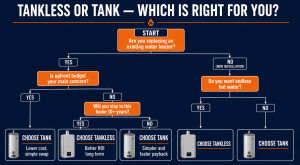
For most households that plan to stay in their home for 8 years or more, yes — a tankless water heater is worth the extra upfront investment. The 20–30% energy savings compound year over year, and the 20+ year lifespan means you’ll likely only purchase one tankless unit versus two or more tank replacements over the same period. If you’re in a short-term rental, flipping a property, or on a tight budget, a tank heater remains the more practical choice.
In most cases yes, but it typically requires additional work beyond a simple swap. A licensed plumber will assess whether your gas supply line has sufficient capacity (gas tankless units require significantly more BTUs than tank heaters), and an electrician should check your panel if you’re considering an electric tankless unit. Venting will also need to be reconfigured, as tankless gas units use a different exhaust system than traditional tank heaters. Budget for installation costs well above a standard tank replacement.
A well-maintained tankless water heater typically lasts 20 years or more — roughly twice the lifespan of a traditional tank unit. Annual descaling is important in hard water areas, where mineral buildup inside the heat exchanger is the primary cause of premature failure. Most reputable manufacturers offer 10–15 year warranties on heat exchangers, reflecting the long-term durability of the technology when properly maintained.
A family of four typically needs a whole-home tankless unit rated at 8–10 GPM (gallons per minute) to comfortably handle simultaneous demand — for example, two showers running at the same time as a dishwasher or washing machine. If you live in a colder-climate state where incoming groundwater temperatures are lower, look for a unit at the higher end of that range, as colder inlet water requires more energy to heat to your desired output temperature. A licensed plumber can size the unit correctly for your household and local conditions.
Both tank and tankless water heaters are proven, reliable choices — the right one depends entirely on your household’s needs, budget, and long-term plans.
If tankless is the right fit for your home, see our guide to the best tankless water heaters for our tested picks across every budget and household size. For any water pressure concerns after installation, check our guide on how to increase water pressure. Still weighing options? Our electric vs gas water heater and heat pump vs gas water heater comparisons cover the other major forks in the decision.
✍️ About This Review
PTR Editorial Team — Product Comparisons. We compare manufacturer specifications, installation requirements, compatibility and available product documentation to help homeowners choose suitable tools and parts. How we review →
Pop-up drains seal to hold water; grid drains never close but resist clogs better and cost less. Here's how to choose between them for your bathroom sink.
Test strips, digital meters or send-to-lab testing? Match the method to your situation — screening, ongoing monitoring, or a real health concern.
25-foot vs 50-foot drain snake: compare handling, the cable diameter trade-off and the jobs that justify extra length, plus where 50 feet stops.

