Please note: Product availability, pricing and tax credit terms are based on our research at time of writing and are subject to change. Always confirm current incentive eligibility and specifications before purchasing.
Introduction
Heat pump water heaters have moved from a niche, expensive novelty to a genuinely mainstream option since federal incentives made them financially competitive with conventional gas units. If you’re replacing a water heater in 2026, the choice between a heat pump model and a gas tank unit is no longer just about upfront cost — it now involves federal tax credits, state rebates, local electricity and gas rates, and the physical space you have available for installation.
This comparison covers every practical factor a US homeowner needs to weigh when making this decision, from how each technology actually works through to climate suitability and long-term running costs. This is a different comparison from our broader electric vs gas water heater guide, which covers conventional electric resistance units rather than heat pump technology, and our tankless vs tank water heater guide, which compares tank format rather than heating method. If you’re choosing between all these options, read this guide first — it addresses the specific financial and climate trade-offs driving the modern heat pump decision.
✏️ Our Take
A heat pump water heater uses the same technology as a refrigerator in reverse — it moves heat from the surrounding air into the water rather than generating heat directly, which makes it 2–3 times more energy efficient than a conventional electric or gas unit. The trade-off is that it needs adequate space and air volume to work efficiently, costs significantly more upfront, and performs less effectively in cold climates or unheated spaces. A gas water heater heats water faster, costs less upfront, and works in any climate — but ongoing gas costs and the absence of federal energy efficiency incentives make the long-term math less favourable than it once was.
How a Heat Pump Water Heater Works
A heat pump water heater extracts heat from the surrounding air using a refrigerant cycle and transfers that heat into the water sitting in the tank, rather than generating heat directly through a burner or resistance element. This is the same basic principle a refrigerator uses, just running in reverse — instead of pulling heat out of a box to keep food cold, the unit pulls heat out of the surrounding room and concentrates it into the water. Because the unit is moving existing heat rather than creating it from scratch, it uses considerably less energy to deliver the same amount of hot water.
These units run on electricity, but they use 2–3 times less energy than a conventional electric resistance water heater to heat the same volume of water — which is the core efficiency argument in favor of heat pump technology. For a more detailed look at how heat pump units stack up against standard electric resistance models specifically, see our electric vs gas water heater comparison. Heat pump water heaters are often called hybrid water heaters, and most models include an electric resistance backup element that kicks in during high-demand periods when the heat pump alone can’t keep up with hot water draw.
💡 Tip: Heat pump water heaters actually cool and dehumidify the air around them as a byproduct of operation — a useful bonus in a warm basement or utility room in summer, but a drawback in an already cold space in winter.
How a Gas Water Heater Works
A gas water heater burns natural gas or propane to heat water directly via a burner positioned beneath the tank. The flame heats the bottom of the tank and a flue running through the center carries combustion gases up and out of the home, transferring additional heat to the water along the way. This is a direct-heat process — there’s no intermediate step of moving heat from one medium to another, which is part of why gas units reheat water so quickly.
That direct combustion gives gas water heaters a fast recovery rate — they reheat a full tank significantly faster than electric resistance or heat pump units, which matters for households with high simultaneous hot water demand. The trade-off is that gas units require a gas supply line and flue venting to operate safely, and that infrastructure isn’t available everywhere. A home without existing gas service represents a meaningful additional cost and complexity if gas is the desired option.
💡 Tip: Gas water heaters require adequate ventilation for combustion gases — a dedicated flue or direct vent to the exterior is mandatory. Homes without an existing gas line or flue would need significant additional work to install gas.
Energy Efficiency and Running Costs
Heat pump water heaters are 2–3 times more efficient than gas units in terms of energy input versus hot water output, with a typical uniform energy factor (UEF) rating in the 3.0–4.0 range. Gas tank water heaters have a much lower efficiency rating by comparison, typically UEF 0.6–0.7, because a meaningful portion of the combustion heat is lost up the flue rather than transferred to the water. On paper, the heat pump’s efficiency advantage looks decisive.
In practice, the net running cost depends entirely on local electricity versus gas rates in your area — this is not a universal winner in every US region. Gas is generally cheaper per BTU than electricity across most of the country, which narrows or even reverses the efficiency advantage depending on your specific utility rates. Watching for early signs of inefficiency matters regardless of which technology you choose — see our guide to signs your water heater is failing for what to look out for as any unit ages.
💡 Tip: Check your local utility rates before making this comparison — in some US regions electricity is cheap enough that a heat pump unit’s efficiency advantage translates directly to lower bills; in others, cheap gas still wins on running cost despite the efficiency gap.
Upfront Cost and Tax Credits
Heat pump water heater units cost significantly more upfront than a comparably sized gas tank unit — this remains the single biggest barrier to adoption for budget-conscious homeowners. However, the federal Inflation Reduction Act (2022) provides a tax credit of up to 30% on qualifying heat pump water heater purchases through 2032, which significantly changes the upfront cost calculation in favour of heat pump units when the credit is factored in.
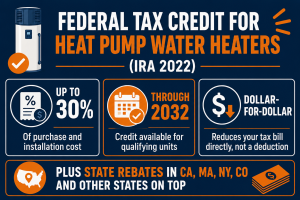
Several US states — including California, Massachusetts, New York and Colorado — offer additional rebates on top of the federal credit, which can narrow or in some cases largely close the upfront cost gap versus gas depending on where you live. Because these state programs vary significantly and change periodically, it’s worth checking your state energy office or utility provider for current rebate availability before budgeting your purchase.
💡 Tip: The federal tax credit is a dollar-for-dollar reduction in your tax bill, not a deduction — it directly reduces what you owe at tax time up to the credit cap. Check IRS Form 5695 for the current qualifying product list.
Installation Requirements
A heat pump water heater needs roughly 1,000 cubic feet of surrounding air space to operate efficiently, a standard 240V electrical connection, and a drain for the condensate the unit produces as it extracts heat from the air. These space and electrical requirements need to be confirmed against your specific installation location before purchasing — not every utility room or basement will qualify without modification.
A gas water heater needs an existing gas supply line, a flue or direct vent to the exterior, and the installation must meet local code requirements for combustion appliance zones. If your home already has gas service and an existing flue from a previous gas water heater, installation is comparatively straightforward. If not, adding gas infrastructure from scratch is a substantial project in its own right.
⚠️ Warning: A heat pump water heater installed in a small enclosed closet will not operate efficiently and may short-cycle continuously — the unit needs enough surrounding air volume to extract heat from. Basement utility rooms and garages are ideal; small interior closets are not.
Climate and Space Considerations
Heat pump water heaters work best in spaces that stay above 40°F year-round, since the unit relies on extracting ambient heat from the surrounding air to function efficiently. In unheated garages located in cold-climate states, efficiency drops significantly during winter months, and the electric resistance backup element takes over more frequently — which erodes the efficiency advantage that makes heat pump units attractive in the first place.
Gas water heaters, by contrast, are essentially climate-agnostic — performance is consistent regardless of ambient temperature because the unit generates its own heat directly rather than depending on the surrounding air. This makes gas a more predictable choice in any installation location, cold or otherwise, as long as gas supply and venting are available.
💡 Tip: In mild-climate states (Southeast, Pacific Northwest, Southwest), a heat pump water heater in an unconditioned garage performs near its rated efficiency year-round — the climate case for heat pump is strongest in these regions.
Recovery Rate — How Quickly Each Heats Water
Gas water heaters have the fastest recovery rate of any residential tank technology, thanks to direct burner heat. A heat pump water heater running in hybrid mode recovers more slowly than gas — comparable to a conventional electric resistance unit — which is generally adequate for a household of 2–4 people as long as the tank is sized correctly for that household’s peak demand.
When the electric resistance backup engages on a heat pump unit, it can match gas-like recovery speed during high-demand periods, but only at the cost of the efficiency that makes heat pump technology worthwhile in the first place. Relying on the backup element too often effectively turns an expensive heat pump unit into an expensive electric resistance heater.
💡 Tip: Size the heat pump tank generously — a 65–80 gallon heat pump unit often performs better for a family than a smaller tank that relies on resistance backup too frequently.
Which Should You Choose?
The choice between a heat pump and gas water heater resolves around your local utility rates, available installation space, existing gas infrastructure, and climate. The head-to-head table below shows where each technology has a genuine practical edge.
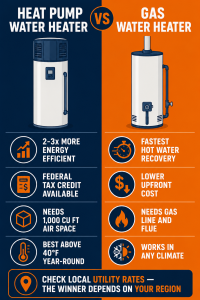
| Scenario |
Winner |
| Lower upfront cost |
Gas (before incentives) |
| Lower running cost (most US regions) |
Heat Pump (2–3x efficiency) |
| Federal tax credit available |
Heat Pump (up to 30% through 2032) |
| Best in cold unheated spaces |
Gas (climate-agnostic) |
| Fastest hot water recovery |
Gas (direct burner heat) |
| No gas line required |
Heat Pump (runs on electricity) |
| Best long-term total cost of ownership |
Heat Pump (most regions) |
| Climate-agnostic performance |
Gas (unaffected by ambient temperature) |
Choose Heat Pump if:
- You have adequate space (around 1,000 cubic feet of surrounding air) and a 240V electrical connection available at the installation site.
- You want to maximise federal and state incentives — the 30% federal tax credit plus any applicable state rebate significantly improves the upfront cost picture.
- Your installation space stays above 40°F year-round, so the unit can run efficiently without leaning on its resistance backup. See our electric vs gas water heater guide if you’re also weighing a conventional electric unit as a lower-upfront-cost alternative.
Choose Gas if:
- You have an existing gas line and flue already in place, making installation straightforward and comparatively inexpensive.
- You need the fastest possible hot water recovery rate for a household with high simultaneous demand.
- Your installation space is cold, enclosed, or otherwise unsuited to the air volume a heat pump unit needs. If format rather than heating method is your main question, see our tankless vs tank water heater comparison.
Need a Professional Plumber?
Heat pump water heater installation involves electrical and condensate drain work, and gas water heater installation involves gas line and venting work — both are jobs most homeowners are not equipped to handle safely without a license. A licensed installer also ensures your unit qualifies for the federal tax credit and any state rebate, since some programs require professional installation documentation.
Find a licensed plumber in your area at PlumberArchive.com — the US plumber directory with 12,000+ verified local plumbers across all 50 states.
Find a trusted plumber near you → PlumberArchive.com
Follow Us on Facebook
Get weekly plumbing tips, honest brand comparisons and DIY maintenance guides delivered straight to your Facebook feed. We cover water heater technology, energy efficiency incentives, pipe repairs and everything in between — written for US homeowners who want to make smarter decisions without overspending.
Follow PlumbingToolsReview on Facebook →
Frequently Asked Questions
Q: Is a heat pump water heater worth it over gas in 2026?
For most US homeowners, yes — particularly once the federal tax credit of up to 30% and any applicable state rebate are factored into the upfront cost. The long-term running cost advantage from 2–3 times greater efficiency generally outweighs the higher purchase price over the unit’s service life, especially in regions with moderate-to-low electricity rates and a mild climate. The exceptions are homes in cold climates without adequately heated installation space, and regions where gas remains very cheap relative to electricity — in those cases, the math is closer or can favor gas.
Q: What is the federal tax credit for a heat pump water heater?
The federal Inflation Reduction Act (2022) provides a tax credit of up to 30% of the purchase and installation cost for qualifying heat pump water heaters, available through 2032. This is a dollar-for-dollar reduction in your tax bill rather than a deduction, applied up to the credit cap. Check IRS Form 5695 for the current list of qualifying products and confirm your specific unit is eligible before purchasing. Several states offer additional rebates on top of this federal credit.
Q: Can a heat pump water heater work in a cold garage?
A heat pump water heater can operate in a cold garage, but its efficiency drops significantly once ambient temperatures fall below about 40°F, since the unit relies on extracting heat from the surrounding air. In an unheated garage during a cold-climate winter, the electric resistance backup element engages more often to compensate, which erodes much of the efficiency advantage that makes heat pump technology attractive. In mild-climate states, an unconditioned garage installation performs much closer to the unit’s rated efficiency year-round.
Q: How long does a heat pump water heater last compared to gas?
Heat pump water heaters and gas tank water heaters generally have comparable service lives when properly maintained, though actual lifespan depends heavily on water quality, maintenance, and usage patterns rather than the heating method itself. Both technologies benefit from routine maintenance such as anode rod checks and tank flushing to prevent sediment buildup and corrosion, which is the leading cause of premature tank failure in either type. Watch for the early warning signs covered in our guide to signs your water heater is failing regardless of which technology you choose.
Conclusion
Heat pump water heaters win on long-term running cost and federal incentives in most US regions — the combination of 2–3 times greater efficiency and a federal tax credit of up to 30% through 2032 has genuinely shifted the economics in their favor since the Inflation Reduction Act took effect. Gas water heaters still win on upfront cost, recovery rate, and cold-climate performance, and remain the simpler choice for homes that already have gas infrastructure in place.
The right decision for your home comes down to your local utility rates, the available installation space and climate, and whether your home already has gas infrastructure. If you have the space, a 240V connection, and a location that stays reasonably warm year-round, a heat pump unit is likely to pay off its higher upfront cost through lower bills and tax incentives over its service life. If you already have gas service, need fast recovery, or are installing in a cold or enclosed space, gas remains the more practical and predictable choice — though it’s worth reviewing our gas line safety guide and considering a dedicated gas leak detector for the added peace of mind that comes with a combustion appliance in the home.
For a broader look at electric versus gas technology generally, see our electric vs gas water heater comparison. If tank format rather than heating method is your main open question, our tankless vs tank water heater guide covers that decision separately. And whichever unit you choose, keep an eye on signs your water heater is failing so you can plan a replacement before an emergency failure forces the decision.
✍️ About This Comparison
PTR Editorial Team — Product Comparisons. We compare manufacturer specifications, installation requirements, compatibility and available product documentation to help homeowners choose suitable tools and parts. How we review →