Please note: Information in this comparison is based on manufacturers’ and standards bodies’ published documents at the time of writing and is subject to change. Always follow the instructions for the specific tubing and fittings you buy, and check your local plumbing code or consult a licensed plumber before choosing a connection method.
Introduction
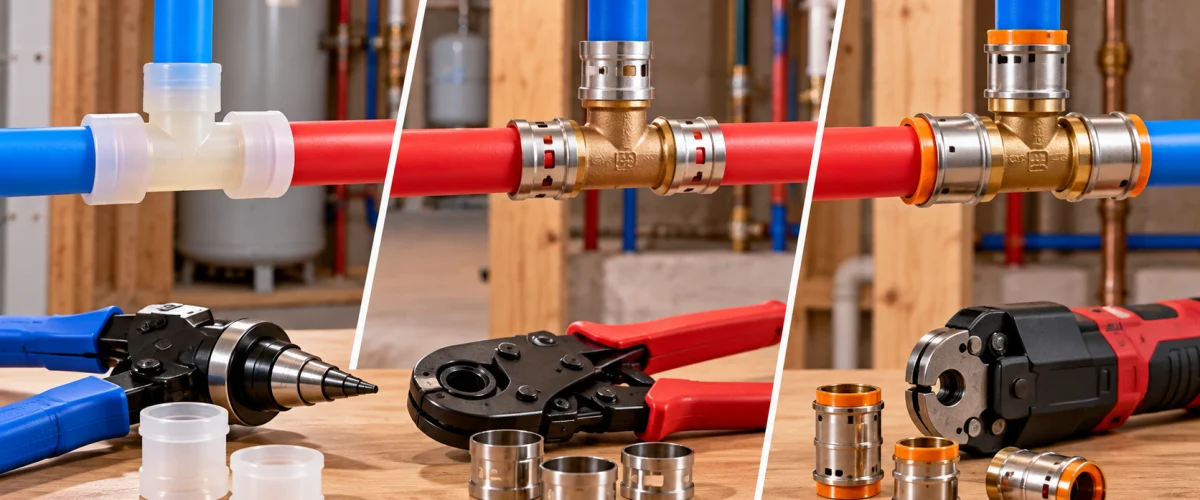
PEX connections are usually described by method — expand, crimp or press — but each method works only as part of a system: a fitting, a ring, clamp or sleeve, tubing, and a tool that the manufacturer documents together. This comparison reads manufacturers’ and standards bodies’ published documents, system by system, to show what each connection method requires and where manufacturers’ own statements differ.
It is a documentation comparison, not a hands-on test, and it does not rank the methods. Push-to-connect fittings are a separate category; our comparison of push-to-connect vs crimp fittings covers them.
✏️ Our Take
No single rule links a connection method to a PEX letter type. ASTM F1960, the standard for cold-expansion fittings with PEX reinforcing rings, refers to tubing that meets ASTM F876 or F3253 rather than to PEX-a, PEX-b or PEX-c, so any tubing restriction comes from each manufacturer’s own documents — and the manufacturers we read differ. Uponor says cold expansion is designed for PEX-a pipe and warns about microcracking on PEX-b or PEX-c; Zurn’s specification sheet certifies its silane-method tubing for F1960 cold-expansion fittings; REHAU designs its EVERLOC+ fittings specifically for its own RAUPEX pipe; and Viega says its press components are not interchangeable with components or tubing from other suppliers. The practical rule is to start from the tubing and the system documents, not from the method name.
How a PEX Connection Is Made: Four Parts and Their Standards
A PEX joint has four parts: the fitting, the ring, clamp or sleeve that holds the tubing onto it, the tubing itself, and the tool that assembles them. The guide published for the Plastics Pipe Institute and the Plastic Pipe and Fittings Association describes the compatibility rule plainly: “Not all fittings are compatible with all PEX tubing. Consult your tubing manufacturer for acceptable joining methods or review the markings on the tubing which indicate which fitting system type or types have been approved for use with that tubing.”
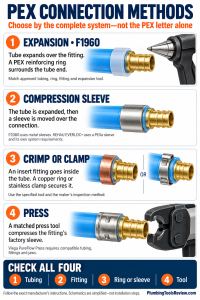
Each method has its own ASTM specification, and the differences between them matter later in this comparison:
Wide table: this table is wider than the page on small screens — swipe or scroll it sideways to see every column →
| Standard |
What the specification covers |
How the seal is made |
| ASTM F1960 |
Cold-expansion fittings and PEX reinforcing rings, for tubing meeting ASTM F876 or F3253 (and PE-RT tubing meeting F2769), in nominal sizes 3/8 to 3 in., intended for 100 psi systems up to 180°F. |
A PEX reinforcing ring is placed over the tube end, the tube is expanded, the fitting is inserted, and the expanded tube retracts onto the fitting. |
| ASTM F2080 |
Cold-expansion fittings using metal compression-sleeves, in nominal sizes 3/8 to 2 in. |
The tube is cold-expanded and the fitting inserted; a metal compression sleeve is then pulled over the connection to compress the tube onto the fitting. |
| ASTM F1807 and F2098 |
F1807: metal insert fittings with copper crimp rings, or alternate stainless steel clamps, in nominal sizes 3/8 to 2 in. F2098: stainless steel clamps as an alternative to the copper crimp rings. |
The fitting is inserted into the tubing and a copper crimp ring or stainless steel clamp is compressed around the tubing. |
| ASTM F3347 and F3348 |
Metal (F3347) and plastic (F3348) press insert fittings with factory-assembled stainless steel press sleeves that have three view holes and a tool locator ring. |
A press tool is used to complete the connection on the factory-assembled sleeve. |
Two further specifications appear throughout manufacturers’ documents: ASTM F876 covers the tubing, and ASTM F877 covers the performance of PEX hot- and cold-water distribution systems.
A fifth case does not fit these headings cleanly. REHAU describes its EVERLOC+ system as “a cold-expansion PEXa fitting system” that is “assembled with a specially designed PEXa compression sleeve” and lists it to ASTM F877 and CSA B137.5. Because ASTM F2080 covers metal compression-sleeves and the REHAU documents reviewed cite F877 and do not cite F2080 for EVERLOC+, this comparison treats EVERLOC+ as its own system and does not classify it under F2080.
Compatibility Is Set by the System, Not the Method Name
The ASTM specifications above define the fitting, not the tubing brand. The scope text of F1960 (as shown on the ASTM store abstract, which is what was reviewed) refers to tubing that meets ASTM F876 or F3253 and does not name PEX-a, PEX-b or PEX-c. Where a restriction exists, it is written by the manufacturer of the system. Our guide to PEX-A vs PEX-B tubing explains how the tubing types are made; this section is about what the makers say their systems accept.
Tubing markings are the practical evidence. Zurn’s tubing, for example, is printed with the fitting standards it is approved for: its installation guide shows a print string reading “Fitting Standards F1807, F1865, F1960, F2080, F2098, F2159.”
Uponor makes the same distinction from the fitting side. It states that other makers’ expansion fittings “claim they’re compliant to F1960, but that doesn’t mean they’re tested and listed to the standard.”
What Each Manufacturer Documents, System by System
The table covers the systems for which this review could read the manufacturer’s own documents. Systems for which no manufacturer document could be read (for example Apollo and NIBCO) are not included. Quotation marks show a manufacturer’s exact words; statements are the makers’, not test results. Where the table says something was “not found in the documents reviewed”, it means only that: the documents listed under each row were searched, and the manufacturer may state the point elsewhere. Matching a quotation to its document shows where a statement comes from; it does not prove that our reading is complete.
Wide table: this table is wider than the page on small screens — swipe or scroll it sideways to see every column →
| System |
Tubing and fitting statements |
Tools |
Inspection and temperature |
Warranty and listings |
Uponor ProPEX
cold expansion, ASTM F1960, PEX ring |
Uponor states: “Cold expansion is designed for use with PEX-a pipe.” It adds that “If you use cold expansion fittings with PEX-b or PEX-c pipe, you run the risk of microcracking the pipe, which can lead to leaks.” Its warranty statement names “Uponor PEX-a pipe and the ProPEX connection.” ProPEX fittings are made from engineered polymer (EP). |
Expansion tool, fitting and PEX ring. Uponor says its Milwaukee M12 and M18 ProPEX tools are “Designed specifically for Uponor ProPEX,” that Uponor heads “will not auto-rotate on the Milwaukee tools,” and that “H-heads are not compatible with Milwaukee tools and Milwaukee heads are not compatible with Uponor tools.” |
Uponor calls the connection “visually verifiable.” Its ring submittal says to “Make ProPEX connections at temperatures above 5°F/-15°C”; its pocket guide adds that fewer expansions are needed below 40°F. |
25-year transferable limited warranty on the system of Uponor PEX-a pipe and the ProPEX connection. ProPEX rings are listed to ASTM F1960, F876 and F877, CSA B137.5, NSF/ANSI/CAN 61 and NSF/ANSI 14.
Source: Uponor blog, ProPEX page, ProPEX ring submittal, M18 kit page, commercial piping pocket guide |
REHAU EVERLOC+
cold expansion plus a PEXa compression sleeve |
The fitting “is designed specifically for use with RAUPEX pipe” and is “intended for use with RAUPEX SDR9 copper tube size (CTS) pipe manufactured in accordance with ASTM F876.” REHAU’s fittings page also says it offers F1960 fittings “that pair with RAUPEX pipe.” |
The system “can only be assembled with the EVERLOC+ compression-sleeve tools”; the guide’s notice says “Use of other tools will result in an improperly assembled joint.” |
REHAU’s page describes “360 degree connection control, with a visual inspection” and says “Cold temperatures are no problem for EVERLOC+.” (Manufacturer statements; no numeric installation-temperature limit was found in the REHAU guide sections reviewed.) |
Certified to ASTM F877, NSF/ANSI 14, 61 and 372 and CSA B137.5. 25-year limited warranty on pipe, fittings and sleeves; 2-year limited warranty on the tools, when installed per REHAU’s warranty document.
Source: Internet Archive copies, not REHAU’s live site: REHAU fittings page (archive capture 1 Feb 2026); REHAU PEXa Plumbing Design and Installation Guide, 855.739, 09.2023 (archive capture 3 Sep 2024); EVERLOC+ compression sleeves sheet PS1200, 01-Aug-17 (archive capture 18 Nov 2025). These conclusions are limited to these documents and are not a check of REHAU’s current catalogue, tools or warranty. |
Sioux Chief
F1960 expansion, PowerPEX Type-B example |
Sioux Chief’s PEX Expansion Ring Connection Guide (file created 2 July 2020) is written “For use with ASTM F1960 Fittings” and refers to “ASTM F1960 PEX expansion joints made using PowerPEX Type-B tubing.” See the evidence note below the table about an older Sioux Chief document. |
The 2020 guide says F1960 joints on PowerPEX Type-B tubing “MUST be made with a self-rotating, power expansion tool.” |
Below 55°F, “keep tube/sleeves warm”; the guide also says “Do Not make connections in temperatures below 5°F.” |
Current warranty applicability to F1960 joints on PowerPEX Type-B tubing is unconfirmed; no warranty statement was found in the 2020 guide (see evidence note).
Source: Sioux Chief PEX Expansion Ring Connection Guide 632WG335 (file created 2 July 2020) |
Zurn
crimp and F1960 expansion |
Zurn’s specification sheet states that its tubing “is produced using the silane method of crosslinking” and is “Certified for use with the following fitting standards: ASTM F1807 Crimp for Brass Fittings, ASTM F1960 Cold Expansion Fittings, ASTM F2098 SS Clamp Fittings, ASTM F2159 Crimp for plastic CR Fittings.” Its installation guide (Rev. 05/16), which covers the tubing, headlines “The Silane (PEX-b) Method.” Zurn’s F1960 ring sheet (QER_X, Rev. D, 12/22/2022) says the ring “is used with Zurn Non-Barrier Pex pipe in potable water applications”; its brass coupling sheet (QEC_GX, 08/07/17) says the coupling “is used with Zurn Non-Barrier Pex tubing in potable water applications.” |
Zurn’s 2017 press release says contractors can “choose between either crimp or expansion fittings.” Both F1960 sheets list “QEMT345 F1960 Manual Expansion Tool Kit – 1/2″ to 1″” as an accessory. |
No installation-temperature limit was found in the Zurn documents reviewed. |
Zurn’s 2017 press release states the F1960 expansion system “is backed by an industry-leading 25-year warranty”; the tubing specification sheet says “ZurnPex, Inc. offers a limited 25-year system warranty” and points to a separate Professional Installation Limited Warranty, which was not among the documents reviewed. The ring sheet lists ASTM F1960, CSA B137.5 and NSF/ANSI 61, and the coupling sheet lists NSF/ANSI 61 and 372, ASTM F1960 and CSA B137.5.
Source: Zurn tubing specification sheet (Rev. C 4/20); Zurn PEX Plumbing Installation Guide (Rev. 05/16, tubing only); Zurn QER_X ring sheet (Rev. D, 12/22/2022); Zurn QEC_GX coupling sheet (08/07/17); Zurn press release (Sept. 2017, as reproduced by Construction Dive) |
Viega PureFlow Press
press, ASTM F3347 / F3348 |
Viega’s tubing page reads “For use with Viega PureFlow Press or Viega PureFlow Crimp” and lists “PEX designation code 5306,” ASTM F876 and F877. Viega’s data sheet says its press polymer fittings “are for use with Viega PureFlow and Viega Barrier SDR-9 cross-linked polyethylene (PEX) tubing” and that the components “are available only from Viega and are not interchangeable with components and tubing from other suppliers.” (No PEX letter type was found in the Viega documents reviewed.) |
The connections are completed with “a Viega PureFlow Press Hand Tool or Viega PureFlow Press Power Tool”; Viega describes “system-matched tools and press jaws.” |
The stainless steel press sleeves “incorporate three view holes,” and the tool locator rings are color-coded to match the correctly sized press tools. (No installation-temperature limit was found in the Viega documents reviewed.) |
30-year limited warranty. Listed standards include NSF/ANSI 14, 61 and 372, ICC-ES PMG-1038 (PureFlow) and IAPMO file 4874 (FostaPEX).
Source: Viega PureFlow Press page, PureFlow PEX tubing page, PureFlow Press Polymer technical data sheet |
SharkBite barb system
crimp or clamp, ASTM F1807 / F2098 |
The sheet states: “The SharkBite barb fittings and crimp rings meet ASTM F1807 requirements. The SharkBite barb fitting clamp rings meet ASTM F2098 requirements.” It describes the system for “connecting PEX pipe in water distribution systems” and no PEX letter type was found in the sheet. |
Crimp rings: “the heavy duty tool with interchangeable jaws”; clamp rings: “one tool clamps all sizes” (manufacturer statements). |
Crimp: “allows each joint to be checked with a go / no-go gauge.” Clamp: “Verify the connection is secure by visually checking the clamp tab.” (The sheet says the clamp tool removes the need to check each ring with a gauge.) |
All components “are listed to the NSF 14 Standard.” Sheet revised August 2016.
Source: SharkBite Barb Connection System sales and specification sheet. For the crimp procedure see our PEX crimp connection guide |
Evidence note — Sioux Chief (dated by PDF file metadata). A Sioux Chief catalog PDF (file created 15 August 2016) states: “Sioux Chief warrants ASTM F1960 fittings ONLY when used with PEX-a tubing and when joints are made according to ASTM specifications.” The 2020 guide above describes F1960 expansion joints made with PowerPEX Type-B tubing. The documents reviewed do not reconcile the two, and we did not find a current Sioux Chief warranty statement covering F1960 joints on Type-B tubing. Current warranty applicability therefore remains unconfirmed, and the 2016 wording is not presented here as current coverage.
Evidence note — Zurn. Zurn’s installation guide (form ZMKTG370-04, Rev. 05/16) was issued before Zurn announced its F1960 expansion system in September 2017. This comparison uses it only for what it covers — the tubing and its print line, and crimp and clamp fittings — and not for Zurn’s expansion system, which is described from Zurn’s later ring and coupling specification sheets and its 2017 press release.
Read across the table, the manufacturers disagree on the question most readers ask first. Uponor and REHAU tie their expansion systems to PEX-a tubing (Sioux Chief’s position on PEX-a versus PowerPEX Type-B is covered in the evidence note above), Zurn certifies silane-method (PEX-b) tubing for F1960 expansion fittings, and Viega documents its own PureFlow tubing for its press system, with no letter type found in the Viega documents reviewed. That is why this comparison does not state a rule by PEX letter.
Each method needs its own kind of tool, and several makers say the tool, head, jaw or ring must come from the same system. The documents reviewed say:
- Expansion (Uponor ProPEX): an expansion tool, a fitting and a PEX ring; Uponor’s page lists which Uponor and Milwaukee heads fit which tools, as quoted above.
- Compression sleeve (REHAU EVERLOC+): the EVERLOC+ compression-sleeve tools only, per REHAU’s installation guide.
- Press (Viega PureFlow): a Viega press hand tool or power tool with system-matched jaws, per Viega.
- Crimp and clamp (SharkBite): a crimp tool with interchangeable jaws, or a clamp tool, per the manufacturer’s sheet. Our review of PEX crimp tools compares the crimp and cinch tools themselves.
The documents above make expansion and press tools system-specific, so a head or jaw should be matched to the maker’s system before it is bought. This comparison does not recommend any specific tool.
Checking a Finished Connection
Manufacturers describe different ways to confirm a finished connection, and the descriptions below are theirs, not test results:
- Uponor describes ProPEX connections as “visually verifiable”; no gauge was found described in the Uponor documents reviewed.
- REHAU describes “360 degree connection control, with a visual inspection.”
- Viega’s press sleeves “incorporate three view holes,” and the tool locator ring marks the tool position; the ASTM press specifications describe the same features.
- SharkBite says each copper crimp joint can be checked with a go/no-go gauge, and that a clamp joint is verified “by visually checking the clamp tab.”
Temperature and Site Conditions
Installation-temperature guidance was found in only some of the documents reviewed, and the figures differ by system:
- Uponor: make ProPEX connections “at temperatures above 5°F/-15°C”; warming the fittings and rings reduces contraction time; fewer expansions are necessary below 40°F; make a test connection for each pipe size when temperatures differ from day to day.
- Sioux Chief (F1960): below 55°F keep tube and sleeves warm and use only enough expansions to insert the fitting; do not make connections below 5°F; do not apply heat with a heat gun.
- REHAU: states that cold temperatures “are no problem for EVERLOC+.” This is a manufacturer statement; no numeric installation-temperature limit was found in the REHAU guide sections reviewed.
- Zurn, Viega and SharkBite: no temperature limit for making connections was found in the documents reviewed.
The 100 psi, 180°F figures in the ASTM scopes are operating limits for the distribution system, not installation conditions.
Warranty and Listing Statements
Warranty wording is tied to using each maker’s components together, which is one more reason to buy by system:
- Uponor: 25 years “on the system of Uponor PEX-a pipe and the ProPEX connection.”
- REHAU: 25 years on RAUPEX pipe and EVERLOC+ fittings and sleeves and 2 years on the tools, “when the installation is carried out in accordance with” REHAU’s warranty requirements.
- Zurn: the tubing specification sheet says Zurn “offers a limited 25-year system warranty” and refers to a separate Professional Installation Limited Warranty, which was not among the documents reviewed; the 2017 press release states 25 years on the F1960 expansion system.
- Viega: a 30-year limited warranty on PureFlow Press, whose components Viega says are not interchangeable with other suppliers’.
- Sioux Chief: current warranty applicability to F1960 joints on PowerPEX Type-B tubing is unconfirmed (see the evidence note above the table).
Read each warranty before you buy: the figures above are the makers’ summaries, and the full terms govern.
Choosing by What You Can Verify
Because the documents tie each method to a system, the useful question is not which method is better but which system your project can actually be built from:
Wide table: this table is wider than the page on small screens — swipe or scroll it sideways to see every column →
| Your starting point |
What the documents say to check |
| Tubing already installed |
Read the print line on the tubing and the maker’s documents; the PPI/PPFA guide says to consult the tubing manufacturer or review the markings that show which fitting systems are approved. |
| New work, tubing not yet bought |
Choose the system first, then buy the tubing, fittings, rings or sleeves and tool the maker documents together; the Uponor, REHAU and Viega statements above all point the same way. |
| You already own a tool |
Check the tool against the maker’s statement: Uponor’s head and tool notes, REHAU’s “only” EVERLOC+ tools, Viega’s system-matched jaws. |
| Large pipe sizes |
The ASTM scopes differ: F1960 covers sizes up to 3 in., F2080 and F1807 up to 2 in., and the press specifications up to 2 in.; confirm the maker’s available sizes. |
| Work in cold weather |
Check the installation-temperature statements above for your system; several of the documents reviewed give none. |
| Inspection or permit requirements |
Ask your local building department; the makers’ listing statements (ICC-ES, IAPMO, NSF) show what each system is listed to but do not replace local approval. |
Frequently Asked Questions
Q: Does PEX expansion always require PEX-a tubing?
Not as a rule of the standard. ASTM F1960 refers to tubing meeting F876 or F3253 without naming a letter type. Uponor says cold expansion is designed for PEX-a pipe and warns about microcracking on PEX-b or PEX-c, and Sioux Chief’s 2020 guide describes F1960 expansion joints made with its PowerPEX Type-B tubing (and an older catalog’s conflicting warranty wording is left unresolved in the evidence note above); Zurn’s specification sheet certifies its silane-method tubing for F1960 cold-expansion fittings. Check the documents for the specific system and the markings on the tubing.
Q: What is the difference between F1960 and F2080 expansion systems?
F1960 systems use a PEX reinforcing ring around the tube end; F2080 systems use a metal compression sleeve pulled over the connection after the tube is expanded and the fitting inserted. REHAU’s EVERLOC+ also uses a compression sleeve, but its sleeve is made of PEXa and its documents cite ASTM F877 and CSA B137.5, not F2080.
Q: Is a press connection the same as a crimp?
No. ASTM covers crimp rings and clamps in F1807 and F2098, and press fittings with factory-assembled stainless steel sleeves in F3347 and F3348. Viega’s press system uses a press tool with system-matched jaws.
Q: Can I mix rings, tools and tubing from different manufacturers?
Only where the manufacturers say so. Viega says its press components are not interchangeable with components and tubing from other suppliers; REHAU says its EVERLOC+ system can only be assembled with EVERLOC+ tools; Uponor says other makers’ F1960 fittings are not necessarily tested and listed to the standard. The PPI/PPFA guide advises consulting the tubing manufacturer.
Q: Can I use crimp rings on any PEX tubing?
ASTM F1807 refers to tubing meeting F876 or F3253 (and certain PE-RT standards) rather than a letter type, and no letter type was found in SharkBite’s sheet. Check the tubing markings and the maker’s instructions for your fittings; our crimp connection guide covers the procedure.
Conclusion
Expansion, crimp and press connections are different systems with different documented requirements, and the manufacturers’ own statements do not reduce to one rule about PEX letter types. The reliable way to choose is to start from the tubing and its markings, pick the system whose documents cover every part — fitting, ring or sleeve, tubing and tool — and follow that maker’s instructions, temperature guidance and warranty terms.
If you are still weighing push-to-connect fittings, see push-to-connect vs crimp fittings, and for how the PEX types themselves differ, see PEX-A vs PEX-B tubing.
✍️ About This Comparison
PTR Editorial Team — Product Comparisons. We compare manufacturer specifications, installation requirements, compatibility and available product documentation to help homeowners choose suitable tools and parts. How we review →