Please note: Information in this comparison is based on our research at time of writing and is subject to change. Always confirm your specific PEX manufacturer’s fitting and tool requirements before purchasing.
Introduction
If you’ve started shopping for PEX tubing for a repipe, a new fixture line, or a DIY repair, you’ve probably noticed two nearly identical-looking products labeled PEX-A and PEX-B, with little explanation of why one costs more than the other. This is a different question from our PEX vs copper pipes and PEX vs CPVC pipe comparisons, which weigh PEX as a category against an entirely different pipe material. PEX-A and PEX-B are both cross-linked polyethylene — the exact same base plastic — made by two different manufacturing processes that can change how the finished tubing behaves, although products vary by maker.
Most homeowners buying PEX for the first time don’t realize there’s a choice to make here at all. Big box stores often stock only one type on a given shelf, contractors tend to default to whichever fitting tools they already own, and the letter suffix rarely gets explained anywhere on the packaging. But the labels can matter: depending on the product, they can affect how flexible the tubing is to route, which fittings and tools its maker approves, and how much you’ll pay per foot. This comparison breaks down how PEX-A and PEX-B are made, where each can have a practical advantage, and how to decide which is the right fit for your specific project.
At a Glance
PEX-A
- Manufactured using the Engel (peroxide) method
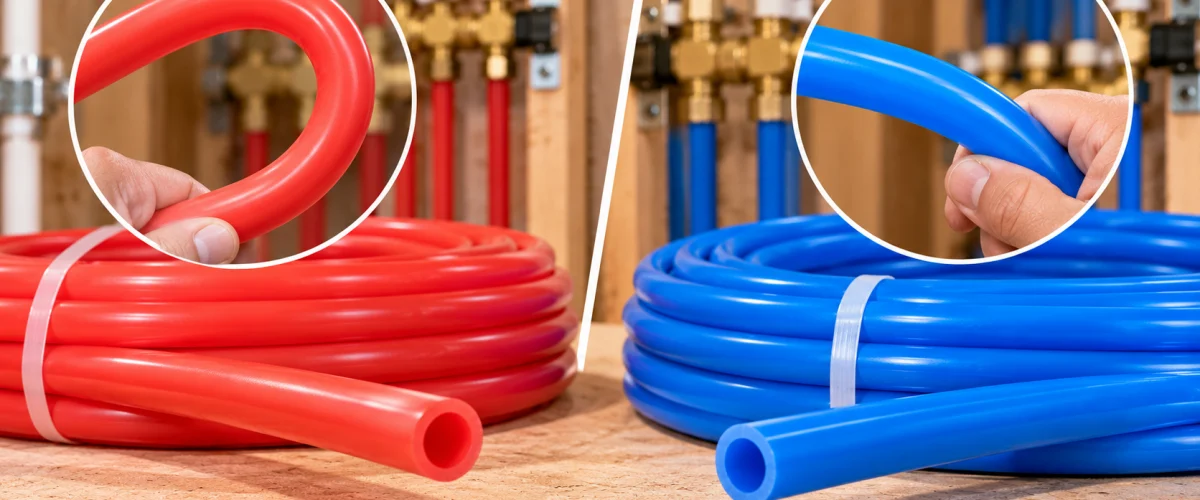
- Often described as the more flexible type, with strong shape memory; flexibility varies by product
- Commonly used with expansion-style fittings (check the tubing’s markings)
- Often costs more per foot
PEX-B
- Manufactured using the silane method
- Often described as somewhat stiffer than PEX-A; varies by product
- Commonly used with crimp rings or stainless-steel clamps, and with push-fit fittings its maker lists (check the tubing’s markings)
- Often lower in price and widely stocked
✏️ Our Take
PEX-A and PEX-B are the same basic material — cross-linked polyethylene — made two different ways, and that manufacturing difference can show up in flexibility, fitting compatibility, and price, though products vary by maker. PEX-A is often described as the more flexible option and is commonly used with expansion-style fittings, and it often costs more. PEX-B is often described as somewhat stiffer and is commonly used with crimp or clamp fittings, and it is often cheaper. Flexibility and approved fittings vary by product, so check the tubing’s markings and its maker’s instructions. Neither is objectively wrong for residential plumbing — the right choice usually comes down to the fitting system your tubing’s maker approves and you’re set up to use, and how much of a premium you’re willing to pay for extra flexibility.
Quick Comparison Table
The table below lists the decision factors covered in this comparison and what to compare for each. It does not name a winner: individual products vary, so check the tubing’s markings and its maker’s instructions.
| Factor |
What to compare |
| Flexibility |
How flexible the specific tubing is and the maker’s minimum bend radius (SharkBite’s PEX-B, for example, lists 8 times its outside diameter) |
| Freeze resistance |
The maker’s freeze guidance for the tubing; the evidence we found does not rank PEX-A against PEX-B, and no PEX is freeze-proof |
| Number of fittings on complex, tight routing |
Whether the product’s bend radius lets it follow your routing with fewer fittings |
| Price per foot |
Current price for your size and length; PEX-A often costs more, but prices vary by product |
| Retail availability |
What your retailer stocks in the size you need |
| Tooling and approved fittings |
Which fitting systems the tubing’s maker lists (expansion, crimp, clamp or push-fit), the tool each needs and its price |
| Kinks |
The maker’s instructions: heat repair of kinks is maker-specific (Uponor says it applies to PEX-a), and some makers advise cutting out the kink |
How PEX-A Is Made
PEX-A tubing is produced using what’s known as the Engel method, named after the process’s original developer. In this method, the cross-linking of the polyethylene molecules — the chemical bonding process that gives all PEX tubing its heat resistance and durability — is done with peroxide as part of the extrusion process, rather than in a separate step afterward.
That process difference is what sets PEX-A apart. PEX-A is often described as the most flexible type, although flexibility varies by product; Viega, for example, says its PEX-B has the flexibility characteristics of PEX-A. All PEX types must meet the same ASTM F876 and F877 standards (Viega, SharkBite), which according to Viega set a 70% minimum degree of cross-linking for PEX-A and 65% for PEX-B. PEX-A is also described as having shape memory, which is what expansion fittings rely on (PPI). Kinks are maker-specific: Uponor says a kink in PEX-a pipe can be repaired with a shot of heat from a heat gun and that this isn’t possible with PEX-B or PEX-C pipe, but its pages give no procedure or temperature, while Viega recommends cutting out a kinked section and replacing it with a fitting, noting that heat-repaired tubing is more likely to kink again, and SharkBite’s PEX guide says not to expose its pipe to direct flame. This comparison therefore gives no heating instructions: avoid kinking the tubing, and if it does kink, follow your tubing maker’s instructions or cut out the kinked section.
One often-cited tradeoff is cost: PEX-A tubing often costs more at retail, though prices vary by product and we found no maker data tying the price difference to the manufacturing process.
How PEX-B Is Made
PEX-B tubing is produced using the silane method. Unlike PEX-A, the cross-linking here happens after the tube has already been extruded into its final shape. The extruded tubing is exposed to moisture in combination with a catalyst, which triggers the cross-linking reaction gradually, over time, rather than all at once before shaping.
PEX-B is often described as somewhat stiffer than PEX-A, although flexibility varies by product. It’s still genuinely flexible compared to rigid pipe materials like copper or CPVC, and it bends easily enough for most residential routing situations — many PEX-B products don’t coil as tightly as PEX-A, and heat repair of kinks is maker-specific (see above).
PEX-B tends to be widely stocked and is often lower in price at retail.
Flexibility and Cold Weather Performance
Flexibility can have a real, practical effect on how a job gets installed, and it varies by product. PPI notes that PEX’s flexibility lets installers use fewer fittings. Where a PEX-A product bends more easily than a PEX-B product, it can be routed through tight joist bays, around corners, and past obstacles like ductwork with fewer fittings, but every PEX product has a minimum bend radius (SharkBite’s PEX-B, for example, lists 8 times its outside diameter), so check your tubing’s limit. Fewer fittings can mean fewer potential leak points, less time spent making connections, and often a faster installation, particularly in older homes with cramped or irregular framing.
Freeze resistance is worth understanding, but the evidence we found does not establish that either type is more freeze-resistant than the other. The Plastics Pipe Institute (PPI) says PEX’s flexibility typically lets it expand without cracking or splitting when its water freezes and return to its original diameter on thawing, and it describes this for PEX in general. Manufacturers publish their own freeze-test claims for their own products, and PPI notes that installation variables can cause PEX to fail in some situations.
It’s worth being clear about what this does and doesn’t mean, though. Freeze tolerance is not freeze immunity, PPI says freezing of water in any pipe should be prevented, and neither PEX-A nor PEX-B is designed to be routed through genuinely unheated spaces without any protection at all. Insulation, proper heat tape where needed, and basic precautions like keeping cabinet doors open during a hard freeze still matter regardless of which PEX type is running through your walls.
💡 Tip: According to the Plastics Pipe Institute, PEX tubing can typically expand when its water freezes and return to its diameter, but no PEX is freeze-proof, and insulation still matters whichever type you use.
Fitting Compatibility
Expansion fittings are used with tubing whose maker lists them, which is commonly PEX-A (Uponor’s ProPEX system, for example, relies on the shape memory of its PEX-a). Installing one starts with an expansion tool that temporarily stretches the end of the tube, fitted with a reinforcing ring or followed by a compression sleeve depending on the system (ASTM F1960 and F2080, per PPI). The fitting is inserted into the expanded end and the tube contracts around it to form the seal, as the maker’s instructions describe.
Crimp rings and clamp bands are used with tubing whose maker lists them, which is commonly PEX-B; some makers list them for other PEX types too, so check the tubing’s markings. The two are installed and verified differently. With a copper-ring crimp, the ring is slid over the tube, the fitting is inserted, the ring is positioned about 1/8 to 1/4 inch from the tube end and the crimp tool compresses it; SharkBite’s crimp tool guide says to check all crimps with the go/no-go gauge and to replace over- or under-crimped rings.
With a stainless-steel clamp, a clamp band is slid over the tube, the fitting is inserted, the band is positioned about 1/8 to 1/4 inch from the tube end and a clamp tool closes it. SharkBite says a properly calibrated clamp tool eliminates the need to check each ring with a go/no-go gauge, but the tool must be checked with its calibration gauge before installing and after the last clamp, and each connection is verified by checking the clamp tab.
The practical takeaway is that these two fitting systems require genuinely different tools, and that reality often matters more to buyers than the tubing itself. If you or your contractor already own a crimp or clamp tool, tubing whose maker lists those fittings (commonly PEX-B) avoids an additional tool purchase. If you already have an expansion tool, tubing whose maker lists expansion fittings (commonly PEX-A) is the more economical continuation. Starting from scratch, either system is a reasonable choice where your local code and the tubing manufacturer allow it — our PEX crimp tools reviews cover current options if you’re leaning toward the PEX-B route.
⚠️ Warning: Expansion tools and crimp tools are not interchangeable with each other, and not all fittings are compatible with all PEX tubing (PPI). Check the markings on the tubing and the manufacturer’s instructions for the fitting systems approved for it before you buy tools or fittings.
Cost Differences
In typical retail listings PEX-A tubing often costs more per foot than comparable PEX-B, but prices vary by size, length and brand and change over time, so compare current prices for the size you need.
The tools needed to install each system add another layer to the cost comparison. Expansion tools for PEX-A, particularly battery-powered models designed for repeated use on a full repipe, often cost more than a comparable crimp tool for PEX-B. For a one-off small repair, compare the price of a basic manual expansion tool, a basic manual crimp or clamp tool, and push-fit fittings that need none of them. For a full whole-home repipe where dozens of connections are involved, tool cost is spread across more connections and is worth weighing against per-fitting and tubing costs at current prices.
Which Should You Choose?
A more flexible product (often PEX-A) can be the better fit for jobs with tight, complex routing — think older homes with irregular framing, retrofits where the tubing has to snake around existing obstacles, or any run with several tight bends in a confined space. More flexibility can mean fewer fittings and less fighting with the material, within the product’s minimum bend radius. Lines exposed to freezing still need insulation and freeze protection with either type; PPI’s freeze-break findings apply to PEX generally, so freeze resistance alone shouldn’t decide between PEX-A and PEX-B.
A lower-priced product (often PEX-B) can be the better fit for straightforward, budget-conscious projects — a single bathroom remodel, a water heater replacement, or any run that’s mostly straight with only occasional gentle bends. If you or your contractor already own crimp or clamp tools and the tubing’s maker lists those fittings for it, you can avoid buying new equipment, and a lower per-foot cost can add up on larger projects. For a first DIY project on a tight budget, compare current prices and approved fittings; PEX-B is often widely stocked and lower in price, which can make it a practical starting point.
If your project doesn’t fall clearly into either category, weigh routing complexity and existing tools first, then let cost break the tie. Neither type is the “wrong” answer for standard residential plumbing when the tubing, fittings and tools are approved for each other and your local code allows them — the decision is more about matching the tubing to your specific job and toolkit than picking a universally superior product.
Local Code and Approvals: PEX tubing of either type is made to ASTM standards, but which fittings are approved for a given tubing, and what your local code allows, can vary, so confirm both with the tubing maker’s instructions and your local code authority before you buy.
Frequently Asked Questions
Q: Can PEX-A and PEX-B be connected together in the same plumbing system?
Often yes, but it depends on the tubing and fittings. Both are cross-linked polyethylene made to the same ASTM standards, but PPI says not all fittings are compatible with all PEX tubing, so each connection must use a fitting system the maker approves for that tubing (check the markings), which can mean more than one tool. Most installers stick to one tubing and fitting system throughout a project to keep tooling simple; ask your local code authority if you’re unsure whether mixing is allowed.
Q: Is PEX-A worth the extra cost for a typical home repipe?
For a whole-home repipe with long runs through tight stud bays, attics, or crawlspaces, A more flexible product can reduce the number of fittings needed and speed up installation, depending on the product and its bend radius, which can offset some of a higher material cost over the course of the job. For simpler, shorter runs with mostly straight paths, a lower-priced product often achieves the same end result for less money. The right answer depends heavily on how complex your specific routing actually is.
Q: Do PEX-A and PEX-B use the same fittings?
Not always. PEX-A is commonly used with expansion fittings, where a tool temporarily widens the tube end so it can slide over a fitting before shrinking back into place to form the seal. PEX-B typically uses crimp rings or stainless steel clamp fittings that compress around the tube from the outside instead. The tools required for each system are different and not interchangeable, and some fitting systems are approved for more than one tubing type, so confirm what your tubing is marked for before buying fittings or tools.
Q: Which PEX type is better for unheated spaces?
Neither type is established as better. PPI describes freeze-break resistance as a property of PEX generally, and no PEX is freeze-proof, so insulate and protect lines in unheated areas whichever type you use. Keep PEX out of sunlight too: PPI says PEX shouldn’t be installed outdoors unless it is buried or protected from UV, and each manufacturer sets its own maximum UV exposure time (SharkBite’s PEX, for example, lists 6 months), so check your tubing’s label.
Conclusion
PEX-A and PEX-B ultimately deliver the same core benefit — flexible, corrosion-resistant tubing that’s easier to install than rigid copper or CPVC — they just get there through two different manufacturing processes with two different sets of trade-offs. A more flexible product (often PEX-A) can be a strong pick for complex routing jobs, but it often costs more and is commonly used with an expansion tool. PEX-B is often somewhat stiffer and may need more fittings on tricky runs, but it’s often widely available, lower in price and used with crimp or clamp tools many DIYers and plumbers already own.
If you’re working with straightforward runs, compare the price of tubing whose maker approves crimp or clamp fittings with the tools you already own; if you’re planning a complex repipe, a more flexible product may be worth a premium. Either way, choose tubing, fittings and tools that are approved for each other. For the broader question of PEX versus other pipe materials, see our PEX vs copper pipes and PEX vs CPVC pipe comparisons, and check our PEX crimp tools reviews if you’re leaning toward a PEX-B installation.
Prices change. Check current prices before you buy.
✍️ About This Comparison
PTR Editorial Team — Product Comparisons. We compare manufacturer specifications, installation requirements, compatibility and available product documentation to help homeowners choose suitable tools and parts. How we review →