Comparisons
2 Oct 2026

Pop-Up Drain vs Grid Drain: Which Should You Choose?
Pop-up drains seal to hold water; grid drains never close but resist clogs better and cost less. Here's how to choose between them for your bathroom sink.
PEX vs CPVC pipe — which should you use for your home plumbing? Complete 2026 comparison covering cost, installation, freeze resistance, heat tolerance and which material wins for US homeowners.

PEX and CPVC are the two most popular plastic pipe materials used in US residential plumbing today — and both replaced copper as the default choice for supply lines over the past 30 years. They look different, install differently, and perform differently in key situations, but at first glance it is not obvious which one belongs in your home. Understanding the differences could save you a costly rework or a burst pipe in a cold winter.
This guide compares PEX and CPVC across every dimension that matters for a home plumbing project: cost, installation difficulty, freeze resistance, heat tolerance, durability and lifespan. For a broader material comparison, see our in-depth guide to PEX vs copper pipes — the other major comparison every homeowner faces when repiping. And if you are cutting any pipe yourself, our guide to the best pipe cutters covers the right tools for both PEX and CPVC.
Please note: Product availability and information are based on our research at time of writing and are subject to change. Always check retailer listings for the latest details before purchasing.
✏️ Our Take
PEX has genuinely changed residential plumbing in the US over the last decade — it is faster to install, more freeze resistant and easier for DIYers than any previous pipe material. CPVC still holds its own in hot water applications and remains popular in the South where it has been installed for decades. For a new build or full repipe, PEX wins on almost every practical measure.
In This Guide
PEX stands for cross-linked polyethylene — a flexible plastic tubing that has become the dominant choice for residential water supply lines in the US over the last 15 years. The cross-linking process creates molecular bonds across the polymer chains, giving PEX a combination of flexibility, strength and thermal memory that rigid pipe materials cannot match.
PEX comes colour-coded for easy identification: red for hot water lines, blue for cold, and white for either. The three types — PEX-A, PEX-B and PEX-C — differ in manufacturing method and performance characteristics:
PEX connections use crimping rings, clamp rings, or expansion fittings — all require a specific tool, though SharkBite fittings provide a push-fit option that requires no tools at all. One important limitation: PEX cannot be used outdoors or in direct sunlight — UV light degrades the material and causes it to become brittle. All PEX runs must be protected from sunlight.
CPVC stands for chlorinated polyvinyl chloride — a rigid plastic pipe produced by chlorinating standard PVC resin. The additional chlorination raises the temperature rating significantly, making CPVC suitable for both hot and cold water supply lines where standard PVC is not. CPVC is typically cream or light yellow in colour, which distinguishes it from grey PVC drainage pipe and prevents misidentification on a job site.
CPVC has been used in US residential plumbing since the 1960s and is particularly well-established in the South and Southeast, where plumbers and builders have worked with it for generations. It is joined using solvent cement — a chemical welding process that fuses the pipe and fitting together into a single piece when cured. This requires no special tools beyond a pipe cutter, making it accessible for DIYers comfortable with precise measuring and cutting.
PEX and CPVC are closely matched on raw pipe cost per linear foot — both fall in the $ price tier and represent a significant saving over copper. The differences appear when you factor in fittings and tools.
On a full repipe, CPVC is typically slightly cheaper for materials. However, PEX installs significantly faster — fewer fittings are needed due to the pipe’s flexibility, and labour time is reduced. For a professional installation, the labour saving on PEX often offsets the fitting cost difference. For DIY projects, CPVC’s lower tool cost is an advantage if you are not already equipped for PEX work. Our guide to the best pipe cutters covers tools that work effectively on both materials.
This is where PEX and CPVC diverge most clearly for the DIY homeowner. PEX’s flexibility fundamentally changes how pipe runs are planned and executed.
PEX installation: The pipe bends around corners, joists and obstacles without fittings — a run that would require four elbows in rigid pipe can often be done with PEX as a single continuous length. Fewer fittings means fewer potential leak points and faster installation. With SharkBite push-fit connections, PEX can be connected without any tools at all — push the pipe into the fitting until it clicks and the joint is made. For DIYers, this is a genuinely transformative difference.
CPVC installation: Rigid pipe must be cut to precise lengths, dry-fitted to check alignment, and then solvent-cemented in sequence. The cement sets quickly — you have a short working window after application before the joint becomes permanent. Mistakes require cutting out the fitting and starting again. The technique is learnable but less forgiving for beginners than PEX, and the rigid routing requires more pre-planning through walls and floors.
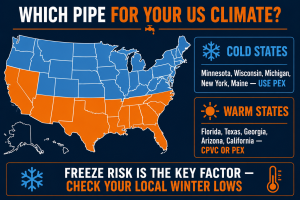
Freeze resistance is the single most important difference between PEX and CPVC for homeowners in cold climates — and it is not close.
PEX expands when water inside it freezes. PEX-A in particular can expand significantly without cracking, and in many cases the pipe contracts back to its original dimensions when the ice thaws without any damage. This property is a direct result of the cross-linked molecular structure. PEX pipes can survive multiple freeze-thaw cycles that would destroy any rigid pipe material.
CPVC is rigid and cannot accommodate the expansion of freezing water. When water inside CPVC freezes, the pipe cracks or bursts — the same failure mode as copper, and with less warning since CPVC fractures rather than deforming. Cracks often appear at fittings or elbows where the pipe cannot flex at all.
CPVC is particularly common in Florida, Texas and the Southeast where it has been the standard residential pipe material since the 1970s — in these climates, freezing is rarely a concern and CPVC performs excellently. In colder Northern states like Minnesota, Wisconsin and Michigan, PEX is strongly preferred for its superior freeze resistance — burst pipes in winter are a major concern in these climates, and a single freeze event that destroys CPVC supply lines can cause tens of thousands of dollars in water damage.
Both PEX and CPVC are rated for water temperatures up to 200°F — well above the 120–140°F range of a typical domestic hot water heater. In normal residential use, neither material requires special consideration for hot water supply lines.
In sustained high-heat applications — such as pipes running through areas with elevated ambient temperatures or carrying water at the upper end of the rated range — CPVC maintains its shape and rigidity more consistently than PEX, which can soften slightly under prolonged extreme heat. This is rarely relevant in residential plumbing but worth noting for specific industrial or commercial applications.
One important note for both materials: neither PEX nor CPVC should be connected directly to the flue connections, relief valve discharge, or the immediate outlet of a tankless water heater where water temperatures can momentarily exceed rated limits. Use copper for the final 12–18 inch connection from the heater to the distribution system before transitioning to PEX or CPVC.
Both PEX and CPVC are long-lasting pipe materials in the right conditions. Neither is subject to the corrosion and pinhole leaks that eventually affect copper and galvanised steel.
PEX is expected to last 50 years or more in residential plumbing applications. It is resistant to scale buildup and highly resistant to the chlorine present in municipal water supplies — chlorine degrades some plastic materials over time, but PEX handles it well. The flexible nature of PEX also means it is less vulnerable to damage from minor impacts or settling movement in the building structure.
CPVC has an expected lifespan of 50 to 75 years under ideal conditions — a longer theoretical maximum than PEX. However, CPVC is more vulnerable to degradation from certain municipal water chemistries, particularly water with high chlorine concentrations or water treated with chloramines rather than chlorine. Some municipal supplies in the Southeast — where CPVC has been installed since the 1970s — have seen premature CPVC failures attributed to changes in water treatment chemistry over the decades. Homeowners with CPVC in these areas should monitor for hairline cracks, particularly at fittings.
CPVC is also more brittle than PEX and more vulnerable to physical impact — a sharp knock during renovation work, a dropped tool or a collision can crack CPVC pipe, while the same force would simply dent or deform PEX without creating a leak.
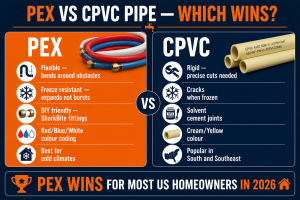
The head-to-head comparison makes the decision clear in most situations:
| Category | PEX | CPVC | Winner |
|---|---|---|---|
| Cost (materials) | $ | $ | Tie |
| DIY Installation | ✓ Easier | More complex | PEX wins |
| Freeze Resistance | ✓ Expands & recovers | Cracks and bursts | PEX wins |
| Heat Tolerance | 200°F rated | 200°F rated | Tie |
| Flexibility | ✓ Highly flexible | Rigid | PEX wins |
| Outdoor Use | No — UV degrades | No — UV degrades | Neither — use copper |
| Lifespan | 50+ years | 50–75 years | Tie |
| Cold Climates | ✓ Strongly preferred | Not recommended | PEX wins |
| Warm Climates | ✓ Suitable | ✓ Suitable | Tie |
Choose PEX if:
Choose CPVC if:
A full home repipe — whether PEX or CPVC — is a significant undertaking. If you prefer a licensed plumber to handle the work, search PlumberArchive.com — the US plumber directory with 12,151+ verified plumbers across all 50 states.
Find a trusted plumber near you →
Looking for our top recommended tools in one place? Browse our curated Amazon Storefront →
Get weekly plumbing tips, honest tool reviews and DIY guides delivered to your Facebook feed.
Both are equally suitable for standard domestic hot water lines — both are rated to 200°F, which is well above the 120–140°F output of a typical home water heater. In everyday residential use there is no meaningful performance difference between them on hot water lines. CPVC holds a marginal advantage in very high sustained heat applications, but this is not relevant for standard home plumbing. For the brief connection directly out of a water heater, use copper for the first 12–18 inches regardless of which plastic pipe you use for the rest of the run.
Yes — PEX and CPVC can be joined using transition fittings designed for the purpose, or with SharkBite push-fit fittings which accept both PEX and CPVC. This makes PEX a practical choice for extending or repairing an existing CPVC system without replacing the whole installation. The key is using the correct transition fitting for the pipe sizes involved — CPVC and PEX sizing can differ slightly. Always verify the fitting is rated for both pipe materials and that the pipe is fully inserted to the depth mark on the fitting before securing.
PEX is significantly easier for most DIYers. Its flexibility means fewer fittings and less precise routing, and SharkBite push-fit fittings allow tool-free connections that require no soldering, cement or crimping. The main tool investment — a PEX crimp or clamp tool — is modest for a full repipe and avoidable entirely if you use push-fit fittings. CPVC requires more precise measuring and cutting, and the solvent cement technique has a learning curve — a misaligned fitting that has started to cure cannot be corrected without cutting it out. For a first plumbing project, PEX with push-fit fittings is the recommended starting point.
CPVC has a slightly higher theoretical maximum lifespan — 50 to 75 years in ideal conditions versus 50-plus years for PEX. In practice, both will outlast the typical homeowner’s time in a property. The more important consideration is the installation conditions. CPVC in cold climates is vulnerable to freeze damage that dramatically shortens its lifespan. CPVC in areas with aggressive water treatment chemistry (high chloramine levels) can degrade faster than expected. PEX in UV-exposed areas degrades rapidly. In the right conditions for each material, both are long-term reliable choices. For a broad look at pipe material comparisons, see our guide to PEX vs copper pipes.
For most US homeowners in 2026, PEX is the better choice. It is easier to install, significantly more freeze-resistant, more flexible in routing, and the availability of push-fit fittings makes it the most accessible pipe material for DIY work ever produced. The head-to-head comparison shows PEX winning on every practical dimension where there is a meaningful difference between the two materials.
CPVC remains a valid and reliable choice in specific circumstances — particularly in warm climate states like Florida, Texas and across the Southeast, where freeze risk is negligible and CPVC has been the regional standard for half a century. If you are extending an existing CPVC system, CPVC is the natural choice. If you are building new in a warm climate with a tight materials budget and some plumbing experience, CPVC is a sensible option.
For a full home repipe in a Northern state, or any project where freeze protection and DIY-friendliness matter, PEX is the clear recommendation. Compare your full options in our guide to PEX vs copper pipes, and make sure you have the right cutting tools for the job with our guide to the best pipe cutters for PEX and CPVC. Not sure what you already have? Our pipe material identification guide walks through PEX, copper, CPVC and galvanized, and PVC vs CPVC covers the related plastic-pipe question.
✍️ About This Comparison
PTR Editorial Team — Product Comparisons. We compare manufacturer specifications, installation requirements, compatibility and available product documentation to help homeowners choose suitable tools and parts. How we review →
Pop-up drains seal to hold water; grid drains never close but resist clogs better and cost less. Here's how to choose between them for your bathroom sink.
Test strips, digital meters or send-to-lab testing? Match the method to your situation — screening, ongoing monitoring, or a real health concern.
25-foot vs 50-foot drain snake: compare handling, the cable diameter trade-off and the jobs that justify extra length, plus where 50 feet stops.

