Comparisons
20 Sep 2026

Utility Pump vs. Sump Pump (2026) — Which Do You Need?
Utility pump vs sump pump: one is portable for occasional jobs, the other a permanent install for ongoing water. See which your basement needs.
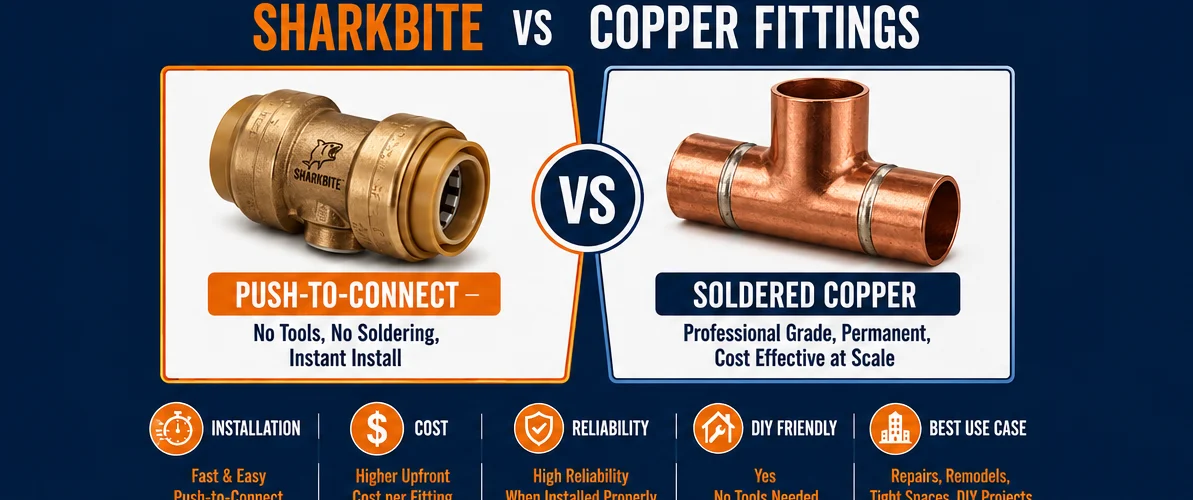
SharkBite push-fit vs soldered copper fittings — we compare 5 products across installation difficulty, cost, reliability, and best use case to help you choose the right fitting for every job.
Please note: Product availability and information are based on our research at time of writing and are subject to change. Always check Amazon for the latest details before purchasing.
Few decisions divide DIY homeowners and professional plumbers quite as sharply as the choice between SharkBite push-fit fittings and traditional soldered copper. SharkBite revolutionized home plumbing repairs when it arrived in the US market — the ability to connect PEX, copper, and CPVC pipe in seconds without a torch, flux, or any plumbing experience changed what was realistically DIY-accessible. But copper soldering remains the professional standard for permanent supply lines, and many licensed plumbers still won’t specify push-fit fittings for behind-wall installations.
So which is actually right for your project? The honest answer is: both, depending on the job. This guide reviews three of the best SharkBite Max fittings and two professional-grade copper options side by side. For a deeper look at pipe material choices, see our PEX vs copper guide. If you’re leaning toward soldering, our roundup of the best soldering kits covers everything you need to get started.
| Product | Rating | Best For | Price | Buy |
|---|---|---|---|---|
| SharkBite Max 1/2″ Coupling UR008A BEST OVERALL | ★★★★★ | Repairs & Quick Fixes | $ | Buy → |
| SharkBite Max 90° Elbow UR248A | ★★★★★ | Tight Spaces & Turns | $ | Buy → |
| SharkBite Max Tee UR362A | ★★★★★ | Branch Line Additions | $ | Buy → |
| EZ-FLUID 1/2″ Copper Slip Coupling (10-pack) | ★★★★★ | New Construction | $ | Buy → |
| PROCURU 1/2″ Copper Coupling with Stop (10-pack) | ★★★★★ | Pro Permanent Installs | $ | Buy → |
1. SharkBite Max 1/2 Inch Coupling UR008A — Best Overall
🏆 Best Overall
Editor’s Choice
The SharkBite Max UR008A is the push-to-connect fitting that most DIYers reach for first — and for good reason. The Max range is SharkBite’s latest generation, featuring a redesigned grip ring and O-ring system that the company says delivers measurably improved reliability over the original SharkBite line. The brass body is compatible with 1/2 inch PEX, copper, CPVC, PE-RT, and HDPE pipe, covering the vast majority of residential water supply systems in the US. That multi-pipe compatibility is what makes the coupling the most versatile fitting in this entire roundup.
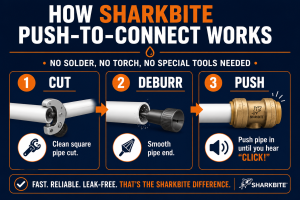
Installation is as fast as advertised: deburr the pipe end, mark the insertion depth, and push the fitting on until it seats against the mark. Done. No torch, no flux, no waiting for the pipe to dry. The coupling is also removable using a SharkBite disconnect clip — so if a layout needs to change or you’re using it as a temporary repair, you can pull it off cleanly and reuse it. For accessible repairs, emergency fixes, or locations where a torch simply isn’t practical, the UR008A is hard to beat.
⭐ Our Top Pick
Bestselling
When a repair or new run requires a direction change — routing around a joist, navigating a tight under-sink cabinet, or connecting to an appliance stub-out — the SharkBite Max UR248A 90-degree elbow does the job without a flame anywhere near your joinery. Like the coupling, the Max elbow features the updated grip ring and O-ring design for secure, code-compliant connections on 1/2 inch PEX, copper, and CPVC. Push both pipe ends in, and the joint is as watertight as anything a professional would solder in the same spot.
The real advantage emerges in confined spaces. A plumber sweating a 90-degree copper elbow in a cramped cabinet under a kitchen sink needs torch clearance, a dry pipe, and a steady hand in an awkward position. None of that applies here. As long as the pipe ends are cut cleanly and squarely — use a proper pipe cutter rather than a hacksaw — the UR248A seats reliably every time. It’s one of the most practically useful fittings in any plumber’s or DIYer’s toolkit.
🔥 Most Popular
Staff Pick
The SharkBite Max UR362A tee is the fitting that makes adding a new branch line genuinely accessible to the average homeowner. Traditionally, splicing in a tee on a copper supply line means cutting a section of pipe, cleaning and fluxing three pipe ends, making three soldered joints in quick succession while keeping everything properly aligned, and hoping none of the joints cool unevenly and weep. The UR362A turns that into a two-cut, push-and-done job that requires nothing beyond a pipe cutter and a marker.
What makes the tee particularly valuable is its ability to work on a pressurized live line. With the water briefly shut off just long enough to make the two cuts, you can push the tee onto the existing pipe and restore water pressure in under a minute — the fitting seals the moment it seats. Plumbers increasingly use push-fit tees as provisional connections when running new lines in occupied properties, even when the final install will be soldered copper. For accessible branch additions — refrigerator ice makers, bathroom additions, whole-house filters — the SharkBite Max tee is the fastest, most practical solution available to a DIYer.
💰 Best Value
Pro Grade
The EZ-FLUID 1/2 inch copper slip coupling is the go-to choice when cost per fitting matters and you have the skills — or the willingness to learn — to solder. Sold in a 10-pack, the per-fitting cost significantly undercuts any SharkBite option, which adds up quickly when you’re running new supply lines through multiple rooms or an entire house. The CxC (copper-by-copper) sweat connection is the industry standard for residential water supply, and a properly made soldered joint is among the most durable connections in plumbing — outlasting the pipe itself in most cases.
The trade-off is technique. Sweating copper requires a propane or MAPP torch, lead-free solder, flux, clean and dry pipe ends, and the manual dexterity to heat the joint evenly and feed solder smoothly into the gap. For a first-timer, the learning curve is real — a cold or bridged joint will leak even if it looks fine on the outside. But for contractors, remodelers, and experienced DIYers running new copper through walls where the fittings won’t be accessible after drywall, the EZ-FLUID coupling at this price point is the professional-standard choice. See our roundup of the best soldering kits if you’re setting up to solder for the first time.
👷 Pro Choice
Made in USA
PROCURU’s 1/2 inch copper coupling with stop stands apart from generic copper fittings on two counts: it’s manufactured in the USA, and it carries lead-free certification to NSF/ANSI 61 and 372 — the standards required for potable water contact in all 50 states. For licensed plumbers who need to document material compliance on commercial or residential projects, those credentials matter. The roll stop (a small internal ridge partway through the fitting body) ensures both pipe ends seat correctly at the center of the fitting during soldering, making alignment more consistent and reducing the chance of a pipe slipping through during the heat cycle.
Where the EZ-FLUID slip coupling is best suited to new runs where insertion depth can be varied, the PROCURU stop coupling is the professional’s choice for clean, symmetrical repair joints on existing pipe where exact centering is important. The 10-pack pricing makes it practical for multi-connection jobs, and the made-in-USA assurance gives contractors and homeowners alike confidence in material quality and dimensional consistency. If you’re running new copper throughout a property and want fittings you can stake your reputation on, PROCURU is worth the small premium over generic imports.
Here’s how push-fit SharkBite fittings and traditional soldered copper compare across the five criteria that matter most when choosing for a specific job:
| Criteria | SharkBite Push-Fit | Copper Soldered |
|---|---|---|
| Installation difficulty | ✓ Easy — push-fit, no tools or skills needed | Moderate to hard — requires torch, flux, and technique |
| Cost per fitting | Higher — significantly more per fitting vs copper | ✓ Lower — especially when bought in multi-packs |
| Long-term reliability | Very good — SharkBite rates fittings to 25 years in accessible locations | ✓ Excellent — properly soldered joints routinely last 50+ years |
| Best use case | Repairs, DIY additions, accessible locations, mixed pipe types | New construction, behind-wall permanent installs, large-scale projects |
| DIY friendly? | ✓ Yes — no training or special tools needed | Conditional — learnable, but poor technique causes leaks |
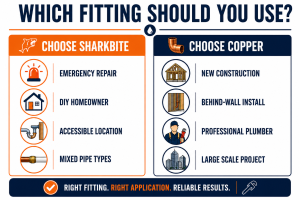
Push-fit fittings are the right call in the following scenarios:
Soldered copper fittings remain the better choice in these situations:
🔧 DIY OR HIRE A PLUMBER?
Use our free Plumbing Cost Estimator to compare DIY costs vs hiring a licensed plumber — takes just 30 seconds.
Yes — SharkBite fittings are designed and rated for permanent installation in residential potable water systems. SharkBite rates the Max range for 25 years of service life and they are listed to ASTM and CSA standards for permanent use. However, SharkBite’s own documentation and most plumbing professionals recommend that permanently installed fittings remain accessible for inspection rather than being concealed inside walls or under concrete. This isn’t a code requirement in most jurisdictions, but it’s widely considered best practice. For accessible locations — under sinks, in utility rooms, in crawl spaces — SharkBite fittings are a legitimate permanent solution.
In the majority of US states and jurisdictions, yes. SharkBite Max fittings are listed to ASSE 1061, ASTM F877, and CSA B137.2/B137.9 standards, and are approved for use with PEX, copper, and CPVC under the International Plumbing Code (IPC) and the Uniform Plumbing Code (UPC). However, plumbing codes are adopted at the local level, and individual municipalities or inspectors may have additional requirements or restrictions. If you’re doing permitted work, always verify with your local building department before specifying push-fit fittings — especially for concealed installations.
SharkBite rates their fittings for 25 years of service life in residential applications when installed correctly. In practice, field experience suggests they perform reliably over that period when used in accessible locations with compatible pipe. The O-ring is the component most likely to degrade over time — it can be affected by chloramine-treated water (now common in many US municipal systems) at an accelerated rate compared to chlorine alone. If your water supply is treated with chloramine, this is worth factoring into a long-term decision between push-fit and soldered copper for permanent installations.
Sometimes a job is too big for DIY. If you need a licensed plumber in your area, search PlumberArchive.com — the US plumber directory with 12,151+ verified plumbers across all 50 states.
Find a trusted plumber near you →
Looking for our top recommended tools in one place? Browse our curated Amazon Storefront →
Get weekly plumbing tips, honest tool reviews and DIY guides delivered to your Facebook feed.
For accessible installations where the fitting can be periodically inspected, SharkBite fittings have a strong real-world track record and are code-compliant in most US jurisdictions. However, a properly soldered copper joint is mechanically more robust and carries a longer expected service life — 50+ years versus the 25 years SharkBite rates their fittings for. The reliability gap is most significant for concealed behind-wall installations, where a push-fit failure is much harder to detect early. For visible, accessible locations, the reliability difference is less meaningful in practice. For permanent behind-wall installs, most professional plumbers still specify soldered copper.
Yes — this is one of SharkBite’s most useful characteristics. Push-fit fittings connect directly to copper pipe at one end and to PEX, CPVC, or other compatible materials at the other, making them the natural choice for repairs and additions in mixed-material systems. You can solder copper fittings throughout the majority of a system and use SharkBite push-fit fittings specifically for the connections that are hardest to solder — tight spots, locations near wood where torch use carries fire risk, or repairs made on wet pipe. Many professional plumbers do exactly this, using each fitting type where it makes the most practical sense.
SharkBite fittings are designed to be removable. You’ll need a SharkBite disconnect clip (or disconnect tongs, sold separately) — a small U-shaped tool that slides over the pipe and depresses the fitting’s release collar while you pull the pipe free. Without the clip, it’s very difficult to release the internal grab ring cleanly. Shut the water off before removal, then slide the disconnect clip onto the pipe up against the fitting body, press it in firmly to compress the release collar, and pull the pipe and fitting apart simultaneously. The fitting can then be reused on a new pipe end if the O-ring and grab ring are in good condition.
It depends on the application. Most professional plumbers accept and use SharkBite fittings for accessible repairs, emergency fixes, and situations where a torch isn’t practical — and many carry them on their vans for exactly these scenarios. Where opinions diverge is permanent behind-wall or concealed installation. Conservative plumbers won’t specify push-fit fittings inside walls regardless of code compliance, preferring the longer track record and greater mechanical permanence of soldered copper. Others use them routinely for all accessible work with no issues. The consensus view is broadly: SharkBite for visible, accessible locations; soldered copper for anything that goes inside a wall permanently.
The honest answer is that SharkBite and soldered copper aren’t competing for the same jobs — they excel in different situations. If you’re a DIY homeowner making a repair, adding a branch line, or working in a tight spot where a torch isn’t practical, the SharkBite Max Coupling and its push-fit companions are the clear, safe, reliable choice. They’re fast, they’re removable, and they work. If you’re a plumber or experienced DIYer running new copper through open framing before drywall, the PROCURU copper coupling and the EZ-FLUID 10-pack give you the lowest cost per fitting and the most durable joints available.
For more on pipe material decisions, see our full PEX vs copper guide. And if you’re ready to add soldering to your skillset, our roundup of the best soldering kits covers everything from entry-level kits to professional torches. For more on the push-fit side, see our best push-to-connect fittings guide and push-to-connect vs crimp fittings.
✍️ About This Review
Sarah Mitchell, Home Improvement Editor — Sarah Mitchell focuses on helping homeowners make smart buying decisions without overspending. She specialises in product comparisons, buying guides and budget-conscious recommendations — cutting through the marketing noise to find tools that genuinely deliver value. Learn how we test →
Utility pump vs sump pump: one is portable for occasional jobs, the other a permanent install for ongoing water. See which your basement needs.
Pipe repair clamp, tape, or epoxy — which should you use for a leaking pipe? Compare how each works, durability, and when to reach for which.
Not sure if your home has a septic tank or a sewer connection? Learn how to tell which one you have, plus the maintenance and cost differences.

