Please note: Product availability and information are based on our research at time of writing and are subject to change. Always check Amazon for the latest details before purchasing.
Introduction
Push-to-connect fittings let you join pipe, redirect a run, or add a shutoff point by simply pushing the pipe into the fitting — no torch, no flux, no cure time. They’ve become a genuine staple for repair and renovation work because they remove the two biggest barriers to a DIY plumbing fix: the specialized tools soldering requires, and the uncertainty of matching a fitting to whatever pipe material is already in the wall.
This roundup covers five SharkBite Max push-to-connect fittings, each built for a different job — a coupling for joining pipe, an angle stop valve for a fixture shutoff, an elbow for redirecting a run, a ball valve for inline shutoff control, and a tee for branching a line. That’s a different focus than our SharkBite vs copper fittings comparison, which weighs push-to-connect against soldered copper as a joining method in general — here, we’re assuming you’ve decided push-to-connect is the right approach, and helping you pick the right fitting type for the job in front of you.
✏️ Our Take
Push-to-connect fittings solve the same basic problem as soldering or gluing pipe — joining two sections together, redirecting a run, or adding a shutoff point — but without the torch, flux, or cure time. The fitting type you need depends entirely on the job: a coupling for a simple straight join, an elbow for a directional turn, a tee for branching a line, and a valve for shutoff control. SharkBite dominates this category so completely that it’s genuinely difficult to find a comparably established competitor selling in meaningful volume — for push-to-connect specifically, sticking with the established brand is a reasonable default rather than a missed opportunity to shop around.
Quick Comparison Table
Full Reviews — 5 Best Push-to-Connect Fittings
1. SharkBite Max 1/2 Inch Coupling, Push to Connect Brass Plumbing Fitting, PEX Pipe, Copper, CPVC, PE-RT, HDPE, UR008A — Best Overall
🏆 Best Overall
Universal Compatibility
The SharkBite Max 1/2 inch coupling joins two pipe ends of the same size, covering the single most common repair scenario in residential plumbing. Exceptional buyer demand and a very large review base back it up.
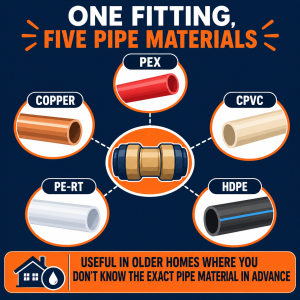
What sets it apart is genuinely universal compatibility: the same fitting works on PEX, copper, CPVC, PE-RT, and HDPE pipe, so you don’t need to identify the exact pipe material before buying — a real advantage in older homes. Installation is push-and-done, with brass construction built for long-term durability. The tradeoff is a per-piece price premium, and removing it later requires a low-cost disconnect clip.
- Joins two pipe ends of the same size for straight-line repairs
- Compatible with PEX, copper, CPVC, PE-RT, and HDPE pipe
- Brass construction for durable, long-term performance
- Push-to-connect installation — no soldering, clamps, or special tools
✓ Pros
Exceptional buyer demand and a very large review base confirm this is one of the most trusted push-to-connect fittings on the market
Genuinely universal compatibility across PEX, copper, CPVC, PE-RT, and HDPE pipe means one fitting works across nearly any residential plumbing material
No soldering, clamps, or special tools required for installation
Brass construction offers durable, long-term performance
SharkBite is the most established and widely recognized brand in this specific fitting category
✗ Cons
Premium pricing compared to traditional threaded or soldered fittings on a per-piece basis
A specialized (though inexpensive) disconnect clip tool is needed if you ever want to remove and reuse the fitting
🛒 Check Price on Amazon — $ →
2. SharkBite Max 1/2 x 3/8 Inch Compression Angle Stop Valve, Quarter Turn, Push to Connect Brass Plumbing Fitting, PEX Pipe, Copper, CPVC, PE-RT, HDPE, UR23036 — Best for Shutoff Replacement
⭐ Best for Shutoff Replacement
Compression Angle Stop
A seized or corroded fixture shutoff valve is one of the most common small plumbing jobs a homeowner runs into, and it’s what this quarter-turn angle stop valve is built to replace. Strong buyer demand confirms reliable performance, and the quarter-turn mechanism gives a clear, tactile sense of fully open versus fully closed.
The push-to-connect inlet is the real time-saver: instead of soldering a new valve onto old copper pipe, you push the inlet on and you’re done. The outlet side uses a standard compression fitting, so you’ll still need to seat a nut and ferrule correctly there. It’s built for a specific angle orientation — worth confirming against your existing setup before ordering.
- Quarter-turn ball design for a clear open/closed position
- Push-to-connect 1/2 inch inlet, 3/8 inch compression outlet
- Angle configuration for standard under-fixture installations
- Compatible with PEX, copper, CPVC, PE-RT, and HDPE supply pipe
✓ Pros
Strong buyer demand confirms reliable performance for one of the most common plumbing repair jobs — replacing a seized or leaking fixture shutoff valve
Quarter-turn design gives a clear, tactile confirmation of fully open or fully closed
Push-to-connect inlet eliminates the need to solder onto old copper pipe when swapping out a valve
Compatible across the same wide range of pipe materials as the rest of the SharkBite Max line
✗ Cons
The compression outlet side still requires a properly seated compression nut and ferrule for the connected supply line
Angle configuration only fits specific installation orientations, so confirm your fixture’s setup before buying
🛒 Check Price on Amazon — $ →
3. SharkBite Max 1/2 x 1/2 in PTC 90-Degree Elbow, Push-to-Connect Brass Plumbing Fitting, UR248A — Best for Directional Fitting
🎯 Best for Directional Fitting
90° Redirect Fitting
Every plumbing run eventually hits a corner, a stud, or some other obstruction it needs to route around, and that’s the job this 90-degree elbow handles. Strong buyer demand and a solid review base confirm dependable performance, with push-to-connect fittings on both ends — no soldering or gluing at either connection.
That’s the elbow’s whole value proposition: navigating framing obstructions or tight cavities a straight run of rigid pipe can’t get through. It shares the same brass construction and broad pipe-material compatibility as the rest of the SharkBite Max lineup. The one tradeoff is inherent to elbow fittings generally — a 90-degree turn adds a small amount of flow restriction versus a straight section, regardless of brand.
- 90-degree elbow redirects a pipe run around corners or obstructions
- Push-to-connect on both ends — no soldering or gluing at either connection
- Brass construction shared with the rest of the SharkBite Max line
- Compatible with PEX, copper, CPVC, PE-RT, and HDPE pipe
✓ Pros
Strong buyer demand and a solid review base confirm dependable performance for redirecting pipe runs
Push-to-connect on both ends means no soldering or gluing required at either connection
Ideal for navigating tight spaces or framing obstructions that a straight run of rigid pipe can’t accommodate
Same broad pipe material compatibility as the rest of the SharkBite Max lineup
Brass construction holds up well to the repeated pressure changes typical of a directional fitting
✗ Cons
A 90-degree elbow adds a small amount of flow restriction compared to a straight run, as is true of any elbow fitting regardless of brand or connection type
🛒 Check Price on Amazon — $ →
4. SharkBite Max 1/2 x 1/2 in PTC Ball Valve, Push-to-Connect Brass Water Shut-Off Plumbing Fitting, UR22222 — Best for Full Shutoff Control
💰 Best for Full Shutoff Control
Full Ball Valve
There’s an important distinction between a fixture-level stop valve and a full ball valve, and this fitting is the latter — a complete inline shutoff you can install anywhere along a water line. Strong buyer demand confirms dependable long-term sealing performance, which matters most here, since its whole job is holding a leak-free seal in both positions for years.
Push-to-connect on both ends makes it straightforward to add a dedicated shutoff point anywhere a line doesn’t already have one — ahead of a new appliance or fixture where you’d otherwise shut off the whole house to work on it. It carries the same broad pipe compatibility as the rest of the SharkBite Max line. The added mechanism does mean a higher price and a bulkier profile, so confirm you have clearance before installing in a tight space.
- Full ball valve — not just a fixture-level stop — for complete inline shutoff
- Push-to-connect on both ends for tool-free installation anywhere along a line
- Brass construction built for repeated open/close cycling
- Compatible with PEX, copper, CPVC, PE-RT, and HDPE pipe
✓ Pros
Full ball valve design gives complete, reliable inline shutoff control rather than just a fixture-level stop
Strong buyer demand confirms dependable long-term sealing performance
Push-to-connect on both ends makes installing a new shutoff point anywhere along a line straightforward without soldering
Ideal for adding a dedicated shutoff before a fixture or appliance that doesn’t currently have one
Consistent SharkBite Max compatibility across PEX, copper, CPVC, PE-RT, and HDPE
✗ Cons
Higher price point than a simple coupling or elbow, reflecting the added mechanism inside a full ball valve
Bulkier profile than a basic fitting, so confirm you have adequate clearance before installing in a tight space
🛒 Check Price on Amazon — $$ →
5. SharkBite Max 3/4 Inch Tee, Push to Connect Brass Plumbing Fitting, PEX Pipe, Copper, CPVC, PE-RT, HDPE, UR370A — Best for Branch Connections
👷 Best for Branch Connections
3/4″ Branch Tee
A tee fitting solves a different problem than anything else in this roundup — instead of joining, redirecting, or shutting off a line, it splits one line into two. That makes it the fitting to reach for when adding a new fixture connection onto an existing supply run without re-routing the whole thing. This one is sized at 3/4 inch, larger than the 1/2 inch fittings covered elsewhere here, matching the diameter most homes use for main supply lines.
Solid buyer demand and an established review base confirm reliable performance at that larger size. All three ports are push-to-connect, so branching a main line doesn’t require soldering across the installation. The main thing to double-check before ordering is pipe diameter — 3/4 inch isn’t a drop-in match for the more common 1/2 inch fixture-level connections most homeowners work with.
- Tee configuration branches a single line into two directions
- 3/4 inch sizing matches common main supply line diameter
- Push-to-connect on all three ports
- Compatible with PEX, copper, CPVC, PE-RT, and HDPE pipe
✓ Pros
Tee configuration allows you to branch a single water line into two directions without cutting and re-routing the entire run
3/4 inch sizing matches common main supply line diameter, distinct from the 1/2 inch fittings elsewhere in this roundup
Solid buyer demand and an established review base confirm reliable performance at this larger size
Push-to-connect on all three ports eliminates soldering across an entire branch installation
Useful for adding a new fixture or appliance connection to an existing main line
✗ Cons
Larger 3/4 inch sizing means it’s not a drop-in match for the more common 1/2 inch fixture-level connections most homeowners deal with
Confirm your existing pipe diameter before ordering
🛒 Check Price on Amazon — $ →
Push-to-Connect Fitting Buying Guide
Choosing the right fitting type for your job
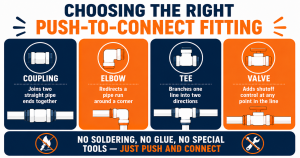
The biggest mistake in buying a push-to-connect fitting is picking one on brand recognition alone rather than the job. A coupling only joins two pipe ends in a straight line. An elbow redirects a run at a fixed 90-degree angle. A tee branches one line into two. A valve — simple angle stop or full ball valve — controls flow rather than just connecting pipe. Map out what your repair needs to do — join, turn, split, or shut off — before price or brand.
Why push-to-connect works across so many pipe materials
Push-to-connect fittings like the SharkBite Max line use an internal stainless steel release collar and O-ring seal that grip a pipe’s outer surface, rather than a chemical bond (solvent-welded PVC) or fused metal joint (soldered copper). Because the seal works on outer diameter rather than chemistry, the same fitting grips PEX, copper, CPVC, PE-RT, and HDPE pipe once it’s cut cleanly and sized correctly — the core reason these fittings can claim universal compatibility.
Removability — using a disconnect clip if you need to reuse a fitting later
Push-to-connect fittings hold permanently under normal use but aren’t meant to be pulled apart by hand — doing so risks damaging the internal O-ring or collar. A small, inexpensive disconnect clip depresses the collar so the pipe pulls free undamaged. Keep one on hand for regular repair work.
US regional context: mixed pipe materials in older homes
Push-to-connect fittings have become particularly popular across the US for repair and renovation work in older homes, where matching an existing pipe material exactly (especially in homes with a mix of copper and PEX from different renovation eras) can otherwise mean extra adapters or a full re-plumb of a section. Because SharkBite Max fittings work across PEX, copper, CPVC, PE-RT, and HDPE without needing to know the exact pipe material in advance, they’re particularly useful for repairs in homes where the existing plumbing history isn’t fully documented — a common situation in older housing stock nationwide.
Frequently Asked Questions
Q: Are push-to-connect fittings as reliable as soldered connections?
Yes, when installed correctly on a properly cut and deburred pipe end, push-to-connect fittings form a seal rated for the same pressure and temperature range as a standard soldered joint. The internal collar and O-ring create a mechanical seal rather than a fused one — different from soldering, but not weaker, and commonly used by licensed plumbers, not just as a DIY workaround.
Q: Can push-to-connect fittings be removed and reused?
Yes. A small disconnect clip depresses the internal release collar so the pipe pulls free without damaging the fitting’s seal, allowing it to be reused elsewhere. Pulling a fitting apart by hand without the clip risks damaging the O-ring or collar, which is why the clip — not brute force — is the correct removal method.
Q: Do push-to-connect fittings work on all pipe materials?
SharkBite Max fittings are rated for PEX, copper, CPVC, PE-RT, and HDPE pipe, covering most residential plumbing materials. They’re not designed for PVC or ABS drain, waste, and vent piping, or for gas lines — fittings in this category are for pressurized water supply lines only.
Q: Is a push-to-connect fitting a permanent connection?
It holds permanently under normal use, but isn’t permanent in the same irreversible sense as a soldered joint. With a disconnect clip, it can be removed cleanly if a repair or fixture swap requires changing the connection later — an advantage over a soldered joint, which typically has to be cut out entirely to modify.
Conclusion
For most repairs, the SharkBite Max 1/2 Inch Coupling is the easiest recommendation — it covers the single most common job with universal pipe compatibility and exceptional buyer trust behind it. If you’re replacing an old or leaking fixture shutoff, the SharkBite Max Angle Stop Valve is purpose-built for that job, while the SharkBite Max 90-Degree Elbow is right for routing a line around a corner.
For a new inline shutoff point ahead of an appliance or fixture that doesn’t have one, the SharkBite Max Ball Valve gives full shutoff control rather than just a fixture-level stop. If the job is branching a main line, the SharkBite Max 3/4″ Tee is sized correctly for that larger-diameter work. Still weighing push-to-connect against soldered copper in general? Our SharkBite vs copper fittings and PEX vs copper pipe comparisons cover that broader decision, and if you’re working with PEX pipe directly, our PEX crimp tools review covers the tools for that method instead. Or if you’re still weighing push-to-connect against other connection types, our push-to-connect vs crimp fittings and push-to-connect vs compression fitting comparisons cover those matchups directly.
✍️ About This Review
PTR Editorial Team — Product Reviews. We compare manufacturer specifications, installation requirements, compatibility and available product documentation to help homeowners choose suitable tools and parts. How we review →