
Comparisons
2 Nov 2026

Shower Filter vs Water Softener: What Each Can—and Cannot—Do
Softening reduces hardness; shower filters target specific substances. Compare what each is documented to do, check claims and test your water first.
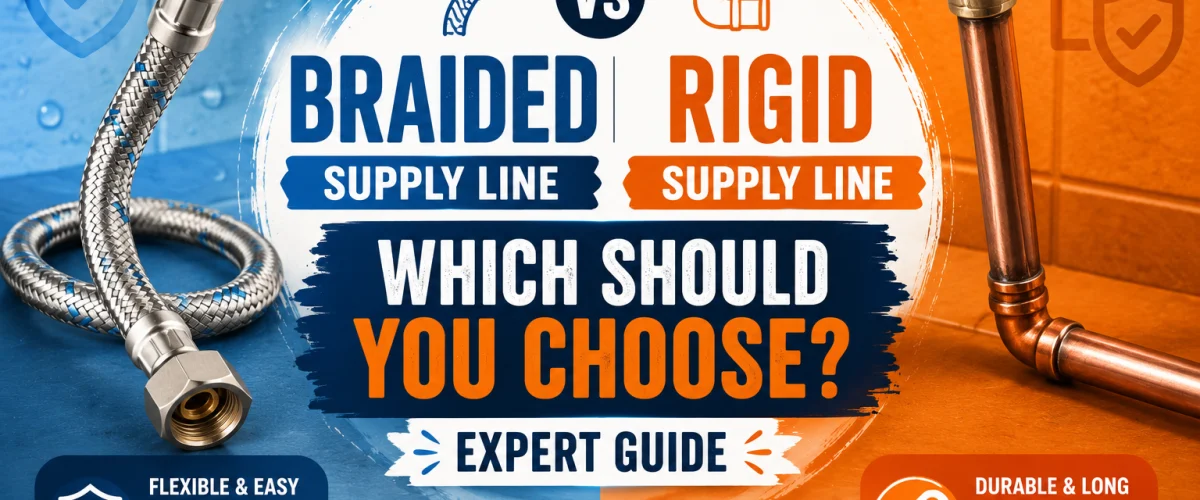
Braided vs rigid supply lines compared — durability, installation difficulty, cost, and which one to choose for your fixture.
Please note: Information in this comparison is based on our research at time of writing and is subject to change. If you notice active leaking or water damage, address it immediately rather than waiting to compare options.
Supply lines are an easy thing to overlook until one fails, and the choice between rigid and braided materially affects both how easy the installation is and how much leak risk you’re carrying afterward. Toilets, faucets, ice makers, and dishwashers all rely on one of these two connection types, and the difference between them is bigger than most homeowners assume.
This comparison covers the practical differences for anyone replacing or installing a supply line in 2026, whether that’s a single toilet connection or a full round of fixture upgrades. If you’re troubleshooting an active leak right now, our leaking toilet supply line guide walks through diagnosis and repair, and our Water Shut Off Valves review is worth a look if you’re upgrading the valve at the same time.
✏️ Our Take
Rigid supply lines were the standard for decades — solid copper or chrome-plated tubing that had to be cut to an exact length and carefully bent to fit. Braided stainless steel lines have largely replaced them for good reason: they’re flexible, come in standard lengths that fit almost any installation without cutting, and the steel braiding over an inner tube dramatically reduces the risk of a sudden burst compared to a line that’s aged and become brittle. Rigid lines aren’t obsolete — they still have a place in certain fixed installations — but for the vast majority of toilet, faucet, and appliance connections, braided lines are the safer, easier choice, and the price difference is small enough that it rarely makes sense to choose otherwise.
IN THIS GUIDE
A rigid supply line is solid metal tubing, typically copper or chrome-plated copper, that must be cut and carefully bent to the exact length and angle needed for a specific installation. There’s no flex to it once it’s shaped — the tubing holds whatever form it was bent into. Older homes sometimes have rigid lines in other materials too, including plain brass or, in some pre-1980s installations, thin-walled steel, both of which are even more prone to corrosion over time than copper.
Once installed correctly, rigid lines are very stable and don’t move or vibrate, which some installers consider a genuine benefit for a permanent, fixed connection. The tradeoff is precision: because the tubing can’t flex, it requires accurate measurement and a proper fit at installation, since there’s no give to accommodate small misalignments between the valve and the fixture.
Connections at each end are typically compression fittings, where a ferrule (a small brass ring) is compressed around the tubing as the nut is tightened, forming the seal. That connection style works well, but it generally only tolerates being made once — repeatedly disconnecting and reconnecting the same compression fitting can deform the ferrule and compromise the seal, which is part of why rigid lines are treated as more of a set-it-and-leave-it installation than something meant to be serviced repeatedly.
A braided supply line is a flexible inner tube, typically PVC or rubber, wrapped in a braided stainless steel mesh sleeve, with standard fittings crimped onto each end. The flexibility lets it bend slightly to accommodate minor misalignment between the shutoff valve and the fixture.
These lines are sold in standard pre-set lengths, so installation is generally a matter of picking the right length rather than cutting or precisely bending anything. The steel braid itself does real structural work too — it provides reinforcement around the inner tube, significantly reducing the risk of a sudden rupture compared to an aged rigid line or an unreinforced flexible line.
Connector sizes are standardized too, which is a big part of why these lines are so easy to shop for and install. Most toilets use a 3/8-inch compression fitting on the valve end and a larger fitting on the tank end, while faucets typically use 3/8-inch compression on both ends — checking your fixture’s existing connection before buying a replacement avoids an awkward second trip to the store.
Durability and Failure Risk
Rigid lines are very durable when properly installed, but they become brittle and prone to cracking after decades of service, particularly at bend points where the metal has been stressed the most since installation. That brittleness tends to develop slowly and invisibly, with no obvious warning sign until the line actually fails. Corrosion at the connection threads is another common failure point, especially in homes with harder water or older galvanized plumbing feeding into the line.
Braided lines hold up differently. The steel mesh sleeve resists bursting even if the inner tube develops a weakness, providing a meaningful safety margin that rigid or unbraided lines simply don’t have. That reinforcement is the main reason braided lines have become the default recommendation over the last couple of decades. Unbraided vinyl or plastic lines sit at the opposite end of the spectrum — without any reinforcing layer, they’re the most likely of the three to fail suddenly and without warning, which is why they’re worth avoiding even though they’re usually the cheapest option on the shelf.
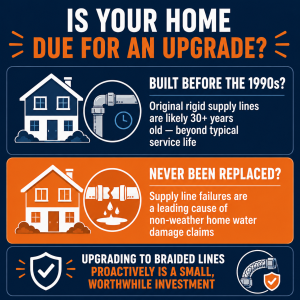
Homes across the US built before the 1990s often still have original rigid supply lines throughout the house, particularly on toilets and older faucet installations — these lines have frequently been in service for 30+ years at this point, well beyond what most plumbers consider a reasonable service life. Insurance claims data consistently shows supply line failures as a leading cause of non-weather-related home water damage claims, which is part of why many home inspectors now flag old rigid lines as a recommended (if not urgent) update during a home sale or routine inspection.
Rigid lines require precise measurement, cutting, and bending to match the exact fixture and wall configuration — a job that genuinely benefits from prior plumbing experience or specialized bending tools to get a clean, leak-free fit. A tubing cutter, a bending tool sized to the tubing diameter, and a flaring or compression-fitting kit are the minimum toolset, and a bend that’s slightly off can throw the whole fit out of alignment, forcing a redo with fresh tubing.
Braided lines are sold in standard lengths, so the job is mostly just connecting both ends by hand-tightening, then snugging with a wrench. It’s a genuinely accessible repair for most DIY homeowners, with none of the cutting or bending precision rigid lines demand. If you’re currently dealing with a leak rather than a fresh installation, our leaking toilet supply line guide walks through diagnosing and fixing it step by step.
Rigid lines carry a similar or occasionally lower material cost ($), but the labor side often costs more, since a proper custom fit frequently requires more time or a professional installer with the right tools on hand. If you don’t already own a tubing cutter and bending tool, that’s an additional upfront cost on top of the tubing itself.
Braided lines run slightly higher on material cost per line ($), but the difference is minor, and DIY installation avoids labor costs entirely for most homeowners. Once you factor in the time and tools a rigid installation demands, braided usually ends up the cheaper option in practice, not just on paper, especially for a single fixture replacement rather than a full-house re-plumb.
Rigid lines still have a legitimate place in certain new construction installations, where a completely fixed, non-flexing connection is specifically desired as part of the design rather than a matter of habit or tradition.
They also make sense in situations where an exact custom fit is required and a professional installer is already doing the work, since the labor cost of a precise rigid installation is no longer a downside if you’re paying for professional installation regardless. Some plumbers also prefer rigid lines in tight or unusually shaped spaces where a braided line’s slight flex could still leave it rubbing against a cabinet wall or another pipe over time.
For most DIY replacement or repair situations, though, braided remains the more practical choice by a wide margin, and there’s rarely a strong reason to seek out rigid tubing specifically for a routine toilet or faucet swap.
The table below maps the most common decision factors to whichever type actually wins on that point, based on everything covered above.
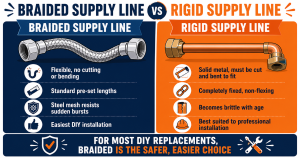
| Factor | Winner |
|---|---|
| Easiest DIY installation | BRAIDED |
| No cutting or bending required | BRAIDED |
| Lower risk of sudden failure | BRAIDED |
| Completely fixed, non-flexing connection | RIGID |
| Best for standard toilet/faucet replacement | BRAIDED |
| Marginally lower material cost (in some cases) | RIGID |
| Best for a beginner DIYer | BRAIDED |
| Preferred in certain new construction designs | RIGID |
If you’re dealing with an active leak rather than a proactive swap, our leaking toilet supply line guide covers diagnosis and repair before you get to the replacement step.
If you’re weighing a rigid installation with a custom fit, or you’d rather have a professional handle the swap entirely, search PlumberArchive.com — the US plumber directory with 12,000+ verified local plumbers across all 50 states.
Get weekly plumbing tips and DIY guides delivered straight to your Facebook feed.
For most homeowners, yes. Braided lines are easier to install, more forgiving of minor misalignment, and significantly more resistant to sudden failure than an aged rigid line. Rigid lines aren’t worse in an absolute sense, but they’re a better fit for specific fixed installations than for the general toilet, faucet, and appliance connections most homeowners deal with. If you’re simply replacing a worn or leaking line and have no particular reason to stick with rigid, braided is the safer default.
A general guideline is 5 to 10 years, though many last longer with no issues. Life expectancy depends on water quality, water pressure, and how much the connection experiences vibration or movement over time. Visible corrosion, cracking, or bulging in the braid is a sign it’s time to replace one regardless of exact age, and it’s worth a quick visual check any time you’re already working near a fixture’s connections.
Yes, in almost all cases. Turn off the shutoff valve, disconnect the old rigid line at both ends, and connect a braided line of the correct length in its place, hand-tightening first and then snugging with a wrench. It’s a genuinely straightforward swap that doesn’t require cutting or bending anything, which is part of why braided lines are the more DIY-friendly option — just double-check the connector sizes on both ends before buying a replacement.
Yes, though it’s less common and typically less sudden than a rigid line failure. The steel braid provides meaningful reinforcement against bursting, but the connections at each end can still loosen, corrode, or wear out over time. Periodic visual inspection, and replacing any line showing corrosion or wear, is the best way to avoid a failure regardless of which type you have installed.
Braided stainless steel supply lines are the more practical, DIY-friendly, and safer choice for the large majority of home installations — easier to install correctly, more forgiving of minor misalignment, and meaningfully more resistant to a sudden failure than an aged rigid line. Our roundup of the best braided supply lines covers the specific models worth buying.
Rigid lines still have a place in specific fixed or professionally-installed configurations, but they aren’t the default recommendation for most homeowners handling their own supply line replacement or repair. Unless your installation specifically calls for a non-flexing connection, or a professional is already doing precise custom work, there’s little reason to seek rigid tubing out over the modern alternative.
If your home still has original rigid lines from before the 1990s, proactively upgrading to braided is a worthwhile small investment rather than waiting for a failure to force the issue. Our leaking toilet supply line guide covers diagnosis and repair if you’re dealing with a leak right now, our Water Shut Off Valves review covers upgrading the valve itself, and our Kitchen Faucet replacement guide is a useful next stop if you’re tackling a full fixture swap.
✍️ About This Comparison
PTR Editorial Team — Product Comparisons. We compare manufacturer specifications, installation requirements, compatibility and available product documentation to help homeowners choose suitable tools and parts. How we review →
Softening reduces hardness; shower filters target specific substances. Compare what each is documented to do, check claims and test your water first.
A recirculation pump needs a path back to the water heater. Compare a dedicated return line with an under-sink bypass, and check your heater model first.
Compare PEX expansion, crimp and press connections system by system: the tubing, fittings, rings or sleeves, tools, inspection and temperature limits each maker documents.

