Guides
4 Oct 2026

How to Make a PEX Crimp or Clamp Connection (2026) — Step-by-Step Guide
Make a PEX crimp or clamp connection step by step: ring and clamp placement, gauge checks, failed joints and code notes from maker sheets.
Learn how a water heater's thermostat setting, tank water and tap temperature differ, how to measure tap temperature, and who should adjust it.
Please note: This guide is general reference for conventional gas and electric tank water heaters in single-family homes. Your heater’s own manual and rating label come first, and local rules may apply. It is not medical advice.
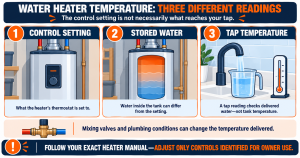
Questions about water heater temperature usually start with one number, the setting on the heater. But three different temperatures are involved, and they are not always the same. The thermostat setting is what the control is set to. The stored-water temperature is the temperature of the water inside the tank. The measured tap temperature is what actually comes out of a particular faucet. This guide shows how to measure the tap temperature, how to compare it with the setting, and how to decide who should change a setting if a change is needed.
It covers conventional gas and electric tank water heaters in single-family homes. It does not cover tankless or heat-pump water heaters, boiler-fed or shared building hot water systems, or disinfection procedures, and it does not recommend one setting for every household. A federal safety agency and a public health agency give guidance for different risks, and the manual for your own heater comes before anything written here. For related topics, see our guides to a water heater with no hot water, flushing a water heater and testing the pressure relief valve. For tankless sizing, see our water heater sizing guide.
At a Glance
| Difficulty | Easy for checking the tap temperature. Whether you can adjust anything depends on what your exact manual says. |
| Time | Varies—includes the manual’s waiting and recheck period. |
| Cost | $ for a water-temperature thermometer if you don’t already own one. This covers checking the temperature only; it does not include mixing valves, their installation or any professional adjustment. |
| Tools Needed | A thermometer made for measuring water temperature, used according to its own instructions; your heater’s owner’s manual and rating label; pen and paper for your readings |
| Skill Level | Beginner for checking the tap temperature. Adjusting depends on your manual and is sometimes a job for a qualified professional. |
✏️ Our Take
The number on a thermostat is not the temperature at your tap, and the published guidance points in different directions for different households. CPSC is concerned with scalds, CDC also with germs that can grow in plumbing, and manufacturers add instructions specific to each model. Measure the tap temperature first, think about who lives in your home, change only a control your own manual identifies for owner use, and bring in a qualified professional for anything else.
IN THIS GUIDE
| Term | What it means | How you find out |
|---|---|---|
| Thermostat setting | The temperature the heater’s control is set to, shown as a dial position, a label or a displayed value. | Read it from the control, and use your manual to understand what the marks or labels mean. |
| Stored-water temperature | The temperature of the water inside the tank. It can differ from the setting. | A tap reading checks delivered water, not the tank’s stored temperature. Mixing valves and plumbing conditions can affect it. |
| Measured tap temperature | The temperature of the water coming from one faucet at one moment. | Measure it with a water-temperature thermometer, as in Step 3. |
Manufacturers describe several reasons these can differ. A. O. Smith’s manual for an electric heater says repeated small draws can leave hot and cold water in the tank in layers, so the water can be as much as thirty degrees hotter than the thermostat setting, and that a hot surrounding area, a pre-heated water supply or a malfunction can also raise the temperature. Rheem’s manual for a gas heater says maximum water temperatures occur just after the burner has shut off. Heaters, controls and use patterns differ, so treat the setting as a starting point and the tap measurement as the check.
The Consumer Product Safety Commission’s Publication 5098, “Avoiding Tap Water Scalds” (edition marked March 2012) is written for consumers and aims at preventing scald injuries. It says most tap water scald injuries and deaths involve the elderly and children under five, and that burns can happen quickly at higher temperatures and, with long enough exposure, even at 120°F. CPSC urges users to lower their water heaters to 120°F. It also says a thermostat setting of 120°F may be necessary to reduce or eliminate the risk of most tap water scald injuries, and suggests lowering the thermostat to the lowest setting that still meets the hot water needs of clothes and dish washing machines. The publication is short and dates from 2012, and its notes on adjusting heaters are general, so your manual governs how your own heater is adjusted.
The Centers for Disease Control and Prevention’s page “Preventing Waterborne Germs at Home” (dated March 15, 2024) is written for households and addresses a different concern: germs that can grow in plumbing. About water heaters, CDC says keeping a home water heater between 130°F and 140°F can kill germs like Legionella in water but also increases the risk of burns. If you set a water heater above 120°F, CDC says to use valves that mix cold and hot water at the tap (thermostatic valves) to avoid burns, and it calls this especially important if young children, older adults or other people at increased risk of burns live in the home.
CDC also says to ask your healthcare provider about your risk of getting sick from Legionella and to discuss whether setting your water heater to 130°F or above is right for you. According to CDC, most healthy people do not get sick from these germs, and its page lists people who are more likely to, such as adults 50 and older and people with chronic lung disease or a weakened immune system. Read the full list on CDC’s page.
These recommendations address different risks that can apply to the same household. CPSC addresses scald prevention for consumers in general. CDC addresses germ growth, explains that a higher setting raises burn risk, and ties higher settings to mixing valves and a conversation with a healthcare provider. Neither is a rule that fits every household, and this guide does not choose a setting for you. The right decision can reasonably differ depending on who lives in your home, any advice you have received from a healthcare provider, your appliances and your heater’s manual.
This guide assumes a conventional gas or electric storage tank heater in a single-family home. If you have a tankless or heat-pump heater, or hot water from a shared or boiler-fed building system, your situation is different and this guide does not apply.
Manufacturers do not agree on how their heaters are adjusted, or on who should do it. Bradford White’s gas-fired manual shows several gas controls with different dial markings, notes that the direction that raises the setting is not the same on all of them, and says the dial ships at its lowest setting. Rheem’s manual for an electric model with an electronic control says not to try to set the temperature by removing the electronic control or the lower access panel. A Bradford White electric manual describes thermostat adjustment as work done inside the heater, which this guide does not cover. A. O. Smith’s manual for an electronic-control electric heater says water temperature should be adjusted primarily from the heater’s electronic control. Instructions written for one model, including any in this guide, may not apply to yours.
Find the owner’s manual that came with the heater. If you don’t have it, the heater’s rating or data plate lists the manufacturer, model and serial number you will need to find the manual on the manufacturer’s website or to ask the manufacturer for it. Read the sections on water temperature, scalding and adjusting the temperature. Note whether your manual identifies any control for owner use, and what it says about waiting after a change.
Manuals and public guidance give different timing advice, so use your manual’s if it gives any. CPSC’s publication suggests, for gas heaters, measuring first thing in the morning or at least two hours after hot water use. Rheem’s manual for a gas heater with an electronic display says reliable readings should be taken shortly after the burner cycles off, during a period of little or no use. Whatever timing you use, write it down with the reading in Step 4 so later readings can be compared.
Use a thermometer made for measuring water temperature, and follow its instructions for how to use it, how long to wait for a stable reading and what temperature range it is rated for. CPSC’s publication and Rheem’s manual both describe measuring with a thermometer in the hot water from a faucet. Use the thermometer, not your hands, to find out how hot the water is. Measure at the faucet your household uses most for bathing or showering; A. O. Smith’s manual suggests checking several points of use, such as a bathtub faucet, a shower and a bathroom sink.
Write down the date and time, which faucet you measured, how long it had been since hot water was last used, the thermostat setting as it appears on the control (the exact mark, label or displayed value), and the thermometer reading. A tap reading that differs from the setting is not necessarily a problem, for the reasons in the section on the three temperatures.
A reading that is much higher than the setting, or that keeps rising, is different. A. O. Smith’s manual lists a thermostat problem or other malfunction among the causes of higher-than-expected water temperature. If that is what you see, don’t adjust anything. Contact the manufacturer or a qualified professional.
There is no number in this guide to match. Consider:
If the measured temperature fits your household’s needs and your manual’s guidance, you may not need to change anything.
Only change a control that your exact manual explicitly identifies for owner use.
| If your exact manual… | Then |
|---|---|
| Names a control on the outside of the heater (a dial, knob or display) and tells owners how to use it | Follow those steps exactly. Make one small change at a time, and note the new setting. |
| Describes an adjustment that involves opening panels, disconnecting power or handling electrical or gas parts, or says a qualified installer, service agency or service technician handles it | Don’t attempt it yourself. Contact a qualified professional or the manufacturer’s technical support. |
| Says not to remove panels or covers to set the temperature | Follow your manual. Use only the control it identifies, if it identifies one. |
| Doesn’t mention owner adjustment, or you can’t find your manual | Contact the manufacturer with the model and serial number, or a qualified professional. |
| Is unclear, or you aren’t comfortable | Stop. Ask the manufacturer or a qualified professional. |
What counts as a qualified professional can depend on your manual and on local rules. Some manuals specify a qualified installer, service agency or service technician, and others refer to a licensed plumber or electrician. If you are unsure, ask the manufacturer or your local authority. This guide does not provide steps for opening panels, wiring or gas controls.
Follow your manual’s instructions about how long to wait for the water to reach a new setting. Then repeat the measurement under the same conditions as before and record the result. Make one change at a time. If the readings are not what you expected, stop and contact the manufacturer or a qualified professional rather than making repeated adjustments.
A thermostatic mixing valve blends hot and cold water to limit the temperature delivered to the fixture it serves. It does not change the stored-water temperature in the tank. CDC says to use these valves at the tap if you set a water heater above 120°F. Manufacturers recommend them too, and they name different standards: A. O. Smith’s manual refers to point-of-use thermostatic mixing valves and to ASSE 1070, and Rheem’s manual recommends a valve that complies with ASSE 1017. Watts, a valve maker, says valves controlling bathing and washing fixtures are listed to ASSE 1016 Type T or ASSE 1070, while valves controlling water at the source of supply are listed to ASSE 1017.
Which valve is right depends on where it goes and what it protects. Its selection, installation and setting should follow the valve maker’s instructions and your heater’s manual, and usually call for a qualified professional. Valves also need upkeep: Watts says regular inspection is recommended and that how often a valve needs cleaning depends on local water conditions. The cost in this guide’s At a Glance box does not include mixing valves, their installation or their upkeep.
Sometimes a job is too big for DIY. If you need a plumber in your area, search PlumberArchive.com — the US plumber directory with 12,000+ verified local plumbers across all 50 states.
Get weekly plumbing tips, honest tool reviews and DIY guides delivered to your Facebook feed.
There is no single answer in the published guidance. CPSC urges users to lower water heaters to 120°F to help prevent scalds. CDC says 130°F to 140°F can kill germs like Legionella but raises the risk of burns, says to use thermostatic mixing valves if a heater is set above 120°F, and advises asking your healthcare provider whether a setting of 130°F or above is right for you. Your household, your appliances and your manual all matter, so measure first and see Steps 5 and 6.
The setting is not the same as the temperature of the water in the tank, and neither is the same as what comes out of a faucet. A. O. Smith’s manual says layering of hot and cold water in the tank can make the water as much as thirty degrees hotter than the setting, and Rheem’s manual says the highest temperatures occur just after the burner shuts off.
CDC says a setting between 130°F and 140°F can kill germs like Legionella but also increases the risk of burns. It pairs a setting above 120°F with thermostatic mixing valves at the tap and recommends asking your healthcare provider whether a higher setting is right for you. Raising the tank without those protections does not address the concern safely, and this guide is not medical advice.
Only a control that your exact manual explicitly identifies for owner use. Manuals differ: some describe an outside dial or display for owners, while others leave service to a qualified technician or say not to remove panels. If your manual doesn’t clearly identify an owner control, contact the manufacturer or a qualified professional.
CPSC and some manufacturers say lower settings conserve energy. The sources we read give no figures, so this guide doesn’t either. How much you would save depends on your heater and your use.
Some manufacturers’ manuals note that certain appliances may call for hotter water, and CPSC suggests using the lowest setting that meets those appliances’ needs. Check the manuals for your appliances rather than assuming.
This guide doesn’t cover shared or boiler-fed systems. CDC suggests checking with your building owner or manager about the steps they take. Ask your landlord or building manager before changing anything.
They are outside this guide because their controls and manuals work differently. Follow the manual for your model. For tankless sizing and selection topics, see our water heater sizing guide.
Primary sources used for this guide. Manufacturers revise their manuals, so check the current version for your own model.
These are representative examples, not a complete survey of manufacturers. Documents were checked in October 2026.
The setting on a water heater, the temperature of the water in its tank and the temperature at your tap are three different things, and only the last is easy to check. Measure it with a water-temperature thermometer used as its instructions say, record it, and compare it with your setting and your manual. CPSC’s and CDC’s guidance address different risks and neither is a one-size setting, so decide with your household in mind and, where health is a factor, with your healthcare provider. Change only a control your exact manual identifies for owner use, and leave everything else, including mixing valves, to a qualified professional. For other heater problems, see our guides to signs your water heater is failing and no hot water, or the annual home plumbing inspection checklist.
✍️ About This Guide
PTR Editorial Team — Plumbing Guides. We compare manufacturer specifications, installation requirements, compatibility and available product documentation to help homeowners choose suitable tools and parts. How we review →
Make a PEX crimp or clamp connection step by step: ring and clamp placement, gauge checks, failed joints and code notes from maker sheets.
Install a bathroom sink pop-up drain assembly step by step: remove the old stopper, seat the flange, connect the pivot rod, and adjust the lift rod strap.
Replace or install a submersible sump pump in an existing pit: disconnect power, set the pump, connect the discharge pipe and check valve, then test.

